
Bugs Post #1876 · source on Telegram
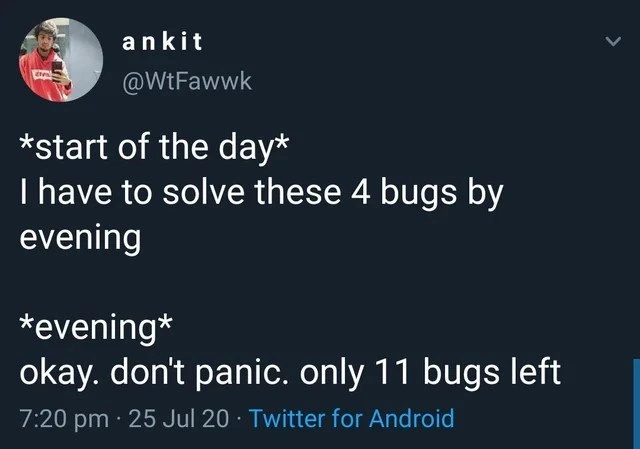
Started with four bugs, ended the day with eleven - debugging reality check
Description
The image is a dark-mode screenshot of a tweet from the user “ankit” (@WtFawwk), featuring a small blurred profile photo on the left. The tweet text states: “*start of the day* I have to solve these 4 bugs by evening *evening* okay. don't panic. only 11 bugs left”. Below the message, Twitter metadata reads “7:20 pm · 25 Jul 20 · Twitter for Android”. White text sits on a navy background, framed by the standard Twitter UI. Technically, the joke highlights how fixing a handful of defects often reveals or introduces many more, a phenomenon familiar to engineers battling regression bugs and hidden edge cases in legacy code
More like this
More like this in Bugs →

Use J and K for navigation
Comments
6Comment deleted
Fixed the four visible defects, triggered eleven side-effects - turns out our monolith also supports cascading CREATE BUG ON UPDATE
The first 4 bugs were just the symptoms. The other 7 are what you found when you actually looked at the code instead of just restarting the service and hoping for the best
This perfectly captures the Hydra principle of legacy codebases: fix one bug, and three more emerge from the tightly-coupled architecture you've been meaning to refactor for two years. By evening, you're not debugging anymore - you're doing archaeological excavation through layers of technical debt, discovering that the 'simple fix' requires touching a God class with 47 dependencies and zero test coverage. The real question isn't how 4 bugs became 11, but whether you should update the sprint burndown chart or just quietly update your résumé
Bug backlogs obey conservation of complexity: close 4 tickets, open 11 regressions and a retro on why 'low-risk' patches exist
Bugs follow exponential growth: fix n, queue becomes 2.75n by close of business - classic undocumented feature of any nontrivial monorepo
Fixed 4, got 11 - our bugfix function has gain > 1; the burndown chart just turned into a control loop begging for a release freeze