
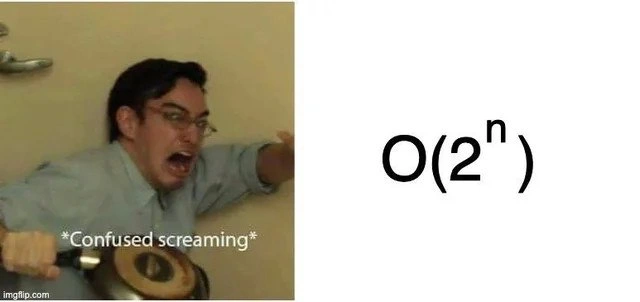
The existential dread of O(2^n)
Description
A two-panel meme. The left panel features a well-known image of the character Filthy Frank (Joji) in a state of sheer panic, holding a pan and screaming, with the caption '*Confused screaming*'. The right panel contains only the text 'O(2^n)' in a standard monospaced font on a white background. This text represents exponential time complexity in Big O notation, a core concept in computer science for analyzing algorithm efficiency. The humor lies in the visceral, panicked reaction to a purely mathematical expression. For experienced developers, encountering an algorithm with O(2^n) complexity is a horrifying discovery, as it implies the runtime will grow exponentially with the input size, rendering it completely unusable for any non-trivial dataset and guaranteeing a performance disaster

Comments
7Comment deleted
A junior dev sees O(2^n) and thinks 'let's optimize it later.' A senior dev sees O(2^n) and has flashbacks to the last time the billing alert system melted
Code review: finds an O(2^n) loop in the request path of a ‘serverless’ function - suddenly the only thing scaling elastically is our AWS bill and the CFO’s heart rate
When the junior dev's "quick optimization" involves nested loops over the power set and you realize the code review is going to outlive the heat death of the universe
When you realize your 'elegant recursive solution' has O(2^n) complexity and production is processing arrays of size 50. Time to dust off that dynamic programming textbook and explain to the PM why the server has been running for three days straight on what should have been a simple feature
Every O(2^n) starts as “n is small” and ends with Finance asking why the autoscaler bought us a new region
O(2^n) in the hot path turns code review into capacity planning
When PM says 'n is small' but your backtracking hits n=35 and the cluster melts