Assemble the Most Online Engineering Team
Level 1: The Weirdest Dream Team
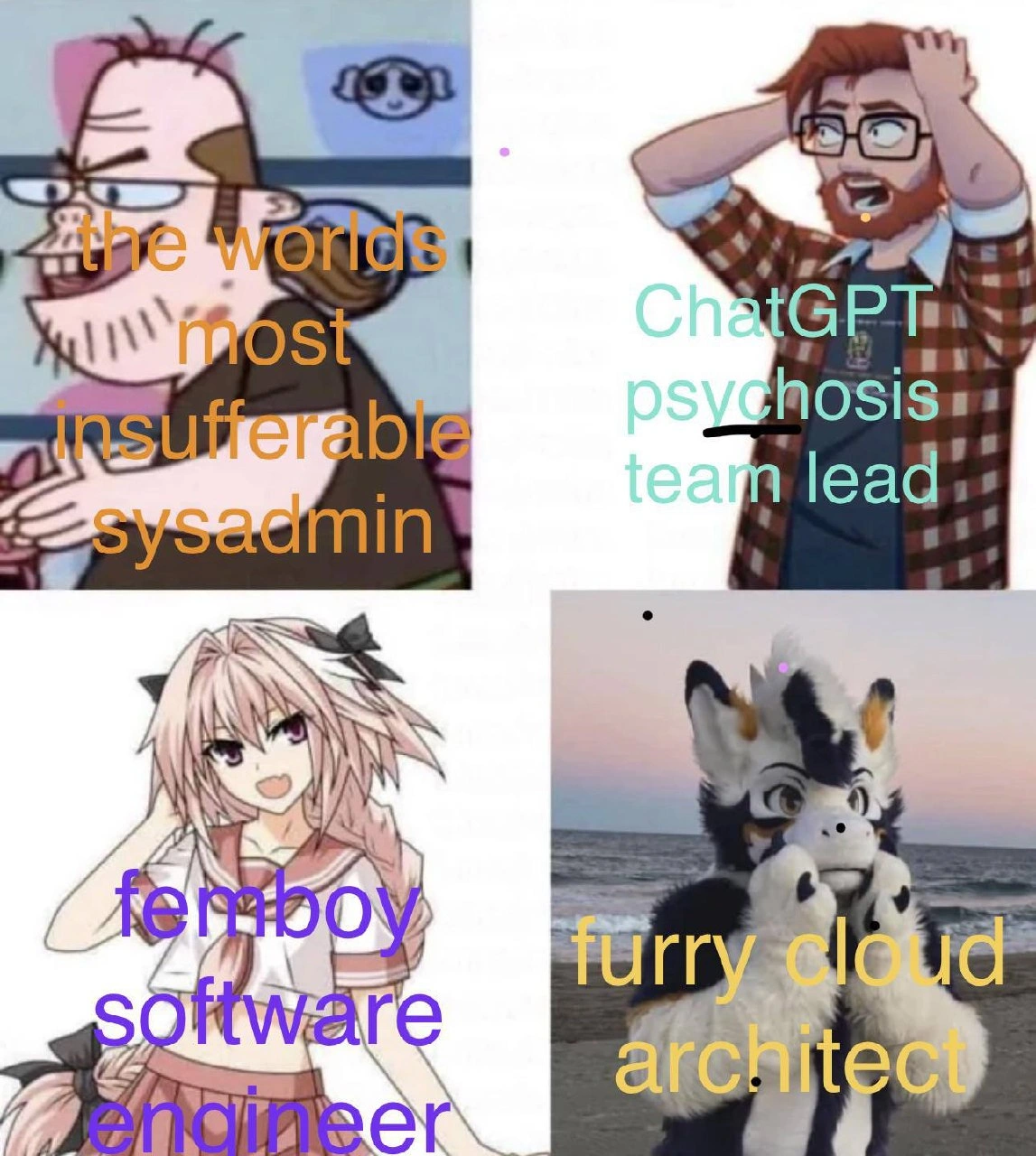
It is like choosing a school-project group from four strange storybook characters: one is grumpy, one believes everything a talking mirror says, one dresses like an anime hero, and one wears an animal costume to the beach. They look like a chaotic choice, but each may be very good at an important job—and the funniest part is that the normal-looking leader who trusts the magic mirror could cause more trouble than everyone else combined.
Level 2: Pick Your Specialists
The four titles describe distinct responsibilities:
- A sysadmin maintains operating systems, servers, user access, monitoring, updates, and recovery procedures.
- A team lead helps developers choose priorities and technical direction while coordinating with the rest of the company.
- A software engineer designs, writes, tests, and repairs application code.
- A cloud architect plans how systems use providers such as AWS, Azure, or Google Cloud, including networks, permissions, storage, scaling, reliability, and cost.
Those jobs overlap. A software engineer may deploy a service; a cloud architect may define its network; a sysadmin may maintain the underlying runtime; and the lead must make sure their decisions fit together. Team dynamics matter because no specialist holds the entire system in their head. The sysadmin needs enough patience to explain a restriction, the architect needs to respect operational details, the engineer needs to communicate application behavior, and the lead needs to test AI-generated suggestions against evidence.
The labels are exaggerated tech stereotypes, much like jokes that every database administrator fears schema changes or every programmer lives on caffeine. “Femboy” describes a feminine-presenting boy or man, while “furry” refers to a community interested in anthropomorphic animal characters; neither is a technical qualification. Their use here signals extremely-online nerd culture and contrasts playful self-presentation with high-responsibility engineering work. The bottom-right beach photo is especially effective: the costume looks far removed from a corporate architecture diagram, yet nothing about it prevents the person inside from knowing exactly why the virtual private cloud cannot reach production.
The AI label adds a newer stereotype. ChatGPT is a conversational AI assistant that generates responses from patterns learned during training. It can help brainstorm, summarize, and draft code, but it can also produce confident errors. A responsible lead treats its output as a proposal to verify, not an oracle. The panel jokes that this team has inverted that relationship: everyone else is visually eccentric, while the supposedly coordinating adult may be the actual operational risk.
Level 3: Org Chart From Hell
The post message, “Assemble your team!”, turns the four-panel collage into a character-selection screen. The available party is labeled, exactly as shown:
the worlds most insufferable sysadmin
ChatGPT psychosis team lead
femboy software engineer
furry cloud architect
The joke is not that these roles naturally belong to those identities. It is that online developer culture has accumulated such specific archetypes that a wildly eccentric lineup can still look like a plausible infrastructure organization. Every panel combines a serious job with a maximal internet persona: an angry cartoon bureaucrat, a panicking bearded lead, a pink-haired anime character, and a full animal costume photographed at the beach. The rough collage and mismatched colored text make the “team roster” feel assembled with the same governance as a late-stage startup.
Each role also occupies a different kind of technical power. The system administrator controls machines, accounts, patches, backups, and the permissions that determine whether anyone else can work. The stereotype of the “insufferable sysadmin” grew around a real asymmetry: when administration is done well, nothing appears to happen; when someone makes a careless request, the sysadmin inherits the outage. Years of being asked to disable safeguards “just for today” can turn helpful caution into territorial gatekeeping. The scowling top-left character exaggerates that battle-scarred posture until interpersonal friction becomes the job’s defining qualification.
The team lead should coordinate decisions, resolve ambiguity, and protect the team from organizational noise. Labeling that person ChatGPT psychosis team lead instead suggests the authority figure is the least reality-anchored member of the group. “ChatGPT psychosis” is an informal and contested phrase, not a clinical diagnosis. In the meme’s internet shorthand, it evokes someone spending so much time in agreeable chatbot conversations that speculative ideas return dressed as certainty: the assistant praises the vision, the lead presents it as strategy, and engineering receives a roadmap apparently dictated by autocomplete with excellent bedside manner. The clutching-head illustration reinforces frantic conviction rather than calm leadership.
There is a serious edge beneath that exaggeration. Conversational systems can mirror a user’s framing and sometimes reinforce false premises instead of challenging them. That risk is especially sensitive for people experiencing delusions or mania, so the real phenomenon should not be reduced to “person has strange opinions.” In a workplace version, the safer and more ordinary target of the joke is automation bias: a lead over-trusts polished AI output, mistakes fluent language for evidence, and asks the team to implement requirements nobody independently verified.
The lower panels switch from abrasive behavior to subcultural identity. The femboy software engineer and furry cloud architect labels draw on a long-running observation that technical communities overlap with queer, anime, gaming, and furry spaces. The humor depends on recognition, not on either identity affecting coding ability. In fact, the recurring punchline in this family of stereotypes is often that the person with the most unconventional avatar is quietly the only one who understands the compiler, the networking rules, or the production account.
Putting a sysadmin beside a cloud architect adds an industry-history conflict. Traditional operations focused on named machines and locally managed infrastructure; cloud architecture abstracts those concerns into services, identity policies, virtual networks, managed databases, and infrastructure-as-code. The boundary is rarely clean. Someone still has to reason about DNS, Linux, access control, capacity, backups, and failure domains—only now the bill arrives by API. Thus the irritable sysadmin and costumed architect may fight over terminology while debugging the same packet path.
The collage satirizes how teams are discussed through stereotypes instead of capabilities. Real delivery depends on whether these people can share context, challenge the lead’s assumptions, review one another’s changes, and respond to failures without turning every disagreement into identity theater. A roster can be socially unusual and technically excellent; it can also have conventional headshots and be completely dysfunctional. The meme chooses the first because “competent specialists with memorable avatars contain an AI-intoxicated manager” is now believable enough to count as developer realism.
Description
A white-background four-panel collage presents exaggerated technology-team archetypes, with a few tiny colored dot artifacts scattered across the image. The top-left panel shows a scowling cartoon office worker under orange text reading "the worlds most insufferable sysadmin", while the top-right shows a bespectacled, bearded illustrated man clutching his head under mint text reading "ChatGPT psychosis team lead". The bottom-left uses a pink-haired anime character with purple text reading "femboy software engineer", and the bottom-right shows a black, white, and yellow animal-costumed person on a beach with yellow text reading "furry cloud architect". The meme turns job titles into internet-subculture stereotypes, mixing a topical chatbot-delusion reference with longstanding jokes about the eccentric people who keep software and cloud infrastructure running.
Comments
1Comment deleted
The team lead is hallucinating, the sysadmin is gatekeeping, and the furry is quietly fixing the VPC.