Zero Downtime During Cluster Migration Is Galactus-Level Ask
Why is this DevOps SRE meme funny?
Level 1: Fixing a Moving Car
Imagine you’re in a car that’s driving on the highway at full speed. Now, your parent suddenly says, “We need to change the tires on this car, but we’re not allowed to stop, even for a second.” Sounds crazy, right? How on earth do you switch out a tire or an engine while the car is zooming along? You’d probably say, “That’s impossible! We have to pull over at least for a moment.” But the parent insists, “No stops! Figure it out.”
In this meme’s story, the car is like a big website or application that lots of people are using. The tires/engine are like the servers and databases – basically the machinery that runs the site behind the scenes. The parent who doesn’t want to stop is like a big important boss or client who says the site must always stay online for users (no maintenance break, no “offline” message, nothing). And the people in the car trying to do this impossible tire change are the engineers 🧑🔧 who have to somehow make it happen.
So the joke is that the boss is asking for something as impossible-sounding as changing a car’s tire while driving. It’s an unrealistic demand. The engineers, knowing how hard it is, are preparing for chaos – kind of like saying, “Oh boy, this is going to be wild.” They compare that demanding boss to Galactus, a giant comic book character who literally eats planets, to show just how huge and intimidating the demand feels.
It’s funny in the way a cartoon is funny when a character is told to do an impossible task – you laugh because it’s so over-the-top. But there’s also a little bit of a “gulp” feeling, because if you were actually in that situation, you’d be super nervous. In real life, engineers do their best to keep things running smoothly, but asking for absolutely no interruption ever, even during big changes, is a tall order. The meme takes that feeling and makes it into a dramatic, cosmic joke.
So, even if you don’t know the tech details, you can understand the humor: someone important wants something done that sounds impossible, and the people who have to do it are like “Uh oh… this is going to be nuts!” It’s like a teacher saying, “You have to rewrite your entire essay without ever putting your pen down or pausing.” You’d probably laugh and think, “That’s not possible!” – which is exactly the reaction this meme is going for.
Level 2: Zero Downtime 101
Let’s break down the scenario in simpler terms. In this meme, a stakeholder (basically a person who’s in charge or who has a lot of influence, like a big client or your boss’s boss) is being compared to Galactus, a giant villain from Marvel comics known for eating entire planets (he’s that demanding!). The stakeholder isn’t asking for a planet, thankfully, but he is asking for something really huge in the tech world: zero downtime during a cluster migration.
First, what’s a cluster? In technology, a cluster usually means a group of computers or servers that all work together to run a service or application. Imagine a popular website or app – it’s not just on one computer; it’s on many at the same time, sharing the load. That group of computers is a cluster. They might each have part of the data and handle part of the user traffic. This helps the service handle more users and also provides backup if one computer fails (others can pick up the slack).
Now, what does migration mean here? A migration is when you move something from one place to another. If we’re talking cluster migration, it means moving the whole set of servers (and possibly all the data they hold) to a new environment. For example, maybe your company is moving from their own servers to the cloud, or from an old data center to a new data center. Or maybe they built a brand new cluster (with updated hardware or a new version of the software) and want to shift all the work over to that. It’s like moving from your old house to a new house – but imagine you have to move all your stuff while your business is still open and serving customers.
Downtime is a term for when a service is down, meaning not available or not working. If you’ve ever tried to visit a website and got a message like “Service is temporarily unavailable” or “We’re under maintenance, please check back later,” that website was experiencing downtime. Downtime can happen for many reasons: maybe something broke, or maybe the engineers intentionally took the service offline to update it or fix something. Zero downtime means no downtime at all. The service should never be unavailable – not even for a second if possible. It’s basically saying users shouldn’t even notice that anything changed behind the scenes. The service keeps running, answering requests, without a maintenance page or error.
So put it together: zero downtime cluster migration means moving everything (the whole service with all its servers and data) to a new place without ever interrupting the service for users. That’s like changing all the engines on a plane while it’s in the air and not having the plane slow down or lose altitude at all. 😬 It’s technically possible in some cases, but it’s very complicated and risky. Usually, engineers prefer to have at least a small maintenance window – say at 3 AM when fewer users are online – where they briefly take the service down to do a big move. That takes the pressure off, because you can do the heavy lifting while nobody is using the system. But sometimes a stakeholder will insist, “No, we can’t afford any downtime. Not even at 3 AM. There are always some users and we promised them 24/7 service.” That’s the situation our meme is joking about.
To accomplish a zero-downtime migration, engineers have a few strategies:
- Rolling updates or rolling migration: This means you don’t take everything down at once. Instead, you move one piece at a time. For example, if you have 10 servers, you might move them one by one or a few at a time. While 9 are still serving users, you migrate the 10th. Then you bring that one up in the new environment, and then move on to the next. The idea is the service as a whole is never completely down – there’s always some part of the cluster handling user traffic. Users might not even notice anything if done carefully. However, this gets tricky if those servers share data; you have to make sure the data on the new server is up-to-date. Often this approach needs a lot of planning to ensure each server can seamlessly join the new cluster or that the cluster can temporarily run in a mixed mode (some old, some new).
- Blue-Green deployment: This is a common technique for zero downtime deployments (often referenced by that term “blue_green_switch” in the tags). You basically have two versions of your setup: the old one (let’s call it Blue) and the new one (Green). Before the switch, both Blue and Green are running, but users are only being sent to Blue (the current live cluster). Green is like a shadow, getting ready. You ensure Green has the latest code, and you copy all necessary data to it. When everything with Green looks good, you switch traffic over so that users start hitting the Green cluster instead. Blue can be kept around for a while in case you need to roll back (switch back to Blue) if something’s wrong with Green. If everything goes well, users barely notice a thing – perhaps a slight delay or they might have to re-login if the session data isn’t shared, but ideally not even that. This technique requires double resources (you have two full clusters for a while), and it also requires a way to switch traffic quickly (either via a load balancer or a DNS change or some service discovery trick). If the service is stateless (doesn’t store a lot of data in-memory from one request to the next), this can be quite smooth. If it’s stateful (meaning it has a database or in-memory sessions, etc.), then Blue-Green means you have to keep those states in sync. Often that means the new cluster’s database is continuously replicating from the old one until switchover.
- Load balancers and traffic management: A load balancer distributes user requests among servers in a cluster. During a migration, engineers can use load balancers to gradually move users to the new cluster. For instance, at 1:00 PM they might send 10% of traffic to the new servers and 90% to the old. If that looks good, at 1:15 PM they bump it to 50/50. Finally 100% to new. This gradual shift means if something goes wrong, they can notice it with a smaller percentage of users and roll back before everyone is affected. It’s like slowly merging lanes on a highway rather than a sudden detour. The tricky part is ensuring those users that get moved to the new cluster aren’t running into any missing data or features.
- DNS cutover: Instead of or in addition to load balancers, sometimes the plan is to change the DNS entry for the service (the address that users’ computers resolve). For example, originally “myapp.com” might point to the old cluster’s IP addresses, and now you want “myapp.com” to point to the new cluster. Engineers will update the DNS configuration at the planned time. However, as mentioned, DNS has that TTL (Time To Live). If some user's computer or ISP cached the old address, it won’t ask for the new address until that TTL expires. So there’s a period where some users go to the new cluster and some unknowingly are still going to the old cluster. To mitigate this, engineers often lower the TTL in advance. If TTL was 1 hour, they might lower it to 5 minutes or even 1 minute, 24 hours before the migration. That way, when they make the switch, the majority of users will update to the new address quickly. But there are always stragglers, and you have to keep the old cluster up and doing something (either fully operational or at least redirecting users) until you’re confident everyone’s on the new cluster.
- Maintaining quorum and data consistency: If the cluster uses something like a database cluster or a distributed data store, it often has a concept of quorum (which basically means more than half of the servers need to agree on any update, to avoid conflicting data). While migrating, engineers have to be careful to never break that rule. One common tactic is adding the new servers into the existing cluster before removing the old ones. So for a while, the cluster is larger and spans two environments. This way, the data gets replicated to the new servers as part of the normal cluster operations. Then they start removing the old servers one by one. At each removal, the cluster still has a majority of servers running. By the end, only the new ones remain. Doing this is like doing open-heart surgery on the cluster: the cluster is technically “alive” and serving, but you’re swapping its parts slowly. If done correctly, the cluster’s internal algorithms ensure consistency is never lost. But it’s very easy to mess up if, say, one of those steps fails or takes too long – then you might have two half-clusters that can’t talk to each other, which is what we call a split-brain scenario (very bad, because each half might think it’s the “real” cluster and you get conflicting data). Avoiding that requires carefully following procedures, using automation tools, and having back-out plans.
For a newer developer or someone early in their career, all this sounds pretty intense – because it is! Early on, your deployments might have been simple: maybe you took the app offline for a few minutes, updated some code, then brought it back up. When an app is small or in early stages, a few minutes of downtime late at night isn’t a huge deal. But as systems grow (and as companies promise stricter SLAs – Service Level Agreements – to users or clients), downtime gets more and more expensive and politically unacceptable. You might hear terms like “five nines availability” which, as mentioned, is 99.999% uptime. Companies brag about this, but to achieve it, they have to invest a lot in redundancy and careful processes.
Now, the reason this meme is funny (even if you haven’t done a migration yourself yet) is the dramatic way it highlights an unrealistic expectation. The astronaut’s serious face and tone, and the woman asking “What does he want?”, make it feel like Galactus asked for something like the moon or all the world’s energy. And then the answer is “He asked for zero downtime… during a cluster migration.” If you’re in on the IT joke, you know that’s absurdly tough – hence the comedy. If you haven’t been through it, think of it like this: it’s an extremely demanding request. It’s not literally world-ending, but for the engineers responsible, it might feel like the weight of the world on their shoulders.
As a junior engineer, you might eventually be part of a project like this. When that happens, you’ll see the amount of planning and anxiety that goes into it. People will talk about things like “Have we tested the cutover in a staging environment?” “What if the database replication falls behind?” “Do we have monitoring in place to catch errors immediately?” “Who’s on call if something breaks at 2 AM?” It’s practically an operation of its own. And behind a lot of those questions are lessons learned from seniors who did this before and did encounter those very problems.
Finally, the stakeholder vs ops engineers dynamic: Stakeholders (like clients, managers) often focus on what they want, whereas ops engineers focus on what’s technically safe and possible. There’s often a back-and-forth: engineers might say “we need a 1-hour maintenance window at midnight, during which the site will be down,” and the stakeholder says “No, that’s not acceptable, we promised no downtime,” and then engineers have to go back to the drawing board. In the meme, that negotiation failed – the stakeholder didn’t budge (Galactus is not known for being reasonable, after all). So the engineers have no choice but to attempt the heroic feat. When you’re new, seeing that kind of pressure can be surprising. With time, you realize it’s part of the job: communicating to non-technical folks why some things are dangerous or require trade-offs. Sometimes you win those arguments, sometimes you have to attempt the near-impossible. The meme basically laughingly says, “Yep, here we go again – management wants a miracle, and the ops team is gearing up for chaos.”
In summary, zero downtime cluster migration in plain terms is making a huge change with no visible break. It’s doable for certain systems with lots of careful work (and often with advanced setups), but it’s one of the more challenging stunts in system administration. The meme uses an exaggerated comic book scenario to highlight how crazy such a demand can feel. For a junior dev, the takeaway is: downtime is usually needed for big changes, but sometimes you’ll be asked to find a way around it, and that’s when things get really interesting (and stressful!). And if a senior colleague rolls their eyes or chuckles darkly when hearing “zero downtime,” now you know why – they’ve lived through the DeploymentPainPoints and have the battle scars to show for it.
Level 3: Devourer of Downtime
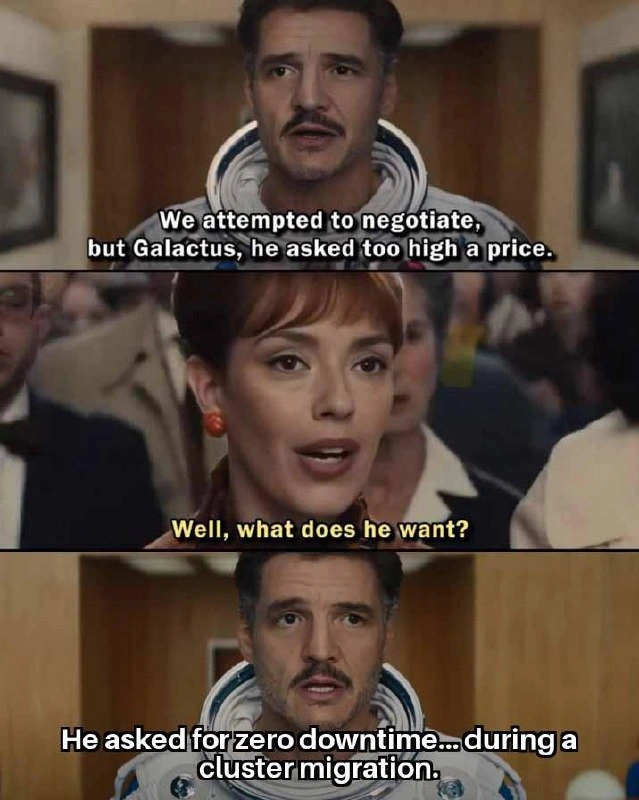
This meme nails a very specific nightmare scenario that senior DevOps and SRE folks know all too well. It casts the stakeholder as Galactus (the Marvel cosmic entity known as the "Devourer of Worlds") who in our tech context becomes the Devourer of Downtime. In the panels, an astronaut messenger gravely reports, "We attempted to negotiate, but Galactus, he asked too high a price." When asked what the villainous stakeholder wants, the punchline lands: "He asked for zero downtime… during a cluster migration." Immediately, every battle-scarred ops engineer in the room groans in sympathy and dark humor. It’s an absurdly over-the-top demand – which is exactly why it’s funny and painfully relatable at the same time.
Why do seasoned engineers smirk (or cringe) at this? Because we’ve all met a stakeholder or client who might as well be a planet-eating cosmic force when it comes to demands. They sit at the gala (perhaps an executive boardroom rather than a literal gala) casually asking for the near-impossible: “Can’t you just migrate everything with no downtime? I mean, how hard can it be?” In the meme’s dramatic terms, that's Galactus demanding tribute. In reality, it’s often someone from upper management or a big customer who treats 100% uptime or five-nines availability as if it were just another checkbox item on a contract. Senior engineers recognize this disconnect: the higher-ups negotiate uptime guarantees like they’re haggling over a car price (“What do you mean you can’t do 99.999%? Our competitors promise it, so we should too!”) without fully grasping the heroic effort (and sheer luck) required to actually meet those promises. Five-nines uptime means less than 5.3 minutes of downtime in a year – and here we have Galactus basically saying even that is too much downtime to pay. No wonder the poor astronaut-engineer looks shell-shocked. 😅
The phrase "zero downtime cluster migration" is basically the stuff of on-call engineer nightmares. A cluster migration means moving your whole production environment – all services, data, everything – to a new setup. Maybe it’s a new data center, a new cloud provider, a new Kubernetes cluster version, or a major architecture overhaul. Seasoned ops folks have scars from such projects. Typically, you’d schedule a maintenance window at 3 AM on a Sunday, warn users days in advance, triple-check backups, and still keep a Red Bull-fueled team on standby for when things (inevitably) go sideways. So when management says "Actually, we need to do it with zero downtime, because the system must stay up for our global users," that sounds about as reasonable as a demand from a cosmic supervillain. It's the kind of requirement that triggers PTSD in senior developers: sweaty palms at the memory of all-nighters spent coaxing glitchy databases through an upgrade, or that one time a "zero downtime" deployment ironically led to a major outage because of a tiny oversight. We hear “zero downtime migration” and immediately think, "Alright, which unsuspecting engineer's soul are we sacrificing for this one?" – a dark joke that rings true when you've been through these fire-drills.
The humor here comes from the epic scale of the ask. Galactus devours entire planets to satiate his hunger; a stakeholder of that caliber in the tech world seemingly wants to devour engineer peace-of-mind by asking for the unattainable. It’s a comedic exaggeration, yet it reflects actual corporate scenarios. There are war stories in every senior dev circle about the boss who demanded no downtime during a data center move, or the client who insisted on deploying a major update on Friday 5 PM with zero impact on users. (Seasoned rule: Never deploy on Friday unless you enjoy spending your weekend fighting fires. But guess what? Galactus-level stakeholders don’t care about your weekend.) The meme’s astronaut says “we attempted to negotiate” – implying the engineers tried to push back or at least get some downtime scheduled – “but he asked too high a price.” That too high a price wasn’t money or servers; it was the absolute guarantee of uninterrupted service. In other words, the stakeholder wasn’t willing to grant even a minute of downtime. Senior engineers recognize that exasperation: sometimes management treats any downtime as unacceptable, but won’t acknowledge the risk they’re assuming by pushing that stance. It’s as if the ops team offered, “We can do this with 5 minutes of downtime at 3 AM, minimal user impact,” and Galactus boomed back, “No. Not one second. Make it seamless, or suffer my wrath.” Cue the ops team exchanging looks and muttering “This is how worlds end.”
From an experienced perspective, a cluster migration touches so many moving parts that guaranteeing zero user-visible impact is almost mythical. We think about all the things that can (and often will) go wrong:
- Quorum nightmares: If it’s a database or a stateful system, how do you carry over the data and leadership? There’s always that anxiety that adding new nodes or removing old ones could accidentally trigger a split-brain or a failover at the wrong time. Seniors have learned (sometimes the hard way) that even with careful planning, a cluster might decide a routine node removal is actually a failure and go into panic mode. Suddenly half the services start screaming that they lost the database – cosmic chaos, indeed.
- Load balancer shenanigans: They’re great until they aren’t. You might script the load balancers to phase traffic over to the new cluster gradually. But misconfigure one health check or forget one API endpoint, and the LB might start sending users into a black hole. Perhaps you’ve seen that incident where some portion of user traffic was quietly still hitting the old cluster that had stale data or was half-decommissioned – not pretty. Senior devs double- and triple-check these settings, like priests appeasing a capricious deity, because they know a single misrouted packet can escalate into a full outage.
- DNS gremlins: We’ve all waited nervously for DNS changes to propagate. Maybe you lowered the TTL to 60 seconds days before, thinking it’s all set. But inevitably, some ISP or corporate network out there ignores your TTL and caches the old IP for hours. So even after you flip to the new cluster’s IP, a chunk of users ends up calling the old servers, which by then are serving a maintenance page or, worse, have been repurposed and now respond with something bizarre. Meanwhile, your support team is getting calls from confused users who seem to be in an alternate reality. Yep, cosmic chaos.
- Stateful data migration: Perhaps the scariest part. Copying data over beforehand is fine, but the moment you allow new writes in two places, you risk divergence. Solutions like synchronizing writes or freezing writes temporarily are possible, but stakeholders hearing “we’ll freeze writes for a few seconds” often go “Nope, not acceptable – zero means zero!” A senior engineer has to choose between pushing back on that or conjuring an even more complex workaround, like queueing all incoming writes globally for a moment (which... is basically a fancy way of saying downtime, just hidden). It’s a “damned if you do, damned if you don’t” scenario.
All these considerations mean one thing: massive stress for the ops team. The meme’s final panel, “ops engineers brace for cosmic chaos,” is exactly right. When a no-downtime migration is underway, you prepare as if a storm or battle is coming. Monitoring systems are cranked up to eleven, every Grafana dashboard and log stream is watched obsessively for any anomaly, pager on standby. You schedule the migration during the lowest traffic period (often an ungodly hour) to minimize impact if things go wrong, and everyone has a role in a detailed runbook. It’s almost militaristic planning – because so many things have to go right. And despite all that, in the back of your mind, you know Murphy’s Law is lurking: whatever can go wrong might go wrong. A veteran SRE has probably been through at least one “seamless migration” that turned into a multi-hour outage. Maybe a script behaved differently in prod, or a config value was off by one, or the new cluster couldn’t handle real traffic as well as it did in testing. The trauma of those past incidents means when someone now demands “no downtime,” the senior folks exchange weary glances and start preparing for battle (and maybe draft an email up the chain gently reminding them that *“zero downtime” has a non-zero chance of failure).
Another layer to the humor is how management often underestimates the complexity. To a non-technical stakeholder, it might sound perfectly reasonable: “We have two clusters, just switch users over, what’s the big deal?” They might imagine it like flipping a power switch. The meme exaggerates this disconnect by bringing in a universe-devouring entity to represent that stakeholder; it feels like only someone totally beyond reason (or understanding) would be so cavalier in the demand. And yet, in real life, it’s not usually malice – it’s ignorance or business pressure. Perhaps the stakeholder promised their higher-ups or customers that the migration would be invisible. Now the engineering team is stuck delivering on that promise. Best case, they somehow pull it off through insane amounts of work and careful execution. Worst case, they don’t – and ironically the downtime they were trying to avoid happens spectacularly. In either scenario, the stress is on the engineers, while the stakeholder just expects a miracle.
Galactus-level is such an apt descriptor: it implies an almost god-like, immovable force. If Galactus wants to eat your planet, you don’t really get to refuse; similarly, if a CEO or government client demands zero downtime, the team might not have the power to say “that’s not realistic.” Instead, they nod, gulp, and then go figure out how close to that ideal they can get. The meme’s cosmic scale underscores how disproportionate the demand feels to those who actually have to implement it. It’s both funny and a bit cathartic – laughing so we don’t cry, essentially. Every experienced ops person reading that final subtitle ("He asked for zero downtime... during a cluster migration") probably has an internal scream and laughter at once: “Haha, of course he did. Sounds like my life.”
In summary, from a senior perspective this meme is a perfect storm of DeploymentAnxiety and StakeholderExpectations. It jabs at the classic gulf between what non-technical stakeholders want (absolute perfection, like five-nines and beyond) and what engineers know is realistic (everything fails eventually, and complex changes need breathing room). The cosmic imagery and dramatic dialogue amplify the absurdity we feel in those moments. And like any good inside joke, it’s funny because it’s true – behind the exaggeration lies that very real experience of sitting in a meeting where someone essentially says, “Just make sure nothing goes wrong. It has to be flawless.” and you, as the battle-hardened engineer, are thinking, “Alright, time to perform some dark magic and cross my fingers, because this is where chaos could happen.” The meme captures that feeling perfectly, so we chuckle, share it with the team, and say “Haha, mood… also, this is literally our project next quarter, isn’t it?”
Level 4: The Quorum Conundrum
At the extreme end of ops sorcery, zero downtime during a cluster migration is essentially the holy grail of distributed systems reliability. It demands that a complex system undergo a massive change in infrastructure without ever letting the service blink out. In theoretical terms, this means maintaining continuous availability and consistency even as you replace or relocate every node. Achieving that starts to bump up against fundamental limits like the CAP theorem: in a distributed system, you can't have perfect Consistency and Availability if your system gets partitioned (and a migration can look an awful lot like a deliberate partition or split-brain scenario if not carefully managed).
Consider a cluster that uses a consensus algorithm (like Paxos or Raft) to maintain a single source of truth across nodes. These algorithms require a quorum – a majority of nodes – to agree on the system state. If you want to move to a new cluster without downtime, you face the quorum conundrum: how do you shift that majority from the old cluster to the new one without ever dropping below the required majority or introducing conflicting leaders? One approach is to gradually extend the cluster: spin up new nodes (in the new environment) and join them to the existing cluster one by one, so the quorum straddles both old and new. For a time, the system runs in two places at once, like a galaxy stretching across a cosmic divide. Then you retire the old nodes so only the new remain. Throughout this dance, a quorum must persist. If at any point the cluster's brain (leader node) or its majority goes missing, even for a second, clients will feel a hiccup (or outright errors). Maintaining that uninterrupted consensus is incredibly delicate – it's like passing a single baton among marathon runners without ever stopping the race or dropping the baton, all while swapping runners mid-stride.
Now add the complexity of stateful data to this scenario. Suppose the cluster is hosting a database or any system with stored data. You can't just flip a switch and teleport terabytes of data to new servers instantaneously (not unless you've found a way to break the speed of light 😜). Instead, you might set up continuous replication: the new cluster starts empty and replays an event log or uses a streaming pipeline to catch up on every transaction happening on the old cluster. This resembles database replication or a distributed log (think change data capture streams or even the internal mechanism of tools like pglogical for PostgreSQL). The goal is to bring the new cluster’s state in sync with the old cluster’s state. In the ideal scenario, by the time you're ready to cut over, the difference between the two is zero or minimal. But ensuring perfect synchronization is tricky – if a single write isn't replicated or if there's any lag, the moment you switch to the new cluster might drop or duplicate a transaction. Distributed systems researchers grapple with exactly these problems: how to do online migration or live consensus reconfiguration with strong guarantees. There are academic papers on dynamic reconfiguration of consensus groups, which essentially describe how to change the set of nodes (the cluster membership) without stopping the protocol. It usually involves multi-phase commits or carefully orchestrated state transfer protocols that ensure the new configuration takes over exactly when the old one steps back, with no overlap or gap.
Even with all that, you have to deal with in-flight user requests and connectivity. In practice, achieving “zero downtime” often means cleverly hiding any hiccups from users rather than literally zero milliseconds of interruption. For example, load balancers and proxies can queue or retry requests during the split-second of a switchover. If you're using a load balancer in front of your cluster, you might employ techniques like gradually shifting traffic from old to new (so-called traffic drainage or phased cutover). That is essentially a controlled experiment in partial partitioning: for a while, some users hit the new cluster while others still talk to the old cluster. This can only be safe if the state is synchronized between them or if the operations are read-only. If both clusters are active for writes, you've got to consider distributed transactions or eventual consistency models. Some systems perform a dual-writing strategy during migrations: every user action is written to both old and new systems in parallel, until the new one can stand on its own. Dual-writes, however, open up a pandora’s box of consistency issues (what if one write succeeds and the other fails?). There’s a whole universe of idempotency and retry logic needed to ensure no user action is lost or duplicated.
Another thorny aspect is network addressing. Often, switching clusters means switching where the service lives (maybe new IP addresses, new data center, new cloud region). If clients connect via a domain name, updating that to point to the new cluster can be a propagation problem. That's where DNS TTLs come in. The DNS Time-To-Live is how long resolvers cache the address for your service. If it's set to, say, 5 minutes, some users might continue trying to reach the old cluster for up to 5 minutes after you've officially moved. SREs anticipate this by lowering the TTL well before the migration or by using techniques like DNS cutovers combined with overlapped operation (keep the old cluster running in read-only mode until you’re sure nobody’s left pointing at it). Alternatively, big services use smart global load balancers or anycast IPs to instantaneously repoint traffic – effectively making the switch at the networking layer. But even then, there's the issue of existing connections: what do you do with persistent connections or ongoing sessions? Advanced setups might use connection draining (stop sending new requests to old servers but let existing ones finish) or even live migration of network connections (some fancy proxies can transfer state). These add complexity and edge cases – e.g., a client that doesn't retry failed connections might see an error if it hits an old node that just went offline.
In short, this Galactus-level demand – zero downtime cluster migration – forces engineers to confront the very physics and math of distributed computing. They have to ensure continuity of service across what is essentially a shifting foundation. It's a bit like performing an atomic swap of the underlying universe: one moment the service is served entirely by Cluster A, and an instant later, entirely by Cluster B, with atomicity (all users see only A or only B, never a half-available mix). In theory, atomic cutover is as close to magic as it gets – any misstep and you either double-serve (both clusters active, risking divergence) or drop requests (neither cluster fully handling them during a brief gap). The engineers must craft a plan that to the outside world looks like nothing happened at all, even though behind the scenes it's a symphony of synchronized steps: data replication, node orchestration, traffic rerouting, and a final sleight-of-hand to unveil the new cluster. The meme sets this up as an almost comically impossible feat – and indeed, from a purist theoretical perspective, it’s immensely hard. As system designers we know some downtimes are practically inevitable due to propagation delays and state handoff. In an academic sense, true zero downtime might require time travel or communication faster than light to ensure absolute simultaneity (which is to say, it’s impossible per current physics). Galactus asking for this is like a cosmic being demanding you break fundamental laws – a rather fitting analogy for a frustrated engineer: "They want five-nines uptime? Sure, let me just bend reality real quick."
Description
Three-panel meme using scenes from what appears to be the Fantastic Four movie featuring Pedro Pascal. Top panel shows a man in an astronaut/space suit saying 'We attempted to negotiate, but Galactus, he asked too high a price.' Middle panel shows a woman responding 'Well, what does he want?' Bottom panel reveals the punchline with the man looking distressed: 'He asked for zero downtime... during a cluster migration.' The meme repurposes a movie scene about a cosmic-level villain's impossible demands to highlight the absurdity of stakeholder expectations for zero-downtime infrastructure migrations
Comments
9Comment deleted
Even Galactus, Devourer of Worlds, draws the line at promising zero downtime during a cluster migration. Some things are simply beyond cosmic power
The business wants a zero-downtime migration. Engineering says it's possible with a detailed plan, three months of work, and a temporary doubling of infrastructure costs. The business decides a 'thoughts and prayers' maintenance window is suddenly acceptable
Sure, we can do it - just ask the CAP theorem to hold its breath until DNS propagation finishes
After 20 years in this industry, I've learned that 'zero downtime migration' is like 'just a small change to the requirements' - technically possible in theory, but in practice it means you'll be debugging race conditions at 3 AM while the CEO asks why the 'simple database move' is taking so long
Ah yes, zero downtime during a cluster migration - right up there with 'just make it scale infinitely' and 'the database will handle eventual consistency, no problem.' Any architect who's actually orchestrated a live migration of stateful services across availability zones while maintaining ACID guarantees knows this is the engineering equivalent of being asked to change the tires on a Formula 1 car at 200mph. Sure, we can get close with blue-green deployments, careful traffic shifting, and enough load balancers to make your AWS bill weep - but truly zero downtime during a cluster migration? That's when you politely explain that the laws of distributed systems physics still apply, even to stakeholders named Galactus
Zero-downtime cluster migration: the SRE's event horizon where CAP theorem meets cosmic entitlement
Zero downtime during a cluster migration is just multi‑region active/active with double‑writes, flawless PDBs, instant DNS, and a CAP-theorem exemption - easy if you also control physics
Zero‑downtime cluster migration? Easy - make everything stateless, dual‑write perfectly, cut traffic atomically across regions, and get a temporary CAP‑theorem waiver; I’ll have Galactus co-sign the SLO
Dual read/write: non-existent in this universe Comment deleted