Skip to content
DevMeme
5106 of 7435
YouTube's Algorithmic Irony: An Ad for Ad Blockers
IndustryTrends Hype Post #5590, on Oct 18, 2023 in TG

YouTube's Algorithmic Irony: An Ad for Ad Blockers

Why is this IndustryTrends Hype meme funny?

Level 1: The Backfiring Ad

Imagine you run a lemonade stand that makes money by selling lemonade. Now picture that you also put up a big sign on your stand that says, “Don’t buy our lemonade – here’s a recipe so you can make it at home for free!” You did this because someone paid you a dollar to display that sign. Kinda silly, right? You’re basically telling people not to buy your lemonade, the very thing that keeps your stand open.

That’s exactly what happened with YouTube and this ad. YouTube is like a TV channel or a website that makes money from showing ads (like little commercials). But here, YouTube showed an ad that told people how to stop seeing ads on YouTube. It’s like the platform said, “Hey, here’s how you can skip all the commercials from now on!” 😄 It’s funny because it’s a big oops moment – YouTube accidentally let someone pay them to share a tip that could make YouTube lose money in the future. In simple terms, YouTube kind of tricked itself.

For us, the humor is like watching a store owner accidentally help customers shoplift. It’s unexpected and goofy. Even though YouTube didn’t do it on purpose (it was an automated system that put that ad there), it feels like watching someone play a prank on themselves. Everyone who sees it goes, “Wait a second… did YouTube just advertise a way to not watch YouTube’s own ads? That’s hilarious!” It’s a classic case of something backfiring: the ad meant to make money actually encourages people to avoid ads. And that twist makes us laugh because even big, smart companies can do very silly things without realizing it at first.

Level 2: AdBlock vs Google Ads

At its core, this meme highlights a simple irony: YouTube makes money by showing ads, yet here it is showing an advertisement for an ad-blocking tool. For a newer developer (or anyone newer to how online ads work), let’s break down why that’s so contradictory.

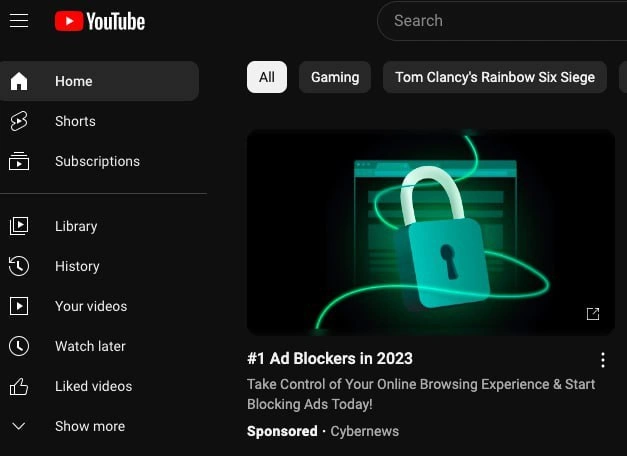
Ad Blockers are browser extensions or software (like uBlock Origin or AdBlock Plus) that do exactly what their name says: they block ads on websites and platforms. Many developers (and users in general) install these to avoid pesky pop-ups, video ads, or banners. On the flip side, YouTube (owned by Google) is part of Google’s huge advertising machine (Google Ads/AdSense). YouTube shows ads before or during videos and even as sponsored thumbnails on the homepage – that’s a big part of how it earns revenue. In fact, whenever you see a “Sponsored” label on YouTube (like in the screenshot), that’s YouTube telling you “this content is a paid promotion.” So in the image, the card with “#1 Ad Blockers in 2023” is not a normal video from a channel you’re subscribed to – it’s basically an ad disguised as a video suggestion, paid for by Cybernews. YouTube got paid to put it there. Normally, these sponsored video cards are for things like a new gadget, a game, or some product that an advertiser wants to promote to a relevant audience.

Now, why is this funny or noteworthy? Because the product being advertised here is essentially “how to stop seeing YouTube ads.” 😅 It’s the definition of a self-defeating ad. Imagine a store that makes money selling candy, but right inside the store they allowed someone to put up a big poster saying “Candy is bad for you, don’t buy candy.” That would be quite silly, right? That’s what happened with YouTube’s ad platform: it allowed an ad that goes against YouTube’s own interests. Google generally doesn’t want users to use ad blockers on YouTube – in fact, if you have an ad blocker enabled, YouTube might pop up a warning or limit your video playback, essentially saying “please allow ads or get Premium.” They do this because if everyone blocks ads, Google loses money (fewer ads seen = fewer ad dollars). So normally, their marketing and product messaging is all about not skipping or blocking ads (or encouraging you to pay for YouTube Premium to officially go ad-free).

That’s why seeing a Sponsored ad for “#1 Ad Blockers in 2023” on YouTube is so ironic. It’s like the platform is contradicting itself. One automated system at YouTube said “okay, advertiser X, you can show this to users interested in tech or who hate ads,” without a human catching the conflict. The target audience for ad blockers is often tech-savvy people or folks frustrated with online ads – ironically, those might be exactly the users browsing YouTube and likely to click such a video. The meme’s caption “nice ads hitting the target audience” points out this exact fact: from a pure advertising standpoint, the ad hit the bullseye (people who would want an ad blocker). It’s effective targeting in the narrow sense. But from a bigger picture, it’s a fail for YouTube itself because it’s essentially giving users a roadmap to avoid future ads, which could hurt YouTube’s ad revenue down the line.

In web development terms, the screenshot shows YouTube’s dark theme UI with the sidebar and the feed. The highlighted content is clearly marked “Sponsored · Cybernews”, which is the platform’s way of being transparent that “hey, this is an ad, not an organic recommendation.” For a user without any extensions, this sponsored card appears just like any other video suggestion, except for that small label. Ad blockers typically detect these labels or known ad markup and hide them. The fact that we can see it in the screenshot implies either the user had no ad blocker active, or the ad slipped past the filters (maybe because it’s a newer format or the user allowed YouTube ads temporarily). It’s a bit of a cat-and-mouse game: YouTube introduces new ways to show ads (like this sponsored tile or other native ad formats), and then ad blocker maintainers update their filter lists (like EasyList) to block or hide those. Here, the browser_extension_ads dynamic is front and center: a browser extension (ad blocker) is being promoted through the ad it’s supposed to eventually block.

Let’s clarify some terms from the tags/context for completeness:

  • AdTech (Advertising Technology) refers to the software and systems that deliver online ads. This includes everything from ad creation, targeting specific audiences (by interests or demographics), to real-time bidding systems that decide which ad to show you in milliseconds. YouTube’s sponsored videos and pre-roll ads are all part of Google’s AdTech ecosystem.
  • MarketingTech in this context is the use of tech platforms (like YouTube) for marketing campaigns. The Cybernews sponsored video is a marketing campaign using technology (YouTube’s platform) to reach consumers. It just so happens this campaign is promoting a tool that undercuts another marketing tool.
  • youtube_ad_irony and self_own_marketing are phrases capturing the essence: YouTube advertising something that undermines YouTube = ironic, almost like YouTube is making fun of itself unintentionally. A “self-own” in internet slang is when you unintentionally sabotage yourself or prove yourself wrong – here YouTube self-owned by hosting this ad.
  • browser_extension_ads implies that what’s being advertised is a browser extension (ad blockers are often extensions you add to Chrome, Firefox, etc.). So it’s advertising a piece of software that users add to their browser to modify how websites (like YouTube) behave (in this case, to stop certain content from loading).
  • YouTube dark theme UI just describes that the screenshot is in dark mode – not hugely important technically, but it’s the visual style we see (white text on black background). Dark theme is popular among developers, so it’s no surprise the meme screenshot is in dark mode; it’s kind of an in-joke that devs always use dark theme for IDEs, terminals, and even YouTube.
  • Sponsored video card denotes that specific type of advertisement on YouTube: it looks like a video suggestion with a thumbnail and title, but it’s actually a paid ad placement. This is different from an in-video ad; it’s sitting in the feed of content.

In summary, for a junior dev or someone new to this: the meme is pointing out the contradiction of Google/YouTube’s advertising system. The system is so automated and driven by targeting data that it ended up doing something against the company’s own interests. It’s funny because you’d think “surely YouTube wouldn’t want to promote ad blockers,” yet the automation allowed it. It’s a bit like an AI going rogue in a very specific, humorous way (not by destroying humanity, but by cheekily undermining the business model). Developers find it funny because we understand both sides: we know why ad blockers exist (nobody likes too many ads, and ads can be privacy-invasive), and we also know why platforms hate them (they need ads to make money). Seeing these two worlds collide in one interface – essentially YouTube saying “watch ads!” and also “here’s how to hide ads!” at the same time – is a perfect little paradox that only a computer-driven system might create. It’s a teachable moment about incentives and oversight in systems design: if you don’t program in certain rules or ethical guidelines, the system might logically do something that seems obviously foolish to a human. And for the devs who deal with such edge cases daily, it’s satisfying (and yes, a bit humorous) to catch a giant like YouTube with an embarrassing oversight exposed on the front page.

Level 3: Monetizing Self-Sabotage

On the YouTube homepage, a keen-eyed developer spots the ultimate self-own: a Sponsored video card advertising “#1 Ad Blockers in 2023”. Yes, YouTube’s algorithm is effectively promoting an ad blocker on its own platform. The bold title literally invites users to “Take Control of Your Online Browsing Experience & Start Blocking Ads Today!” – on a site whose entire business model is showing you ads. It’s a delicious irony in the world of AdTech and MarketingTech: YouTube, which normally battles ad blockers tooth-and-nail, got paid to tell its audience how to nuke its own revenue stream. This isn’t just a one-in-a-million glitch; it’s the byproduct of highly autonomous systems optimizing for immediate ad revenue while oblivious to long-term business goals. The result? YouTube ad irony at its finest – the platform has shot itself in the foot, with a grin, in full dark theme UI.

From a senior developer’s perspective, the humor comes from clashing incentive layers. The ad-serving algorithm has one job: maximize click-through and revenue from each ad slot. It doesn’t “understand” what the ad actually advocates; it just knows that an advertiser (in this case, Cybernews) paid for a sponsorship targeting users interested in AdBlockers or tech privacy. Meanwhile, another part of YouTube is desperately trying to detect and dissuade ad-blocker usage to protect its ad income. These two pieces of the system clearly aren’t chatting over coffee. It’s a classic example of corporate left hand vs. right hand in a massive platform: the Marketing department’s automated engine ends up countermanding the product team’s goals. As the original poster quipped, “nice ads hitting the target audience!” – indeed, the campaign laser-targeted the exact demographic likely to want an ad blocker (tech-savvy, probably frustrated by intrusive ads), proving the ad targeting is on-point. In pure marketing terms, it’s effective reach. In bigger-picture terms, it’s self_own_marketing hilarity: YouTube essentially paid itself (via a sponsor) to encourage users to avoid YouTube’s own ads.

Let’s unpack how this facepalm moment happens. Modern AdTech runs on real-time auctions and algorithmic targeting. Advertisers bid to get their content in front of specific audiences. Say an advertiser wants to reach users interested in “internet privacy” or “web tools” – an ad about browser extension ads (like ad blockers) fits that profile. YouTube (via Google’s ad platform) will take the money and slot the ad if it thinks users will click it. There’s likely no hard rule in the system saying “don’t promote ad blockers on YouTube,” either because nobody anticipated such self-sabotage or they didn’t want to turn down ad revenue from a seemingly legit tech ad. The ad algorithm operates with tunnel vision:

# Pseudocode of ad placement logic
if sponsor.bid == highest and user.interest matches sponsor.target:
    display(sponsor.ad_content)
# No awareness of corporate strategy - it optimizes for immediate revenue/CTR

It’s essentially doing its job too well, in a vacuum. The algorithm optimizes for short-term clicks and $$; it has zero context that “Ad Blocker” content undermines long-term ad revenue. This is akin to an AI following its objective blindly: a kind of Goodhart’s Law in action where maximizing one metric (ad revenue from sponsor) leads to a contradictory outcome for another metric (overall platform revenue). Engineers have a term for this scenario: “working as intended, but not as desired.” The system isn’t broken – it’s too efficient at selling any ad space to the highest bidder, even if that ad tells users to stop consuming future ads.

The comedic tension resonates with developers because we’ve all seen these cat-and-mouse dynamics in tech. It’s reminiscent of security arms races: one team builds a wall, another team accidentally sells a ladder to climb it. Within WebDev circles, everyone knows YouTube and Google have waged war on ad blockers (detecting them, restricting video quality or access, pushing YouTube Premium). There are even code snippets floating around to bypass adblock-blockers, and constant updates to filter lists to hide new “sponsored” UI elements. It’s a relentless loop of one-upmanship. And right in the middle of this war, the YouTube ad platform effectively said, “Sure, we’ll take your money to advertise the enemy’s weapon.” It’s so absurd that it crosses into comedic genius — as if the algorithm itself has a dark sense of humor. Veteran devs chuckle imagining the internal slack messages at Google: “Uh, guys… who approved an ad for AdBlock on YouTube?!” followed by a lot of scrambling and filter rule updates.

This self_own_marketing snafu also highlights siloed systems in big tech companies. The Google Ads division cares about CPC (cost-per-click) and revenue from advertisers, while the YouTube product team cares about user engagement and ad impressions. When those systems don’t coordinate, you get a perfect storm like this: monetizing user eyeballs to tell those eyeballs how to escape monetization. It’s the Ouroboros of AdTech, the snake eating its own tail. Developers find this hilarious because it’s a devil-in-the-details case: a tiny oversight (not blacklisting “ad blocker” ads) leads to a moment of epic irony visible to millions. It’s a reminder that even the biggest, smartest platforms can blunder in algorithmic decision-making. In a way, the tech did exactly what it was asked (sell ad space efficiently) and thereby exposed the absurdity of a system where AdBlock vs Google becomes content on Google’s own turf.

To put the irony in perspective, here’s essentially what YouTube is saying versus what it’s doing, side by side:

YouTube’s Implicit Plea Sponsored Ad’s Message
“Please don’t block our ads.” “Here’s how to block all ads.”

It’s Ad paradox at its finest. The platform publicly insists “ads are necessary to keep things free,” while its automated ad channel whispers to users, “Psst, tired of ads? Here’s the fix.” Developers humor comes from recognizing such hypocrisy instantly — we build these systems, we know how easily an innocuous flag or missing rule can lead to hilarious outcomes. We’ve seen internal dashboards where one metric’s win is another metric’s loss. This meme is a screenshot of that phenomenon in the wild. It’s both a Marketing failure (brand safety, anyone?) and a technical gag: the almighty algorithm betraying its maker. In an age of AI and automation, consider this a cheeky reminder: sometimes the call is coming from inside the house – or in this case, the ad telling you how to block ads is coming from the ad platform itself. Chef’s kiss, algorithm. Well played.

Description

A screenshot of the YouTube homepage, shown in dark mode. The main content area features a large sponsored advertisement. The ad's title is '#1 Ad Blockers in 2023' and its subtitle encourages users to 'Take Control of Your Online Browsing Experience & Start Blocking Ads Today!'. The ad, sponsored by 'Cybernews', has a graphic of a large teal padlock. The humor stems from the deep irony of YouTube, a platform famously reliant on ad revenue and actively fighting against the use of ad blockers, serving an advertisement that promotes the very tool it seeks to neutralize. The original post caption, 'That's an example of nice ads hitting the target audience!', underscores the sarcastic nature of the observation. For senior developers, this is a perfect illustration of algorithmic targeting gone wrong, highlighting the amusing contradictions within the digital advertising ecosystem
Comments

11
Anonymous ★ Top Pick YouTube's ad targeting model is apparently in its rebellious phase, promoting the very tools designed to destroy its own revenue stream. It's the digital equivalent of a turkey voting for Christmas
  1. Anonymous ★ Top Pick

    YouTube's ad targeting model is apparently in its rebellious phase, promoting the very tools designed to destroy its own revenue stream. It's the digital equivalent of a turkey voting for Christmas

  2. Anonymous

    You know the ad-ranking model has overfit when it’s A/B testing ‘rm -rf $REVENUE’ by recommending ad blockers on the very medium that pays the GPU bill

  3. Anonymous

    The beautiful irony of YouTube's algorithm: spending millions on anti-adblock detection while simultaneously serving ads for ad blockers. It's like watching your CI/CD pipeline deploy code that disables the CI/CD pipeline - technically impressive self-sabotage at scale

  4. Anonymous

    This is the software equivalent of a vegan restaurant buying billboard space at a steakhouse convention. YouTube's ad auction algorithm just sold inventory to literally undermine its own business model - a beautiful O(n²) complexity problem where n is the number of layers of irony. The real kicker? Someone at Cybernews ran the ROI numbers and decided paying YouTube to tell people how to stop paying YouTube was actually profitable. That's either 4D chess or a spectacular case of 'works on my machine' applied to marketing strategy. Meanwhile, the YouTube product team is somewhere having an existential crisis about their recommendation engine serving ads that teach users to block the very system funding their salaries

  5. Anonymous

    An ad for ad blockers is the only campaign with built‑in churn - post‑install, your retargeting pipeline returns 410 Gone

  6. Anonymous

    YouTube's A/B test: sponsored ad for ad blockers converts at 100% for devs who already run uBlock Origin

  7. Anonymous

    When your RTB model optimizes only for CTR, it happily pays CPM to promote the plugin that deletes your own ad inventory - OKR passed, P&L paged

  8. Алексей 2y

    Google...

  9. @ilia_esmaili 2y

    Ad blocker ads are absurd. If your audience is people who avoid ads then you can't attract them with ads. (even if the ad is about blocking ads)

    1. @GeForceSingBoxTi 2y

      The users saw this ad , maybe the one want to change to another blocker most in the world .🤪

    2. @TheRamenDutchman 1y

      Also they're often for adware that block other ads to display their own, scummier ads

Use J and K for navigation