FFmpeg's Social Media Manager Has Had Enough
Why is this DevCommunities meme funny?
Level 1: More Than Meets the Eye
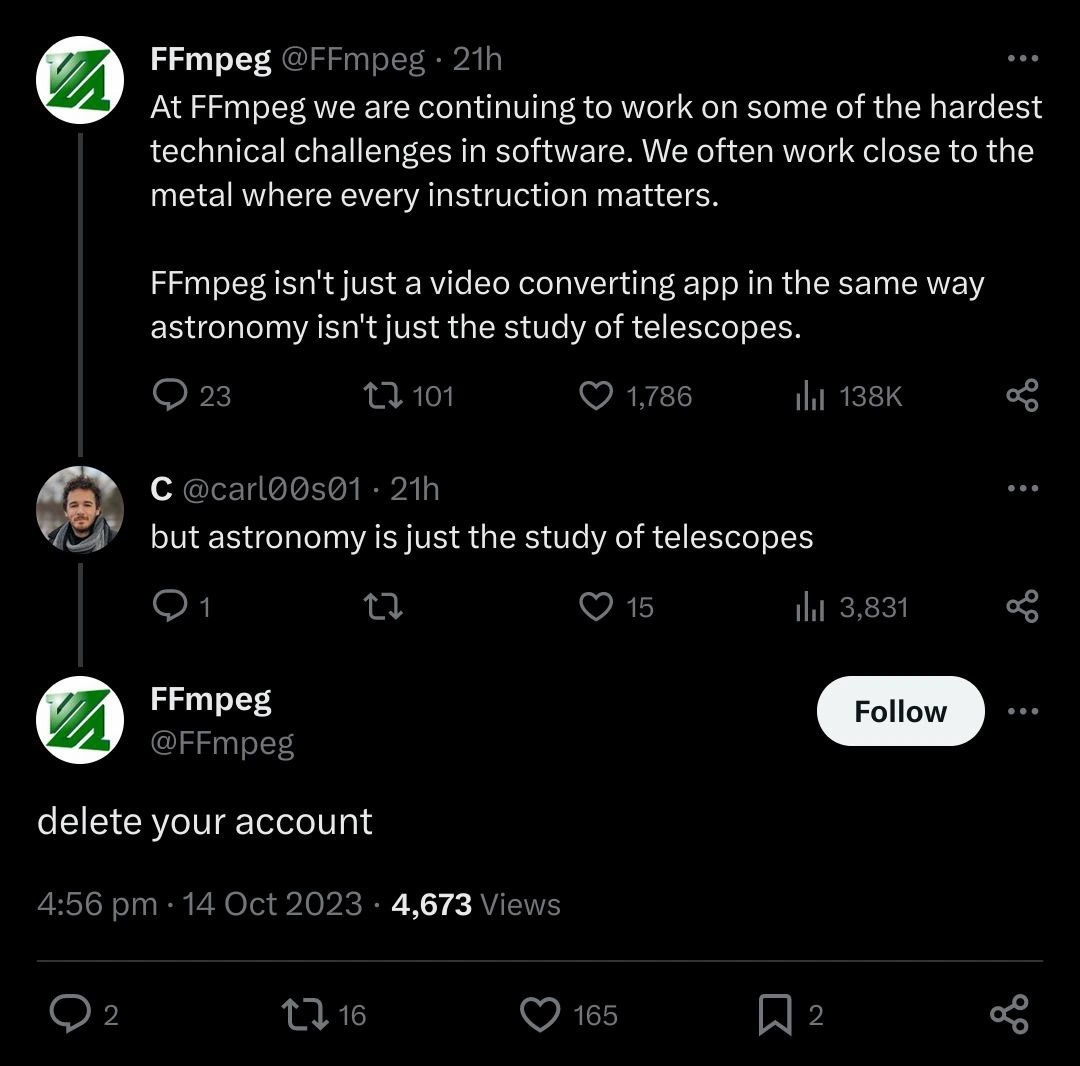
Imagine you’re watching a magician perform an amazing trick. You say, “Pfft, magic is just pulling rabbits out of hats.” In reality, there’s a lot more going on behind the scenes – secret compartments, practiced sleight of hand, years of training – and the magician feels a bit insulted by your comment. In this meme, the FFmpeg team is like the magician, doing incredibly hard work behind the curtain to make video stuff happen, and the person replying is like someone who doesn’t understand magic and says something silly. FFmpeg used a comparison: they said their work is to video tech what astronomy is to space – in other words, it’s a big, complex deal, not just fiddling with a simple tool. The person replied “but astronomy is just the study of telescopes,” which is like saying a chef’s job is just about using an oven. 🥴 It misses the big picture entirely. That’s why FFmpeg told them “delete your account.” That phrase is an internet joke meaning “what you said is so wrong, you should basically go away now.” It’s a funny, over-the-top way to show just how absurd the first comment was. So the core of the humor is this: someone disrespected a very complicated, hard job by calling it super simple, and the experts responded with an ultimate zinger. Even if you don’t get the tech details, you can understand the feeling – nobody likes it when their hard work is dismissed. This meme is basically saying “there’s a lot more going on than you think, and that comment was way off-base!” and it delivers that message with a punchy joke.
Level 2: Close to the Metal
Let’s break down the technical references in this meme in simpler terms. FFmpeg is a widely-used open-source software suite for processing video and audio. Many people encounter it as a command-line tool to convert media formats (for example, turning a .mov video into .mp4), so on the surface it might seem like “just a video converting app.” However, under that simple command is a colossal amount of complex code. FFmpeg contains implementations of codecs (coder-decoder algorithms) for countless video and audio formats, and it’s renowned for being extremely fast and efficient.
When the FFmpeg team says they work “close to the metal,” they mean they program at a very low level, interacting closely with the computer’s hardware. In programming, low-level programming usually involves languages like C or C++ (or even writing bits of assembly language) that allow you to manage memory directly and use processor-specific instructions. “The metal” is a metaphor for the actual machine (the metal circuits of the CPU/RAM). Working close to the metal is all about performance – making the software run as fast as possible by utilizing the hardware optimally. For instance, FFmpeg developers will optimize how data travels through the CPU, ensuring video frames are processed using CPU features like multiple cores or special vector instructions. A performance optimization might include using a specific CPU instruction that can process multiple pieces of data in one go (as opposed to doing one piece at a time). They also have to manage how memory is used because processing large videos involves moving huge amounts of data to and from memory and disks. In everyday terms, it’s like packing a suitcase with a very clever strategy so that you can carry as much as possible in one trip – FFmpeg developers pack data efficiently into the CPU’s “hands” so it can carry more each trip, speeding things up.
Now the astronomy metaphor: Astronomy is the scientific study of outer space – stars, planets, galaxies, and the physics of the universe. A telescope is an instrument astronomers use to observe distant objects. Saying “astronomy isn’t just the study of telescopes” is a way of pointing out that while telescopes are important tools, the real essence of astronomy is understanding how the universe works (using math, physics, theory, plus telescope observations as evidence). The FFmpeg tweet leverages this analogy to point out that their work isn’t just about the tool (the app that converts videos); rather, it’s a whole field of performance engineering and algorithm development – a lot of brainpower and ingenuity that isn’t immediately visible.
When the user replies “but astronomy is just the study of telescopes,” he’s either joking or misunderstanding the analogy. It’s like he’s saying, “No, actually, astronomy is nothing more than using telescopes.” This statement is reductive – it reduces a complex subject to a single element. The humor here is that anyone who knows about astronomy will immediately see this reply as a silly oversimplification (astronomers don’t obsess over telescopes for their own sake; they use them as tools to learn about space). It’s as if someone said “cooking is just the study of ovens” – it misses the whole point of what a chef actually does (combine ingredients, techniques, flavors – not just stare at an oven). Similarly, saying FFmpeg is “just a video converting app” misses all the intricate work going on inside that makes video conversion possible and fast.
The phrase “delete your account” in internet slang is a harsh, humorous comeback. On platforms like Twitter (now called X), telling someone to delete their account is basically saying, “that comment was so bad, you should leave the platform out of embarrassment.” It’s not meant literally, but it’s a meme-y way to clap back at a terrible take. In this case, the official FFmpeg account dropped that line in response to the telescope comment. This is surprising and funny because official brand or project accounts usually stay professional, but here FFmpeg’s social media manager (likely also a techie who felt the pain of the comment) just lost patience in a comedic way. The bluntness of “delete your account” underlines how misguided the user’s statement was. It’s a very developer-humor kind of response – a mix of exasperation and sarcasm that many tech folks find relatable. We often see jokes like "It's always DNS" or "have you tried turning it off and on again" in tech circles; “delete your account” has that same kind of iconic ring in online banter.
For a newcomer or junior developer, a key lesson from this meme is: don’t underestimate the complexity behind software tools. That simple command you use or that app you click often represents years of engineering. Also, industry experts take pride in their work’s depth. Dismissing something like FFmpeg as “just” this or that might earn you a stern (if humorous) correction. And on the flip side, it highlights how passionate tech communities are about their projects. We actually find it funny when someone is so wrong on the internet that the only sensible response is a joking “go home” call-out. In short, FFmpeg’s tweet was saying “We do rocket-science-level stuff in code,” someone quipped “haha, you just make a tool,” and FFmpeg clapped back with a meme-worthy one-liner. If you’ve ever been the newbie who said “why all this fuss, it’s simple, right?” and then realized it wasn’t simple at all, this exchange probably makes you chuckle (and maybe cringe at the memory). It’s a classic DeveloperHumor moment born on Twitter.
Level 3: Not Just Telescopes
This meme hits home for seasoned developers because it satirizes a familiar scenario: an expert describes their complex, performance-critical work, and then a bystander completely trivializes it. In the Twitter thread, the official @FFmpeg account proudly explains that they tackle “some of the hardest technical challenges in software,” optimizing at the instruction level (often literally writing assembly code or finely tuned C) so that video processing runs blazingly fast. This is a humblebrag most senior engineers appreciate—after all, many of us have spent late nights squeezing out performance gains or debugging at the machine level. FFmpeg compares their endeavor to astronomy, implying that just as astronomy is a grand scientific pursuit (not limited to mucking around with telescopes), their project is a grand engineering pursuit (not just a trivial video converter app). It’s a way of saying, “Our work has depth and significance beyond the obvious tool you see.”
Enter user @carl00s01 with the reply: “but astronomy is just the study of telescopes.” This reply is dripping with either profound misunderstanding or deadpan trolling. It’s a reductive take — essentially claiming “Nah, you are just fiddling with a tool.” To an experienced dev, this feels like nails on a chalkboard. It’s the kind of statement that ignores all the unseen complexity: the years of research in video codecs, the careful PerformanceOptimization needed to transcode 8K video in real-time, the countless edge cases and platform-specific hacks. The user’s comment is a perfect example of telescopic oversimplification – taking something vast and rich (like astronomy or low-level code optimization) and flattening it to the most trivial instrument involved. It’s as if someone told a database engineer, “But databases are just big Excel files,” or told a security expert, “Encryption is just hiding stuff.” Seasoned pros have heard similarly naive takes from clients or junior devs who don’t yet grasp why things are harder than they appear.
The real punchline is the FFmpeg account’s savage retort: “delete your account.” In developer and Twitter humor, telling someone to “delete your account” is a hyperbolic way of saying “that was such a disastrously bad take, you should basically remove yourself from the conversation entirely.” It’s TechHumor at its spiciest, especially unexpected coming from a corporate/open-source project’s official account. This wasn’t a polite correction or a nerdy counter-argument — it was a blunt mic-drop that translates to “I can’t even begin to educate you; just… go away.” The contrast is hilarious. You have an educational, almost inspirational analogy about LowLevelProgramming and PerformanceEngineering on one side, and an utterly flat, misguided reply on the other. The clash between high-minded technical pride and low-effort snark triggers the comedic spark.
For those of us who have poured our souls into optimizing code, the exchange is cathartic. We’ve all had moments where someone demeans our painstaking work with “Isn’t that just [oversimplification]?” and we only wish we could respond as directly as FFmpeg did. The meme encapsulates a mini-drama: Act I – expert shares wisdom; Act II – ignorant reply; Act III – expert’s brutal takedown. It also subtly nods to the culture of TwitterHumor (or “X humor” these days): the brevity of “delete your account” delivers the burn succinctly, pleasing the crowd (as indicated by the likes and reposts). In short, this meme resonates with developers because it validates the depth of their expertise and lampoons the folly of ignoring that depth. Plus, it’s just plain funny to see a respected software project channel that inner sarcastic sysadmin we all know and love.
Level 4: Every Nanosecond Counts
At the FFmpeg codebase’s core, developers grapple with low-level programming so intense it borders on hardware architecture. When they say “close to the metal where every instruction matters,” they mean optimizing code down to each CPU cycle. Consider how a single video frame contains millions of pixels; processing each pixel involves math (color transforms, compression algorithms). If an inner loop in a codec uses even one extra CPU instruction unnecessarily, that overhead multiplies millions of times per second. FFmpeg’s engineers often write performance-critical sections in hand-tuned assembly or use CPU-specific instructions (like AVX or NEON) to squeeze out maximum throughput. They must understand details like cache hierarchies (to keep frequently used data in fast L1 cache), SIMD vectorization (computing on multiple data points in one instruction), and even quirks of branch prediction (restructuring code so the CPU’s instruction pipeline stays full without costly mispredicts). This is PerformanceEngineering at its most extreme: akin to rocket science for software. A simple operation like adjusting brightness on a 4K video can involve gigabytes of data and billions of math operations. So FFmpeg’s team employs every trick from the computer architecture playbook to achieve real-time speed. They will unroll loops, use bitwise operations, and count instructions like an astronomer counts stars – meticulously and with deep knowledge of patterns. In fact, modern video codecs are backed by intense academic research, much like astrophysics papers. Compression algorithms rely on concepts from information theory (Shannon’s entropy) and signal processing (discrete cosine transforms, motion prediction). Yet even the most elegant algorithm can fail to meet real-time needs if it’s not implemented with bare-metal efficiency. FFmpeg devs might profile code with CPU performance counters, looking at cache misses and pipeline stalls the way a scientist analyzes anomalies in telescope data. Here’s a flavor of how PerformanceOptimization gets down to the byte level:
// Naive loop: adjust contrast for each pixel one at a time (slow)
for (int i = 0; i < num_pixels; ++i) {
output[i] = input[i] * contrast;
}
// Optimized with SIMD intrinsics: process 4 pixels per instruction (faster)
for (int i = 0; i < num_pixels; i += 4) {
__m128 pix = _mm_load_ps(input + i); // load 4 floats (pixels) at once
__m128 factor = _mm_set1_ps(contrast); // set vector = [contrast, contrast, contrast, contrast]
__m128 result = _mm_mul_ps(pix, factor); // multiply 4 pixels by contrast in one CPU instruction
_mm_store_ps(output + i, result); // store 4 results at once
}
In the above snippet, the optimized loop uses an SIMD instruction to do the work of 4 iterations in one go – a huge win when num_pixels is in the millions. This is what “every instruction matters” is all about: choosing the absolute best low-level operations so that the computer does as little redundant work as possible. It’s the kind of painstaking engineering you don’t see when you simply run ffmpeg -i input.mp4 output.mkv, but it’s happening under the hood so fast it feels like magic. And just as astronomy pushes the limits of physics to understand the cosmos, FFmpeg’s work pushes the limits of silicon to handle terabytes of media data efficiently. The tweet’s metaphor captures this perfectly: calling FFmpeg “just a video converting app” is as silly as calling astronomy “just telescope watching.” Both fields involve deep theory and careful practice far beyond the tools you visibly see. FFmpeg devs aren’t merely twiddling bits for fun – they’re solving hard technical challenges at the edge of what modern CPUs can do. That’s why seeing someone dismiss all that effort can trigger a cosmic eye-roll from those in the know.
Description
A screenshot of a Twitter thread involving the official FFmpeg account. In the first tweet, FFmpeg posts a serious, reflective message, stating they work on 'hard technical challenges' and that 'FFmpeg isn't just a video converting app in the same way astronomy isn't just the study of telescopes.' A user named C replies with a pedantic and incorrect counterpoint: 'but astronomy is just the study of telescopes'. In a perfect display of online exasperation, the official FFmpeg account delivers the final, blunt reply: 'delete your account'. The humor arises from the stark contrast between FFmpeg's initial profound analogy and its subsequent curt, dismissive comeback, a reaction any developer can relate to after having a complex point deliberately misunderstood

Comments
16Comment deleted
That user's comment is the equivalent of a null pointer exception in a philosophical debate. The only valid response is to terminate the process
We spend months hand-unrolling SIMD loops to save two clock cycles per macroblock, and Twitter still thinks FFmpeg is “basically Save As → MP4.” Fine - shipping a new filter: -vf delete_account
When you've spent years optimizing H.264 decoders at the assembly level and someone reduces your entire domain to 'just converting videos,' you realize some people think Kubernetes is just YAML files and distributed systems are just multiple computers talking - the same energy as thinking the Linux kernel is just a bootloader with extra steps
FFmpeg's response perfectly captures the frustration of maintaining performance-critical, instruction-level optimized multimedia codecs while the world thinks you're just a CLI wrapper around 'convert video to mp4.' It's the software equivalent of telling a compiler engineer 'oh, so you just translate code?' - technically true in the same way that a neurosurgeon 'just cuts people open.' The real humor is that FFmpeg literally works at the level where SIMD intrinsics and cache line alignment matter, yet gets reduced to 'that thing I use to compress videos for Discord.' The 'delete your account' is the digital equivalent of a senior architect hearing a PM say 'can't we just use a library for that?' about their entire life's work
Calling FFmpeg “just a converter” is like calling your microservice “just an HTTP endpoint” - sure, until you try shipping H.265 at 60fps without SIMD, cache-awareness, or a sane GOP
FFmpeg: Hand-tuning assembly intrinsics across 20 arches so normies run 'ffmpeg -i foo.mp4 bar.mp4' without a segfault symphony
Calling FFmpeg “just a converter” is the same energy as “Kafka is a queue” - accurate enough for marketing, guaranteed to page an SRE at 3am
hardest technical challenge write 1 line of C code without vulnerability Comment deleted
; Comment deleted
isnt this a greek question mark? Comment deleted
at least it doesn't have a vulnerability Comment deleted
you can't break someone's pc if your program won't compile Comment deleted
Rust philosophy Comment deleted
if (false) Comment deleted
https://youtu.be/9kaIXkImCAM?feature=shared Comment deleted
And best CLI interface 😜 Comment deleted