Skip to content
DevMeme
4976 of 7435
Generational Priorities: Marriage vs. The Unending Tech Stack
Career HR Post #5443, on Sep 14, 2023 in TG

Generational Priorities: Marriage vs. The Unending Tech Stack

Why is this Career HR meme funny?

Level 1: Candy Store Overload

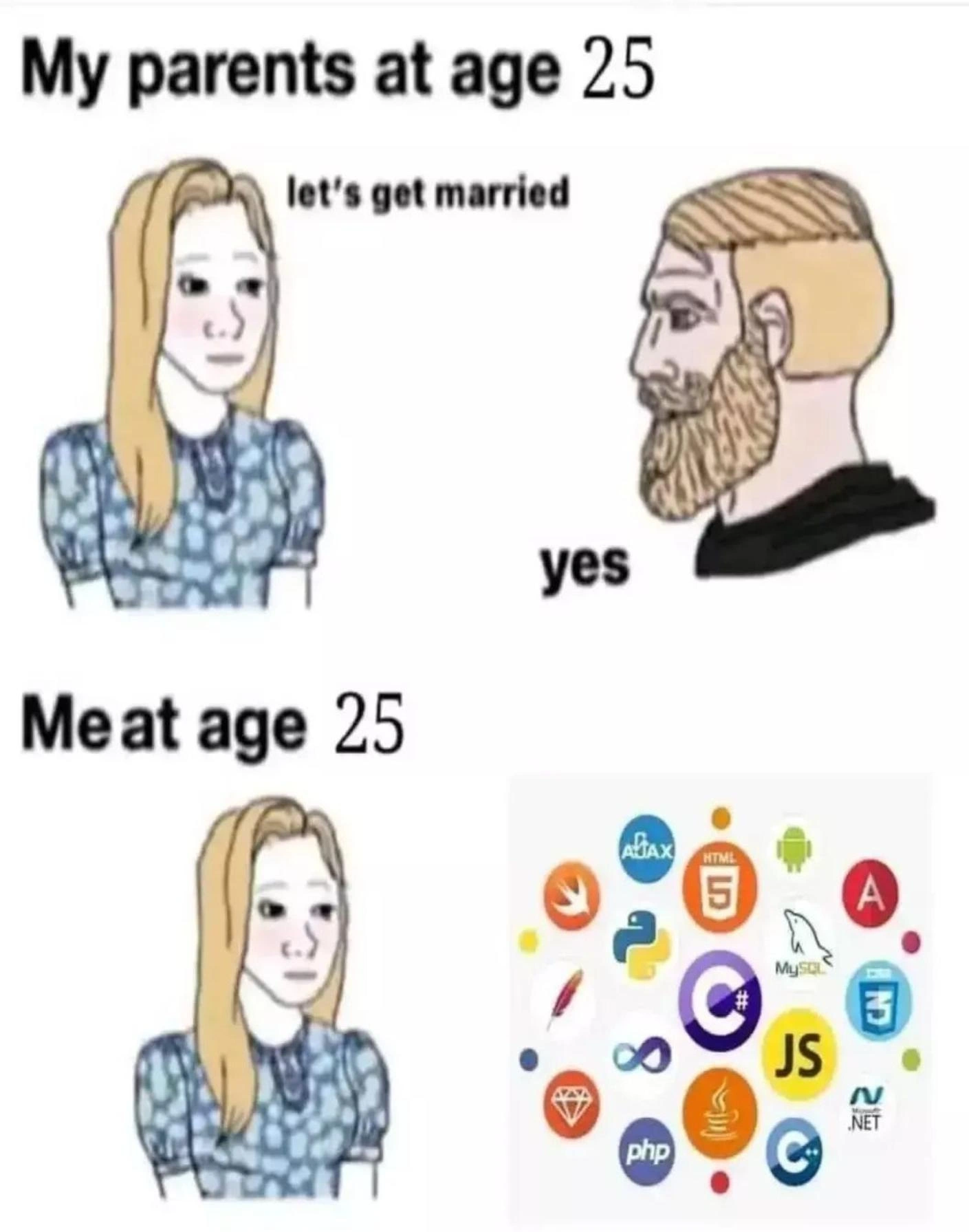
Imagine your parents only had one toy or one TV channel to enjoy when they were 25. It made life pretty simple – like having one favorite candy that you always eat. Now imagine you walk into a giant candy store with hundreds of different candies. It sounds fun, but it can also be overwhelming because you don’t know which candy to pick and you kind of want to try them all. That’s what this picture is joking about. For our parents, being 25 was like picking one special thing (like getting married to one person) and sticking with it. For someone 25 today who is a computer programmer, it’s like being surrounded by too many choices – all those colorful logos are different computer languages and tools, sort of like dozens of candies. The girl in the picture is me at 25, feeling a bit lost looking at all the options. It’s funny because having so many choices can be a little scary, just like a kid with a huge pile of candy who isn’t sure which piece to eat first! The meme makes us smile by comparing a simple life decision (like my parents saying “let’s get married”) with my super complicated to-do list (learning all those coding languages). Even if you’re not a grown-up or a programmer, you can understand that sometimes more choices just make things harder. The joke shows that difference in a simple, silly way: one generation had one big thing to focus on, and the new generation has a million little things swirling around instead.

Level 2: Tech Logo Tornado

If you’re a newer developer or just learning to code, this meme might look like a tornado of random tech logos swirling around – and that’s exactly the point. The bottom panel shows a young coder faced with a flurry of programming languages and frameworks. Let’s break down some of these buzzwords and icons in that cloud:

  • Programming Languages – These are the core tools we use to tell computers what to do. Examples in the image include JavaScript, Python, C#, C++, Java, Swift, Ruby, and PHP. Each is a different language with its own syntax (rules and grammar). For instance, JavaScript and Python are popular for their ease of use and huge communities; C++ is known for performance and complexity; Java and C# are common in enterprise environments; Swift is used for iOS apps; Ruby and PHP were big for web development (think Ruby on Rails, WordPress). It’s a lot of languages – imagine having to be fluent in French, Spanish, Chinese, and more all at once in human terms! No wonder it feels like a whirlwind.

  • Web Basics (HTML, CSS, AJAX) – The icons for HTML5 and CSS3 represent the fundamental building blocks of websites. HTML defines the structure of a webpage (like the paragraphs, headings, images), and CSS defines the styles (colors, layouts, fonts). They’re not programming languages in the same way as the others; they’re more like the vocabulary and style rules of the Web. AJAX stands for Asynchronous JavaScript and XML. It’s not a separate language but a technique that allows web pages to update data in the background without reloading the whole page (for example, when your Twitter feed loads new tweets automatically – that’s AJAX in action). These are considered essential knowledge for any web developer.

  • Frameworks and Libraries – You’ll notice logos like Angular and .NET (sometimes shown with that infinity-loop symbol for Visual Studio). A framework is a collection of pre-written code that provides a structure for building applications. Think of it as a ready-made template or skeleton that you fill in, so you don’t have to reinvent the wheel for common tasks. Angular is a framework for building web front-ends (interactive websites) using JavaScript/TypeScript. .NET is a framework (from Microsoft) for building all kinds of applications, from websites to desktop apps, usually using languages like C# or VB.NET. These frameworks often come with their own learning curve and flavors of doing things. There are also libraries (smaller than frameworks) that provide specific functionality. The meme doesn’t explicitly show library logos, but in a real developer’s life, you’d encounter things like React (for UI components) or jQuery, etc., which serve a similar purpose of making coding tasks easier (once you learn them, that is!).

  • Platforms and Tools – The little green robot icon stands for Android, which is Google’s mobile operating system. Developing for Android involves its own ecosystem of tools and languages (like Java or Kotlin). Seeing that logo implies mobile app development is yet another domain the developer might be considering. The purple infinity symbol in the image is actually the logo of Visual Studio, which is an Integrated Development Environment (IDE). An IDE like Visual Studio or VS Code is a software application that provides comprehensive facilities to programmers – editor, debugger, build automation – everything you need to write and manage code. It’s funny to include Visual Studio’s logo among languages, because it’s not a language itself but a tool; it reinforces how many different things a developer juggles (not just languages, but also the tools to use those languages).

  • Database and Servers – The dolphin icon is for MySQL, a popular relational database system. Databases are used to store and retrieve data (imagine the user accounts of a website or the posts on a blog – those typically live in a database). MySQL uses yet another language – SQL (Structured Query Language) – to manage data. The feather icon represents Apache, which is a widely-used web server software. Apache’s job is to serve web pages to users; it runs on a server (a computer) and responds to requests for web content. Together, databases and servers form the backend of many applications – yet more things a developer at 25 might need to learn about or work with.

That’s a lot of tech! The meme’s “me at age 25” character isn’t saying anything – she’s just 😐 staring overwhelmed – and now you can see why. It’s a relatable scenario for many programmers in their twenties: there’s a feeling that you have to learn all of these languages and tools just to keep up. This feeling is often referred to as the learning curve. A learning curve describes how much you have to learn to become proficient in something new. When people say “steep learning curve,” they mean there's a lot to grasp in a short time, which can be challenging. In tech, the learning curve can feel never-ending because as soon as you climb to the top of one curve (say you finally got comfortable with Angular), you see another mountain ahead (oh wait, now everyone’s talking about React or Vue…).

There’s even a term developers joke about: “framework fatigue.” This is the tiredness or burnout you feel when you’re constantly having to learn the next framework or library that comes out. One year everyone tells you to learn Angular, the next year it’s Drop everything, we’re using React now, and a year later it might be Have you tried Vue? 😵 Keeping pace with these trends can be exhausting. Newcomers often worry, “Do I really need to know all these things?” The honest answer is no, not all at once! Even experienced developers specialize. But early in your career (around that 25-year-old mark for many), you might still be figuring out which technologies to focus on, so it feels like you need to familiarize yourself with the entire universe of programming tools. That pressure is exactly what this meme is capturing in a humorous way.

The top panel with “My parents at age 25” highlights a generational humor aspect. A few decades ago, by 25 a person might have been expected to have certain life things sorted out — a stable job, maybe marriage or even kids. That was their “big to-do list.” In contrast, a 25-year-old developer today might still be in learning mode, hopping jobs or projects, or pursuing advanced skills instead of settling down. It’s not that one is better than the other; it’s that the priorities and environment have changed. Today, tech and career often take center stage in one’s twenties. So the meme playfully exaggerates: my parents were planning a wedding, I’m here planning which coding language to devote my time to next. And truthfully, in tech there’s a bit of a running joke that we’re all lifelong students – no matter your age, you’re always learning the next thing because technology evolves so fast.

For a junior developer or someone learning to code, the key takeaway is: don’t panic! You’re not actually expected to know every item in that logo cloud simultaneously. Part of the humor is that feeling of “Oh man, do I need to catch up on ALL of this?!” Seasoned programmers will tell you that no one knows everything – the field is just too broad. Instead, we learn one thing at a time, and over a career you might pick up many of those languages/tools as needed. The meme cleverly uses the absurdity of trying to juggle dozens of skills at once to get a laugh out of those of us who have felt that exact same overwhelm. It’s saying, in effect, “Hey, if you feel like you’re drowning in new technologies, you’re not alone – we’ve all been there (and some of us are still there)!”

Level 3: Hello World vs Wedding Bells

Mom at 25: "let’s get married."
Dad at 25: "yes."
Me at 25: stares at an endless swirl of programming language logos

In the top panel, our parents seal a life commitment with two simple words. In the bottom panel, the developer’s wide-eyed Wojak character faces a vortex of tech logos instead of a fiancé. This meme humorously contrasts a generational milestone (marriage by mid-twenties) with a modern developer’s reality: being married to the code. It’s poking fun at how millennial or Gen-Z techies often delay traditional life steps because they’re busy grappling with an ever-evolving tech stack. The colorful cloud of icons (JavaScript, Python, C#, C++, Java, Swift, Ruby, PHP, .NET, HTML5, CSS3, Angular, Android, MySQL, AJAX, the Apache feather, the Visual Studio infinity symbol, and more) represents a never-ending stack of languages, frameworks, and tools all vying for our attention. Instead of fielding marriage proposals, the 25-year-old developer is fielding “proposals” from new frameworks and programming languages – each one promising to be the next big thing to learn.

This is hilariously relatable to developers because of the phenomenon of framework fatigue. Every other month there’s a JavaScript framework du jour or a new backend language paradigm. Keeping up feels like a full-time job (on top of your actual full-time job!). The meme exaggerates this reality: while our parents might have settled down with one person and perhaps one lifelong career, today’s devs are expected to “settle down” with an ever-shifting tech stack. Choosing a life partner vs. choosing a tech stack? – the joke implies that picking the right JavaScript framework for a project can feel as daunting as picking a spouse. After all, one wrong choice and you’re stuck with incompatibility issues and a lot of regret. 😅

There’s also a nod to “language wars” in that swirling logo cloud. With so many options, developers often passionately debate which language or framework is the best. It’s as if each logo in the vortex is a suitor trying to win the developer’s heart: JavaScript is fun and popular!Python is powerful and easy!Java is reliable and established!Swift is trendy and iOS-native! – and so on. The result? A feeling of being pulled in every direction by endless possibilities. Seasoned engineers know this feeling all too well; it’s the perpetual learning curve of our industry. No sooner do you master one technology than a shiny new one appears on the horizon. The meme captures that collective developer fatigue and packages it in a generational joke format that makes us laugh and cry at the same time.

We can even compare the two 25-year-old realities side by side:

My parents at 25 Me at 25 (as a developer)
Major life choice: marry one person for life 💍 Major career choice: which language or framework to learn next 💻
Stable path (one home, one job) Dynamic path (gig economy, job-hopping in tech)
Knew a few skills well (e.g. Dad could fix the car) Expected to know dozens of tools (full stack from Docker to Django)
Life goal: “Start a family and settle down.” Life goal: “Keep up with the latest technology.”

The humor strikes a chord because it’s too real: instead of shopping for a ring, the developer is shopping for which JavaScript library to invest time in. And unlike a marriage (which ideally is one big decision followed by stability), the tech world demands continuous commitment to lifelong learning. There is no happily ever after with one language – today’s stack might be obsolete tomorrow. As a tongue-in-cheek reflection of modern life, the meme perfectly captures the absurdity of a 25-year-old developer’s “proposals” being software tools popping the question: “Will you commit to me (in Git)?”

Description

A two-panel Wojak comic meme comparing life milestones across generations. The top panel, labeled 'My parents at age 25', depicts a Trad Girl Wojak saying 'let's get married' to a Nordic Chad Wojak, who replies 'yes'. This represents a traditional life path. The bottom panel, labeled 'Me at age 25', shows the same female Wojak character, but instead of a partner, she is looking at a circular collage of numerous programming language and technology logos. These logos include prominent ones like Python, JavaScript, C#, Java, C, HTML5, CSS3, MySQL, PHP, .NET, Swift, and Android. The meme humorously contrasts the societal norm of settling down in the past with the modern developer's reality of being overwhelmed by the vast and ever-growing ecosystem of technologies they need to master for their career. It captures the feeling that a developer's primary long-term commitment is to continuous learning
Comments

18
Anonymous ★ Top Pick My parents' marriage at 25 was a monolith with a simple API. My relationship at 25 is a sprawling microservices architecture of half-learned frameworks held together by existential dread and CI/CD pipelines
  1. Anonymous ★ Top Pick

    My parents' marriage at 25 was a monolith with a simple API. My relationship at 25 is a sprawling microservices architecture of half-learned frameworks held together by existential dread and CI/CD pipelines

  2. Anonymous

    Funny how my parents needed one commitment at 25, while my micro-service résumé already has twenty-five of its own - and they all want version upgrades before dinner

  3. Anonymous

    While your parents were committing to each other with a simple 'yes', you're still uncommitted on your Git branches, debating whether to marry React or have an affair with Svelte, all while your package.json has more dependencies than you have life goals

  4. Anonymous

    At 25, our parents committed to one person for life. We commit to learning 15 frameworks simultaneously, knowing half will be deprecated before we finish the tutorials. The real relationship status? 'It's complicated' with JavaScript, and we're polyamorous with backend languages - because choosing just one stack is apparently more commitment than our generation can handle

  5. Anonymous

    My parents had one lifelong dependency; my stack has 1,462 transitive ones - commitment is easy, the upgrade path is terrifying

  6. Anonymous

    My parents shipped Family v1.0 at 25; I’m herding a polyglot microservices zoo where npm, pip, Maven, and NuGet demand more commitment than any fiancé - SemVer is the only ring I trust

  7. Anonymous

    Parents locked in monogamy at 25; I've been in a toxic polyglot relationship with 12 frameworks since bootcamp

  8. @mon_faleymon 2y

    Fuck(

  9. @Araalith 2y

    Even an amoeba can replicate, but can it be a full-stack developer? Well, maybe for PHP and React, but generally speaking?

    1. @RiedleroD 2y

      ayo, I like php :(

  10. Deleted Account 2y

    Evil challenge: Write it in C++

    1. @klemaai 2y

      ASM, for the win

      1. Deleted Account 2y

        Binary all the way bro

        1. valentyn 2y

          Flipping switches on a CPU

          1. Deleted Account 2y

            I have no idea how we can go lower maybe just adjust the voltages to make signals after that ?

  11. Deleted Account 2y

    Wheres rust wtf

    1. @SamsonovAnton 2y

      In the same place as Go and other buzzword languages — out of scope. 😁

      1. Deleted Account 2y

        ouch

Use J and K for navigation