Skip to content
DevMeme
1191 of 7435
A Classic 'Yo Mama' Joke Updated for File System Limitations
Storage Post #1330, on Apr 18, 2020 in TG

A Classic 'Yo Mama' Joke Updated for File System Limitations

Why is this Storage meme funny?

Level 1: Too Big to Fit

Imagine you have a small box that can only hold 4 basketballs. If you try to put a 5th basketball in, the box just won’t take it – it’s completely full. This meme is playing with that idea using a mom as the character and computer storage as the box. It jokes that “your mom is so fat, she can’t save files bigger than 4GB,” which sounds weird at first! But in simple terms, it’s saying your mom is like a storage box that has a fixed limit (4GB) and just can’t fit anything more. It’s funny because it mixes a normal silly insult with a super nerdy computer fact. It’s like telling someone, “Your backpack is so full, it can’t even fit one more book, no matter how small.” We don’t literally mean a person can save computer files, of course. The joke is using an unexpected comparison to make us laugh. The surprise of hearing a tech term (“4GB files”) in a yo mama joke is what makes it goofy and fun. Even if you don’t get the technical bit, the over-the-top claim itself is so absurd that it makes you giggle.

Level 2: USB Drive Surprise

If you’re newer to programming or IT, this meme might seem bizarre at first. How can someone’s mom “not save files bigger than 4GB”? 🤔 To understand the joke, you need to know about FAT32, which is a type of file system. A file system is basically the method an operating system uses to organize data on a disk or USB drive (other examples include NTFS, exFAT, ext4, etc.). FAT32 was a very common file system for USB drives, memory cards, and older versions of Windows. It’s loved for its simplicity and compatibility – nearly every device (PCs, Macs, cameras, TVs) can read a FAT32 drive. But it has a quirk: no single file can be larger than 4 GB on a FAT32-formatted drive.

What does that mean in practice? Say you have a flash drive with plenty of space, and you try to copy a high-definition movie file that’s 5 GB. Even though the drive has enough total room, the copy will fail with an error like “file too large for the destination file system.” The operating system is basically saying, “This drive’s format can’t handle a file that big.” That 4GB threshold is a built-in limit of FAT32. It’s a well-known restriction (known as the 4gb_file_size_limit) that often surprises people the first time they encounter it. Many of us learned about it when trying to transfer a large game, ISO, or video to a FAT32 USB drive and scratching our heads when it wouldn’t work.

Now, onto the joke format: “Yo mama” jokes are a form of playful insult – commonly, “Yo mama’s so fat, she [something funny]…”. They’re a silly, often outrageous type of humor from playground culture. In this meme, the punchline is “she can’t save files bigger than 4GB,” which is not a typical ending for a yo mama joke! It’s referencing that exact FAT32 file size limitation, using the word “fat” as a pun. Essentially, it’s saying your mom is like a FAT32 drive: she has a size cap. Of course, it’s not actually talking about anyone’s real mother – it’s referring to the FAT32 system. The joke lands if you know that FAT in FAT32 has nothing to do with body weight; it’s just unfortunate (or fortunate, for joke-making) naming. So the meme mixes a childish joke with a tech fact: your mom is “so FAT32” that 4GB is her max file size. 😅 It’s absurd, but that absurdity is exactly why it’s funny.

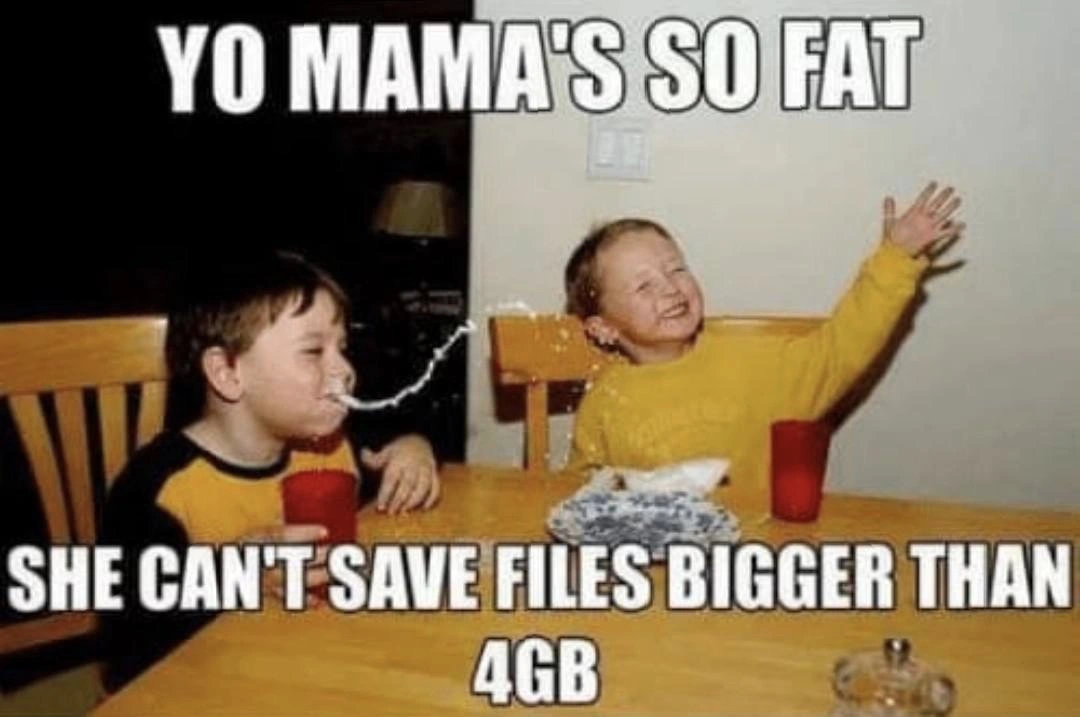
Let’s break down why engineers chuckle at this: It’s an unexpected crossover. You take a mundane tech limitation—something we usually only discuss in serious contexts like disk management or troubleshooting—and you drop it into a casual joke format. The image helps set the scene: one kid spits out his drink in surprised laughter, and the other kid has his arm up like he just delivered the ultimate zinger. That’s basically how it feels in a room of developers when someone drops a pun like this. First comes a moment of “wait, did you just make a FAT32 joke?” then everyone cracks up because it’s so geeky.

In everyday terms, this meme is a fun way to remember “hey, FAT32 can’t handle files over 4GB.” It edu-tains: if you didn’t know about the limit, now you do, and with a smile. And if you did know, you’re in on the joke. The next time you format a drive and consider what file system to use or you get a “file too large” error, you might just hear “yo mama’s so FAT—32” echo in your head. It’s filesystem_limitation_humor at its finest: turning an irritating technical constraint into something to laugh about. And it subtly points out that legacy_filesystem choices (like FAT32 for wide device support) come with baggage, in this case a 4GB baggage limit. In short, the meme uses a silly scenario to highlight a real tech lesson, which is a very programmer way of joking around.

Level 3: FAT32 Weight Limit

For experienced devs and IT veterans, the phrase “can’t save files bigger than 4GB” immediately screams one thing: FAT32’s notorious limit. It’s the kind of quirk you encounter early in your career (and never forget). The meme sets up a classic “Yo mama’s so fat…” joke but delivers a punchline about a file system constraint, and that unexpected combo is hilarious to those of us who’ve battled with old storage formats. The child doing a spit-take with his drink perfectly captures our reaction the first time we hear a nerdy punchline like this — “Did they really just make a yo mama joke about disk formatting?!”

The humor here relies on a double meaning: FAT32 has the word “FAT” in it (for File Allocation Table), so it cleverly doubles as an insult about someone’s mom being fat. The setup “Yo mama’s so fat” primes you for some outrageous exaggeration, and then it blindsides you with pure tech: “she can’t save files bigger than 4GB.” It’s a one-two punch of nostalgia and nerdiness. On the nostalgia side, yo mama jokes are goofy schoolyard classics. On the nerdy side, every seasoned programmer or sysadmin remembers hitting that 4GB file size wall and going “Huh? Why won’t this file copy even though I have space? …Ohhh, it’s FAT32!” 😅. Combining the two is so absurd it’s brilliant.

We laugh because it’s true. No, not about anyone’s actual mother, of course, but about the file system. In the world of Storage and OperatingSystems, FAT32 has a well-known weight limit: one file can’t exceed 4 GiB. If you’ve ever tried to put a DVD-sized movie or a huge backup onto a USB stick and gotten a cryptic error, you’ve probably discovered this the hard way. The meme is basically reenacting that moment as a joke: “your mom (a.k.a. your FAT32 drive) is too ‘fat’ to handle that big file.” The kid triumphantly grinning with his arm raised is like the developer who just dropped this ultimate geek burn, while the other kid spraying soda is the rest of us, caught between laughter and “I can’t believe I laughed at that.”

Beyond the wordplay, there’s industry lore here. Disk management woes have given us battle scars – copying large files, dealing with partitions, choosing formats – and FAT32’s limit is a classic gotcha. Experienced folks chuckle because we’ve all done the dance of splitting a file into smaller chunks or reformatting a drive to NTFS/exFAT just to move one big file. It’s funny now, though at the time it was frustrating. This meme lets us collectively roll our eyes at how a decades-old design (FAT32 dates back to Windows 95-era) still sneaks into our modern workflows. It’s legacy tech humor: the joke is on how far we’ve come (huge files everywhere) and how this old file system just can’t keep up.

The spit-take image amplifies the comedic timing. One moment you think it’s an immature insult, next moment you realize it’s poking fun at a filesystem limitation. That jolt of recognition – “I know this problem!” – is where the laughter comes from. It’s an inside joke among tech folks. We’re effectively laughing at the absurdity that something named “FAT” ironically has a strict size diet. And on a meta level, we’re amused that we find a yo_mama_joke about usb_drive_formatting funny at all! It’s a celebration of geeky humor: only in programming circles would a fat joke about a legacy_filesystem make people cheer. In short, the meme lands because it transforms a shared annoyance (the 4GB file limit) into a shared laugh. It reminds us that even arcane issues in FileSystem design can be comedy gold when delivered with the right punchline. Sometimes, healing from tech trauma comes in the form of a good joke that only those who’ve been there truly appreciate.

Level 4: The 32-Bit Ceiling

Deep beneath this joke lies a very real technical limit grounded in binary math and old-school file system design. FAT32 (which stands for File Allocation Table, 32-bit) uses a 32-bit number to record file sizes. A 32-bit unsigned integer can count up to 2^32 − 1 distinct values. In terms of bytes, that’s exactly 4,294,967,295 bytes (which is 4 GiB minus a single byte). This number isn’t random – it’s the absolute maximum value that fits in 32 bits. As a result, a FAT32-formatted drive simply cannot represent a file larger than ~4.0×10^9 bytes. It’s like a hard mathematical wall: any single file beyond that size would overflow the counter. The file system doesn’t even allow it – the OS will stop you because it knows the FAT data structure would roll over.

To put it in perspective, here’s essentially what the FAT32 directory entry looks like in C-like pseudocode:

struct FAT32DirEntry {
    // ... other fields ...
    uint32_t fileSizeBytes;  // 32-bit file length (max ~4.29 billion bytes)
};

That uint32_t field for fileSizeBytes is the culprit: it imposes a strict upper bound (4 GiB) on how large any one file can be. Back in the mid-90s when FAT32 was introduced (for Windows 95 OSR2 and Windows 98), a 4GB file was practically unthinkable for average users – an enormous size given typical hard drives and software of the era. The designers chose a 32-bit length partly for efficiency and compatibility, never expecting home videos, ISO images, or backups to regularly exceed that limit.

Modern file systems have long since moved past this. For example, NTFS (Windows’ newer file system) and ext4 (common in Linux) use 64-bit file size counters, allowing single files to be exabytes big (trillions of bytes, effectively no practical limit in daily use). Microsoft even created exFAT (extended FAT) in 2006 to overcome FAT32’s 4GB ceiling while retaining a lightweight design for flash drives. But despite these advancements, FAT32 stuck around because of its simplicity and near-universal compatibility. It became the lowest common denominator for Storage devices: USB sticks, SD cards, and external drives that needed to work on any Operating System (Windows, Mac, Linux, cameras, TVs—you name it). The trade-off was carrying that old 4GB file-size ceiling along.

So, the meme’s punchline isn’t just random absurdity—it’s grounded in this technical reality. It personifies the file system’s limitation as “yo mama is so fat… she can’t save files bigger than 4GB.” In other words, the FAT32 system is “fat” in name but has a fixed limit on how much it can handle at once. For seasoned engineers, this quip hits on a fundamental design constraint: a literal numeric overflow scenario turned into a playground-style burn. It’s a nerdy nod to how legacy design decisions (like choosing a 32-bit field) echo for decades. The humor arises from recognizing that behind the scenes of this silly insult is a precise 4,294,967,296-byte reason. Yo mama (FAT32) can’t count past 4 billion – and that’s why she can’t handle a file larger than 4GB. It’s a perfect marriage of computer science trivia and classic joke format, triggering that “aha, I get it!” moment for those in on the tech joke.

Description

This is a classic 'spit take' reaction meme format. The image shows two young boys at a wooden dining table. The boy on the left, wearing a black and yellow shirt, is dramatically spitting a stream of white liquid (likely milk) from his mouth. The boy on the right, wearing a yellow sweater, is recoiling in laughter, arms thrown wide, as if reacting to a hilarious joke. The meme's text is overlaid in a bold, white, impact font. The top text reads 'YO MAMA'S SO FAT', and the bottom text delivers the punchline: 'SHE CAN'T SAVE FILES BIGGER THAN 4GB'. The humor comes from the unexpected tech-savvy twist on the classic 'yo mama' joke format. The punchline is a direct reference to the limitations of the FAT32 file system, where the maximum possible size for a file is 4GB (or, more precisely, 4 GiB minus 1 byte). The 'FAT' in the joke is a clever double entendre, referring both to the insult and the File Allocation Table (FAT) architecture, making it a niche joke for those familiar with computer hardware and operating system history


Comments

7
Anonymous ★ Top Pick Some developers' codebases are like a FAT32 drive - they look fine at first, but try to load one modern dependency and the whole system just gives up
  1. Anonymous ★ Top Pick

    Some developers' codebases are like a FAT32 drive - they look fine at first, but try to load one modern dependency and the whole system just gives up

  2. Anonymous

    The microservices pitch deck really wrote itself the day the 7-GB monolith wouldn’t fit on the CTO’s FAT32 thumb drive

  3. Anonymous

    The real tragedy is she's still more reliable than our microservices architecture that splits a 4GB file into 4000 network calls, each with its own retry logic, circuit breaker, and eventual consistency model

  4. Anonymous

    Ah yes, FAT32 - the filesystem that's been keeping us from storing 4K movie files on USB drives since 1996. Nothing says 'modern computing' quite like having to split your Docker image into multiple parts because your external drive is still formatted like it's Windows 95. At least when you hit that 4GB wall, you know exactly which ancient filesystem to blame - unlike debugging a distributed system where the root cause could be literally anywhere across three continents and two cloud providers

  5. Anonymous

    Devs be like: 'exFAT? Nah, my drive's still rocking that FAT32 bod.'

  6. Anonymous

    FAT32: the ‘universal’ format that turns a 6.2GB installer into an architecture decision - chunk it, reformat, or explain 2^32-1 bytes to UEFI

  7. Anonymous

    Air-gapped deploys: FAT32 is the chief architect - keep the release under 4GB or start calling your thumb-drive shards “microservices.”

Use J and K for navigation