A Purr-fectly Flawed Inheritance Model
Why is this DesignPatterns Architecture meme funny?
Level 1: Don’t Serve Dinner on Your Cat
Imagine you’re organizing things in your house. You have a table and a cat. Both the table and the cat have four legs, right? Now, would you ever say “Well, my cat has four legs and my table has four legs, so my cat must be a type of table!” Of course not – that would be silly. You wouldn’t try to set a dinner plate on your cat just because it also stands on four legs. The cat would run away and the plate would crash! 🐈💨💥 This meme is funny because it shows someone making that exact kind of mix-up, but in a programming sense. They treated a cat like it belongs in the furniture category just due to one superficial similarity. It’s basically saying someone grouped things the wrong way. Everyone knows a cat is an animal, not a piece of furniture, so we immediately see it’s a mistake and laugh. The humor comes from how obviously wrong it is — it reminds us not to confuse things that only seem alike in one way, because in reality they are very, very different.
Level 2: Is-a vs Has-a Showdown
Let’s break down the joke in simpler terms. In object-oriented programming, classes are blueprints for objects, and inheritance is when one class extends another to reuse code and represent a logical hierarchy. For instance, you might have a general class Animal and let Cat extend Animal because a cat is an animal. That means Cat automatically gets the common features of Animal. The relationship should make sense: each Cat is a type of Animal. This meme flips that on its head by saying Cat extends Table – meaning someone coded a cat to be treated as a type of table. They likely did this just because both cats and tables have "four legs," thinking that was a clever way to avoid writing the same property in both places. But in programming, just sharing a trait (like number of legs) isn’t enough for inheritance. Inheritance implies an "is-a" relationship: a cat is a table? No way! The meme shines a light on this category error.
The correct approach would be to use composition or separate properties instead of inheritance. Composition means you build classes by combining smaller parts. For example, rather than saying Cat is a kind of Table to give it legs, you would say Cat has legs and Table has legs as separate pieces of data. Both could have a field legsCount = 4 or even a Leg object, without forcing a weird parent-child class relationship. This follows the guideline “favor composition over inheritance” – a common mantra in clean software design. It avoids the problem of having a nonsensical family tree in your code.
Why is Cat extends Table such a mistake? One big reason is the Liskov Substitution Principle (a fancy term from the SOLID design principles). In simpler words, this principle says: if you have a class B that extends class A, you should be able to use B anywhere you use A without things breaking. So if a Cat extends Table, any place the program expects a Table, it should be fine to pass a Cat. But think about it: if a function is designed to use a Table (perhaps to set the table for dinner), passing a Cat would be ridiculous. The function might call table.holdObject(plate) expecting the object to sit on a surface. A cat object might have that method (inherited from Table), but a real cat won’t behave like a flat, steady surface – it might drop the plate or run away! So Cat fails that substitution test, which tells us the inheritance was wrong in the first place. This is what we mean by a Liskov violation.
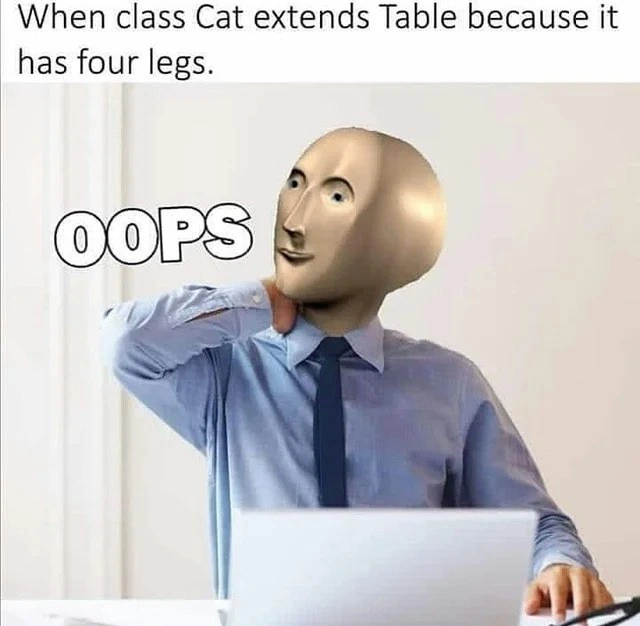
The image reinforces this humor: we see an office worker looking embarrassed or in distress, and the big text "OOPS" next to him. This "OOPS" is a play on OOP, the acronym for object-oriented programming. It’s showing that our developer made an “oops” in their OOP design. The meme’s text is essentially the developer’s thought: “I made class Cat inherit from class Table because both have four legs”. Seasoned developers immediately recognize this as a bad class hierarchy choice – it just feels wrong, the way putting a cat in the furniture section of a store would feel wrong. It’s a lighthearted way to point out a code quality issue.
In software talk, we’d call Cat extends Table a misuse of inheritance. It’s like categorizing things incorrectly: you wouldn’t put a cat in a list of tables, even though both have legs. Instead, if you needed to handle cats and tables in some common way, you might use a more sensible trait (perhaps an interface called Legged that just gives the number of legs, though it’s rarely useful to lump animals and furniture together in code!). Generally, such a strange hierarchy would create technical debt – future developers will scratch their heads wondering why these classes are related at all, and it might cause bugs when the program tries to treat a cat as a piece of furniture. This is why understanding Inheritance vs. Composition is so important for CS fundamentals: use inheritance for true "type-of" relationships, and use composition or common fields for shared features. The meme humorously shows what happens when someone gets that wrong. It's a joke most programmers learn early: just because two things share a feature (four legs in this case) doesn't mean one should inherit from the other in code.
Level 3: Four-Legged Faux Pas
In the world of Object-Oriented Programming (OOP), this meme is a facepalm-worthy gem that makes senior developers both chuckle and cringe. The top text "When class Cat extends Table because it has four legs." describes a hilariously absurd class hierarchy: someone designed a Cat class to inherit from a Table class simply because both have four legs. In OOP terms, that means they declared “a Cat is a kind of Table” – an obvious modeling blunder. It's a classic code smell and a textbook example of misusing inheritance. In well-designed systems, inheritance implies an “is-a” relationship that must make logical sense (like Cat is a Animal). Here, sharing a trivial property (number of legs) is not a valid reason to use inheritance.
This sloppy design violates fundamental clean code principles and the L in SOLID: the Liskov Substitution Principle (LSP). Barbara Liskov’s principle demands that if Cat is a subclass of Table, then anywhere a Table works, a Cat should work too without blowing up expectations. Clearly, that contract is broken: if a function expects a Table (to, say, holdObject() on its surface), passing in a Cat would be disastrous. Imagine calling a method to place a coffee mug on a Table object and accidentally handing it a Cat instance! The program might accept it (since a cat is-a table in this code), but at runtime you’ve essentially tried to use a living pet as furniture. The cat won’t stay put, and your coffee ends up on the floor (or on the cat, who is now very unhappy). In short, Cat cannot substitute for Table without causing mayhem – a crystal-clear LSP violation.
Why would anyone do this? Often it’s a rookie architecture mistake: using inheritance for code reuse without thinking through the model. Perhaps the developer noticed both Cat and Table have a legsCount = 4 and thought, “Hey, free legs property if I extend Table!” This is the inheritance vs composition dilemma gone wrong. Instead of abusing the class hierarchy, good design favors composition over inheritance. For example, a better design is to give both Cat and Table their own Leg components or a numberOfLegs field (composition), rather than forcing a false family tree. You might create a Legged interface or trait if you needed to treat all leg-having things similarly, but you would never make Cat inherit from Table in a sane codebase. That's like using a wrench as a hammer because they’re both metal tools – technically possible, but wrong tool for the job.
This meme’s "OOPS" caption nails the punchline: it’s not just a mistake, it’s an OOP mistake. The blurred office worker clutching their neck in distress perfectly embodies the “Oops, what have I done?” moment. Every seasoned developer has seen their share of ill-conceived class hierarchies (or created one early on) and knows the pain it causes. It’s humor born from real experience: we laugh because we’ve encountered that technical debt – those perplexing inheritance chains where things that should never be related are tangled together. The meme exaggerates it to a cat and a table, making the violation obvious. It’s a lighthearted reminder that bad class hierarchy decisions can be as silly as this example, and that adhering to Clean Code design principles matters. Even if you haven't literally seen a Cat extends Table, you've likely seen something nearly as ridiculous in legacy code, prompting the same reaction: "OOPS!"
Let’s illustrate why this design is nonsense by comparing the expectations for a Table versus a Cat in code:
class Table {
int legs = 4;
void holdObject(Object item) {
// Place item on the table
}
}
class Cat extends Table {
// Inherits legs = 4, and holdObject(...) -- which makes no sense for a cat!
}
// Somewhere else in the code...
Table sideTable = new Table();
Cat kitty = new Cat();
// Polymorphism in action: treating a Cat as if it's a Table (because Cat extends Table)
Table maybeTable = kitty;
maybeTable.holdObject("coffee mug"); // Uh-oh, we're trying to use a Cat as a table!
In the snippet above, a Cat is being used wherever a Table is expected (thanks to polymorphism). A senior dev instantly recognizes this as dangerous. The call maybeTable.holdObject("coffee mug") will compile, but there's no sensible way for a Cat to fulfill the holdObject behavior defined in Table. This is exactly how you spot a Liskov violation in code. If we ran this, the cat object might throw a runtime exception, or worse, silently do something incorrect. It’s a bug breeding ground. No wonder the meme screams "OOPS" in big bold letters!
To fix this design, we’d refactor so that Cat and Table don’t have this fake inheritance relationship. Perhaps both could use a common helper or just each define their own getNumberOfLegs() method. If we truly needed a generic way to handle “four-legged things” (rare in practice), we might introduce an interface like LeggedEntity that both can implement. The key is proper modeling: use inheritance only for true “is-a” relationships and use composition for shared features. This keeps the hierarchy logical and maintainable. Seasoned architects keep an eye out for these four-legged mix-ups because they signal deeper design issues. As funny as Cat extends Table sounds, it’s a lighthearted nudge reminding us to keep our class hierarchies sensible. After all, a cat might sit on a table, but it should never sit in your class inheritance tree under Table! 🐱🪑
| If it's a Table... | If it's a Cat (treated as Table)... |
|---|---|
| Meant to stay in one place. | Will wander off on its own. |
| Provides a stable surface for objects. | Might knock objects off or drop them. |
| Inanimate – has no will or surprise behavior. | Alive and unpredictable (may jump or scratch!). |
| Okay to put dinner plates on. | Do not put your dinner on a cat! 😹 |
Description
The image features the surreal 'Meme Man' character - a smooth, grey, disembodied head - superimposed on the body of a person in a blue shirt and tie, sitting at a desk with a laptop. The character is rubbing the back of their neck in a gesture of awkwardness or mistake. The text at the top reads, 'When class Cat extends Table because it has four legs.' Next to the character's head, the word 'OOPS' is written in a simple, outlined font. The meme humorously illustrates a classic misunderstanding of Object-Oriented Programming (OOP) principles. It satirizes the flawed logic of using inheritance for a 'has-a' relationship (both have four legs) instead of an 'is-a' relationship (a cat is not a type of table). This is a common anti-pattern that experienced developers instantly recognize as a sign of a junior programmer's mistake, leading to a rigid and illogical class structure

Comments
7Comment deleted
My new `Cat` class now inherits the `canBeSandedAndVarnished()` method, and my `Table` instance won't stop purring. It's a feature, not a bug
Latest code review: “class Cat extends Table.” Looks fine until Liskov drops a 20-pound roast on the instance and the subclass jumps off the call stack, hissing about unsupported load
This is the same inheritance hierarchy that led to our authentication system where Admin extends User extends Guest because "they're all people who access the system" - now every guest has dormant sudo privileges waiting to be discovered
This is the architectural equivalent of inheriting from AbstractVehicle because your coffee maker has a power button and so does your car. Sure, they both have four legs - I mean, wheels - but when your Cat class suddenly inherits a setTablecloth() method and your polymorphic dinner party tries to serve food on a feline, you'll realize that shared attributes don't justify inheritance. Composition over inheritance isn't just a principle; it's what prevents your codebase from becoming a taxonomical nightmare where everything is-a something it definitely is-not. The real OOPS here is that this mistake usually survives code review until production, when someone tries to instantiate new Cat() and wonders why it implements the Furniture interface
If “Cat extends Table” made it past code review, your domain model is an IKEA catalog and LSP just knocked your coffee off the interface
Cat extends Table because it has four legs - classic attribute-driven inheritance; Liskov cries, composition says “told you so,” and suddenly the cat implements ILoadBearing
Cat extends Table? Liskov weeps - substitute that feline for furniture and watch your hierarchy collapse