YC President's Overreaction to a Startup Rejection Meme
Why is this DevCommunities meme funny?
Level 1: Small Letters, Big Feelings
Imagine a classroom where a kid comes out of an important interview or tryout and tells all their friends, “I didn’t get picked just because I didn’t use any CAPITAL letters on my worksheet!” All the other kids start buzzing and getting angry, saying “Wow, that’s so unfair! Getting rejected over something so small?!” It becomes the talk of the playground, and everyone is upset at the teacher for being so picky. But then the teacher (who hears the commotion) comes over with a stern face and says, “That’s not true at all. Please stop spreading rumors.” Suddenly, the kids realize they were all worked up over something that wasn’t even true. In this little story, the small letters were a tiny, unimportant detail, and the big feelings were how upset and excited everyone got. It’s funny (and a bit silly) because it shows how a tiny detail can cause a huge fuss. Just like in the meme, a little joke about lowercase letters made a whole community of grown-up tech folks react like an upset group of kids, until the adult in the room told them to calm down and get back to reality.
Level 2: Tech Twitter Tantrum
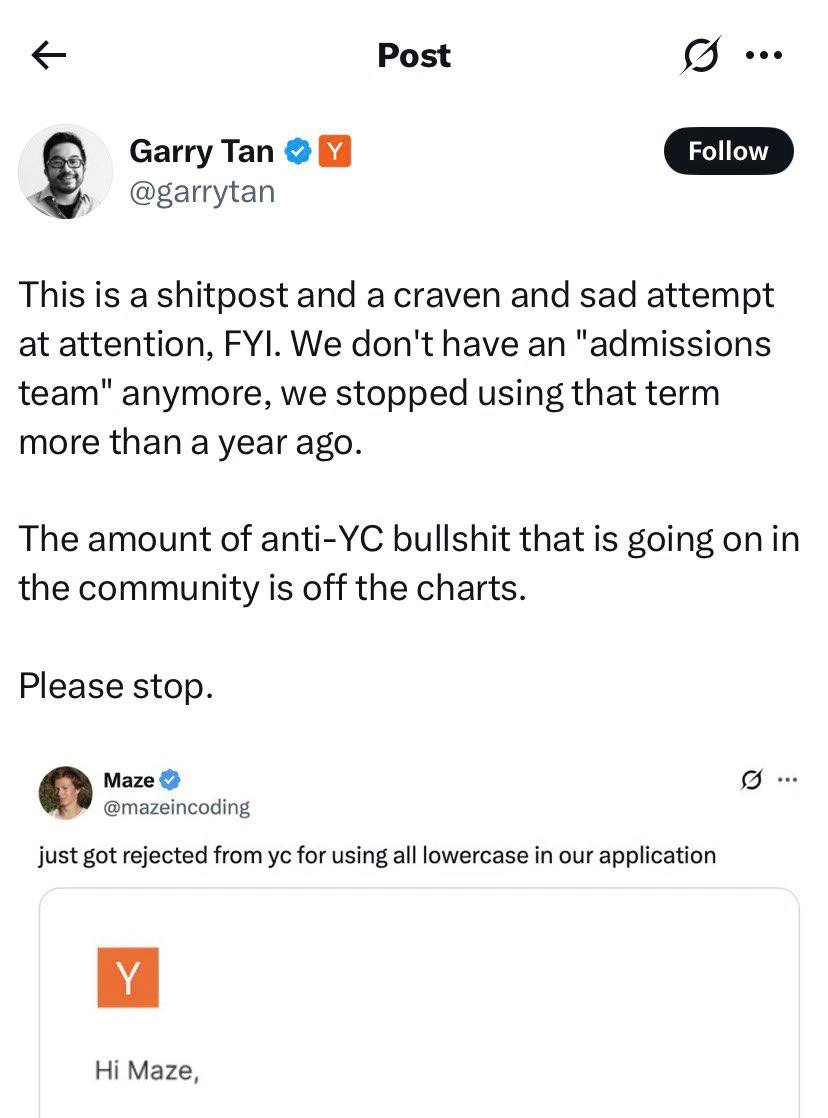
Let’s unravel this incident in plain terms. Y Combinator (YC) is like a famous school for startups – a place that gives new tech companies money and guidance to grow (think of it as tech’s Harvard or Hogwarts, but for companies). Founders apply to YC hoping to get in. In our story, a person named Maze applied to YC and then tweeted that they “just got rejected from yc for using all lowercase in our application.” In other words, they claimed YC turned them down just because they didn’t use any capital letters when filling out the form or writing their answers. It sounded like YC was nitpicking something as silly as grammar or formatting. That tweet came with a screenshot of an email snippet (with an orange Y logo header) that began with “Hi Maze,”, implying it was an official YC email. Pretty quickly, this tweet blew up and kicked off a tweetstorm (a rapid series of reactions, retweets, and replies on Twitter). The whole startup DevCommunity on Twitter started talking about it. Many people were upset or incredulous, asking “Is this for real? Does YC really care about capital letters?!”. This is what we mean by an online community flare-up or social_media_backlash – a lot of people getting riled up on social media over a story.
Now, why would this make the tech crowd go crazy? For one, YC is a big deal in the StartupCulture. Getting accepted or rejected by YC is an emotional topic for entrepreneurs. If YC were actually rejecting teams over something trivial like lowercase text, that would feel extremely unfair (and frankly ridiculous). People in the startup world have strong feelings about gatekeepers and fair treatment. So a claim like this hits a nerve. It also has a bit of schadenfreude (taking joy in someone else’s misfortune) and scandal to it: some folks love the idea of a big institution like YC looking foolish or overly strict. So the tweet was like throwing a match into a dry forest – drama was ready to ignite. In the developer community, we have a term for when everyone weighs in on a minor detail instead of the big picture: bikeshedding. Bikeshedding basically means arguing over something unimportant because it’s easier to grasp than the important stuff. Here, the important stuff would be a startup’s business idea or team quality, but instead the conversation derailed into outrage about letter casing (the unimportant stuff). This is similar to when programmers argue endlessly about coding style (like whether to use tabs or spaces for indentation) rather than focusing on the program’s design. It’s a familiar pattern for anyone in tech: small issue, big noise.
So what actually happened versus what was claimed? The tweet from Maze turned out to be a shitpost, meaning it was basically a joke or a lie posted for attention. We know this because Garry Tan, who leads YC (and is a well-known figure in tech), jumped in on Twitter to clear things up. He responded very directly, calling the tweet “a craven and sad attempt at attention” and basically saying “please stop.” Garry also noted that YC doesn’t even use the term “admissions team” anymore – they haven’t for over a year. Why does that detail matter? It’s like catching someone in a lie because they used an outdated fact. If YC changed what they call their admissions group, any real email or insider talk would use the new term, not “admissions team.” Garry pointing that out was a polite way of saying, “This tweet is not telling the truth.” In other words, Maze’s story had a telltale sign of being made-up.
Once Garry Tan responded, most people understood that no, YC did not reject anyone just for writing in lowercase. It was just a rumor that spiraled out of control. But the whole episode was memorable because it showed how quickly the TechTwitter crowd can get worked up over something that sounds scandalous. One little tweet led to a huge community_bikeshedding session, where the focus shifted entirely to a silly detail. It also demonstrated the power of communication (and miscommunication) in the developer/startup world: a lot of folks immediately believed or at least spread the claim without verifying it. This is similar to how developer rumors can spread, like “X company rejects candidates who don’t use a particular keyboard” – it sounds crazy, people pass it around, and suddenly everyone’s arguing about it.
In simpler technical terms for newcomers: lowercase vs uppercase is usually just a style or readability concern in text. In programming, sometimes it matters (for example, in many programming languages myVariable and MyVariable would be two different identifiers, so case matters). But in an application essay or form, writing in all lowercase might look unprofessional, yet it wouldn’t be a make-or-break issue by itself. YC, being a top startup program, looks at the big picture (your idea, your team, your market) – they wouldn’t outright reject you solely for a typography choice like that. The meme exaggerates this scenario to make a point and to poke fun at both YC and the community’s tendency to overreact. It’s highlighting an inside joke: developers often encounter community_in_jokes about trivial criteria being the “real reason” something got rejected (think of jokes like “I failed the coding interview because I used single quotes instead of double quotes”). Here that inside joke is transposed to the startup world.
So, to recap in plain language: A founder joked (or lied) that they got rejected by YC for using all lowercase letters. The online startup and developer community briefly went bonkers over it, debating and yelling as if it were true. The head of YC stepped in to say “This is nonsense, knock it off.” The humor and irony of this whole thing come from how silly the supposed reason was (all lowercase letters – really?!) and how quickly people took the bait. It’s a lesson in community behavior: even smart developers and founders can get caught up arguing over something that turns out to be a non-issue. And it’s a reminder that on social media, especially in tech circles, DeveloperIrony and outrage can spread faster than you can hit the caps-lock key.
Level 3: Low-Case, High Drama
This meme spotlights a collision between StartupCulture melodrama and classic developer nitpicking. Seasoned engineers recognize it instantly as a case of Parkinson’s Law of Triviality – better known as bikeshedding – playing out on Tech Twitter. In short, a trivial stylistic choice (writing in all lowercase) blew up into an industry-wide discourse, much like a minor code style gripe turning a code review into a flame war. Here, the trivial detail was letter casing in a Y Combinator application, and the ensuing tweetstorm became a spectacle that the developer community couldn’t resist rubbernecking.
Let’s break down the saga: A startup founder (Maze) posts on Twitter that they “just got rejected from yc for using all lowercase in our application.” They even attach a sliver of a yc_rejection_email screenshot – complete with YC’s iconic orange Y logo and a casual “Hi Maze,” greeting – to lend credence to this absurd claim. This is equivalent to a developer posting a screenshot of an error log with a single, silly StyleError: TextNotTitleCased message. It’s a DeveloperIrony bait: hinting that the world’s top startup accelerator cares more about capitalization than about your product-market fit. The humor here is DeveloperHumor 101: a mix of absurdity and plausibility that preys on everyone’s worst fear of being judged on superficial details. To experienced devs, it immediately smells like a contrived story – basically a shitpost for clout. But that didn’t stop it from catching fire. Tech Twitter loves a juicy narrative, and StartupCulture has a long-running meta-story that “YC is elitist/pretentious” which this tweet fit perfectly. It’s the startup world’s equivalent of claiming a coding interview rejected you because you used tabs instead of spaces – a perfect spark for outrage, whether believed or not.
Right on cue, the DeveloperCommunity on Twitter grabbed their popcorn. Replies and retweets started pouring gasoline on the fire. Some folks were laughing (“lol, is this for real?!”), but many were ready to dunk on YC: “If true, that’s ridiculous – classic YC arrogance!” It became a social_media_backlash storm, with the community gleefully piling on assumptions. This is where the meme brilliantly parallels community_bikeshedding in engineering teams: everyone has an opinion on trivialities because it’s easy to weigh in. You might not be able to critique YC’s investment strategy, but hey, you can definitely rant about uppercase vs lowercase because that you understand. It’s like those interminable debates over coding style in open-source projects – bikeshedding at scale. In software, we’ve seen teams nearly split over whether to use CamelCase or snake_case for naming, or whether a commit message should start with a capital letter. Here, the entire startup community got sidetracked by the letter case of an application, rather than, say, discussing the startup’s idea or the real criteria for acceptance. The whole thing exemplified how an insignificant detail can hijack the conversation when lots of people feel qualified to chime in. After all, TwitterHumor and outrage often thrive on the lowest common denominator – in this case, the alphabet.
Enter Garry Tan (the president/CEO of YC, with that little orange Y badge on Twitter) to apply a hard stop. In a scathing reply tweet, he declared the story a total fabrication: “This is a shitpost and a craven and sad attempt at attention… Please stop.” You can almost hear the facepalm. Garry’s response is the equivalent of a lead maintainer closing a frivolous GitHub issue with a terse WONTFIX, or an architect shutting down a pointless bikeshed discussion in a meeting: “Alright folks, nothing to see here, back to real work.” He specifically points out a bug in Maze’s story: YC doesn’t even have an “admissions team” anymore – they stopped using that term over a year ago. This detail is golden to an experienced eye. It’s like catching someone using a deprecated API and claiming it’s the system’s fault – DeveloperIrony at its finest. Maze essentially referenced an outdated piece of YC’s internal nomenclature, a telltale sign the story is as flimsy as a badly mocked unit test. In developer terms, the error message didn’t match the current codebase. Garry calling this out is him saying “your lie isn’t even consistent with our current version; update your story, or better yet, just stop.” Burn.
To drive home how absurd the premise is, imagine if YC’s selection process were actually implemented in code. It might look like this tongue-in-cheek snippet:
# Tongue-in-cheek "algorithm" for YC admissions (as per the meme's joke):
def evaluate_application(text):
if text.islower():
return "Rejected: application must contain UPPERCASE letters."
else:
return "Proceed: evaluate startup idea on its merits."
Experienced devs know YC isn’t running some islower() check to auto-reject founders for typos – just like we know a serious code review won’t really reject your patch solely for a missing semicolon. The exaggeration is the joke. Garry’s garry_tan_response basically told everyone that no, YC isn’t a regex filter looking for capital letters; it actually reads what you wrote. His “Please stop.” at the end reads like an assertion to halt an infinite loop of Twitter outrage. It’s both funny and painfully relatable: the grown-up in the room had to step in and end the bikeshedding so we can focus on real issues again.
In the end, this “all lowercase application” saga was a tempest in a teapot, or more aptly, a storm in a lowercase y. It became a meme because it rings true to anyone who’s watched trivial issues get blown out of proportion online. The humor works on multiple levels: non-technical folks see a silly startup drama, while devs see a mirror of our own tendency to argue about naming conventions and code style. It’s a perfect showcase of DeveloperHumor meets StartupHumor. After all, whether it’s a codebase or a community, we often learn that communication can break down over the smallest things – even over something as tiny as a lowercase letter. And as any battle-scarred engineer will tell you with a smirk, sometimes the bikeshed really does catch on fire while everyone’s busy arguing about its color (or in this case, its capitalization).
Description
A screenshot of a Twitter (now X) post where Garry Tan, President and CEO of Y Combinator, is publicly responding to a satirical tweet. The original tweet, by a user named Maze, jokes 'just got rejected from yc for using all lowercase in our application' and includes a cropped image of a generic YC email. Garry Tan's reply is a lengthy, serious, and defensive paragraph starting with 'This is a shitpost and a craven and sad attempt at attention, FYI.' He denies the existence of an 'admissions team' and complains about 'anti-YC bullshit.' The humor stems from the stark contrast between a low-effort joke and the high-profile, humorless, and corporate-toned reaction from the leader of a major tech institution. For experienced developers, this meme is a commentary on the sometimes-fragile egos in venture capital, the inability of corporate leaders to understand online culture like shitposting, and the inherent drama of the tech ecosystem on social media platforms
Comments
20Comment deleted
YC teaches you how to scale a business, but apparently the lesson on not feeding the trolls is an elective
Pro-tip: run your pitch deck through `npx prettier --write --uppercase` before the YC CI pipeline fails on style
The real bug here isn't the lowercase - it's thinking you can unit test YC's admission criteria when they've clearly refactored their entire evaluation pipeline and deprecated the 'admissions team' class over a year ago
When your startup's biggest innovation is inventing a rejection reason that doesn't exist - truly disrupting the traditional 'we went with another candidate' playbook. At least they're demonstrating product-market fit for engagement farming, even if their Series A pitch deck is just screenshots of their own tweets
YC rejecting lowercase apps: like a linter failing your PR for missing camelCase - but with millions in funding on the line
Nothing says founder‑friendly like an admissions CI job rejecting on case - switch to utf8mb4_unicode_ci before shipping more culture bugs to prod
YC deprecated the term “admissions,” but the founder pipeline still fails the caps_lock linter - another breaking change where the migration guide is a tweet
maybe stop funding dogshit startups then 🤷 Comment deleted
it's their money 😅 Comment deleted
yeah, and they're being stupid with it Comment deleted
are they profitable? (genuine question) Comment deleted
highly doubt it except for a few unicorns Comment deleted
I suppose that's how VC world works, no? You give out a few million bucks to crazy projects but one of them makes billions and you live off of that Comment deleted
😁 isn't that how vc works? 1 unicorn offset 100 shitty ones? Comment deleted
Investor's 💰 Comment deleted
highly fucking doubt it Comment deleted
everybody involved with YCombinator is a clown Comment deleted
tbh everything that starts with Y and have Y on logo is absolutely fucking dogshit Comment deleted
this includes applicants Comment deleted
There would be fewer pitchforks if they stopped funding slop Comment deleted