Skip to content
DevMeme
6331 of 7435
The Original, Unhackable Analog Blockchain
Blockchain Post #6942, on Jul 5, 2025 in TG

The Original, Unhackable Analog Blockchain

Why is this Blockchain meme funny?

Level 1: Taking It Literally

Imagine your friend hears the word "blockchain" and thinks it must be something you build with actual blocks and a chain, like a Lego project. 🧱🔗 It’s as if someone told them about a "magic data chain," and they ran to grab some toy blocks, tied them together, and said, "Look, I made a blockchain!" You’d probably giggle because what they made is just a chain of blocks – something totally different from the invisible internet technology that a real blockchain is.

This meme is funny in the same way it’s funny when a kid takes a figure of speech literally. It’s like if you heard about “cloud computing” and you looked up at the sky for computers in the clouds ☁️💻, or if someone said “open Windows on your PC” and you actually walked over to open the window in your room. Here, the big tech term “blockchain” gets turned into a simple picture of blocks linked by a chain. The joke is that the person doesn’t really understand the complicated meaning, so they just copied the sound of the word with everyday things. It’s a play on words: they made the word block-chain into a real-life object. That literal misunderstanding is what makes it humorous and easy for anyone to laugh at – you don’t need to know how cryptocurrencies work to get the joke. It feels like watching someone pretend to know something and getting it adorably wrong, like explaining a secret with a silly guess. In short, it’s funny because they took the name way too literally, turning high-tech into child’s play.

Level 2: Not That Kind of Chain

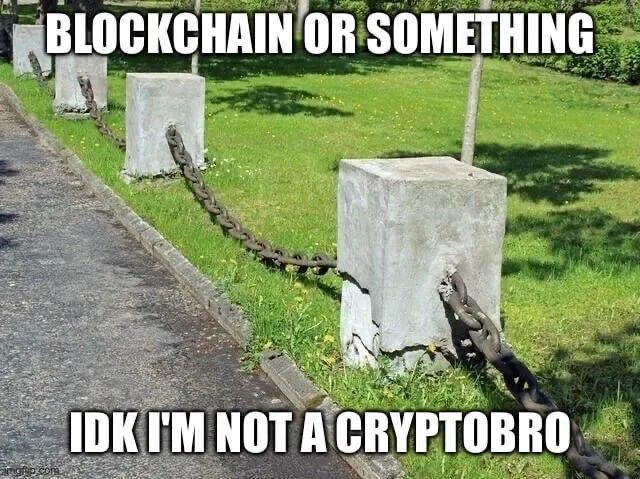
Let’s dial it back and explain the basics. The meme shows a row of square concrete blocks connected by a heavy iron chain in a park. These concrete posts form a physical barrier – literally a block-chain in the most literal sense (blocks + chain). The top caption reads “BLOCKCHAIN OR SOMETHING,” and the bottom says “IDK I’M NOT A CRYPTOBRO.” In plainer language, the person showing this image is saying: “Here’s a blockchain, I guess? I don’t really know, I’m not one of those crypto guys.” It’s a goofy visual pun. They took the term “blockchain” (which in technology refers to a complicated digital data structure) and interpreted it as blocks chained together in real life. If you’ve ever heard a confusing tech term and tried to imagine it literally, you’re doing exactly what this meme does for laughs.

Now, what is a blockchain really, and why is this funny? In real tech, a blockchain is a type of database that’s very secure and distributed (meaning it’s shared across many computers, not kept in one central place). Think of a ledger or a record book that everyone has a copy of. When new transactions or data entries come in, they get packaged into a “block.” Each block gets a unique code (a hash) and also carries the code from the block before it, chaining them together in sequence. Because everyone on the network has copies of these blocks and they all link up neatly, it’s super hard to fake or change past entries – if someone tries, everyone else notices the mismatch in the chain. This is what makes blockchain technology trusted without a central authority: it’s like a book that everyone watches, and any tampering is immediately obvious because the chain of entries no longer lines up. You might have heard of cryptocurrency (digital money like Bitcoin); blockchains are the underlying tech that make cryptocurrencies possible by preventing cheating (like the same coin being spent twice). Each coin transaction goes into a block, and once it’s “chained” in, it’s permanent and verifiable by all. So the key ideas are: blocks of data, chained by cryptographic links, shared by a network that agrees on what’s official. No physical concrete involved anywhere – it’s all digital data and math!

The meme jokes that someone who isn’t well-versed in all that (hence “not a cryptobro,” where cryptobro is a slang term for a cryptocurrency enthusiast, often stereotyped as a tech trend follower) might only know the word “blockchain” and nothing else. So what do they do? They throw together the most literal depiction: actual blocks and a chain. It’s as if they Googled “block + chain” and went with the first image they found. For a junior developer or anyone new to this, the humor is pointing out a ridiculous mismatch between a buzzword and its meaning. We have a high-tech concept on one hand, and a low-tech literal object on the other. If you’ve ever taken an idiom or technical term at face value and gotten it hilariously wrong, this meme is using that exact setup.

Let’s break down a few terms and tags to understand the context fully:

  • Blockchain: As described, it’s a digital ledger technology. It’s decentralized (many copies on different computers), append-only (you only add, never rewrite or delete old blocks), and uses cryptography (like secret codes) to link blocks securely. The chain in the word refers to how each block is connected to the previous one via those cryptographic hashes. So, a blockchain is not something you can touch; it’s not made of cement or metal. It’s basically software and algorithms creating a special kind of database. Because of their security properties, blockchains became famous for enabling cryptocurrencies (Bitcoin being the first big one, introduced in 2009). Beyond currency, people have explored using blockchains for supply chains, voting systems, record-keeping, and more — often with a lot of hype and mixed success.

  • Cryptobro: This is internet slang merging “crypto” (short for cryptography or cryptocurrency) and “bro” (as in bro culture). It playfully (or mockingly) refers to folks, usually young enthusiastic males, who are super hyped about cryptocurrency/blockchain trends. A cryptobro might be the kind of person who invests in random digital coins, talks about them constantly on Twitter or Reddit, uses lingo like “HODL” (hold on for dear life) and “to the moon” 🚀, and can be a bit zealous or overconfident about blockchain tech — sometimes without deep technical knowledge. In this meme, the speaker says “I’m not a cryptobro” to clarify, “Hey, I’m not one of those hardcore blockchain fans who claim to be experts.” It sets the stage that they might get the explanation hilariously wrong (and they do).

  • IndustryTrends_Hype: This category tag suggests the meme is commenting on a tech industry trend that was probably overhyped. Indeed, blockchain has been through a hype cycle. A few years ago, it was the buzzword — similar to how “AI” or “machine learning” are buzzwords today. Whenever a technology is hyped, you get lots of people name-dropping it (sometimes inappropriately). This meme comes from that vibe. It’s essentially spoofing a nontechnical_explanation of blockchain. i.e., how a totally non-technical person might try to explain it at a high level and fail spectacularly (or comically). They know just enough to connect “block” and “chain”, but nothing about consensus algorithms or proof-of-work or any real details.

  • Literal_block_chain_visual_pun: This is exactly what the meme is. The humor is a visual pun – using the literal image of a block and chain to represent the concept of “blockchain.” It’s like those jokes when someone illustrates “cloud computing” with pictures of actual fluffy clouds carrying laptops, or depicts a computer “bug” with an insect on a keyboard. Here, the meme maker found (or took) a photo of a concrete_barrier_chain (the kind used for crowd control or guiding foot traffic) to serve as the stand-in for a blockchain. If you imagine explaining blockchain to your grandpa and he thinks it’s literally a chain of building blocks, that misunderstanding is what’s being lampooned. The tags highlight that this is an analogy taken to a humorous extreme.

By understanding these terms, a junior developer or anyone learning tech can see why the meme is funny: It’s intentionally confusing the literal meaning of “blockchain” with the actual meaning in technology. The phrase “IDK I’m not a cryptobro” adds a layer of relatability, because not everyone in tech is into crypto. Some of us mainly work on web apps, databases, etc., and might only know blockchain from a distance. If one of us tried to explain it without research, we might jokingly throw up our hands and point to something like this picture and say, “Well… maybe it’s something like that, who knows!” It’s poking fun at ourselves and at the overuse of the term.

In summary, at Level 2 we clarify that the meme’s joke comes from a play on words: blockchain (the high-tech concept) vs block-chain (the ordinary objects). It’s highlighting the gap between hype and understanding. And indeed, many newbies or outsiders only recognize the buzzword without grasping the nuts and bolts. The image of chained concrete blocks is a tongue-in-cheek reminder: if you don’t learn what’s behind the buzz, your explanation might be as off-base as this one. It’s a lesson in not taking tech jargon at face value – always dig deeper than the name!

Level 3: Concrete Example of Hype

From a senior developer’s perspective, this meme lands as a satirical jab at blockchain hype and the kind of shallow understanding that often accompanies it. A few years back, during the peak of the cryptocurrency craze, it felt like everyone and their dog was name-dropping “blockchain” as the magical solution to every problem. Did your startup need funding? Just sprinkle the word blockchain in your pitch. Got a boring database issue? Some executive would pipe up, “Have we considered putting this on the blockchain or something?” 🙄. Seasoned engineers have sat through meetings where non-technical stakeholders insist on using trendy tech jargon they heard in a TED talk, without grasping the immense complexity or unsuitability for the task at hand. This meme’s caption “BLOCKCHAIN OR SOMETHING – IDK I’M NOT A CRYPTOBRO” perfectly captures that boardroom farce: it’s the voice of someone who’s heard the buzzword, feels pressured to mention it, but has no real clue what it means. They end up suggesting the most literal interpretation – in this case, a chain of actual blocks – which is about as useful to real software architecture as a concrete barrier is to high-speed internet.

The humor here is multilayered for an experienced dev. First, there’s the visual pun: an actual chain of concrete blocks in a park used as a physical barrier (the kind you see to prevent cars from driving onto grass). The meme maker labeled it “blockchain” as if this mundane object were the elusive technology everyone is hyping. It’s a classic case of taking a metaphorical concept and turning it into something absurdly literal. Senior folks immediately recognize the tongue-in-cheek implication: many self-proclaimed “experts” in the crypto craze were just as clueless, essentially equating a revolutionary decentralized ledger to, well, literal blocks and chains. The bottom text “IDK I’m not a cryptobro” adds that extra sting – it parodies those who aren’t actually knowledgeable (“not a cryptobro”) yet feel entitled or obligated to say something about blockchain. It’s the tech equivalent of someone at a party loudly saying, “Quantum computing, wormholes, I don’t know – science stuff – but hey it sounds cool!”

This resonates with veteran developers because we’ve witnessed many IndustryTrends_Hype cycles. Blockchain was huge, but it’s part of a pattern: remember when everything had to be “Big Data”, or when every app was adding “AI” whether it needed it or not? We’ve seen managers insist on using XML for everything because it was the hot thing 🌶️, or rewiring solid designs into microservices just because conference talks said so – even if it introduced needless complexity. The BlockchainHype era (circa late 2010s into early 2020s) had companies literally renaming themselves to include “Blockchain” in their name to boost stock value. It became a running joke that you could ask, “But have you tried blockchain?” about any problem – from supply chain management to curing diseases – and some investor might actually pay attention.

Now, the experienced engineer’s inside joke here is that those pushing blockchain often have no idea of the consensus algorithms, proof mechanisms, or architectural trade-offs under the hood. They’ll rave about decentralization and smart contracts at a cocktail party but go silent if you ask about Byzantine fault tolerance or the difference between Proof-of-Work and Proof-of-Stake. In other words, calling a string of concrete blocks a “blockchain” is a hilariously apt metaphor for the ignorance behind much buzzword bandwagoning. We chuckle (maybe with a hint of cynicism) because we’ve had to clean up after such misguided projects. A CTO hears that Blockchain is the future, next thing you know the team is forced to use a slow, over-engineered distributed ledger where a simple SQL database would have done the job. Months later, the project collapses under its own weight, much like a literal heavy chain of concrete would grind any agile movement to a halt.

Furthermore, the image subtly mocks the “cryptobro” subculture: those ultra-zealous cryptocurrency enthusiasts who might wear Bitcoin logo t-shirts, constantly talk about hodling to the moon 🚀, and believe blockchain will revolutionize everything whilst often lacking depth in software engineering. By saying “I’m not a cryptobro”, the meme’s author is distancing themselves from that tribe – essentially saying, “Hey, don’t expect me to actually understand this crazy tech fad you’re all excited about. Here’s my best guess: maybe it’s like, blocks on a chain?” It’s self-deprecating and satirical at the same time. Seasoned devs find this funny because it captures how they often feel when cornered by hype: eye-rollingly skeptical, yet amused that the hype train has gone so off-track that a literal interpretation is being joked about.

In essence, Level 3 understanding laughs at the culture of buzzwords. The meme exaggerates what happens when complex ideas get diluted in popular discourse. It’s poking fun at situations we’ve all seen: a non-technical CEO demands blockchain integration because “our competitors are doing it,” or a friend at a barbecue insists you should put your grocery list on a blockchain for “security”. The concrete blocks and chain stand there awkwardly, accomplishing nothing high-tech, just as all those misguided blockchain-for-everything projects often produced nothing of value. This is cathartic humor for tech workers: we’re laughing to keep from crying, knowing how much time and money has been sunk into ventures that treated Blockchain as a buzzword rather than a complex tool. The meme says, “Look, if you don’t actually know what it means, your explanation might as well be this stupidly literal!” — and that blunt truth is both funny and painfully relatable.

Level 4: Concrete Consensus

At the deepest technical level, a blockchain is far more than just blocks chained together with iron links – it’s a sophisticated distributed ledger secured by cryptography and consensus algorithms. In a real blockchain (like the one behind Bitcoin or Ethereum), each digital “block” is a bundle of transaction data plus a special fingerprint called a cryptographic hash. This hash isn’t random; it’s computed from the block’s contents and, crucially, the hash of the previous block. By chaining blocks through these hashes (instead of metal chains), the system ensures immutability: if someone tries to alter an earlier block, its hash changes and no longer matches the copy stored in the next block – the chain breaks, and the network rejects the tampered version. In mathematical terms, if we denote hash() as a secure hash function, a blockchain’s integrity can be described by a recurrence:

hash_n = H(data_n || hash_{n-1})

Each block’s hash depends on the previous block’s hash (denoted hash_{n-1}), concatenated with the current block’s data (data_n). The symbol || means string concatenation. Because of this formula, altering any data_n (even by one bit) will completely change hash_n and all subsequent hashes, rendering the forged chain unusable. In other words, the ledger’s history is “set in stone” (cryptographically speaking). The meme’s literal concrete blocks humorously echo this idea of data set in stone: a real blockchain’s records are so hard to change that they might as well be carved into concrete barriers.

However, ensuring everyone agrees on this chain of blocks (the “distributed consensus”) is a non-trivial, theoretically rich problem. Blockchain systems solve it with algorithms that force participants to prove they’ve done work or stake value, deterring fraudulent edits. The original blockchain (Bitcoin) introduced Proof-of-Work (PoW) as its consensus mechanism. Proof-of-Work makes each new block intentionally hard to add – a miner (a participating node) must solve a complex cryptographic puzzle (basically finding a special number called a nonce such that the block’s hash looks a certain way, e.g. has a bunch of leading zeros). This “mining” process is computationally intensive (burning CPU/GPU cycles and electricity) and thereby costly. It’s as if, to attach another concrete block to the chain in the photo, you had to perform massive heavy lifting or quarry new stone under strict rules – a literal “proof of work”! The humor of those hefty concrete blocks chained together carries an engineer’s inside joke: in a real blockchain, adding a block also feels like dragging a 200-pound stone because of the deliberate computational effort.

This PoW mechanism ties into deep principles of game theory and distributed computing, notably solving a variant of the classical Byzantine Generals Problem (how to achieve agreement in a network with potentially malicious actors). By requiring expended energy (work) for block creation, the network makes it economically impractical for an attacker to rewrite history unless they control 51% of the total mining power (often cited as the 51% attack threshold). In more theoretical terms, the blockchain’s design embraces the CAP theorem trade-offs and the principles of Byzantine fault tolerance: it sacrifices a bit of performance (all that redundant work and data replication) in exchange for censorship-resistance and trustless consensus across untrusted nodes. The “chain” is robust because breaking it would require overturning math and collective agreement – not easy!

Over time, other consensus algorithms have emerged (like Proof-of-Stake, Delegated Byzantine Fault Tolerance, etc.), aiming to be more energy-efficient than Proof-of-Work. These replace brute-force hashing with economic skin-in-the-game or voting by known validators. But regardless of method, the core idea is the same: every participant agrees on the one true chain of blocks. The structure is literally a chain of cryptographic blocks, each reinforcing the last. So while our meme’s author says “IDK I’m not a cryptobro” and gives us a naive chain of concrete blocks, a real blockchain’s genius lies in these cryptographic linkages and consensus rules that guarantee a single source of truth without any central authority. Seasoned developers and computer scientists chuckle here because they appreciate how nontrivial it is to make a distributed system of thousands of nodes act in unison — it takes more than a physical chain; it takes clever algorithms, rigorous math, and years of engineering. The meme is ironically underplaying an extremely complex system with a physical gag, and that contrast is technically hilarious.

Description

A photo of several large, square concrete blocks sitting on a green lawn next to a paved surface. A thick, dark, rusty chain is threaded through holes in the blocks, connecting them in a line. The sun is shining, casting shadows on the grass. White text in a bold, sans-serif font is overlaid on the image. The top text reads 'BLOCKCHAIN OR SOMETHING' and the bottom text reads 'IDK I'M NOT A CRYPTOBRO'. This meme uses a literal pun to poke fun at the often-abstract and buzzword-heavy nature of blockchain technology. By presenting a physical 'block' and 'chain,' it humorously feigns ignorance of the complex distributed ledger concept. The punchline, 'IDK I'M NOT A CRYPTOBRO,' leverages the 'I Don't Know' meme format to satirize the culture surrounding cryptocurrency enthusiasts. For senior developers, it's a relatable eye-roll at how tech terms can be both ubiquitous and poorly understood, and a lighthearted jab at the sometimes-overzealous crypto community
Comments

17
Anonymous ★ Top Pick This is the only blockchain with 100% uptime and true immutability. Good luck executing a 51% attack on several tons of concrete
  1. Anonymous ★ Top Pick

    This is the only blockchain with 100% uptime and true immutability. Good luck executing a 51% attack on several tons of concrete

  2. Anonymous

    At least this chain achieves physical consensus - good luck forking it without a jackhammer

  3. Anonymous

    After years of explaining distributed ledgers, consensus mechanisms, and merkle trees to executives who just wanted 'blockchain on everything,' sometimes it's refreshing to admit that a chain connecting actual blocks makes more architectural sense than half the ICO whitepapers from 2017

  4. Anonymous

    This is what happens when product managers explain blockchain to stakeholders: 'It's just blocks... in a chain... distributed across... concrete locations.' At least this implementation has better energy efficiency than proof-of-work, though the consensus mechanism seems to rely heavily on gravity and rust. The immutability is solid though - try rolling back that chain without a jackhammer

  5. Anonymous

    An enterprise blockchain: concrete nodes, governance chain, 0 TPS - yet immaculate slideware

  6. Anonymous

    Whenever a stakeholder says 'put it on the blockchain,' I picture this architecture: literal blocks and a chain delivering single‑digit TPS and infinite marketing - basically Postgres with audit logs, but slower

  7. Anonymous

    Achieves Byzantine fault tolerance via gravity - no generals required, just immutable tension

  8. Deleted Account 1y

    linkedlist be like:

    1. @paranoidPhantom 1y

      Idk I don’t do leetcode

    2. @Nekitosss8 0y

      idk, I don't use LinkedIn

      1. Deleted Account 0y

        reply to [user]: The Data Structure Not Platform.

        1. @Nekitosss8 0y

          you missed the joke😅

          1. Deleted Account 0y

            [answer]: I know.

  9. @ZgGPuo8dZef58K6hxxGVj3Z2 1y

    Elon Musk be like. "Same encryption as blockchain"

  10. @NiKryukov 1y

    r/technicallythetruth

  11. @gongchanM1 1y

    Bruh

  12. @gongchanM1 1y

    Oh thanks

Use J and K for navigation