xkcd Standardizes Counting Out Loud Before Doing Things in Sync
Why is this DistributedSystems meme funny?
Level 1: When Do We Jump?
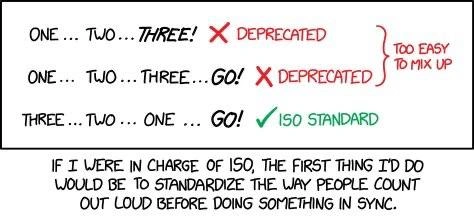
You and a friend are about to jump into a pool together. You shout "one... two... THREE!" — and you jump, but your friend is still standing there, because in their family you jump on "GO!", which comes after three. Now you're wet and betrayed and they're laughing. This comic imagines fixing that forever by having the official rule-makers of the world declare exactly one correct way to count before jumping: "three... two... one... GO!" It's funny because it treats a tiny playground mix-up with the seriousness of international law — and because every single person looking at it has been the kid who jumped alone.
Level 2: On Three, or After Three?
The references worth unpacking:
- ISO (International Organization for Standardization) publishes formal specifications so everyone builds compatible things — paper sizes, date formats (
ISO 8601:2026-04-15), country codes. Stamping a casual habit "ISO STANDARD" is funny because ISO documents are hundreds of pages of solemn precision. - Deprecated is the software term for "still works, but officially disapproved — stop using it." Your IDE shows deprecated functions in
strikethrough. Applying it to a way of counting out loud treats humanity like a codebase. - Doing something in sync — lifting furniture, jumping in a photo, hitting play together — is the everyday version of what programmers call synchronization: making independent actors act at one agreed moment.
If you're early in your career, you'll meet this comic's real-world sibling soon: two services that disagree about whether a list starts at 0 or 1, or whether a timeout is inclusive. The lesson hiding in the joke is real — ambiguous protocols don't fail during design, they fail mid-piano-lift.
Level 3: Deprecation Notices for Folk Protocols
The comic's deeper gag is bureaucratizing folklore. Counting before a synchronized action is an unwritten human protocol — everyone learned some version of it, nobody agreed on which, and the inconsistency only surfaces at the worst moment: half the group heaves the piano on "THREE!" while the other half is still waiting for "GO!". The comic applies the full standards-body apparatus to this: red ✗ DEPRECATED stamps on the legacy conventions, the bracketed engineering rationale ("TOO EASY TO MIX UP"), and a green ✓ ISO STANDARD on the approved replacement. The caption completes it:
"IF I WERE IN CHARGE OF ISO, THE FIRST THING I'D DO WOULD BE TO STANDARDIZE THE WAY PEOPLE COUNT OUT LOUD BEFORE DOING SOMETHING IN SYNC."
Anyone who has lived through a real deprecation cycle knows the dark joke embedded here: deprecation never deletes anything. Mark two counting conventions deprecated and you now have three conventions in production, plus a migration guide nobody reads — the exact dynamic xkcd itself canonized in its famous "Standards" strip, where the 15th competing standard arrives to unify the other 14. ISO's actual catalog is full of this energy (date formats alone took ISO 8601 and decades of evangelism, and Americans still write MM/DD/YYYY). The comic flatters engineers' favorite fantasy — that everyday chaos persists only because nobody competent has been put in charge — while quietly demonstrating why standardization is hard: the problem was never designing the good protocol, it's the installed base of humans running legacy firmware since kindergarten.
Level 4: Consensus Among Unreliable Humans
Strip away the marker-on-whiteboard humor and this comic is describing a genuine distributed coordination problem: multiple independent agents must perform an action at the same instant, with no shared clock, communicating over a lossy audio channel. The ambiguity it skewers — do we act on "THREE!" or one beat after it on "GO!" — is exactly the class of off-by-one disagreement that clock synchronization protocols exist to eliminate. The two deprecated schemes differ only in whether the trigger is the final counted value or a sentinel token, which is the spoken-word version of the eternal fencepost question: does an interval of three ticks contain three boundaries or four?
The blessed protocol, THREE... TWO... ONE... GO!, wins for a reason any protocol designer would endorse: it makes the trigger token unambiguous and type-distinct. In a count-up, "THREE!" is overloaded — it's both a counter value and, in one convention, the commit signal. The countdown reserves a dedicated sentinel (GO!) that cannot be confused with a counter, the same way well-designed wire formats avoid in-band values that double as control signals. NASA didn't pick countdowns for drama alone; a count toward zero gives every listener a monotonically decreasing timer with an obvious fixpoint. There's even a whiff of the Two Generals problem here: no spoken protocol can give provable common knowledge that everyone will lift the couch simultaneously — the countdown just makes the failure probability socially acceptable. Humans solve in three seconds, with prosody and trust, what Lamport needed logical clocks to formalize.
Description
An xkcd-style comic in plain black handwriting on white. Three counting conventions are listed: 'ONE... TWO... THREE!' marked with a red X 'DEPRECATED', 'ONE... TWO... THREE... GO!' also red-X 'DEPRECATED', both bracketed as 'TOO EASY TO MIX UP'; and 'THREE... TWO... ONE... GO!' marked with a green check 'ISO STANDARD'. The caption below reads: 'IF I WERE IN CHARGE OF ISO, THE FIRST THING I'D DO WOULD BE TO STANDARDIZE THE WAY PEOPLE COUNT OUT LOUD BEFORE DOING SOMETHING IN SYNC.' The joke applies standards-body rigor (deprecation notices, ISO standards) to the everyday ambiguity of whether you act on 'three' or on 'go' - essentially a human clock-synchronization protocol problem
Comments
5Comment deleted
Deprecating two counting protocols and blessing a third is how you end up with teams supporting all three indefinitely - backward compatibility applies to humans too
Beep beep beep BEEP! Comment deleted
Thanks microwave you saved my life Comment deleted
"Aminda.eu she/they" Comment deleted
meow? Comment deleted