Reading 'Windows 7 or better' as a promise of Linux support
Why is this OperatingSystems meme funny?
Level 1: Taking It Literally
Imagine a sign outside a playground that says, “Children age 7 or older can play on this slide.” Now picture a goofy grandpa reading that and asking, “I’m way older than 7 – does that mean I can play too?” Everyone would probably laugh because clearly the rule was meant for kids, not a 70-year-old grandpa. He’s taking the words literally just to be funny. The sign really means the slide is safe for kids who are at least 7 years old (and it doesn’t bother listing an upper age limit because it assumes adults won’t be trying). The grandpa knows this, but he jokes that since he exceeds the requirement by decades, he should qualify!
The meme’s joke works the same way. The software box says “works on Windows 7 or better,” and a cheeky person asks if that means it’ll run on Linux. They know full well that’s not what the box meant. Linux is like the grandpa in this scenario – technically older (well, more mature as an OS) or “better” in some eyes, but obviously not what the sign (or software box) was intending to include. It’s funny because someone is intentionally misreading a rule to include themselves (or their favorite thing) when it clearly wasn’t the intention. Just as the playground rule wasn’t really inviting grandpas to go down the slide, the software saying “Windows 7 or better” wasn’t actually promising support for Linux. The humor comes from that playful twist in understanding the words.
Level 2: Better Means Newer, Not Linux
Let’s break down the joke in simpler terms. The meme shows text that says: “This software works on Windows 7 or better.” This is the kind of line you might see on a software box or website, and it’s telling you what operating system the software can run on. An operating system (OS) is the main software that manages your computer and runs other programs. Windows and Linux are two different families of operating systems. Windows 7 specifically is a version of Microsoft Windows released in 2009 that was very popular on PCs. When a label says “Windows 7 or better,” it really means “Windows 7 or any newer version of Windows.” In plain terms, if your PC runs Windows 7, Windows 8, Windows 10, or any later Windows, the software will work. The phrase "or better" is a casual way of saying "or newer (as in a higher version number)", not an actual value judgment of which OS is better. It’s just shorthand. They could have written “Windows 7 or later,” which is what most tech folks would say to avoid any confusion.
Now, here’s why the meme is funny: a developer reads that line and jokingly asks, “Does that mean it’ll run on Linux?” Why would they ask this? Because in the tech community, a lot of people think Linux is a superior OS to Windows. Linux users often proudly claim that Linux is more secure, more efficient, or more customizable — basically “better” in many ways. So the person in the meme is deliberately pretending to misunderstand "Windows 7 or better" as if the box is promising support for any OS that is better than Windows 7. In their mind, Linux qualifies as “better,” so they quip that maybe the software will run on Linux too. Of course, this is a joke. It’s not actually a serious question; it’s a playful way to point out that the phrasing “or better” could be read in a way the software company didn’t intend.
For someone new to this, it helps to know that most software is written to work on one specific kind of operating system unless stated otherwise. A program made for Windows won’t run on Linux by default, and vice versa, because the underlying systems are very different. Think of it like a game console: a game made for PlayStation won’t just run on an Xbox — the machines speak different “languages.” Similarly, Windows and Linux speak different languages in computing terms. Windows programs usually come as .exe files (executables) that contain instructions specifically for Windows. If you try to open a Windows .exe file on a Linux computer, the Linux OS won’t know what to do with it, just like an Xbox can’t play a PlayStation disc. Linux programs have their own formats and conventions (for instance, many Linux apps are packaged in ELF binaries or in distro-specific package formats). So when a box says a piece of software works on Windows (and doesn’t mention Linux), it implicitly means the software is not compatible with Linux out-of-the-box.
The phrase “Windows 7 or better” is basically saying: “You need at least Windows 7, and if you have Windows 8, 10, or anything newer, that’s even better because the software will still run.” It’s not saying: “if you have something better than Windows 7, like another OS, it’ll work.” The meme takes advantage of this potential confusion. It’s as if the words on the box were taken ultra-literally. Developers sometimes do this as a form of humor, because we’re used to thinking very precisely. We know what the box is supposed to mean, but we also see the funny side of how it’s phrased.
There’s also a bit of a nod to the Linux vs Windows rivalry. For years, tech enthusiasts have debated which system is better. This meme gives a wink to that debate by implying, “Linux is clearly better than Windows 7, so hey, maybe they unintentionally included Linux in the deal, ha-ha!” It’s a friendly jest. Both Windows and Linux users can laugh because the idea of a Windows program magically running on Linux just because Linux is “great” is absurd — but it’s absurd in a witty way.
To put it simply:
- The box’s text was meant to outline compatibility with Windows versions.
- The developer in the joke pretends to read it as a promise of compatibility with superior systems.
- They pick Linux as the “better” system, which is a playful jab since many coders do favor Linux.
In reality, if a software only lists Windows systems, you’d need extra tools to run it on Linux (for example, a compatibility layer like WINE, which can run some Windows applications in Linux by imitating Windows environment). But unless the box explicitly said “Linux supported,” nobody actually expects it to run on Linux. The humor comes from knowing that, and yet momentarily acting as if maybe Linux could sneak in under that “or better” wording. It’s a little twist of language that makes you smirk once you understand the context.
Level 3: Cross-Platform Wishful Thinking
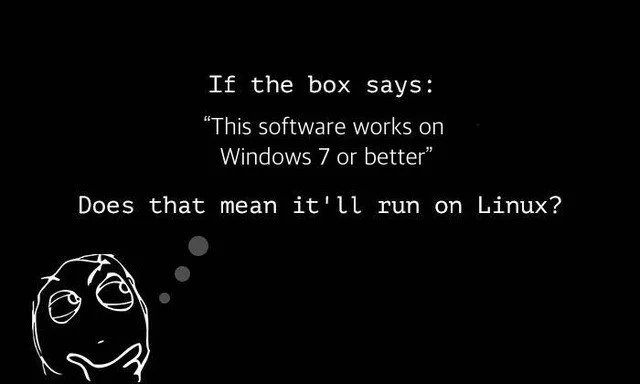
The meme presents a classic black-background panel with white text and a cartoon “thinking face” in the corner. The text asks: “If the box says: ‘This software works on Windows 7 or better’ does that mean it’ll run on Linux?” At first glance, the humor here comes from a developer’s literal interpretation of a standard software requirement phrase. That packaging line “works on Windows 7 or better” is normally meant to indicate that the program supports Windows 7 and all later Microsoft Windows versions (like Windows 8, 10, etc.). But a clever programmer reads it and asks, tongue-in-cheek: Does that mean it’ll run on Linux? The joke hinges on treating Linux as the "better" operating system. In other words, the joke pokes fun at naive cross-platform assumptions. It treats “or better” as if that phrase guaranteed support for any operating system better than Windows 7 – and in the developer world, Linux is often cited as that superior option. It’s a classic bit of OS compatibility snark that mixes marketing language with the perennial Windows vs. Linux rivalry.
From a senior developer’s perspective, this combination of elements is hilarious because we know how OS compatibility labels are phrased and we see how they can be mischievously misread. In tech, requirements are usually worded precisely. For example, saying software “requires Windows 7 or later” is a common way to list supported systems, meaning Windows 7 and any newer Windows release. The box’s phrasing “or better” is essentially a marketing-friendly synonym for “or newer”. However, to someone who thinks in terms of code and logic, that wording is an invitation for a joke. A developer might mentally translate "Windows 7 or better" into a pseudo-code condition like:
if (operatingSystem >= Windows7) {
runSoftware();
}
Here, >= Windows7 is intended to cover Windows 7, 8, 10, 11, etc. But the humor emerges if you imagine an alternative ordering of operating systems by quality. Many engineers jokingly rank Linux higher than Windows on such a scale. So if we read the above code literally, we might ask: “Does a really superior OS count? Could operatingSystem == Linux satisfy this check?” This is obviously a twisted interpretation, but that’s the point – it’s playing with the literal meaning. It’s as if the requirement said, “works on any OS better than Windows 7,” and a cheeky developer quips, “I know one that qualifies!” Developer humor often involves this kind of wordplay, treating human language as if it were code. In this case, turning a straightforward compatibility note into an excuse to declare Linux the winner is a geeky form of wit.
The deeper joke taps into real-world tech culture. There’s a long-running lighthearted feud between fans of Windows and fans of Linux. Each side loves to claim their chosen OS is the superior one. Linux enthusiasts, in particular, pride themselves on Linux’s stability, security, and efficiency – they’ll say it’s a “better” OS than Windows in many ways. So when a Linux fan sees a label that effectively says “Windows 7 or better,” it’s too tempting not to joke that it must include Linux. It’s a way to slip in, “Hey, Linux is better than Windows 7, so by your own words my OS should qualify!” The meme’s rage-comic style thinking face and the question format emphasize that this is a tongue-in-cheek thought experiment. It’s the kind of sly comment you might hear in a developer chat room or from that one coworker who runs Linux on every machine and playfully seizes any chance to tout it.
Technically speaking, we all know that “Windows 7 or better” was never intended to include non-Windows systems. Software built for Windows won’t just run on Linux because you consider Linux superior. A program compiled for Windows relies on the Windows operating system’s specific interfaces (like the Win32 API, system libraries, and the .exe binary format). Windows and Linux are fundamentally different under the hood – different kernel designs, different file formats for executables, different system calls. A Windows .exe file isn’t natively understood by Linux, just like a Linux binary isn’t understood by Windows. In real life, if you wanted to run a Windows-only program on Linux, you’d need help from a compatibility layer or emulator (for example, using WINE – a tool that lets some Windows applications run on Linux – or setting up a virtual machine). In short, “Windows 7 or better” really means Windows 7 or any later version of Windows, not any other OS you think is better. The humor for seasoned developers comes from recognizing this gulf between what the words literally say and what they actually mean in context.
Importantly, this meme resonates because it highlights a shared experience and a bit of frustration in the software world. Many of us have encountered software that only runs on Windows. If you’re a Linux user, you’ve probably sighed at a download page that offers versions for Windows and maybe Mac, but nothing for Linux. The phrase “Windows 7 or better” can feel exclusionary if you’re not a Windows user. The meme transforms that little frustration into a joke – a form of wishful thinking. “Oh, you said or better… well, I happen to have something better!” It’s a moment of rebellious wordplay that garners a laugh because every developer knows the reality: no, that game or tool isn’t magically going to support Linux just because we think Linux is awesome. But for a second, we get to chuckle at the idea that maybe the marketing folks accidentally promised us something they didn’t intend. It’s humor through literal string parsing: taking a phrase at face value to expose how language in tech can be unintentionally funny. In summary, the meme draws on our knowledge of operating systems and compatibility, the ever-present Windows-vs-Linux banter, and the coder’s habit of scrutinizing wording. It’s a senior-level joke that says: we see what you did there with “or better,” and we’re going to have some fun with it.
Description
The image has a solid black background with white text centered at the top and middle. The full text reads: "If the box says: 'This software works on Windows 7 or better' Does that mean it'll run on Linux?" In the lower-left corner is a simple rage-comic style thinking face, outlined in white, with three grey thought-bubble dots leading to the text. The joke plays on developers’ literal interpretation of marketing copy, humorously treating Linux as functionally "better" than Windows 7. Technically it pokes fun at operating-system compatibility labels, cross-platform assumptions, and the perennial Windows-versus-Linux debate among engineers
Comments
33Comment deleted
Marketing says “Windows 7 or better”; my brain parses that like semver >= 7 and defaults to Linux - shame the installer’s regex still hard-codes C:\Program Files
The real compatibility layer was the Wine we debugged along the way - though after 20 years in the industry, I've learned that 'works on Windows 7 or better' usually means it barely works on Windows 7 and definitely won't work on anything actually better
The eternal optimism of a Linux user: interpreting 'Windows 7 or better' as a technical specification rather than a minimum requirement. Spoiler alert: the vendor meant 'Windows 8+' not 'any OS you personally consider superior.' But hey, that's what Wine, compatibility layers, and an afternoon of Stack Overflow troubleshooting are for - because if it compiles, it ships, right?
Veteran truth: 'Windows 7 or better' spawned more Wine configs than actual ports - requirements ambiguity at its finest
“Windows 7 or better” is vendor-speak for “we abuse Win32, COM, and HKLM”; Linux is better, but their MSI thinks C:\ is a law of physics
It’ll run on Linux if “better” means POSIX and your installer isn’t glued to Win32 - otherwise your best hope is Wine and a generous definition of success
It means it won't run on Windows 8 Comment deleted
That means it works on Windows XP Comment deleted
who said it's an inclusive or? Comment deleted
that means it'll run on Plan 9 Comment deleted
What the hell is that? Comment deleted
My man spittin facts Comment deleted
whats that? Comment deleted
https://en.wikipedia.org/wiki/Plan_9_from_Bell_Labs Comment deleted
never heard anyone using it Comment deleted
So? Comment deleted
Sorry that came out rude Comment deleted
no problem Comment deleted
It means it will run on windows 7 or windows 7 pro, that's it Comment deleted
You need to have Wine to figure it out. Comment deleted
Idk about Linux but it definitely should run on MacOS Comment deleted
on MacOS -> from MacOS Comment deleted
Windows is better no doubt Comment deleted
Mineos (for Open Computers) Comment deleted
I remember videos from the author Comment deleted
wait what? Comment deleted
this is beyond the minecraft border Comment deleted
rvvm? Comment deleted
Win7 APIs are well supported in Wine, so I think yes, it is. Comment deleted
ReactOS, anyone? Comment deleted
Nope, it says "better" not "impractical" Comment deleted
holy dam i had a convo about it the other day Comment deleted
who said linux better? Comment deleted