The Windows 11 Early Adopter Gauntlet
Why is this Microsoft meme funny?
Level 1: Better Safe Than Sorry
Imagine you and your friends are at a park and there’s a rickety old rope bridge over a stream. It’s the only way across, but nobody knows if this bridge is strong or if it might break. Now, one brave friend decides to go first to try it out. The rest of you stay back and watch to see what happens. If the bridge holds and your friend gets across safely, great! Then everyone will feel better about crossing. But if a plank snaps and your friend nearly falls in the water, well… you’ll all probably decide to hold off or find another way, right?
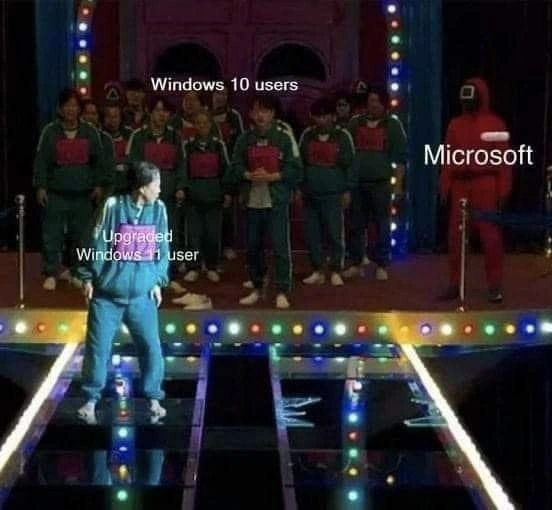
This meme is basically saying the same thing, but with computers. Upgrading to Windows 11 (the new computer system) is like trying that possibly wobbly bridge. The one person on the lit glass bridge in the picture is like that brave friend going first — they’re the Windows 11 upgrader who dared to try the new thing right away. The group of people standing back, watching, are all the Windows 10 users who decided, “Hmm, let’s wait and see if this is safe.” And the guard in red (labeled Microsoft, the company that makes Windows) is like the park ranger watching this happen, eager to see people use the new bridge but also keen to find out if anything goes wrong.
We find this funny because it’s so true to life: often when something new comes out, whether it’s a big software update, a new game, or even a weird new playground slide, most people don’t want to be the very first to try it. There’s a bit of fear that something could go wrong. It’s like when a new roller coaster opens – you might let a few other riders go first to be sure it’s really safe! In the case of Windows 11, people were nervous that if they upgraded their computers right away, they might run into problems (like their favorite game or app not working, or their computer becoming slow or unstable). So a lot of them stayed on the older, well-known Windows 10 for a while and watched as the “brave one” tested Windows 11 for everyone.
The joke exaggerates this feeling by comparing it to a Squid Game challenge where a wrong step has dramatic consequences. Of course, updating your computer isn’t life or death like a TV thriller! But emotionally, the nervousness can feel big when you rely on your PC for important things. The phrase “better safe than sorry” perfectly fits here. It means it’s wiser to be cautious than to do something risky and regret it later. The Windows 10 users in the meme are being “safe rather than sorry” by waiting on the solid ground they trust, while the one Windows 11 user is testing the shaky ground first.
So in simple terms: the meme is funny because it shows what we often do in real life – let someone else try the risky new thing first. If they succeed, awesome, we’ll follow. If they fail (or if the new Windows has big problems), we’re relieved that we didn’t jump in immediately. Microsoft watching is like the game master seeing how the experiment goes. It’s a playful way to say “maybe let others cross the sketchy bridge first, so you know it won’t collapse.” In the end, everyone just doesn’t want their computer to “fall through the glass.” Better to wait and be sure, than to rush and be sorry!
Level 2: Upgrade Anxiety 101
This meme jokingly compares a Windows operating system upgrade to a dangerous game show challenge. In the image, one brave Windows 11 user stands on a glowing glass bridge, while a bunch of Windows 10 users huddle together on the starting side, watching nervously. Off to the side is a guard character labeled Microsoft, overseeing the whole scene. If you’ve seen Squid Game (a popular TV series), you’ll recognize this as the glass bridge challenge, where players must step on glass panels, not knowing which will support them or which will shatter. The meme uses this scene to illustrate how it feels to be the first person to install a brand-new operating system while everyone else waits to see what happens.
What’s being referenced here?
- Windows 10 and Windows 11: These are two versions of Microsoft’s Windows operating system. Windows 10 was the widely adopted, tried-and-true version as of 2021, and Windows 11 was the new shiny upgrade that had just been released. An operating system (OS) like Windows is the main software that runs your computer, manages hardware, and provides the platform for all your applications. Upgrading from Windows 10 to 11 is a major change - akin to renovating a house you live in. It promises new features and improvements (a fresh look, better security, new apps), but it can also introduce new problems if everything isn’t just right.
- Early Adopter vs. Wait-and-See: An early adopter is someone who jumps on new technology as soon as it’s available. In the meme, the “Upgraded Windows 11 user” is an early adopter who installed Windows 11 right away. The “Windows 10 users” are the cautious folks taking a wait-and-see approach — they’re sticking with the old version for now to observe whether the new version is truly stable or if it has serious bugs. This dynamic is very common in tech: think of how some people install the latest phone update or enroll in the beta version of software immediately, while others hold off until they’re sure it won’t mess up their device. Here the Windows 10 crowd are those holding off, possibly thinking “let’s see if any glass breaks under that person first.”
- Upgrade Anxiety: Why would upgrading cause anxiety or fear? Because a major OS upgrade can sometimes lead to unexpected issues. Maybe some of your existing applications won’t work properly on Windows 11, or some device (like your printer, graphic tablet, or even parts of the PC hardware) might not have updated drivers ready. (Drivers are small programs that help the OS communicate with hardware devices; if a driver isn’t compatible with Windows 11 yet, that device could stop working until an update is available.) There’s also the possibility of general bugs – perhaps the system might crash more often at first, or you might encounter weird glitches. Upgrading “in place” (meaning installing the new OS over your old one without wiping the system) carries the worry of something going wrong during the installation too. In short, people fear the unknown problems that early adopters often discover.
- Microsoft’s Role: Microsoft is the company that develops Windows. In this meme, Microsoft is depicted as the guard watching the glass bridge game. The guard in the show isn’t actively pushing anyone to move; they just enforce the rules and watch. Likewise, Microsoft isn’t physically forcing anyone to install Windows 11, but they are definitely encouraging users to upgrade; it’s their new product, after all. They stand to the side, monitoring. This hints at a real-world truth: Microsoft (and other software companies) often rely on user feedback and bug reports especially right after a big release. No matter how much testing Microsoft does internally, once millions of diverse users start using the OS on countless different PCs, new issues will surface. Microsoft then observes these and fixes them via updates. In a sense, Microsoft is watching how that first person (or first wave of users) fares on the “bridge,” gathering information on which “panels” (features or components) might break.
- Squid Game Reference: If someone isn’t familiar with Squid Game, the scene might need a little explanation. In that show’s challenge, contestants had to cross a bridge by stepping on a series of glass panels. Some panels were made of strong glass and would hold a person’s weight, but other panels were made of thin glass that would shatter, sending the contestant plummeting to their doom. The contestants at the back could learn from the mistakes of those who went first (for example, if someone steps on a panel and it breaks, the following players then know that spot is not safe). The parallel to software is humorous: an early user testing out Windows 11 might encounter a “breaking” issue – say the system crashes or a crucial feature fails – and everyone who’s still on Windows 10 can learn from that, thinking “glad I didn’t step there.” Obviously, installing a new OS is not fatal in real life like the show’s game! – but the meme exaggerates the stress and risk people feel. It’s technological risk, not life-or-death, but when your important files, work projects, or gaming setup are on the line, it feels high stakes to geeks.
So, in simpler terms: the meme is saying “Installing Windows 11 right away is a bit scary and risky, so most people stayed on Windows 10 and watched to see if anything bad happens to those who upgraded first.” The one person on the bridge is taking a leap of faith with the new OS. If Windows 11 has a problem that makes a panel “break” (like a major bug or incompatibility), that user will suffer the consequence (maybe their PC crashes or their favorite program stops working). Meanwhile, the crowd of Windows 10 users on the platform can sigh in relief that they avoided that mishap, at least for now.
Tech folks often joke that early adopters act as guinea pigs or canaries in the coal mine (test subjects and early warning signals) for new software. Here the upgraded Windows 11 user is exactly that – a canary testing if the path is safe. Many Windows 10 users in late 2021 were indeed hesitant to jump to Windows 11 immediately. They preferred to let others test-drive it for a few months. By waiting, they hoped that any big bugs in Windows 11 would be discovered and fixed by Microsoft through updates, making the eventual upgrade safer – much like waiting until you’re sure which glass panels are safe to step on.
The meme’s humor hits home for anyone who has seen a big software update go wrong. Maybe you had an experience where you updated your phone or computer and suddenly something important broke. After that, you might have learned to be a bit more cautious. In the Windows world, there’s a tongue-in-cheek rule: never install a new Windows version on day one. Professionals often say wait for a “Service Pack 1” or a few months of patches. This cautious approach is exactly what the crowd of Windows 10 users represents. They’re essentially saying, “We’re fine here on our reliable version. You go test the new one and let us know how it is.” It’s a mix of concern and cheekiness – nobody actually wants their fellow user’s system to fail, but if someone’s going to find the bugs, better it be the volunteer than everyone at once!
In summary, this meme is a light-hearted take on modernization vs. stability. Windows 11 is the new modern system (with presumably better features), Windows 10 is the stable legacy system that everyone knows. The image jokes that adopting new tech can be as nerve-wracking as a game of chance, and that many users would rather observe from the sidelines until they’re sure it’s safe. It’s funny because it’s true: we often do let the “early adopters” be the testers, whether it’s an OS upgrade, a new framework, or even the latest smartphone model. The Windows 11 early adopter isn’t literally going to fall to their death like in the show, but they might end up dealing with crashes, bugs, or the tedious process of troubleshooting issues – the tech equivalent of a scary fall – while the Windows 10 users get to avoid those troubles by waiting. And Microsoft, well, they get their data and will patch the broken glass for the next in line.
Level 3: The Bleeding Edge Bridge
In this meme’s Squid Game metaphor, the single contestant inching across a glass bridge is the bold Windows 11 early adopter on the bleeding edge of technology. The crowd of players safely watching from the platform are the cautious Windows 10 users sticking with the proven legacy system. And the masked guard labeled Microsoft stands to the side, overseeing this high-stakes “upgrade challenge.” It’s a perfect visual for the operating system upgrade anxiety felt in tech communities.
From a senior developer’s perspective, the humor cuts deep: being an early adopter of a brand-new OS release can feel as risky as a life-or-death game. Upgrading to a new Operating System (especially a major version jump like Windows 10 to Windows 11) is the software equivalent of stepping onto an untested glass panel. Will it hold, or will it shatter into a Blue Screen of Death beneath your feet? The meme resonates because seasoned IT professionals have lived through the fallout of being too early on the upgrade path. It’s practically a running joke in enterprise IT that the first release makes you a free QA tester. Here, the “Upgraded Windows 11 user” is that unlucky volunteer, essentially acting as an unpaid beta-tester in production. The Windows 10 users hanging back embody the collective wisdom: don’t rush onto the glass until someone else proves it won’t break. They’re staying on a stable, legacy system and watching to see if the new modern system is safe to adopt – a classic modern vs. legacy standoff.
Microsoft, represented by the guard, adds another layer of irony. In Squid Game, the guard impassively watches players risk their lives; in the tech world, Microsoft encourages users to upgrade but knows full well that early adopters might suffer unexpected crashes or compatibility issues. The company often relies on user feedback and telemetry from those initial upgrades to identify bugs – essentially letting the bravest customers discover the glass panels that crack. This meme wryly suggests Microsoft is aware (perhaps cynically so) that some users will fall through the cracks of early bugs so that patches can be made for everyone else. Microsoft might not be as cold-blooded as a Squid Game guard, but to a cynical veteran, it can feel like big tech companies treat early adopters as contestants in a high-stakes game of “find the bug.”
The situation depicted is painfully relatable: major OS releases often come with unforeseen issues. Even with extensive in-house testing, it’s impossible to replicate the millions of unique PC configurations out in the wild. Drivers (the software that lets Windows talk to your hardware) might not all be ready for the new version. Perhaps your printer stops working or your graphics card driver isn’t optimized – the kind of random failure that feels like a glass tile suddenly cracking. For instance, early adopters of Windows 11 in 2021 quickly discovered performance drops on certain AMD CPUs due to cache latency bugs, a problem that hadn’t surfaced in the beta tests. There’s also the infamous “every other Windows version” superstition in IT: Windows XP (good), Vista (disaster), Windows 7 (great), Windows 8 (ouch), Windows 10 (solid)… which made many pros eye Windows 11 with suspicion. Was it going to uphold the pattern of a problematic release? This lore makes the crowd of Windows 10 users in the meme nod knowingly – they’ve seen glass panels break before (looking at you, Vista and Windows 8), and they’re perfectly happy letting someone else take the first step this time.
The meme expertly captures the legacy systems vs. modernization debate in a single frame. Upgrading an OS is a form of modernization that promises new features and better security, but it also carries the risk of breaking legacy workflows or older software. Organizations especially treat major upgrades like crossing a minefield – they’ll pilot it with a few brave souls (just like the lone glass-walker) while everyone else stays back on the old stable platform (Windows 10) until they’re sure it’s safe. In corporate IT, early adopters are often power-users or IT staff who volunteer as guinea pigs, much like that front player testing each glass tile. Only after they survive the journey (i.e., no critical systems broke, no data was lost, all important apps still run) will the rest of the users follow across the upgrade bridge.
There’s a dark chuckle in how Microsoft is depicted too. The guard isn’t pushing anyone, just watching – similarly, Microsoft wasn’t forcing Windows 10 users to upgrade to 11 immediately (at least not in late 2021), but they were certainly standing by with a vested interest. They’d built the bridge, lit it up with enticing colorful new features (just look at those shiny lights on the glass panels in the meme, like the sleek new UI of Windows 11), and then essentially said, “Who wants to go first?” The early adopters volunteer, either out of curiosity or out of a desire for the latest and greatest, and Microsoft observes the results. If a panel breaks – say, a nasty bug appears – Microsoft notes it (just as a guard would note which panel was tempered glass) and then fixes it in a future patch or update. Meanwhile, the large crowd of Windows 10 users will move only when the path forward is proven secure (or when the old platform behind them is about to fall away due to end-of-support – a bit like if the platform they’re standing on had a timer).
In true cynical veteran fashion, the image also reflects that unwritten rule: never be the first to install a .0 version. Whether it’s an OS, a database upgrade, or even a new programming framework, experienced devs and IT pros often hang back until the first wave of issues has been discovered and ironed out. Let the adrenaline-seekers and early adopters play the glass bridge game; the rest of us will adopt the new tech when it’s a little less likely to explode in our faces. The humor here is that everyone in tech has either been that poor soul on the glass pane (“it seemed like a good idea to update on launch day... until my machine wouldn’t boot”) or has watched someone else go through it and thought “glad it wasn’t me this time.”
So, this Windows 11 meme speaks to an entire culture of release-cycle skepticism. It wraps up the collective memory of buggy upgrades, the wisdom of waiting for patches or Service Packs, and the shared schadenfreude of watching early adopters struggle, all in one darkly funny Squid Game analogy. It’s a nod from one IT professional to another: Yes, we’ve all been there. Better them than me, right?
Description
This meme uses a scene from the Netflix series 'Squid Game,' specifically the perilous glass bridge challenge. A lone contestant, labeled 'Upgraded Windows 11 user,' is carefully navigating the bridge. Watching from the safety of the starting platform is a crowd of other contestants labeled 'Windows 10 users.' Off to the side, a menacing guard in a red jumpsuit is labeled 'Microsoft.' The meme humorously equates the experience of being an early adopter of Windows 11 with a high-stakes, life-or-death gamble. It captures the apprehension and risk associated with upgrading an operating system shortly after its release, highlighting potential bugs, instability, and compatibility issues, all while the creator (Microsoft) and the cautious majority look on
Comments
12Comment deleted
The main difference between the glass bridge and a Windows 11 feature update is that with the bridge, at least you know you're in a death game from the start
Upgrading to Windows 11 is the purest form of canary release: you’re the bird, the pane of glass is prod, and rollback just means hoping Patch Tuesday arrives before gravity does
The real game isn't surviving Windows 11's TPM requirements - it's explaining to the C-suite why half your enterprise fleet needs hardware upgrades just to enable features nobody asked for, while your perfectly functional Windows 10 machines become e-waste in 2025
The Windows 11 upgrade experience perfectly captured: one brave soul who actually met the TPM 2.0 requirements facing down the entire enterprise fleet still running Windows 10 LTSC until 2027. Microsoft stands ready with the 'unsupported OS' warnings, but those Windows 10 users know the real survival strategy is waiting for Windows 11's bugs to be patched by the early adopters. It's not about being first - it's about being second, after someone else has tested production
Enterprise Windows 11 rollout: shove one TPM‑2.0 laptop onto the glass bridge, call it the canary ring, and if it survives Patch Tuesday and the printer drivers, we schedule the rest for Q4
Enterprise “pilot ring” translation: one unlucky laptop tests whether TPM 2.0, Secure Boot, VPN/printer drivers, and legacy line‑of‑business apps survive the feature update while Microsoft chirps “restart required” and the rest of the fleet waits for the post‑mortem
Windows 11 upgrades: Squid Game where the first boss is TPM 2.0 - most Win10 rigs get eliminated before the dance starts
More like Monterey users destroying their macbooks and macs on intel after upgrade And Big Sur users watching Comment deleted
Monterey is not as bad as Release versions of Catalina/Big Sur Comment deleted
so now my pirated games work on ps4 only Comment deleted
now get pirated ps4 Comment deleted
I upgraded to 9.03 💀💀 Comment deleted