Matrix Quote Gets Reality Patch
Why is this AR VR meme funny?
Level 1: No Do-Overs Mode
It is funny because it says something obvious in the serious voice of a sci-fi warning. It is like a kid playing a video game and asking what happens if the player gets hurt outside the TV, and an adult answers, "Then you are just hurt." The joke is that computers often let us undo mistakes, restart levels, and try again, but real life does not come with a reset button.
Level 2: The Respawn Myth
For a junior developer, the key idea is the difference between virtual state and physical state. Virtual state is data inside a system: a database row, a saved game, a container, a process, or a cloud resource. If something goes wrong, engineers can often restore it. Physical state is the real world: people, hardware, rooms, batteries, heat, motion, and injury. Once software affects that world, bugs can stop being funny very quickly.
The meme's VirtualReality tag fits because VR sits exactly on that boundary. The headset shows a synthetic world, but the user is still moving a real body in a real room. A game can render a cliff, a wall, or a monster, but the person wearing the headset can still trip over a table. The PopCultureReference comes from Matrix-style science fiction, where dying in a simulated world can kill the person connected to it. This tweet flips it into literal interpretation: yes, if you die outside the simulation, there is no clever cyberpunk loophole. That is not lore. That is just how reality works.
The developer lesson is that abstractions are useful until they hide the thing that actually matters. A staging environment can protect production data. A simulator can protect hardware. A feature flag can protect users from a bad rollout. But none of those tools make the real world reversible. When software crosses into bodies, machines, money, vehicles, or security, "works on my machine" becomes a confession, not a defense.
Level 3: Reality Has No Sandbox
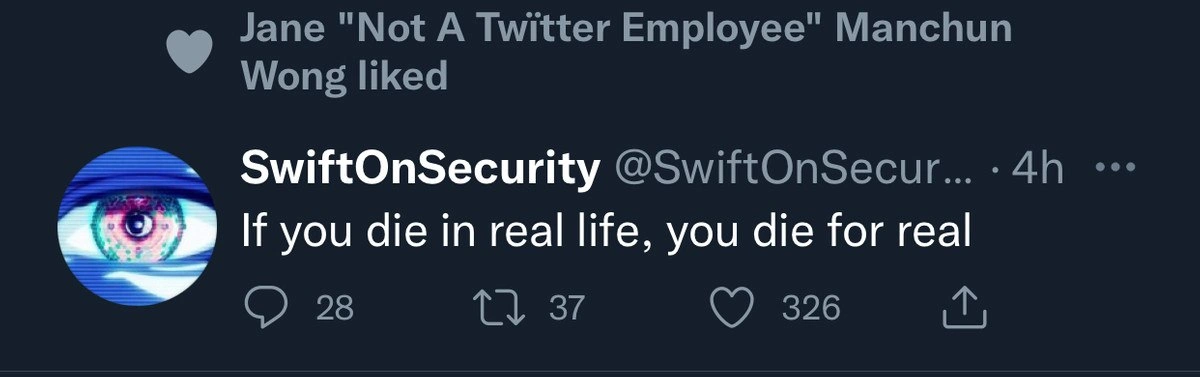
The visible joke is brutally simple:
If you die in real life, you die for real
That line works because it sounds like a patched version of the old Matrix-style warning where virtual harm can map back onto physical harm. Here, the dangerous simulation layer has been removed. The only environment left is production, and production is the human body. No rollback, no snapshot, no docker restart, no friendly error boundary catching the exception before someone gets hurt.
The Twitter framing matters too. The screenshot shows a casual like notification from Jane "Not A Twitter Employee" Manchun Wong above a SwiftOnSecurity tweet, which gives the sentence the dry authority of security culture: the kind of account that usually translates vague hype into operational risk. In an AR/VR or metaverse context, the humor pokes at the industry habit of treating reality as if it were just another platform target. Product decks love words like immersion, presence, and embodied computing; safety reviews have to ask boring questions like what happens when a user walks into furniture, ignores pain signals, or confuses the simulation boundary with the room they are actually standing in.
The deeper developer pain is about real-world consequences. Software teams often build systems where failure is recoverable: retry the request, replay the event stream, restore from backup, redeploy the previous build. But physical systems, security systems, medical devices, autonomous vehicles, industrial controls, and VR hardware do not get to pretend that user harm is just a bad stack trace. The joke is existential because it collapses the fantasy of virtual danger into the one incident class every engineer would rather not own: irreversible damage with no postmortem action item capable of undoing it.
Description
A dark-mode Twitter screenshot shows the line "Jane \"Not A Twitter Employee\" Manchun Wong liked" above a tweet from SwiftOnSecurity, displayed as @SwiftOnSecur... with a timestamp of 4h. The profile image is a blue-toned close-up eye, and the tweet text reads, "If you die in real life, you die for real"; below it are reply, retweet, like, and share icons with 28 replies, 37 retweets, and 326 likes. The metadata caption frames it as an updated Matrix quote, turning the usual virtual-world danger into a blunt reminder that reality has no respawn semantics. Its technical relevance sits in VR/metaverse culture and the software habit of treating reality as if it were another environment with recoverable failure modes.
Comments
3Comment deleted
Reality is still the only environment where crash-only design means you do not get a restart.
if you die in minecraft you die for integer Comment deleted
if you die in terraria you die for byte Comment deleted