Wilber Rendered Through Toolchain Confusion
Why is this Graphics meme funny?
Level 1: The Picture Got Scrambled
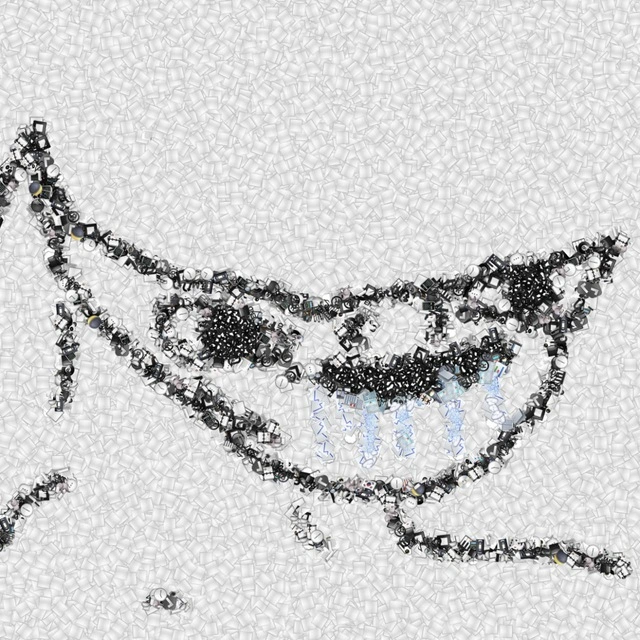
This is funny because the image still looks a bit like the GIMP mascot, but it also looks like it was chopped into tiny pieces and put back together by a confused machine. It is like drawing a face with a pile of crumbs: from far away you can tell what it is, but up close you mostly wonder what happened.
Level 2: Pixel Soup
GIMP is an open-source image editor used for tasks like drawing, retouching, compositing, and exporting images. Its mascot is commonly known as Wilber. The image appears to show that mascot, but instead of clean lines, the shape is built from many tiny dark and light fragments.
Image processing means using software to change or analyze images. A program might resize an image, sharpen it, compress it, trace edges, change colors, convert formats, or rebuild it using patterns. Most of the time, these operations are useful. Sometimes they create artifacts, which are unwanted visual side effects.
The image resembles a mosaic or dithered rendering. A mosaic approximates a larger image using many smaller pieces. Dithering uses small patterns to simulate colors or shades that are not directly available. Both can make an image recognizable from far away while looking chaotic up close.
For a newer developer, this is similar to seeing a program output data that is "correct" only in the most technical sense. The file opens. The dimensions are right. The subject is still recognizable. But the result is obviously not what a human wanted. That means the bug is probably not a total failure; it is a wrong transformation somewhere in the middle.
The meme's "What" reaction fits because visual bugs are often hard to describe. You can write "the mascot is made of tiny fragments now," but that does not really explain why the pipeline decided to reinvent confetti-based branding.
Level 3: Wilber Through Shrapnel
The image has no readable meme caption, which somehow makes it more unnerving. It shows a pale, densely textured background filled with tiny repeated light shapes, while dark clusters of small fragments form a recognizable outline of Wilber, the GIMP mascot: the wide head shape, the eye area, the long brush-like shape to the left, and the sweeping lower outline. The post message is simply "What", which is about the correct amount of incident-report prose for this visual.
The developer humor is in the apparent image-processing pipeline failure. It looks like someone did not merely render an icon. They fed a mascot through a toolchain that involved tiling, dithering, edge detection, texture synthesis, sprite packing, or a very determined bug in an export path. The result is recognizable enough to identify the subject, but chaotic enough to feel like the image was reconstructed by a build system with unresolved dependencies and strong opinions about alpha channels.
GIMP makes the joke sharper because it is itself an open-source graphics editor. Seeing its mascot rendered as a noisy collage of tiny graphical debris feels like a graphics tool accidentally becoming its own test case. If the image were a random logo, the effect would be strange. Because it appears to be Wilber, the effect reads like open-source recursion: the image editor mascot has been edited by an image process that may need image editing.
There is a real technical idea under the absurdity. Many graphics algorithms preserve different kinds of information. Dithering can preserve tonal appearance by distributing error as tiny patterns. Edge detection can preserve outlines while discarding smooth areas. Mosaics can approximate an image by assembling many smaller pieces. Compression can keep the broad structure while damaging local detail. This image feels like several of those concepts had a meeting without an agenda.
Experienced developers recognize the class of failure. A pipeline stage produces output that is technically valid, visually wrong, and just close enough to plausible that nobody knows which component to blame. Was it the asset generator? The icon atlas? The rasterizer? The palette quantizer? A premultiplied-alpha mismatch? A thumbnail cache? The cursed part is that each hypothesis sounds reasonable, and the artifact itself refuses to crash. Broken software that still produces a file is often harder to debug than software that politely explodes.
The open-source angle adds another layer. Graphics tools often support a deep stack of formats, plugins, libraries, export options, color profiles, and compatibility modes. That flexibility is powerful, but it also creates delightful paths to visual nonsense. Somewhere between "load image" and "save image," an innocent mascot can become a forensic diagram of every assumption the pipeline made about pixels.
Description
The image shows a pale, high-texture background covered in tiny light shapes, with a dark mosaic-like outline forming the GIMP mascot Wilber, including the long brush-like element on the left, the eye area, and the wide head silhouette. There is no prominent readable caption or UI text inside the image itself. The humor is the visual absurdity of an open-source graphics mascot appearing to have been reconstructed through a strange image-processing or icon-packing pipeline.
Comments
3Comment deleted
Somewhere, a graphics pipeline confused mascot rendering with dependency resolution and still shipped a recognizable Wilber.
We need more support!!! Comment deleted
If your device just vibrates upon pressing the link and nothing else happens, then you probably don't actually vote — because your Telegram app is not up to the date. The expected behavior is depicted in the screenshot above. And don't forget to press the colored "Boost Channel" button in that popup dialog — only then your vote may be counted, not when you just pressed the link or the regular "BOOST" button in the bottom of the post. Comment deleted