The Six-Figure Art of Copy-Pasting
Why is this Career HR meme funny?
Level 1: The Recipe vs The Chef
Imagine you want to bake a cake. You can find free recipes online for cake, right? That’s like copying code from the internet – the recipe is readily available. But if you don’t know much about baking, you might pick a recipe that’s wrong for what you need: maybe it’s for high-altitude baking, or it assumes you have a special oven. You could end up with a burnt cake or a big mess in the kitchen because you didn’t realize the recipe wasn’t quite right.
Now think of a professional chef. A chef doesn’t just grab any recipe; they know which recipe will work with your ingredients and oven, and they can even tweak it on the fly if something’s off. Hiring a chef costs money – they might charge a lot – because they bring the wisdom of experience. They’ve baked hundreds of cakes and know the little secrets: which ingredient substitutions are okay, how to tell if the batter consistency is right, how to avoid the cake collapsing.
In the same way, a newbie programmer might copy some code they found (like grabbing a random cake recipe), and it might not work out. An experienced programmer is like the chef: they know which code recipe to use and how to adjust it so the software comes out great, not burnt. The meme is funny because it’s basically saying paying a software expert is worth it – you’re not really paying them for the act of typing code (like following a recipe), you’re paying them for knowing what to type and what not to. It’s the difference between a cheap quick fix and a smart solution. And just like you’d pay more for a good chef to ensure your cake is delicious, companies pay more for senior developers to ensure their software is done right.
Level 2: Copy-Paste vs Expertise
Let’s break down the joke in simpler terms. Stack Overflow is a hugely popular Q&A website where developers ask questions and get code examples/answers from the community. It’s like a giant public cookbook of coding recipes. Copy-paste coding means taking those publicly posted code snippets and dropping them straight into your project without much change. Pretty much every new programmer has done this at some point (we’ve all Googled error messages and copied the first fix 😉). The meme plays on this habit, comparing it to actually hiring an experienced software engineer.
The first line, “Copying code from StackOverflow: $1,” suggests that grabbing a snippet from the internet is trivially cheap – basically free. Anyone with an internet connection can find a code snippet for almost any common problem. Need a function to check if a string is a palindrome? There’s probably an answer with code ready to copy. That’s the easy part.
The second line, “Knowing which code to copy from StackOverflow: $100000/year,” is saying that figuring out which snippet is the right one (and then using it correctly) is a much harder, more valuable skill – so valuable that companies pay a six-figure salary for it. Expertise here means understanding context: does this code actually solve my specific problem? Is it efficient enough? Is it secure? Will it work with the rest of my code? A senior developer (someone with lots of experience) has the knowledge to answer those questions. A junior developer (newer to the field) might not even know to ask some of those questions yet. That’s the difference being highlighted.
Think of CodeQuality: it’s a measure of how good and reliable code is. Not all answers on Stack Overflow are equal in code quality. Some are brilliant; some are quick hacks that might cause bugs later. For example, an answer might use a global variable for simplicity, but that could cause issues if you integrate it into a larger application. A senior dev spotting that will say, “Ah, this answer is clever but it’s not thread-safe, I better not use it as-is.” A less experienced dev might not catch that and introduce a bug. That ability to evaluate quality and suitability is what the meme values at $100k/year.
Another aspect is that DeveloperExperience (DX) of using random code can be bad if it doesn’t blend in. Ever copied code that used a completely different naming style or library that your project wasn’t using? It can turn into a headache. Senior engineers tend to think, “Will the next person understand this code?” They might adjust the snippet or choose one that fits the team’s conventions to maintain overall code quality. They also consider maintainability: copying code is easy now, but who will fix it if it breaks later? If the original author on Stack Overflow made a mistake, you need the expertise to debug it yourself.
In the context of Career/HR and hiring practices, this meme is basically a recruiting truth wrapped in humor. When a company interviews candidates, they’re not looking for someone who can copy-paste (anyone can do that); they want someone who knows when to use a snippet and when not to. They want problem-solving skills, understanding of system design, awareness of pitfalls – all these come with experience. So while a junior dev might save the company money in salary, if they introduce a serious bug by copying the wrong code, that mistake can cost far more to fix. Hiring a senior developer is like insurance: you pay more upfront for their salary, but you avoid costly disasters and get robust solutions.
This meme’s format – a Q&A screenshot, almost like a Quora answer – makes it relatable to devs who browse those forums. It’s using a bit of insider humor too: the upvotes from other engineers (even mentioning job titles like Senior Software Engineer at IBM) add credibility. It’s as if the whole developer community (the DevCommunities out there) is nodding along, saying “Yup, this is true.” The tags like StackOverflowDependence poke fun at how reliant some people (especially new devs) can be on searching online for answers. But as every dev learns eventually, there’s a huge difference between knowing and knowing better. That’s essentially what “knowing which code to copy” means – it’s knowing better: which solution is correct, safe, and optimal.
So in simpler terms: the meme emphasizes the value of experience in software development. Sure, all the answers might be out there on the internet, but if you don’t have the experience to filter and apply them correctly, you can end up with a Frankenstein’s monster of code. An experienced dev serves as a quality gate, making sure that the code that goes into your product isn’t just something that compiles, but something that won’t blow up later. And that gatekeeping skill is worth the money. It’s a funny way to justify why senior developers command higher salaries, using the language of a cost breakdown meme (listing a cheap part vs. an expensive part) to make the point.
Level 3: The $100K Context Filter
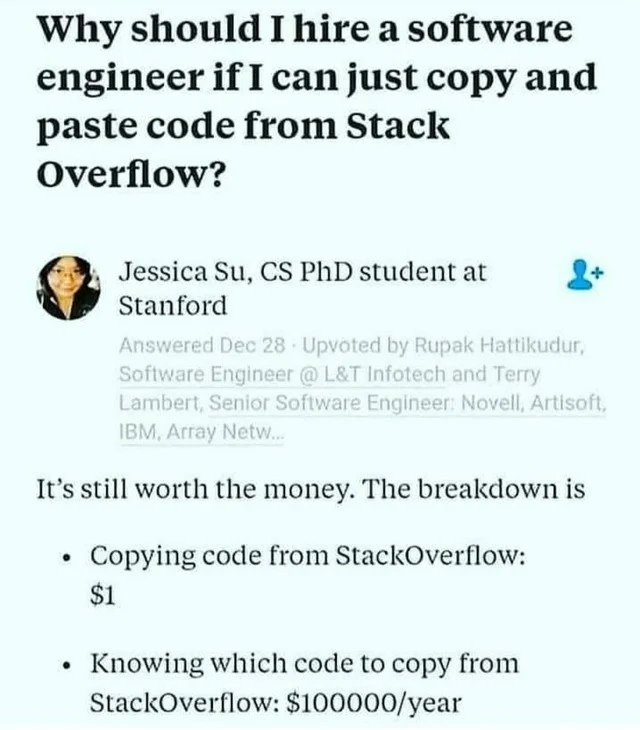
At first glance, this meme looks like a Quora-style Q&A screenshot lampooning a naive question:
“Why should I hire a software engineer if I can just copy and paste code from Stack Overflow?”
The punchline answer breaks down the cost of StackOverflow-driven development in stark terms:
Copying code from Stack Overflow: $1
Knowing which code to copy from Stack Overflow: $100000/year
This is a satirical pricing of expertise. It highlights that copy-paste coding itself is virtually free – anyone can hit Ctrl+C/Ctrl+V – but contextual knowledge is incredibly valuable. The humor targets the disconnect between writing code and understanding code. A fresh grad or overconfident manager might think code on the internet makes developers obsolete (“Why pay a dev if answers are on StackOverflow?”). Seasoned engineers roll their eyes because they’ve seen what happens when you blindly paste unknown code into a codebase: subtle bugs, security holes, performance landmines, and epic technical debt.
Consider what a senior developer brings that a copy-paste approach doesn’t: a mental arsenal of patterns and pitfalls. They’ve likely debugged those “works on my machine” disasters that arise from using a snippet out of context. For example, a Stack Overflow answer might suggest using eval(userInput) to quickly parse something. A junior might copy it without realizing that eval on untrusted input is a security nightmare (it can execute malicious code). A senior engineer’s pattern-matching alarms would go off: Danger! Don’t execute unknown input. Similarly, an answer might show a quick fix that works in one scenario but deadlocks or leaks memory in production. The experienced dev can sniff out these code smells.
Why is that worth $100k/year? Because knowing which code fits your problem is like having a built-in filter. Stack Overflow is a massive dev community knowledge base, but it’s also a free-for-all of varying code quality and outdated solutions. A seasoned dev uses StackOverflow like a reference manual, not a solution vending machine. They’ll examine the top-voted answer’s code quality, check comments for caveats (e.g., “This only works on Python 2” or “Be careful, this assumes a small input size!”), and then adapt it to their code’s context. In contrast, a less experienced dev might copy the first answer that “looks right,” incurring all sorts of hidden costs when that snippet doesn’t play nice with the existing architecture.
Let’s break down a scenario: suppose an application needs to sort a large list of records. A Google search turns up a Stack Overflow snippet implementing a custom sort. A junior dev might paste it verbatim, not realizing it’s an $O(n^2)$ algorithm that will grind to a halt on large data. The senior dev recognizes the pattern (“bubble sort disguised in a fancy way”) and instead uses a built-in efficient sort or a better algorithm. This ability to apply algorithmic knowledge and context transforms a potentially disastrous copy-paste into a proper solution. They are effectively paid to prevent “StackOverflow-driven bugs”.
Another angle is license and maintenance. Stack Overflow contributions are typically under Creative Commons, which means copying large chunks might legally obligate you to credit the source or open-source your project (an often overlooked detail!). An experienced engineer is aware of this and will either avoid copy-pasting large blocks outright or properly attribute and sanitize the code. Plus, they think long-term: Will this snippet be understandable to the team later? Is it consistent with our code style and architecture? If not, a senior might rewrite it in a cleaner way. Those considerations are invisible to someone focused only on quick fixes.
The meme also resonates because it’s DeveloperReality and a bit of dark humor. Every senior dev has at least one war story where a seemingly harmless StackOverflow copy-paste led to a prod outage or an all-nighter debugging. The joke’s sting is that outsider perspectives often undervalue the hard-to-see work of engineering. Non-developers might truly think we just “Google the answer” all day. The meme’s answer (attributed to a CS PhD student with upvotes from industry veterans) gives a snappy comeback: you’re paying for judgement, not keystrokes. It echoes the classic parable: a company pays a consultant $10,000 to fix a machine; the consultant marks an “X” on a part and charges $10 for chalk and $9,990 for knowing where to put it. In software terms, copying code is the $1 chalk, knowing where and how to apply it is the $100k expertise.
In essence, senior engineers cost more because they act as the quality filter and safety net for all that free knowledge out there. They’ve internalized the documentation, the edge cases, and the unwritten tribal knowledge of what actually works in production. They can distinguish a clever hack from a maintainable solution. They know that just because a solution is on Stack Overflow doesn’t mean it’s production-ready or even correct for your situation. That insight – born of experience and countless StackOverflow searches gone wrong – is what companies are really paying top dollar for.
Description
A screenshot of a question-and-answer post, likely from a platform like Quora. The top text poses the question in a large, bold font: 'Why should I hire a software engineer if I can just copy and paste code from Stack Overflow?'. Below the question is the profile of the answerer, 'Jessica Su, CS PhD student at Stanford'. Her answer is formatted as a cost breakdown: 'It's still worth the money. The breakdown is', followed by a bulleted list: 'Copying code from StackOverflow: $1' and 'Knowing which code to copy from StackOverflow: $100000/year'. The humor directly addresses a common misconception about software development, highlighting that the true value of an engineer is not the mechanical act of writing code, but the deep knowledge and experience required to select the correct, efficient, and secure solution. For senior developers, this resonates deeply as it validates their expertise in navigating complex problems, avoiding subtle pitfalls, and understanding the long-term consequences of a seemingly simple code snippet
Comments
7Comment deleted
Anyone can copy code for a dollar. The other $99,999 is for knowing the one answer from 2011 marked 'obsolete' is actually the only thing that works on the legacy server without causing a kernel panic
Stack Overflow is free - until the wrong snippet goes live and triggers a midnight SEV-1; that six-figure salary is basically prepaid incident response insurance
The real senior engineer skill isn't knowing how to solve problems from scratch - it's having memorized which Stack Overflow answers actually work in production versus which ones will trigger a 3am PagerDuty alert six months later
This perfectly captures the Dunning-Kruger valley that separates junior and senior engineers: juniors think Stack Overflow is a code repository, while seniors know it's actually a decision tree where the real skill is recognizing which answer applies to your specific context, understanding the trade-offs in the comments, and knowing when the accepted answer from 2012 will introduce a security vulnerability in your 2024 production system. The $1 vs $100k/year breakdown is essentially pricing the difference between 'ctrl+c, ctrl+v' and 'understanding why this O(n²) solution works but will bring down your service at scale.'
Stack Overflow is free; turning “works on my machine” into “doesn’t page me at 3am, preserves our invariants, and isn’t GPL” is where the salary starts
Senior dev value: turning Stack Overflow roulette into a vetted dependency that survives your first code review
Anyone can paste the 2012 accepted answer; seniors smell the hidden O(n^2), the AGPL tripwire, and the backpressure-induced race before Legal and PagerDuty do