The Duality of the Developer Mind
Why is this MentalHealth meme funny?
Level 1: Superhero to Clueless
Imagine one day you feel like a superhero who can do absolutely anything – you can finish all your homework, solve the hardest puzzle, or beat every level in your video game without breaking a sweat. That’s like the first state: “I can do anything!” But then later on, the same day, you suddenly forget how to do something really simple, as if you’ve never done it before. Maybe you blank out on tying your shoelaces or you can’t remember which button makes your game character jump. You stand there confused, thinking, “Uhh… what does this do again?” You went from feeling unstoppable to feeling totally lost in no time. It’s silly, and that’s why it’s funny!
This meme is saying that grown-up programmers feel that way too. One moment a programmer might feel on top of the world, like they’re a genius inventing something cool (wearing their imaginary superhero cape). The next moment, they might stare at their computer screen and feel clueless, almost like they’ve forgotten what a computer even is. It’s a goofy exaggeration of how our brains work. We laugh because we’ve all had those days: sometimes we’re really confident, and other times we’re really confused, and the switch between the two can happen faster than you’d expect. The meme makes us smile because it reminds us that even the people who seem like superheroes can have forgetful moments, just like everyone else.
Level 2: What Is a Computer?
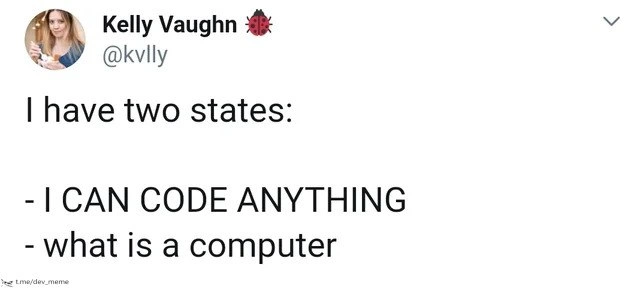
Let’s break down the meme in simple terms. It’s actually a screenshot of a tweet by a developer (Kelly Vaughn) stating: “I have two states:” and then listing them: “I CAN CODE ANYTHING” and “what is a computer”. These two statements represent opposite feelings a programmer might have. The first, “I can code anything,” is the confidence state – the developer feels super productive and capable, like they could tackle any programming task or fix any bug (DeveloperProductivity at max level!). The second, “what is a computer,” is the confusion state – the same developer, at another time, feels completely lost, so much so that they jokingly question the most basic concept (a computer itself!). It’s a humorous exaggeration of those blank-out moments we all have.
In the world of software development, this really resonates because even good developers sometimes suddenly feel like they’ve forgotten the basics. You might spend an afternoon writing a complicated program, and it works – you’re on top of the world (that’s the I can code anything feeling). But later, maybe when you’re tired, you stare at a very simple task – like saving a file or remembering a command – and your brain just freezes. You might think, “Wait, how do I print text to the screen again?” This is the “uhh…what’s a computer?” feeling. It’s as if all the knowledge in your brain ran out of memory for a moment. It’s both funny and frustrating when it happens.
This meme uses those two extremes to poke fun at a common Developer Experience. The terms for this could be “confidence toggle” or “binary developer state” – binary meaning two possible states, just like a light switch can be ON or OFF. Many programmers privately relate to having their switch flipped from hero to zero without warning. One minute, code is flowing and everything makes sense; the next minute, nothing works and you wonder if you ever actually understood any of it. This swing can be influenced by Developer Fatigue (getting mentally tired after long coding sessions) or by impostor syndrome.
Now, impostor syndrome is an important term here. It’s not a technical bug in your code, but a bug in your mind. It means even skilled people sometimes feel like they’re not actually good at what they do – they fear they’ll be “exposed” as an impostor or fraud. In programming, impostor syndrome might hit you when you get stuck on something “simple,” making you think, “A real programmer wouldn’t forget this… maybe I’m not good enough.” The meme’s second state (“what is a computer”) humorously exaggerates that feeling of utter self-doubt. By contrast, the first state (“I can code anything”) is like the opposite of impostor syndrome – maybe a bit of overconfidence or just that awesome feeling when you solve something difficult. DeveloperHumor often highlights this contrast to remind us it’s normal.
For a junior developer or someone new to coding, it’s useful to know that even senior developers have brain-fart moments. They might be able to implement a complex algorithm or understand fancy terms like asynchronous event loops, yet still Google the syntax for a basic for-loop because they blanked out. It doesn’t mean they actually forgot what a computer is 😉 – it’s just a funny way to say “my mind is totally blank right now.” Imagine writing code for 10 hours; your brain would be pretty tired, and you might momentarily forget something obvious, like how to rename a file or which window you left your code in. That’s the time you might catch yourself muttering, “Computer? What’s that? Can I turn it off and on again?” – clearly joking with yourself.
The tweet format itself (two bullet points under “I have two states”) has become a popular tweet_screenshot_meme style in developer communities. It’s straightforward and relatable: just list two extreme opposites. The reason this works for humor is because it’s so true for a lot of people. It’s a relief to know others feel the same wild swings. In terms of mental health, acknowledging these ups and downs is healthy – it shows that feeling brain-dead after intense focus is normal, not a personal failure. In fact, those “what is a computer” moments often mean you need a break. Step away, and you’ll find of course you know what a computer is and how to code – your brain just needed to refresh (just like rebooting a sluggish PC!).
To sum up the key concepts in the meme: It’s highlighting DeveloperAnxiety and the humorous side of DeveloperProductivity. Productivity isn’t a steady thing – it comes in waves. Sometimes you’re riding the wave (coding anything thrown at you), sometimes the wave crashes (you feel like you’re swimming in mud, forgetting even basic stuff). By putting these two states side by side, the meme reassures developers (especially new ones) that it’s okay to have off days or even off minutes. You can be a capable programmer and still have moments where you feel like you know nothing. In other words, don’t panic if your brain sometimes goes blank – it happens to the best of us, and usually you’re just one good Stack Overflow search or a short rest away from switching back to “I can code anything!” mode.
Level 3: The Confidence Toggle
For seasoned developers, the humor in this meme is almost painfully relatable. It highlights the binary developer state many of us experience: one minute you’re in God Mode, confidently refactoring an entire codebase in your head, and the next minute you’re staring at your terminal like “uhh… what’s the command to list files again?” The tweet’s format – a simple list of two bullet points in starkly different tones – perfectly delivers this punchline. Notice how the first state is in ALL CAPS (“I CAN CODE ANYTHING”), practically radiating confidence (or delusional grandeur 😅), while the second state is in timid lowercase (“what is a computer”), signaling utter confusion. That contrast in text style is deliberate and familiar to devs on Twitter: all-caps feels like a triumphant shout, and all-lowercase reads like a sheepish whisper. Visually and emotionally, it mimics those high-and-mighty vs low-and-lost moments we cycle through during big projects.
Why is this so funny (and a little tragic)? Because anyone who’s spent long hours programming knows this exact pendulum swing of confidence. You might spend the morning solving a gnarly algorithmic problem or finally crushing a bug that had haunted the app for weeks – you feel like a wizard who just bent the computer to your will. But then afternoon comes, you’re a bit mentally fried, and suddenly you blank on a simple task: maybe you forget the syntax for a basic for loop, or you momentarily panic, thinking “Wait, how do I even start this server?” That whiplash between “I’m a genius!” and “I’m an impostor who knows nothing!” is the essence of imposter syndrome in tech. This meme nails that feeling with just two bullet points. It’s the developer equivalent of Dr. Jekyll and Mr. Hyde: in one state, you’re the seasoned pro who speaks fluent machine; in the other, you’re like a bewildered newbie who’s apparently never touched a keyboard.
Real-world dev life is full of these moments. Perhaps you’ve been in the zone building a complex feature for hours (maybe even forgetting to eat lunch because the code flow was so good), and then a co-worker swings by and asks you something simple, like to toggle the Wi-Fi or commit your code. You look at them blankly because your brain is still parsing abstract syntax trees, not everyday tasks. It’s as if your brain blue-screened for a second – a mini internal “Blue Screen of Death” where even the word “computer” 404s in your mind. 😂 We joke that “it’s always DNS” when things go wrong, but here it’s like “it’s always the brain’s fault.”
The humor also comes from shared vulnerability. In an industry that often idolizes the “10x engineer” who supposedly eats algorithms for breakfast, it’s refreshing (and funny) to admit that even expert developers have WTF moments. You might be the team’s go-to person for deciphering memory leaks in C++, yet still find yourself Googling “how to exit vim” on occasion. (For the record, it’s :wq to save and quit – but under pressure, who hasn’t typed :q! repeatedly or mashed the Escape key like it’s a game of whack-a-mole?) These blooper moments happen to everyone. The tweet-meme format (common in DeveloperHumor circles) is essentially Kelly Vaughn raising her hand and saying, “Hey, I oscillate between total confidence and total confusion – anyone else?” The enormous positive response such memes get is proof that this is a Relatable Developer Experience.
From a productivity standpoint, the two states also highlight the effect of Developer Fatigue on Developer Productivity. When you’re in that first state (pumped up, “I can build the next big thing!”), you might crank out code at 2x speed, feeling unstoppable. But when the switch flips (brain fog so bad you’re questioning what a computer even is), that’s a red flag that you’re mentally exhausted or overstretched. In a healthier work culture, we’d recognize that as a sign to take a break, not as a personal failure. But many developers internalize it and feel anxiety – “How can I forget something so basic? Maybe I’m not good enough.” It’s a classic imposter_syndrome_moment: you start wondering if your earlier triumphs were flukes. The meme uses humor to poke at this rollercoaster. We laugh because it’s true. It’s basically a community in-joke: “Yesterday I was a coding god, today I googled ‘JavaScript how to declare variable’… yup, been there!”
Importantly, the cycle depicted is not just individual quirk but somewhat systemic. Modern software development involves such a vast ocean of knowledge that even senior engineers live with a subtle dread of what they don’t know or might suddenly forget. One day you’re confidently discussing the merits of event-driven microservices, and the next you blank on the command to deploy because your brain context-switched too hard. Companies might joke about wanting “rockstar developers,” but even rockstars hit wrong notes. This meme’s popularity is developers collectively venting: today I feel like I could code a rocket to Mars, tomorrow I might stare at my code and ask “Who wrote this? Do I even understand it?” Spoiler: you wrote it, you just need a mental reboot.
In summary, at the senior perspective this meme shines a light on a bittersweet truth of the Developer Experience (DX): no matter how experienced you are, your brain will have toggling states of brilliance and blankness. And by laughing at it, we take a bit of the sting out of those "uhh…computer?" moments. After all, if Kelly Vaughn – a respected dev – publicly admits to these two states, it means feeling like an absolute newbie right after feeling like a coding wizard is just part of the programmer life. Embracing that makes it easier to ride out the lows, and trust that the confidence will swing back… usually right after a cup of coffee or a good night’s sleep!
Level 4: Cognitive Cache Invalidation
At the deepest technical level, this meme hints at how our brains handle context switching in a way oddly similar to computers. A developer in the "I CAN CODE ANYTHING" mode is in what psychologists call a flow state – an optimal zone of intense focus where complex problems seem to unravel effortlessly. In flow, the brain is highly engaged in a specific context (like juggling many variables of a code architecture in mind), and it allocates almost all “CPU cycles” of working memory to that task. Just like a computer’s CPU, when you abruptly switch contexts (say, to recall a basic fact like “what is a computer?”), there's a costly pipeline flush. All those cached thoughts and assumptions in your brain’s “RAM” get invalidated. The result? A momentary blank, as if your mind threw a cache miss on something absurdly fundamental.
This phenomenon is akin to a multi-threaded system experiencing a context switch: the state of one heavy thread (deep coding thoughts) is saved aside, and a lightweight thread (basic everyday knowledge) is resumed, but the caches are cold. In computing, context switching too often can lead to thrashing – the system spends more time switching contexts than doing work. The human equivalent is mental thrashing: you were so deep in code that asking “what's 2+2?” right then might genuinely trip you up. The meme exaggerates it to “what is a computer?” for comedic effect, implying a total flush of even the most basic concept.
There’s an old joke that “the two hardest problems in computer science are naming things and cache invalidation.” This meme manages to jokingly encapsulate both: the developer’s brain has invalidated the cache of basic knowledge, and suddenly even naming the most common object in our field (“computer”) fails! It’s a humorous nod to the fundamental challenges of both our machines and our minds. The science behind it is very real: working memory has limited slots (often cited as 7 ± 2 items), and when we max it out designing some intricate system, something as simple as the word “computer” might get temporarily evicted from those slots. The extreme whiplash from master-level coding prowess to basic confusion underscores a core truth of cognitive overload: under heavy load, even trivial operations can timeout. Transient hypofrontality, a fancy term for the brain briefly deactivating non-essential circuits during deep focus, can leave you mentally disoriented when you snap out of that trance. In plain terms, being “in the zone” sometimes means you’ve momentarily misplaced the obvious. The meme captures this absurd technical reality: even the best compiler (our brain) sometimes needs a second to reboot between tasks.
Description
A screenshot of a tweet by Kelly Vaughn (@kvlly). The tweet's text succinctly captures a common developer experience with the statement: 'I have two states:', followed by a bulleted list. The first item is '- I CAN CODE ANYTHING' written in uppercase, representing a state of high confidence and productivity, often known as 'flow state'. The second item is '- what is a computer' written in lowercase, humorously representing moments of utter confusion and self-doubt, often triggered by a simple, frustrating bug or a forgotten basic concept. The technical humor lies in its extreme but relatable portrayal of the volatile confidence levels inherent in software development. This resonates strongly with senior engineers who, despite their experience, still oscillate between feeling like masters of complex systems and being humbled by a trivial mistake, a perfect encapsulation of imposter syndrome

Comments
7Comment deleted
State one is when you architect a multi-region, zero-downtime deployment strategy. State two is five minutes later when you're Googling how to vertically align a div
If our brains were Kubernetes pods, we’d scale from 0 to 100 replicas of overconfidence and then crashloop back to ‘what is /dev/null?’ in milliseconds
After 20 years in tech, I've discovered the confidence interval isn't a statistical concept - it's the 15 minutes between successfully implementing a distributed consensus algorithm and forgetting how to center a div
Every senior engineer knows this oscillation intimately: Monday morning after successfully architecting a distributed system with eventual consistency guarantees, you're convinced you could rewrite the Linux kernel in your sleep. Tuesday afternoon, staring at a null pointer exception in production, you're Googling 'how do variables work' and questioning every life choice that led you to this profession. The frequency of this cycle is inversely proportional to your years of experience, but the amplitude never quite reaches zero - it's the fundamental theorem of software engineering psychology
Imposter syndrome: the only tech debt that accrues interest with every promotion
My career is basically an FSM: caffeine + passing CI moves me to CAN_CODE_ANYTHING; one Slack ping, a SOX audit, or a cache miss in institutional memory sends me to WHAT_IS_A_COMPUTER
My confidence is a two-state FSM with no hysteresis: CI green sets 1, a rebase conflict sets 0; paging at 3am induces oscillation