When Real-Life Stat Allocation Has a Critical Bug
Why is this Bugs meme funny?
Level 1: When Books Give Biceps
Imagine if every time you lifted a heavy box, you became smarter instead of stronger. You’d be scratching your head, right? And what if reading a schoolbook suddenly made your muscles grow? That’s what’s happening in this funny picture. The character expects that doing exercise will make him strong, but the game got its wires crossed. It’s giving him brain power for bench-pressing, which is as silly as getting big biceps from reading a book. We all know in real life that’s not how things work! This joke is funny because the cause and effect are completely mixed up. The poor guy is baffled: he’s doing one thing and getting the result of something totally different. It’s a playful way to show a mistake in the game’s programming — basically the game is confused about what action should do what. Even if you’re not a programmer, you can laugh at how absurd it is: it’s like a world where learning makes you muscular and lifting weights makes you a genius. Clearly, something’s wrong in that world, and that obvious mix-up is the punchline.
Level 2: Gym Glitch 101
Let’s break down what’s happening in simpler terms. In many role-playing games (RPGs), characters have attributes (also called stats) like Strength (physical power) and Intelligence (magical or mental acuity). Typically, when your character does something related to strength – say lifting a heavy weight or swinging a sword – the game should increase the Strength stat. Likewise, studying or reading in-game would increase Intelligence. It’s a basic cause-and-effect mapping in game design.
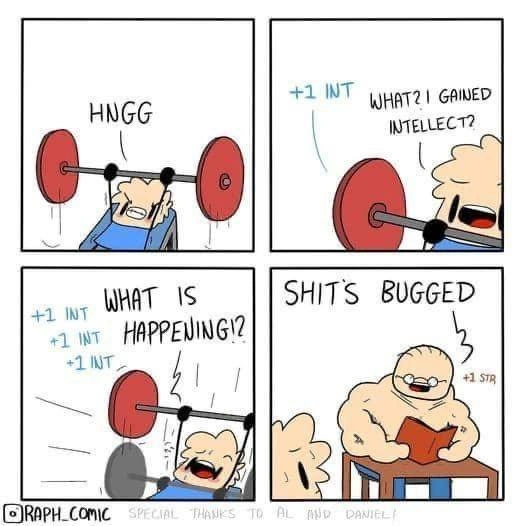
Now, in this comic scene, that logic is bugged (meaning there’s an error in the program). The character is bench-pressing a barbell (a strength-training action), but the game pops up a “+1 INT” message, implying the character gained intelligence instead of strength. The poor lifter is understandably confused, shouting “WHAT? I gained intellect?” As he keeps lifting, the game keeps adding INT points with each rep, which is totally the wrong stat to increase for that action. By the last panel, the joke flips: the character is super muscular (as if all that unintended INT somehow still made him buff) and he’s calmly reading a book – and now the game says “+1 STR” for reading! In other words, the effects got completely reversed.
Why would this happen in a game? Likely due to a variable mapping bug – the code that assigns stat rewards to activities mixed things up. Computers use variables (named values in the program) to keep track of stats. If the game’s code was supposed to add to the Strength variable but accidentally pointed to the Intelligence variable, you’d see exactly this mix-up (we call it an attribute_swap_bug because the attributes were swapped). Maybe the programmer used an enum or ID for each stat and mis-assigned them. For example, if "STR" was supposed to be 1 and "INT" 2, but the code used 2 instead of 1 for the bench press action, it’d give INT by mistake. It’s like telling the game “increase the wrong stat” by accident.
We can illustrate the intended behavior versus the bug:
| Game Action | Expected Stat Gain | Bugged Stat Gain |
|---|---|---|
| Lift weights (bench press) | +1 Strength (STR) | +1 Intelligence (INT) |
| Read a book (study session) | +1 Intelligence (INT) | +1 Strength (STR) |
In a bug-free scenario, pumping iron makes you stronger and reading makes you smarter (the expected stat gain). But with the bug, those rewards got criss-crossed (the bugged stat gain). As a junior developer or gamer, this is a clear sign something is wrong in the code logic. It’s not just a quirky game design – it’s an error. Debugging it would involve checking the section of the code that handles stat increases when an action is performed. A developer would trace, for example, the function or script that runs when you do a bench press in the game and see which stat variable it’s incrementing. Finding a +1 INT there instead of +1 STR would immediately reveal the bug. The fix is usually simple: assign it to the correct stat variable. But getting to that point requires careful troubleshooting: you might have to read logs or use a debugger to pinpoint where the wrong increment happens. This process of finding and fixing the mistake is exactly what Debugging_Troubleshooting is all about. And once you fix it, the game will behave normally – no more genius bodybuilders or brawny bookworms unless that’s intended!
Level 3: Stat Swap Saga
This meme highlights a classic game development bug where an action's effect is mapped to the wrong character attribute. A seasoned developer immediately recognizes the attribute swap: pumping iron should raise Strength, but the code is mistakenly incrementing Intellect instead. In game dev, character stats like STR (strength) and INT (intellect) are often managed by enumerations or lookup tables. If those get misaligned (for example, using the wrong index or constant), you end up with a stat_increment_error just like this: lifting weights magically gives +1 INT. The comic exaggerates the absurdity, but any RPG coder who’s accidentally swapped variables can relate—debugging this feels both hilarious and painful. It’s the kind of bug that makes you do a double-take, much like the lifter shouting “WHAT IS HAPPENING?!”. The visual_gag_debugging here (blue “+1 INT” floating over a bench press) is a dead giveaway that something’s off in the logic.
In practice, this stat mismatch usually boils down to a trivial coding mistake. Maybe the developer copy-pasted a function and forgot to change an enum, or the stats array indices were off by one. Consider a pseudo-code snippet for awarding stat points:
enum Attribute { STR, DEX, INT }; // 0, 1, 2
void awardStatForAction(Action a) {
if (a == Action::BenchPress) {
player.stats[INT] += 1; // Bug: should be STR
}
else if (a == Action::ReadBook) {
player.stats[STR] += 1; // Bug: should be INT
}
}
Here the bench_press_glitch is plain to see in code comments: the developer used the INT index when handling a bench press action, effectively giving intellect points for weightlifting. Similarly, reading a book calls the wrong stat. This rpg_attribute_mismatch could also happen if a data file or script mapped the IDs wrong (e.g., treating “1” as INT instead of STR due to a swapped order). A senior dev has likely seen dozens of such off-by-one or mislabeled ID bugs in their career.
What makes this meme funny to developers is the role reversal of brains and brawn. It lampoons that moment when you realize “sh*t’s bugged” in your code: the outcomes are literally backwards. The buff character calmly reading with a tiny “+1 STR” over a book is the final punchline – a perfect inversion of logic. It’s a BugsInSoftware scenario so obvious that even the character notices. Everyone in the dev team would facepalm and chuckle once they find it. Sure, it’s a dumb mistake, but it’s also textbook debugging pain: easy to fix, yet ridiculous to witness in action. In true DeveloperHumor fashion, some might even joke “It’s not a bug, it’s a feature!” – imagining a bizarre RPG where studying makes you ripped. But let’s be real: this one’s a straight-up bug, and a memorable one at that.
Description
A four-panel comic strip by RAPH_COMIC that uses video game logic to illustrate a bug. In the first panel, a skinny character is struggling to bench press a barbell, making a straining noise, 'HNGG'. In the second panel, he looks shocked and exclaims, 'WHAT? I GAINED INTELLECT?' as the text '+1 INT' (a common RPG notation for gaining an intelligence point) appears. In the third panel, he continues to strain as more '+1 INT' notifications pop up, and he yells, 'WHAT IS HAPPENING!?'. The final panel shows a dramatic change: a very muscular version of the character is now sitting calmly at a table reading a book, with a '+1 STR' (Strength point) notification appearing. He deadpans, 'SHIT'S BUGGED'. The humor is rooted in the inversion of expected outcomes, perfectly mirroring a software bug where an action produces a completely incorrect and illogical result. For developers, this is a highly relatable metaphor for when a piece of code has a bizarre side effect or a function call updates the wrong variable, leading to a state that is completely nonsensical
Comments
14Comment deleted
That's what you get for using a weakly typed language for reality. Someone clearly passed a 'gym_session' object to the 'study' method, and it failed silently
That moment you reorder the enum from [STR, DEX, INT] to [INT, DEX, STR] without a migration: suddenly the barbarians are quoting Gödel and the librarians bench 400 in prod
It's like when you refactor a singleton to fix a memory leak and suddenly your microservices start achieving consciousness - sometimes the bug IS the feature, especially when your load balancer starts questioning its existence after gaining +1 INT
When your character build accidentally triggers an integer overflow and you realize the real bug was in the game engine's stat allocation system all along - suddenly that 32-bit signed integer limit doesn't seem so theoretical. At least the compiler didn't throw a warning about implicit type conversion from INT to STR
Someone persisted RPG attributes by enum ordinal; after “Charisma” slipped into the middle, bench press now emits +1 INT and reading +1 STR - schema drift is the real boss fight
Someone keyed stat updates by enum ordinal; a refactor swapped INT and STR, so benchPress() boosts IQ and reading buffs biceps - an A/B test we didn’t mean to run
Debugging reps rack up INT until a prod heisenbug drops the barbell - cue +STR rage refactor
nah the dev finna be fired after this one ☠️🔥 Comment deleted
Imagine guy's face when the thing overflows Comment deleted
😳 Comment deleted
It's just encouraging you to keep things balanced out. Comment deleted
POV: this machine actually wasn't little endian Comment deleted
💀 Comment deleted
Well... an overflow will be nice for him then Comment deleted