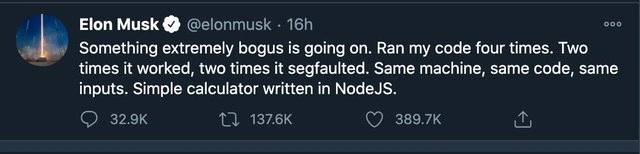
Elon Musk's public battle with a non-deterministic bug
Why is this Bugs meme funny?
Level 1: Haunted Calculator
Imagine you have a basic calculator, and you do the same math problem over and over — say 2 + 2. Now, the first time you get the answer 4 (as expected), and the second time the calculator breaks and shuts off. Then you try again and it gives you 4, and the next time it breaks again! You haven’t changed what you’re doing at all. You’re pressing the same buttons each time, but sometimes the calculator works and sometimes it just crashes. You’d probably feel really confused, maybe even think the calculator is haunted or that a mischievous ghost is playing tricks. In simple terms, that’s what’s happening in this meme: a programmer’s little program (doing something as simple as a calculator would) is acting unpredictably. Half the time it works fine, and half the time it falls apart for no clear reason. It’s funny in a head-scratching way because computers are supposed to be logical — 2 + 2 is always 4, right? When a computer gives different results or just stops working even though nothing changed, it feels absurd and frustrating, like magic or ghosts must be involved. The meme shows that feeling of “Huh?! That shouldn’t happen…” and it makes us laugh because we’ve all had moments when a gadget or app just doesn’t make any sense.
Level 2: Race Condition Riddle
For a less experienced developer, let’s break down why this tweet is funny (and scary). First, NodeJS is a runtime that lets you run JavaScript outside the browser, often used to build servers or tools. Typically, when a NodeJS program has an error, you’d get a nice error message or stack trace in JavaScript. A segfault, on the other hand, is a very low-level error – it’s when a program tries to access memory it shouldn’t touch, and the operating system immediately kills it. You usually hear about segfaults in languages like C or C++, which deal with raw memory addresses. In managed languages like JavaScript, it’s quite rare to see one, because JavaScript itself doesn’t allow direct memory manipulation. If you do see a segfault while running something like NodeJS, it often means that something in the NodeJS runtime or a native addon (perhaps a C++ extension or underlying library) has gone wrong.
Now, Elon’s parody tweet is saying he ran his code four times with the same inputs and environment. Two times, everything worked fine (the calculator gave correct answers, presumably). Two times, it crashed with a segfault. This is what we call an intermittent bug or nondeterministic crash – the result is not predictable even though nothing obvious is changing. In programming, if you run the same code with the same input on the same machine, you expect the same result every time. So if outcomes vary, something hidden is influencing it. A common culprit for this kind of issue is a race condition. That’s when two or more operations happen at almost the same time, and the program’s behavior accidentally depends on which one finishes first (which can be random). For example, if our simple calculator had to, say, initialize something in the background or run in parallel with another process, a timing issue might make it sometimes fail. In NodeJS, your JavaScript code runs mostly in a single thread, but Node can have background threads (for tasks like file I/O or CPU-intensive work, or if using worker threads). If the calculator uses any asynchronous operation under the hood, a tiny timing difference could potentially expose a bug in the native code – maybe a resource that isn’t ready in time or gets freed too early, causing a crash half the time. It’s a bit like two people trying to edit the same document at once without coordination: sometimes it’s fine, sometimes everything gets corrupted.
Another possibility is memory corruption: maybe the code (or the engine) wrote data where it shouldn’t have the first time, and it doesn’t blow up until the second time, making the crash pattern seem random. This kind of UnusualBug is the bane of debugging. Developers often call such elusive issues “heisenbugs” (named after the Heisenberg Uncertainty Principle) because the act of trying to observe or debug them can change their behavior. For instance, adding a console.log to print some debug info might inadvertently change the timing or memory layout enough that the bug disappears, which is incredibly frustrating.
The tweet format itself is funny to developers because it mimics how we sometimes rant on social media or forums when we hit a baffling bug: “I swear I didn’t change anything, but it just broke!”. The inclusion of Elon Musk (a high-profile tech figure) as the one complaining is tongue-in-cheek — Elon famously tweeted something similar about fluctuating COVID-19 test results, and here he’s cast as a developer losing his mind over a program. The numbers at the bottom (32.9K replies, 137.6K retweets, 389.7K likes) are exaggerated to emphasize how relatable this is: tens of thousands of people would sympathize with this situation. It’s exaggeration, but not by much — any post about a wild programming bug tends to attract developers sharing their own horror stories.
Let’s also clarify segfault (segmentation fault) in simpler terms: it’s basically the computer saying “I tried to read or write memory that I’m not allowed to, and now I have to shut down this program.” It’s an immediate crash, often with a message like “Segmentation fault (core dumped)” in the terminal. When you see that, it means the bug is in low-level code (since high-level code would throw exceptions instead). In NodeJS, maybe a buggy native module (like a library for heavy calculations written in C++) or even a rare bug in the NodeJS engine itself could cause this. It’s DebuggingTroubleshooting 101 that reproducible bugs are easier to fix. The tricky ones are those that you can’t consistently reproduce – like in this tweet, only crashing half the time. As a new developer, encountering this can be bewildering. You’d run your program and sometimes it’s totally fine – “Yay, I fixed it??” – and then you run again and boom, it vanishes without a trace. Cue the confusion and DebuggingFrustration. You end up inserting print statements or using a debugger, and sometimes the bug just won’t show up when you’re watching (that’s the heisenbug effect).
In summary, this meme is funny to developers because it dramatises a bug that’s effectively playing hide-and-seek. Even though it mentions a “simple calculator,” which sounds like the easiest program ever, it’s encountering a crash usually reserved for complex systems programming. That contrast is pure comedy for coders: it underscores the feeling that sometimes computers behave in utterly bizarre ways, and even a straightforward task can blow up inexplicably. And trust us, everyone from a junior programmer to an industry veteran (or an Elon Musk) has felt that exasperation of “this makes no sense; something bogus is happening!”
Level 3: Schrödinger's Calculator
At the highest level, this meme highlights a classic Heisenbug scenario: code that both works and fails under identical conditions, as if it exists in two states at once. In the tweet, "Elon Musk" complains:
“Something extremely bogus is going on. Ran my code four times. Two times it worked, two times it segfaulted. Same machine, same code, same inputs. Simple calculator written in NodeJS.”
Seasoned developers will chuckle (and maybe shudder) at this, because it pokes fun at the nightmare of a nondeterministic crash. A segfault (segmentation fault) in a high-level environment like NodeJS is as unsettling as it sounds – it’s like finding a bug that defies logic. If a simple calculator program in JavaScript is sometimes crashing the entire runtime, something is deeply wrong at the system level. The humor (tinged with horror) comes from the absurdity: JavaScript, a garbage-collected language, normally shouldn't produce raw memory faults unless you’ve angered the underworld of C/C++ native code lurking beneath Node’s hood.
This is the kind of bug that makes a veteran developer’s eye twitch. You’ve got the same inputs, same code, on the same machine, yet outcomes vary. Immediately, alarm bells go off: race condition? memory corruption? cosmic rays flipping bits? The experienced crowd knows that when a program behaves erratically like this, you’re likely dealing with an elusive memory bug or a threading issue deep in the runtime (or in a native addon). NodeJS itself runs on Google’s V8 engine (C++), and integrates with libuv for I/O – meaning there’s plenty of lower-level machinery that could go wrong. If one run segfaults and the next doesn’t, perhaps some uninitialized pointer or data race is at play, making the program’s behavior depend on subtle timing or memory states. In short, a race condition might be firing off, but only sometimes, depending on how the stars align during execution.
The tweet format is a parody of a real Elon Musk tweet about inconsistent COVID-19 test results – repurposed here to describe a developer’s WTF moment. The comedic twist is that even a “simple calculator” (the most trivial code imaginable) can become a bug-ridden horror under the right (or wrong) circumstances. The veteran perspective sees a dark humor in this: BugsInSoftware that are intermittent are the hardest to squash. We’ve all had that “it worked on the 1st and 3rd try, but crashed on the 2nd and 4th” situation, and it’s maddening. It’s the kind of problem that leads to all-nighters, combing through core dumps and adding console.log("Where are you, bug?") everywhere, only for the bug to vanish when observed. This meme is essentially a war story in one tweet. The massive likes and retweets count (389.7K likes!) underlines how relatable this is – a huge swath of developers have tasted this pain. Even the persona of Elon Musk, known for rockets and electric cars, isn’t “above” the chaos of debugging such a bogus issue. In a cynical way, it’s comforting: no matter how advanced or wealthy you are, DebuggingFrustration comes for us all.
And from a cynical veteran’s angle, let’s be honest: if NodeJS (or any runtime) starts segfaulting on a trivial program, you know you’ve stepped on a programming landmine. Perhaps the JavaScript JIT compiler decided to optimize too aggressively, or an underlying C++ library double-freed memory. It could be that the “simple calculator” isn’t so simple if it relies on a native module for, say, high-performance math and that module has a bug. We have here a textbook UnusualBugs scenario – the kind that prompts desperate thoughts like, “Did I anger the demo gods?” or “Is Mercury in retrograde affecting my VM?” The meme gets its punch from this collective PTSD: every experienced dev eventually encounters a bug so bizarre that the only reaction is to echo the tweet’s tone, “Something extremely bogus is going on.”
Description
This image is a screenshot of a tweet from the verified Twitter account of Elon Musk (@elonmusk). The tweet reads: 'Something extremely bogus is going on. Ran my code four times. Two times it worked, two times it segfaulted. Same machine, same code, same inputs. Simple calculator written in NodeJS.' The profile picture is a photo of a rocket launch. This tweet became a popular meme in the developer community because it showcases a universally relatable and frustrating problem: a non-deterministic bug, often called a 'heisenbug.' The humor for experienced engineers stems from several layers: the public and somewhat dramatic debugging of a seemingly 'simple' program by a famous tech CEO, and the technical curiosity around a segmentation fault in Node.js. A segfault is a low-level memory error more typical of languages like C++, so its occurrence in a high-level environment like Node.js suggests a more complex issue, likely involving a misbehaving native C++ addon rather than the JavaScript code itself

Comments
21Comment deleted
The only thing less deterministic than a race condition in a Node.js native addon is the stock price of a company that announces its CEO is debugging a calculator on Twitter
Nothing like realizing your ‘simple’ Node calculator pulls in six native NPM addons - congratulations, you’ve built Schrödinger’s malloc: 2 + 2 either equals 4 or segfaults the instant you attach gdb
The real bug here is expecting deterministic behavior from a Node.js app written by someone who thinks launching cars into space is easier than memory management. At least when SpaceX rockets crash, they don't segfault 50% of the time on identical inputs
Ah yes, the Schrödinger's Calculator - simultaneously working and segfaulting until you observe it in production. The fact that a 'simple calculator' in Node.js can segfault is the real tell here: someone's either invoking native addons for arithmetic (because why use JavaScript's perfectly good numbers when you can have memory unsafety?), or they've discovered that V8's JIT compiler has opinions about mathematical determinism. The 50% success rate suggests a race condition so perfectly balanced, Thanos would be proud. This is what happens when you need to calculate 2+2 but accidentally summon undefined behavior from the C++ layer beneath. Remember: in JavaScript, even your calculator can have trust issues
A NodeJS calculator that segfaults isn’t doing math - it’s a C++ addon teaching you quantum determinism. Ship a core dump, not a tweet
Node.js calculator: because who needs deterministic math when async roulette delivers 50% uptime?
“Simple calculator in Node.js” that segfaults 50% of the time is just your NAN-bound C++ addon racing the GC - libuv flipping a coin between numbers and a dangling pointer
Node. Node never changes. Comment deleted
Scam Comment deleted
Oh, that is not that crypto shit Comment deleted
And they still say C++ is more difficult than Node.js... Comment deleted
for c++ it is: two times it worked, two times it hang the whole machine Comment deleted
Don't be retarded. Calculators don't cause segmentation faults unless you intentionally try to by adding pointers for no reason. Comment deleted
I got segmentation faults without using raw pointers, just with iterators, and it was in a calculator Comment deleted
Context for all of yours: initially this tweet was about Covid19 test Comment deleted
By elon musk Comment deleted
Wake up. Remember about JavaScript. Your day is ruined Comment deleted
Yes Comment deleted
Node at least Comment deleted
I was amused at how much I had to fuck up the first time I got it Comment deleted
the trash itself no but the interpreter can Comment deleted