Skip to content
DevMeme
2197 of 7435
When Your Algorithm's Time Complexity is 'Cowabunga'
CS Fundamentals Post #2450, on Dec 11, 2020 in TG

When Your Algorithm's Time Complexity is 'Cowabunga'

Why is this CS Fundamentals meme funny?

Level 1: Cowabunga It Is

Imagine your teacher tells everyone to solve a maze by taking the simple straight path to the exit. That’s the easy way – it takes about as long as the length of the maze (that’s the “efficient, linear” way). But you, feeling adventurous, decide to do something wild: for every step you take forward in the maze, you suddenly run down every possible side path as well, doubling back again and again before taking the next step. So now, a maze that would take 5 minutes the normal way might take you hours because you’re exploring exponentially more paths than necessary. Your teacher and friends are begging you, “Please, just go straight (it’ll be so much faster)!” But with a crazy grin, you yell, “Cowabunga it is!” and charge through the maze in the most over-complicated way possible. It’s funny in the same way this meme is: you’re doing something ridiculously inefficient just for the chaotic thrill of it. Everyone else knows it’s silly to take so long, but you’re having a blast regardless. The humor comes from that over-the-top, rebellious choice – knowingly taking a super slow route when a faster one was right there – just because, hey, why not? It’s like knowingly making a simple task into an epic adventure and laughing about it all the way.

Level 2: Big O Basics

Let’s break down the technical jargon and visuals for those newer to algorithms. The meme revolves around Big O notation, which is a way to describe how an algorithm’s runtime (or the number of operations) grows as the input data size grows. When people say an algorithm is $O(n)$ (pronounced “O of n”), they mean its runtime grows linearly with the size of input $n$. If you double the number of items, an $O(n)$ algorithm roughly takes twice as long. If they say $O(1)$, that’s constant time – the runtime stays the same no matter how much input you have (doubling the data doesn’t change how long it takes, which is awesome for scalability). These are generally efficient behaviors – they scale well as data grows, which is why the team in the meme is begging for something like that.

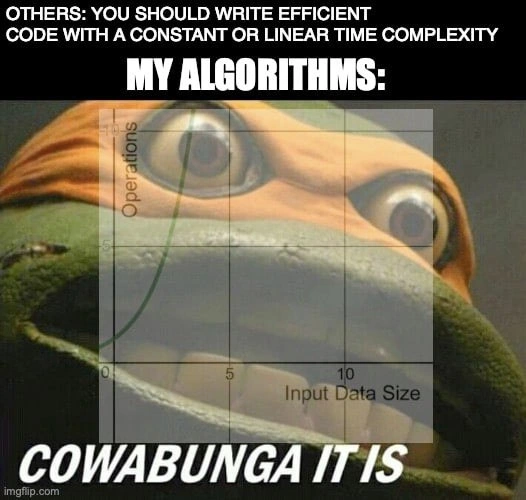
Now, exponential time complexity, like $O(2^n)$, is a whole different beast. “Exponential” means the growth curve is more like doubling the work for each additional input element (or something similarly explosive). If 10 items take, say, 1024 steps (because $2^{10}=1024$), then 11 items would take about 2048 steps ($2^{11}$), and 20 items would shoot up to about one million steps ($2^{20} \approx 1,048,576$). You can see how quickly that blows up! The faint plot in the image illustrates this: the x-axis is labeled "Input Data Size" and the y-axis "Operations". The green curve starts off shallow but then skyrockets upward as it moves right. That steep upward turn is exactly what an exponential (or otherwise super-linear) curve looks like. In contrast, a linear $O(n)$ graph would look like a straight diagonal line (steady growth), and a constant $O(1)$ would be a flat horizontal line (no growth). Michelangelo’s mischievous grin is overlaid on that steep curve, implying “Yup, that crazy rising line is my doing!” It’s a performance issue waiting to happen.

Let’s clarify with simple examples of complexity:

  • O(1) – Constant Time: An example is accessing an array element by index. No matter if your array has 10 elements or 10 million, doing something like x = myArray[0] takes the same amount of steps (basically one step). It’s constant.
  • O(n) – Linear Time: An example is a loop that goes through each element of a list to maybe sum them up or print them. If the list doubles in size, the work (looping) doubles in time. That’s linear growth – it scales in direct proportion.
  • O(2^n) – Exponential Time: A classic example is recursively generating all subsets of a set with n elements. If you have 3 items, there are $2^3 = 8$ subsets to list out; if you have 4 items, $2^4 = 16$ subsets; 10 items would already be $2^{10} = 1024$ subsets. The work doubles with each new element because you essentially explore two possibilities (include or exclude each item) for every item. Another simpler example is the naive Fibonacci recursive algorithm – it recomputes a lot of the subproblems and ends up taking exponential time. These algorithms start feeling painfully slow as n grows.

To visualize, here’s a quick comparison table of growth rates:

Complexity Name If n = 10 steps… If n = 20 steps…
O(1) Constant time ~1 step (unchanging) ~1 step (still constant)
O(n) Linear time ~10 steps ~20 steps (double n, double steps)
O(2^n) Exponential time ~1024 steps ($2^{10}$) ~1,048,576 steps ($2^{20}$) 😱

In the table above, you can see how exponential time blows up dramatically: going from n=10 to n=20 multiplies the work by about 1024 times! That little scream face is basically how a developer feels when they realize their program’s runtime curve looks like a rocket launch 🚀.

So, when the meme says “Others: you should write efficient code with constant or linear time complexity”, it means the smart folks (like mentors or team leads) are advising: keep the algorithm scalable. “Constant” or “linear” are mentioned because those are ideal or at least acceptable growth rates for most tasks. The second line, “MY ALGORITHMS:” with the crazy graph is the punchline: this developer’s code is nowhere near constant or linear – it’s probably exponential (or at least some super-linear monstrosity). The bottom caption “COWABUNGA IT IS” is them proudly (and comically) embracing this inefficient solution.

This is a coding humor mashup of tech and pop culture. The Teenage Mutant Ninja Turtles reference is key: Michelangelo, one of the ninja turtles, is known for saying “Cowabunga!” when he’s about to do something radical (extreme or just plain silly fun). Here, the developer is essentially channeling that energy – knowingly doing something that is technically a bad idea but shouting “why not, let’s do it!” anyway. It’s an inside joke among programmers: we know you should usually optimize the algorithm, but we laugh at the caricature of someone who gleefully does the opposite. And to be fair, sometimes a junior dev might not realize how bad an exponential algorithm is until they learn the hard way – so it’s also a bit of an educational meme. The tags like EfficiencyInCoding and PerformanceTradeoffs are touched on: the efficient approach vs. the quick-and-dirty approach that trades performance for ease. The meme exaggerates the trade-off to the extreme (linear vs exponential is not just a small trade-off, it’s huge).

In summary, the meme uses Big O notation concepts to set up the joke: $O(n)$ (good) versus $O(2^n)$ (bad, but oops we did it anyway). It’s bringing a dry technical topic – algorithmic efficiency – into a funny light. If you’ve just learned about Big O in class or encountered it in a code review, this meme is a tongue-in-cheek reminder: write efficient code... or else be ready to shout “Cowabunga!” and deal with the consequences.

Level 3: Brute Force Rebellion

Seasoned developers can’t help but chuckle (and cringe) at this scenario. It captures a familiar pattern in developer humor: the rebellious coder who ignores performance best practices out of bravado, ignorance, or crunch-time desperation. The top banner – “OTHERS: you should write efficient code with a constant or linear time complexity” – sounds exactly like a senior engineer or professor pleading during a code review or a algorithms class. They’re effectively saying, “Please don’t write something that will blow up when our data grows. Optimize it now.” Constant time $O(1)$ is the holy grail of efficiency and linear time $O(n)$ is usually considered very acceptable for most tasks. These are the PerformanceTradeoffs everyone is willing to make for scalable software.

Then we have “MY ALGORITHMS:” followed by Michelangelo’s face and that terrifying performance graph. This is the coder’s retort: a proud, not-so-subtle inefficient_algorithm_pride. It’s the software equivalent of a mischievous grin while deploying a known bad idea. Michelangelo – the orange-masked Ninja Turtle known for his catchphrase “Cowabunga!” and carefree attitude – is a perfect avatar here. His wide-eyed, reckless grin screams “I know this is wild, but I’m doing it anyway!” The meme is essentially portraying a developer who writes a brute force solution (perhaps out of convenience or lack of time) and knowingly ships it, jokingly embracing the chaos that will ensue with the words “COWABUNGA IT IS.” It’s a form of algorithm humor where the dev is almost proud of the absurd inefficiency, as if it were an extreme sport.

Why is this funny to experienced programmers? Because many have been there – or have had to maintain someone else’s “cowabunga” code. Maybe it was a recursion that exploded exponentially (like the naive Fibonacci calculation that calls itself twice per step), or a triple nested loop that worked fine in testing but dragged production to a crawl. We’ve seen the PerformanceIssues: the web request that times out, the report generation that never finishes, the UI that freezes on larger datasets. The humor is a mix of schadenfreude and commiseration. We all know that sinking feeling when a seemingly harmless piece of code blows up in complexity. And we also remember times when, under pressure, we wrote something ugly just to get the job done, convincing ourselves, “It probably won’t need to handle too much data… hopefully.” This meme exaggerates that mindset to comic effect.

There’s also a cultural reference at play: “Cowabunga it is” as a meme catchphrase has been used to signify joyful acceptance of a risky or dumb plan. In developer culture, it often captions screenshots or jokes about doing something against best practices (like pushing to main on Friday, disabling tests to hotfix, or in this case, using a wildly inefficient algorithm). The Teenage Mutant Ninja Turtles reference (a definite teenage_mutant_ninja_turtles_reference) gives it a nostalgic, absurd flavor — mixing childhood cartoon excitement with dry technical subject matter. It’s the contrast between the serious tone of “You should write efficient code…” and the cartoonish “Cowabunga!” that delivers the punchline.

Importantly, the meme isn’t just mocking one silly developer – it’s poking fun at a broader truth in software development: performance trade-offs are often overlooked until it’s too late. In real life, a team would beg for an $O(n)$ solution if someone proposed a brute force algorithm, because we know scaling pains are real. But sometimes the warnings go unheeded. The result? Perhaps nothing immediate in a small test, but as soon as that code hits a real-world sized input, performance issues strike. The system might exhaust CPU, run for ages, or even crash. The meme’s dark comedy is that the developer seems almost cheerfully aware of this fate. It’s a “rage against the algorithmic machine” moment – knowingly defying the laws of computational scalability with a grin. For any senior engineer who’s fought fires caused by poor algorithmic choices, Michelangelo’s crazy eyes in front of an exponential curve is hilariously on-point. It’s a reminder that, sometimes, efficiency in coding isn’t just academic nitpicking – it’s the difference between an app that scales and one that spectacularly doesn’t. And yet, here we are, shipping the unscalable solution with a carefree “Cowabunga!” – what could possibly go wrong?

Level 4: Combinatorial Explosion

In the realm of algorithm complexity analysis, this meme highlights a classic theoretical blunder: shipping code with exponential time complexity when a linear or constant time solution is desired. In Big O notation terms, the team is begging for an algorithm that runs in $O(n)$ or $O(1)$, but the developer delivers one that likely runs in $O(2^n)$ (or worse). From a computer science fundamentals perspective, this is like choosing brute force enumeration over an elegant polynomial-time solution. Why is that such a big deal? Because exponential growth causes a combinatorial explosion: the number of operations balloons dramatically even with small increases in input size.

Consider the math: a linear $O(n)$ algorithm might require, say, 100 steps for 100 items, while an exponential $O(2^n)$ algorithm might need on the order of $2^{100}$ steps for the same 100 items – an astronomically large number (more than $10^{30}$). No amount of hardware or optimization tricks can save an algorithm with such explosive growth once n gets moderately large. This ties into complexity theory concepts like P vs NP: many intractable problems have brute-force solutions that are exponential, and it’s a fundamental truth that beyond a certain input size, those solutions become effectively impossible to run in reasonable time. Here, the meme humorously depicts a developer gleefully ignoring these theoretical limits, much like a daredevil ignoring the laws of physics. Michelangelo’s wild-eyed grin superimposed on that steep green curve (operations vs input size) is a cartoonish representation of exponential time complexity in action. The graph itself is essentially an algorithm performance plot, and the steep curve suggests super-linear growth – the hallmark of an exponential or factorial runtime.

The phrase “Cowabunga it is,” coming from Michelangelo of the Teenage Mutant Ninja Turtles, adds a twist of irreverence to this serious CS concept. It’s as if the developer is joyfully exclaiming, “Forget elegant algorithms and efficient runtime – let’s brute force it, dude!” From an academic standpoint, this scenario is both hilarious and horrifying. It’s hilarious because it flagrantly violates the wisdom ingrained in every computer science curriculum about avoiding performance pitfalls. Yet it’s horrifying because, in practice, deploying an exponential-time algorithm can bring a system to its knees. The meme perfectly blends algorithm humor with fundamental theory: it’s basically a nod to every theoretical computer scientist’s nightmare – someone yelling “Cowabunga!” and diving head-first into an $O(2^n)$ solution despite all the warnings.

Description

This is a meme featuring a close-up, intense-looking face of Michelangelo from Teenage Mutant Ninja Turtles. The top text reads, 'OTHERS: YOU SHOULD WRITE EFFICIENT CODE WITH A CONSTANT OR LINEAR TIME COMPLEXITY'. Below this, 'MY ALGORITHMS:' is written. Superimposed over the turtle's face is a graph showing exponential growth, with the y-axis labeled 'Operations' and the x-axis 'Input Data Size'. The curve rises sharply, indicating a highly inefficient algorithm. The bottom text emphatically states, 'COWABUNGA IT IS'. The meme humorously contrasts the recommended best practice of writing efficient code (O(1) or O(n)) with the reckless reality of implementing an algorithm with terrible, exponential time complexity (like O(2^n) or O(n!)), embracing the resulting chaos with the turtle's signature catchphrase


Comments

12
Anonymous ★ Top Pick Some developers aim for O(n log n). My latest creation is O(OMG), where the complexity is directly proportional to the amount of screaming from the SRE team
  1. Anonymous ★ Top Pick

    Some developers aim for O(n log n). My latest creation is O(OMG), where the complexity is directly proportional to the amount of screaming from the SRE team

  2. Anonymous

    I told the team our new feature is O(2^n); product loved the roadmap, finance loved the n=5 demo, and now AWS loves us so much they’re sending personalized thank-you invoices

  3. Anonymous

    After 15 years of optimizing distributed systems, you finally achieve O(log n) complexity everywhere... then the junior's PR adds a recursive setTimeout inside a forEach loop, and suddenly you're explaining why the AWS bill looks like a phone number

  4. Anonymous

    When your algorithm's time complexity curve looks like a hockey stick and your production data just hit the inflection point, but the sprint's already over and you've moved on to the next feature. Sure, it works fine with the 10 test records in dev - who could have predicted users would actually *use* the system at scale?

  5. Anonymous

    I call it amortized exponential: O(1) during the demo, O(2^n) by Q4

  6. Anonymous

    Big-O: O(1) on the whiteboard, O(n^2) in the repo, O($$$) on the cloud bill

  7. Anonymous

    O(n) on whiteboard, O(2^n) in prod - the true ninja way to scale your tech debt exponentially

  8. @lord_nani 5y

    n^(e^e)

  9. Сифуд Кстолу 5y

    Write algorithms with complexity N! N!! N!!! Carl!

    1. dev_meme 5y

      🌚🌚🌚 «N!»?

  10. Сифуд Кстолу 5y

    https://en.wikipedia.org/wiki/Factorial

    1. @bit69tream 5y

      gitlab.com/bit9tream/kfib

Use J and K for navigation