When your 'critical' feature gathers dust in the product analytics dashboard
Why is this Management PMs meme funny?
Level 1: No One Wants to Play
Imagine you have a friend who is absolutely sure that everyone in your class will love a new game. He begs the teacher to get this game for recess, saying “We really, really need this! It’s going to be the most popular game ever.” Finally, the game arrives and you set it up on the playground. But then a funny thing happens: nobody comes to play it. All the other kids keep playing their usual favorite games, and that brand-new game just sits there untouched. Your friend is left standing by this unused game, feeling a bit silly because he was so certain it was necessary. It’s kind of funny in that “oops” way. The lesson? Just because someone insists that something is super important doesn’t mean everyone else will think so – sometimes you only find out after you’ve got the whole thing ready and realize no one really wanted it.
Level 2: Feature Creep 101
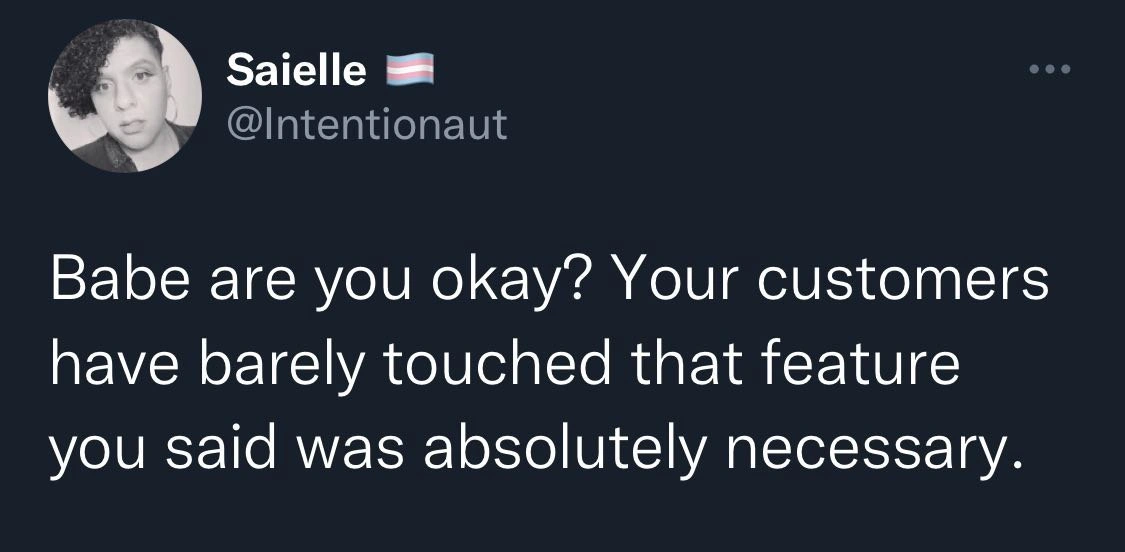
Let’s break down what’s happening here in simpler terms. In a software team, a stakeholder (often a product manager, client, or boss) insists that a certain new feature is absolutely critical. They’re basically saying, “We must have this function; it’s super important!” The development team works hard and adds this feature to the product. Now, after some time, we check the product analytics dashboard – a tool that shows how users interact with the app, what they click on, how often they use each part. And guess what? Those analytics show almost no one is using this so-called “critical” feature. The customers have barely touched it. The feature is just sitting there, kind of gathering dust in the interface, while users ignore it. The meme is pointing out this funny and frustrating situation with a sarcastic “Babe, are you okay?” directed at the person who demanded the feature. It’s like gently teasing them for being so wrong about how “necessary” it was.
Now, a few terms coming out of this scenario: Product management is the field where people decide what features a product should have and prioritize them. A good product manager tries to align features with what customers truly need. But when there’s a lot of stakeholder pressure (for example, a CEO or a big client pushing their idea), teams can fall victim to feature creep. Feature creep means extra features keep creeping into the product beyond the original plan – often more than necessary. It usually happens because people keep saying “oh, it would be nice if it also did X!” or “Competitor has Y, we should too,” until the product is bloated. Here, feature creep manifested as adding an “absolutely necessary” function that, in reality, nobody asked for. This leads to misaligned expectations: the stakeholders expected users to love and use the feature, but the users’ behavior didn’t match that expectation at all. The term Requirements vs Reality sums it up – what was required (or requested) versus what actually happened. And those customer usage metrics (the numbers on that analytics dashboard showing user activity) are the hard evidence. If only 1% of users click a feature, that data is telling you it’s not as important as someone thought. Early in your career, you might encounter this when a higher-up says “we need this done ASAP for our launch,” so you build it, and later you see the logs or analytics and realize almost no one uses it. It’s a bit deflating, but also a valuable lesson: just because someone thinks a feature is critical doesn’t automatically mean customers will care about it.
The meme’s scenario is a gentle introduction to the reality of building products: always check your assumptions. Good product teams will do product discovery – like user research, surveys, or beta tests – to see if customers truly want a feature before dedicating a ton of time to it. When that step is skipped or ignored, you get situations like this: a “critical” feature launch followed by an awkward silence from the users’ side. As a junior developer, it teaches you to pay attention to actual user feedback and data. It’s also a hint that sometimes you’ll build things due to StakeholderPressure, and part of your job is navigating that carefully – maybe even raising a polite question like, “Are we sure users need this?” The bottom line is that it’s better to have a few features people love than a pile of features nobody uses. This meme is a lighthearted warning: avoid the trap of blindly chasing every idea that higher-ups label “must-have,” or you might end up with a lot of code (and work) that doesn’t make anyone’s life better.
Level 3: Roadmap to Nowhere
If you’ve ever shipped a must-have feature that landed with a thud, this meme hits home. It depicts that classic gulf between StakeholderExpectations and reality. A product manager (or other stakeholder) swore up and down that a new button was “absolutely necessary” — the kind of feature request that gets flagged as critical on the roadmap amidst much fanfare and StakeholderPressure. So the dev team obligingly pours weeks of effort into building it. Fast forward to after release: the product’s analytics dashboard reveals it’s an unused feature, practically a ghost town. The tweet’s tone — “Babe, are you okay?” — sarcastically comforts the overzealous PM while highlighting their false must-have confidence. It’s a combination of schadenfreude and sympathy: we feel for the person who championed the feature, but we’re also smirking because the customer usage metrics don’t lie. It’s an ouch moment every seasoned dev and product lead recognizes, a textbook Requirements vs Reality smackdown.
Why is this so humorous (and painful)? Because it satirizes feature overreach in modern Product Management. We’ve all seen perfectly fine products slowly succumb to FeatureCreep: layer upon layer of “necessary” additions pushed by someone important. The meme condenses that whole saga into one biting line. The product analytics dashboard collecting dust is the final verdict on misjudged priorities. It’s essentially saying, “Remember that feature you insisted on? Turns out nobody wanted it.” Oof. This happens in real life with alarming regularity. A HiPPO (Highest Paid Person’s Opinion) can override user research, leading to a feature built on gut feeling rather than actual need. The result? A shiny new UI element that users click once (if at all) before returning to the features they truly value. Picture a tumbleweed rolling past that fancy new menu item — analytics_dashboard_sadness indeed.
In practice, this scenario often starts with good intentions but ends in roadmap regret. Maybe a big client or executive demanded the feature, or a competitor had something similar so the team felt compelled to match it. These “strategic” additions get labelled critical to justify the rush. Developers grumble but implement it, hoping usage will prove them wrong. Then launch day comes and… crickets. The feature usage graph flatlines near zero. In sprint demos it looked flashy; in production it’s basically invisible to customers. The humor here is darkly universal: everyone in the room remembers the PowerPoint slides proclaiming how this would boost engagement, and now they’re staring at metrics that barely register a pulse. It’s product_discovery_failure in hindsight. The gap between the StakeholderPressure that birthed the feature and the apathetic user response is almost comedic — if it weren’t such a waste of effort.
For senior engineers and product folks, this meme triggers war stories. Remember the time you spent two extra sprints building that absolutely necessary integration nobody ended up using? The code is still there, needing maintenance and bug fixes, yet almost no customers invoke it. It’s the Feature Graveyard effect: features live on as bloated menu items and code paths that complicate the system, all for negligible benefit. Removing it is politically tricky (“we invested in that, what if someone complains?”), so it lingers as a monument to misaligned decision-making. This is how tech debt and bloat accumulates — not just through old code, but through misaligned expectations crystalized into features that never justified themselves. The meme’s joke shines a light on this dysfunction with one playful, biting sentence. It’s a senior-level reminder that building something “because someone important said so” without validating user need is a risky bet. Sometimes the real critical feature is the one you don’t build, avoiding clutter and focusing on what users actually want.
Description
The image is a dark-mode Twitter screenshot. In the upper left is a circular avatar with the face blurred. The display name reads “Saielle 🏳️⚧️” and the handle beneath it is “@Intentionaut.” Centered below, in large white tweet text, it says: “Babe are you okay? Your customers have barely touched that feature you said was absolutely necessary.” The minimal UI includes three horizontal dots in the upper-right corner, typical of Twitter’s menu icon. Technically, the meme pokes fun at product managers and stakeholders who insist on shipping ‘must-have’ functionality that real-world usage analytics later show almost nobody clicks, highlighting classic issues of feature creep, misaligned requirements, and the gap between roadmap hype and customer behavior
Comments
6Comment deleted
Our “mission-critical” feature now has exactly two DAUs: the synthetic uptime check and the PM refreshing Mixpanel to prove it was worth the two-quarter death-march
After 20 years in tech, you realize the most critical feature is always the one nobody asked for but the VP saw at a competitor's demo last week - and it'll have a 0.3% adoption rate while consuming 40% of your sprint capacity for the next quarter
This hits different when you've spent three sprints building that 'absolutely necessary' feature, complete with A/B tests, feature flags, and comprehensive monitoring - only to watch the usage metrics flatline at 0.3% adoption while the PM pivots to the next 'game-changing' initiative. At least the observability stack you built to track the feature nobody uses is getting plenty of traffic
It’s okay - the feature was for our real user: Procurement; the KPI was “checkbox on the RFP,” and adoption is 100% in the sales deck
PM: 'Table stakes!' Amplitude: 0.001% DAU. Meet the new ghost in the feature machine
We burned a quarter on a HiPPO ‘must-have’ - telemetry shows DAU is two: QA and the PM refreshing the dashboard