Skip to content
DevMeme
5868 of 7435
When analogies about type-1 hypervisors go completely off the rails
Virtualization Post #6427, on Nov 25, 2024 in TG

When analogies about type-1 hypervisors go completely off the rails

Why is this Virtualization meme funny?

Level 1: Brains vs Computers

Imagine your friend loves computers a lot – so much that they try to describe everything in computer terms. Now say you’re talking about a person who sometimes seems to have more than one personality. Suddenly your friend says, “Wow, that person is like a computer running multiple operating systems at once!” That’s a pretty strange thing to say, right?

In this meme, one character (Jesse) does exactly that: he uses a super technical computer idea (a “hypervisor” which is something that lets one computer act like many computers) to describe a mental condition. The other character (Walter) looks at him completely confused and basically responds, “What on earth are you talking about?!” Walt is baffled because Jesse’s comparison is way too weird. It’s as if Jesse said some random gibberish.

The funny part is the mismatch. Jesse tried to sound clever by comparing a human mind to a complex computer system, but instead he just made things more confusing. It’s a silly mix-up of two totally different worlds. Even if you don’t get the tech words, Walter’s face and reply make it clear that Jesse’s idea is off-the-wall. We laugh because we’ve all heard odd explanations or comparisons that just don’t fit – and seeing Walter so dumbfounded really captures that feeling. In simple terms, it’s humor from one friend using crazy computer talk to describe something about people, and the other friend reacting like, “Huh? That makes no sense at all!”

Level 2: Hardware vs Headspace

Let’s break down the jargon in this meme, because it’s a mash-up of computer science terms with a psychology reference:

  • Schizophrenia – A serious mental disorder that affects how a person thinks, feels, and behaves. It often involves hallucinations or delusions. (It’s commonly mistaken for “split/multiple personalities,” although that’s actually a different condition. In the meme, Jesse is essentially talking about someone having multiple personalities.)
  • Operating System (OS) – The main software that runs on a computer and manages all the hardware, like Windows, macOS, or Linux. An OS controls things like memory, files, and programs, and provides a user interface. Think of it as the personality of a computer that makes it usable.
  • Hypervisor – Software (or a tiny operating system itself) that allows you to run multiple computers within one computer. More specifically, a hypervisor creates and manages virtual machines. Each virtual machine can run its own OS as if it were on a real, separate computer. Essentially, a hypervisor is a virtualization tool – it tricks one physical machine into acting like many independent machines.
  • Type-1 Hypervisor – This is a category of hypervisor that runs directly on the physical hardware, without needing a normal OS underneath. It’s often called a “bare-metal” hypervisor. For example, if you install VMware ESXi on a server, ESXi itself is the only thing running on the hardware and it solely exists to host virtual machines. (In contrast, a “type-2” hypervisor like VirtualBox runs on top of an existing OS like Windows – it’s one layer above the hardware.)
  • Multiple instances at the same time – In computing, an instance usually means one independent running copy of something (like an OS, an app, etc.). Running multiple instances of an OS means you have several OSes running concurrently on one physical machine, typically achieved via a hypervisor/virtualization. For example, a single server might run 10 instances of Linux simultaneously, each in its own virtual machine. Here, Jesse is comparing each “personality” in the patient to an instance of an OS running at the same time.

Now, in the meme’s dialog, Jesse says: “Schizophrenia is a type 1 hypervisor… If a personality can be described as an OS and the patient can have multiple instances at the same time, technically they are a hypervisor.” He’s basically proposing an analogy: imagine a person’s mind is like a computer. In this analogy:

  • Each personality = one Operating System instance (like one OS running on a machine).
  • The person (with schizophrenia) = the hypervisor that manages these multiple OS/personalities on the hardware of their single brain/body.

So, if a patient has several distinct personalities “running” in one brain, Jesse jokes that the person is functioning like a hypervisor hosting virtual machines. And he specifically says type-1 hypervisor to imply it’s running on “bare metal” (the brain is the hardware, and the person’s mind is directly managing the personalities). It’s a very literal interpretation: multiple personalities at once = multiple OS at once, therefore the thing hosting them must be a hypervisor.

Why does Walter react so strongly? Because this analogy is really far-fetched. It’s a huge mix-up of computer terms with human psychology. Telling someone “you’re a type-1 hypervisor” is not normal by any means — it sounds like gibberish if you’re not deep into tech lingo. Even if you are tech-savvy, the comparison is absurd. A human brain isn’t actually like a computer running virtual machines in a data center. Schizophrenia (or multiple personality disorder) doesn’t work in clean, discrete units like software does. So Walter (the bald, glasses-wearing character, who in the show Breaking Bad is a chemistry teacher with a very no-nonsense attitude) just sits there, baffled, and eventually goes, “Jesse, what are you even talking about?!” His face tells us that Jesse’s explanation sounds crazy.

The humor here is that an extremely nerdy metaphor is used in a casual conversation where it absolutely doesn’t fit. It’s tech humor: you have to know what a hypervisor and an OS are to get why it’s funny. If you know those, you immediately see that calling a mental condition a “hypervisor” is a nonsense cross-reference. It’d be like someone saying, “My friend has so many thoughts at once, he’s basically a cloud computing platform.” It’s a playful but nonsensical way to describe a serious thing.

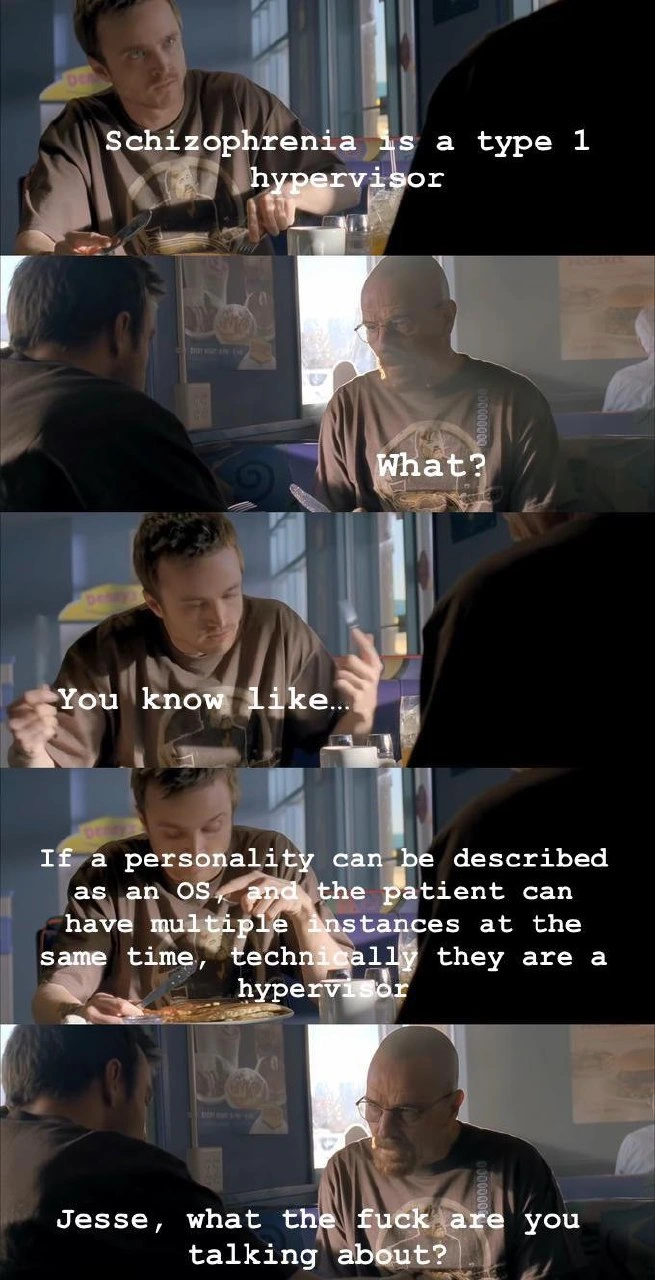
Also, note the meme format: it’s using a scene from Breaking Bad (a popular TV show). Jesse Pinkman (the younger guy with the fork, speaking) often says off-the-wall things, and Walter White (the older bald guy) often reacts with disbelief or annoyance. This scene’s captions are repurposed for the joke:

  • In the first panel Jesse confidently delivers the bizarre line: “Schizophrenia is a type 1 hypervisor.” He looks earnest, as if he’s explaining a genius idea over breakfast.
  • Walt responds with “What?” – a one-word question, indicating he has no clue what Jesse is on about.
  • Jesse then tries to clarify (panels 3 and 4) with the whole explanation about personalities as OS instances and the patient being a hypervisor. He’s basically doubling down on the analogy, using more virtualization jargon to make it “clearer.” Of course, this only makes it more confusing to poor Walt.
  • In the final panel, Walt drops the famous line, visibly flabbergasted: “Jesse, what the f** are you talking about?”* That’s the punchline of the meme. Even without knowing much tech, you can tell Walt is just completely lost and a bit irritated. With the tech knowledge, we understand why he’s lost: Jesse’s explanation was a word salad of misapplied computer science terms.

For a junior developer or someone new to these concepts, the takeaway is: hypervisors and virtualization belong to computing, not people. A hypervisor is a real thing that lets one machine run many OS – imagine you open something like VMware and see Windows and Linux both booted up in separate windows on the same PC, that’s virtualization in action. But saying a person is a hypervisor because they have multiple personalities is just a goofy, literal-minded analogy meant to provoke a laugh. It’s the kind of joke you might hear in a programmers’ chat room, where someone takes a technical concept and applies it to something absurd. Walter’s reaction grounds the scene in reality: basically telling us, “Nope, that analogy makes no sense.” And that contrast is what makes the meme entertaining.

Level 3: Virtual Insanity

Walter White: “Jesse, what the fuck are you talking about?”

That iconic line from Breaking Bad doubles here as the voice of reason — and the collective facepalm of the tech community. This meme delivers its punch by showcasing a classic tech jargon overdose. It’s poking fun at how developers can stretch an analogy so far that it snaps, leaving everyone (including seasoned engineers) both bemused and bewildered.

Why do experienced devs find this so funny? Because we’ve all encountered this scenario: someone enthusiastically uses a fancy technical concept completely out of context. It’s that mix of “I see what you were going for” and “No… just no.” In the software world, analogies are a double-edged sword. On one hand, we love them — explaining complex systems by saying “the CPU is the brain of the computer” or “threads are like workers on an assembly line.” But on the other hand, we sometimes get carried away. Here, Jesse’s comparing a mental disorder to a hypervisor, which is the kind of leap only a sleep-deprived sysadmin or an overzealous junior might attempt as a joke (or misunderstanding). It’s an overextended metaphor writ large. Walter (the older, more grounded character) reacts with pure confusion and exasperation, much like a senior engineer hearing a ridiculous design idea in a meeting: “What on earth are you talking about?!” His baffled look is every code review comment that ever read, “This doesn’t make any sense.”

The humor lands especially well for folks into Virtualization and OperatingSystems. We spend so much time with precise definitions — a hypervisor is a carefully crafted piece of software that demands respect. It’s not a term you throw around lightly in unrelated contexts. So when Jesse labels schizophrenia as a type-1 hypervisor, it’s comically jarring. Imagine someone at the lunch table saying, “My toddler’s tantrums are basically a race condition in a distributed system” — that’s the vibe here. As seasoned devs, we recognize immediately that Jesse is stringing together buzzwords without a grounding in reality. The dissonance is gold: tech humor often lives in that gap between literal technical meaning and absurd re-interpretation. In this case, the virtualization jargon is so misplaced that it circles back to being brilliant comic nonsense.

This meme also plays on the well-known personalities of the Breaking Bad characters as a canvas for developer humor. Walter White stands in as the voice of the no-nonsense senior engineer or the exasperated colleague, while Jesse Pinkman is the excited junior dev or the friend who’s just learned a cool tech concept and insists on applying it everywhere. In the show, Walt is often a mentor figure who gets frustrated with Jesse’s goofy analogies and half-baked ideas — a dynamic that maps surprisingly well to a senior/junior engineering duo. The caption “Jesse, what the fuck are you talking about?” is a meme in its own right, often used to react to any off-track idea. In a software team setting, it’s basically the response you’d have if someone blurted out a completely off-the-wall solution during stand-up. (We’ve all been either the Jesse or the Walt in such moments!)

From an industry perspective, the meme lightly satirizes how techies sometimes nerd-splain things. We’ve seen it happen: a developer tries to describe human behavior or daily life with computing terms — sometimes it’s clever, but other times it earns blank stares. This post’s title even acknowledges that meta-humor: “analogies about type-1 hypervisors go completely off the rails.” That phrasing winks at the audience, saying: Yep, we know this comparison is bonkers. The meme is essentially a gentle roast of that one friend or coworker who can’t drop the tech lens even while discussing something like psychology. It’s making fun of us tech folk in a loving way. After all, who else would laugh at a joke equating systems programming concepts with a psychiatric condition? Only a crowd that knows terms like hypervisor, instance, and kernel — and also knows not to use them at your therapy session!

In sum, experienced developers laugh because the meme captures an inside joke about our habits: taking a very niche technical concept and shoehorning it into an everyday scenario where it absolutely doesn’t belong. It’s virtual insanity — both literally (talking virtualization in a crazy context) and as a nod to how insane the analogy is. Walter’s incredulous face is basically our collective sane voice saying, “Computers are powerful, metaphors are useful, but Jesse… this is not how any of this works.” And that clash — between tech seriousness and absurd application — is what makes it so ridiculously funny.

Level 4: Bare-Metal vs Bare-Mental

At the most granular technical level, the meme’s analogy crashes into the laws of virtualization and Operating Systems design. A type-1 hypervisor (AKA a bare-metal hypervisor) is a highly privileged software layer that runs directly on physical hardware, managing one or more guest Operating Systems (OS). In traditional terms, the hypervisor is like an ultra-minimal OS whose sole job is to host other full OS instances. Unlike a type-2 hypervisor (which runs on top of a normal host OS like any application), a type-1 hypervisor has near-total control of the machine from the outset. It operates at the highest privilege level (often called ring 0 or even ring -1 with modern CPU virtualization extensions), meaning it intercepts hardware access and handles resource allocation for each virtual machine.

To pull this off, a hypervisor employs serious low-level wizardry:

  • CPU virtualization – The hardware (with technologies like Intel VT-x or AMD-V) allows trapping of privileged instructions. When a guest OS tries to execute something sensitive (like modifying page tables or I/O control), the CPU can trap it and let the hypervisor handle it. This ensures each guest OS can think it has its own CPU, while in reality the hypervisor is scheduling time slices or parallelizing guests across cores.
  • Memory virtualization – Ever wonder how multiple OSes each believe they have, say, the same physical memory address 0x100000? The hypervisor uses techniques like extended page tables (EPT) or shadow page tables to give each OS its own virtual memory mapping. One guest’s “physical” memory is actually a chunk of real RAM allocated by the hypervisor, isolated from other guests. This is as if each OS lives in its own memory sandbox – strong isolation is key.
  • Device and I/O virtualization – The hypervisor also intercepts and emulates or passes through hardware devices. For example, multiple virtual machines (VMs) might share one physical network card; the hypervisor tricks each OS into believing it has a dedicated NIC, arbitrating access under the hood.

All of this rests on formal foundations. In fact, Popek and Goldberg’s virtualization criteria (1974) describe the conditions for a system to be a true hypervisor: the hypervisor must provide an environment for programs (guest OSes) essentially identical to real hardware (equivalence), must retain ultimate control over hardware (resource control/safety), and should let most instructions run natively for speed (performance). Type-1 hypervisors like VMware ESXi, Microsoft Hyper-V, or open-source Xen hypervisor meet these criteria by running directly on the machine with minimal overhead, achieving near bare-metal performance for VMs. They are a triumph of systems engineering, enabling one server to host many isolated OS instances as if each were on its own hardware.

Now, consider Jesse’s wild claim: “Schizophrenia is a type 1 hypervisor.” He’s effectively positing that a human mind (the person with the condition) can host multiple “guest personalities” the way a bare-metal hypervisor hosts multiple OSes. If we map the analogy: each personality = an OS instance, and the individual’s brain = the bare-metal hardware + hypervisor controlling those OSes. In Jesse’s imaginative mash-up, a person suffering from schizophrenia (or more accurately, someone with dissociative identity disorder, since he’s talking about multiple personalities) would be a bare-mental hypervisor (pun fully intended 😄): a being that directly runs multiple independent operating systems (identities) on the “hardware” of their single brain. It’s a massive conceptual leap across domains – essentially treating the human brain as a multi-VM server.

From a strict systems programming and neuroscience standpoint, this analogy doesn’t hold water. A biological brain doesn’t have a literally partitioned instruction set or a trap-and-emulate mechanism to neatly containerize distinct “OS” personalities. There’s no known brain equivalent of privileged CPU rings or a system call interface that one personality can’t cross into another’s memory space – the mind is far more intertwined and analog. If we were pedantic CS professors: a human personality doesn’t satisfy isolation or state encapsulation the way a VM does. There’s constant interplay of thoughts and memories; even in genuine multiple personality disorders, the separation is psychological, not a clean hardware-enforced isolation. The hypervisor analogy fails every formal virtualization criterion: the personalities aren’t running in true hardware isolation (they share one brain’s neural network), the “hypervisor” (the patient) doesn’t have a well-defined execution mode to control these personalities cleanly, and you certainly can’t context-switch identities with precise timing interrupts! In short, Jesse’s statement triggers a segmentation fault in logic.

To appreciate just how absurd it is, imagine implementing this in code:

// Hypothetical "brain hypervisor" pseudocode (just for fun)
init_hardware_brain();                        // Initialize brain hardware resources
launch_guest_OS("Personality A");             // Load first personality
launch_guest_OS("Personality B");             // Load second personality
// ...potentially more personalities as additional OS instances...
schedule_virtual_CPU_timeslice("Personality A");
schedule_virtual_CPU_timeslice("Personality B");
// In real hypervisors, each OS would run in isolation and get CPU time slices.
// In a human mind, personalities aren't so neatly scheduled or isolated!

The above pseudo-code is, of course, pure tongue-in-cheek fantasy. We cannot actually compartmentalize a mind with an API call or run multiple consciousness threads in parallel the way a hypervisor manages OS threads. This is where the humor springs from: Jesse is applying virtualization jargon in a context where it utterly breaks down. It’s a category error akin to saying “my car’s engine has a filesystem full of horses” – mixing metaphors across mechanical engineering and computer science to the point of nonsense. By dragging a type-1 hypervisor (a term normally confined to server rooms and OS textbooks) into a discussion about psychology, the analogy goes so far past the kernel boundary that it’s in uncharted (and hilarious) territory. It tickles the tech crowd because there is a geeky internal consistency to the analogy (“multiple OS instances” = multiple personalities, “runs on the bare hardware” = the brain), yet it’s unmistakably an overextended metaphor. The result is equal parts clever and absurd, a reminder that not every real-world phenomenon can be neatly virtualized.

Description

Five-panel Breaking Bad diner scene meme. Panel 1 shows Jesse gesturing with a fork over pancakes; white monospace caption: "Schizophrenia is a type 1 hypervisor." Panel 2 cuts to Walt staring, caption: "What?" Panel 3 returns to Jesse: "You know like…" Panel 4, still Jesse, continues: "If a personality can be described as an OS and the patient can have multiple instances at the same time, technically they are a hypervisor." Panel 5 shows Walt incredulous, caption: "Jesse, what the fuck are you talking about?" The humor hinges on misapplying virtualization terminology - type-1 hypervisors run operating systems directly on hardware - to a psychiatric condition, illustrating how engineers sometimes stretch tech metaphors far past the kernel boundary


Comments

9
Anonymous ★ Top Pick Somewhere a VMware TAM is rewriting the DSM-5 to include a vCenter licensing table
  1. Anonymous ★ Top Pick

    Somewhere a VMware TAM is rewriting the DSM-5 to include a vCenter licensing table

  2. Anonymous

    The real schizophrenia is running both VMware and VirtualBox on the same host because you have that one legacy VM that refuses to migrate and now your RAM is having an identity crisis

  3. Anonymous

    The real joke here is that a Type 1 hypervisor actually provides *better* isolation between instances than this analogy suggests - unlike the chaotic personality switching implied, proper hypervisors enforce strict resource boundaries and memory isolation. Though I suppose if you've ever debugged a VM escape vulnerability, the 'multiple personalities sharing the same hardware' comparison might hit closer to home than we'd like to admit

  4. Anonymous

    Schizophrenia: the bare-metal hypervisor hosting multiple personalities with zero host OS overhead - until the VMs fight over IRQ assignments

  5. Anonymous

    Well actually: if the brain is the host, it’s a Type-2 VMM - no VT-x, shaky isolation, and the scheduler keeps context-switching personas mid-sentence

  6. Anonymous

    Only architects try to model people as VMs - five minutes in, you’re debating NUMA, scheduler affinity, and whether therapy counts as vMotion

  7. @loomingsorrowdescent 1y

    Schizophrenia isn't DPD, dumbass

  8. @lilfluffyears 1y

    Dualboot

  9. @Hollow_Arigo 1y

    Mpreg

Use J and K for navigation