Skip to content
DevMeme
2025 of 7435
From elite hacker threats to googling 'declare variable in HTML'
Learning Post #2257, on Nov 6, 2020 in TG

From elite hacker threats to googling 'declare variable in HTML'

Why is this Learning meme funny?

Level 1: Big Talk, Small Steps

Imagine a friend bragging to you that her boyfriend is the greatest chef in the world who can cook any dish to perfection. She’s really confident and even warns, “Don’t mess with me or he’ll cook something so amazing it’ll blow your mind!” But then, peek into the kitchen and you see the boyfriend nervously flipping through a cookbook or Googling “how to boil an egg.” 😅 The big boast doesn’t match what’s actually happening. It’s funny because the girlfriend talks as if he has super abilities, but the poor guy is clearly just learning the basics. In the meme, the girlfriend claims her BF can “hack your world into oblivion” (like he’s some all-powerful computer genius), but in reality he’s simply trying to figure out something very basic on the computer. It’s the classic case of big talk versus little experience. We laugh because we see the huge gap between the threat and the reality – kind of like someone promising a knockout punch, then tripping over their own shoelaces. The joke reminds us that everyone starts somewhere, and sometimes people on the outside get a wildly wrong idea of what learning a skill really looks like.

Level 2: No Variables in HTML

Let’s break down why this situation is funny, in simpler terms. First, HTML stands for HyperText Markup Language. It’s the standard language for creating web pages, but it’s not a programming language at all – it’s a formatting language. HTML is all about defining the structure of a page (saying “this is a heading,” “this is a paragraph,” “this is an image here”). It doesn’t understand logic or calculations. There are no variables in plain HTML because you can’t store or manipulate data with HTML alone. A variable in programming is like a little container or label that holds a value (for example, a variable named score might hold the number 100). In languages like JavaScript or Python, you’d write something like var score = 100; or score = 100 to declare a variable. But in HTML, there’s no command or tag that does var something = value. The boyfriend’s Google search, “how to declare variable in HTML,” is a sign that he hasn’t yet learned that HTML can’t do that by itself. It’s a bit like someone trying to find out how to bake a cake using a microwave manual – they’re looking in the wrong place, because the tool (HTML) isn’t meant for that task.

So what would an experienced web developer do if they needed a variable on a web page? They’d use a programming language alongside HTML. On the front end (in the browser), the go-to language is JavaScript. You can embed JavaScript inside an HTML page using <script> tags, and within that script you can declare variables and add logic. For example:

<p id="greeting"></p>  
<script>  
  let userName = "Alice";  // This is a JavaScript variable, not HTML  
  document.getElementById("greeting").textContent = "Hello, " + userName;  
</script>

In this snippet, the HTML provides a placeholder <p> element, and the JavaScript fills it with “Hello, Alice”. The key point is that the HTML part alone can’t do the variable or the greeting logic – the JavaScript is doing that. Early in their learning, new developers often mix these ideas up. They might not realize there’s a separation between the page structure (HTML), the design (CSS), and the programming logic (JavaScript or other languages). The boyfriend in the meme likely just started with some frontend web development lessons and hit this confusion. It’s a common rookie question on forums: “How do I store a value or create a variable in HTML?” and the answer is always, “you can’t in HTML alone – you need a scripting language.”

Now, about the Googling part: It’s absolutely normal for someone learning to code (or even an experienced coder) to search for answers online. Programming isn’t about knowing everything off-hand, it’s often about knowing how to find what you need. Websites like Stack Overflow, MDN, W3Schools, and many others are treasure troves of answers. A junior developer might literally type a question like “how to center a div in CSS” or “how to declare a variable in JavaScript” into Google. In this case, the BF googled a very beginner question for HTML. It’s funny to us because it’s so basic, but we’ve all been there at some point. Every senior developer remembers googling things like “CSS background not showing” or “Python list iteration” when they were starting out. In fact, even seniors still google stuff — the difference is the questions get more specific (like the exact syntax for a certain function or how a cutting-edge library works). The meme plays on this JuniorVsSenior contrast: the outside world might think a programmer boyfriend is some tech wizard, but internally that “wizard” might be a regular guy still learning the ropes, with Google as his spellbook.

Finally, consider the girlfriend’s perspective. She says “my BF is a Programmer” as if that title alone means “expert hacker.” Non-technical people often lump all “computer people” together. There’s a bit of a gap between what non-tech folks expect and what developers actually do. She imagines “programmer” = can break into anything, wielding code like magic. But in reality, being a programmer could mean you build websites, or write apps, or just learned HTML yesterday. Her boyfriend in this meme is probably a beginner who maybe made a simple website, and she interpreted that as him being a world-class hacker. It highlights a charming misunderstanding: web development basics are being mistaken for elite hacking skills. So the humor is also educational – it implicitly tells us that HTML isn’t hacking, and knowing a bit of code doesn’t turn someone into an overnight cyber warrior. We’re laughing, but also nodding, because we know real WebDevelopment and programming is a gradual learning process, not instant superpowers.

Level 3: Hackers vs Hello World

At first glance, this meme sets up an epic hacker scenario and then subverts it with reality. The girlfriend boasts, “Don’t mess with me. My BF is a Programmer, he’ll hack your world into oblivion.” This line conjures a Hollywood-esque image of an elite hacker boyfriend — the kind who can bypass firewalls in seconds and bring down entire systems at will. But the punchline hits immediately: BF: (Google search) “how to declare variable in HTML.” The mighty cyber warrior is actually a confused newbie googling one of the most basic web development questions. The humor comes from this jarring contrast between imposter hacker expectation and the mundane truth.

For experienced developers, the joke lands on multiple levels:

  • Overhyped Hacker Stereotype: Non-technical people often dramatically overestimate what being a “programmer” means. The girlfriend’s threat is a perfect parody of that misunderstanding. It’s reminiscent of movie tropes where any coder furiously typing becomes a super-hacker. In reality, real hacking or advanced programming is specialized and tough – certainly not as trivial as movies make it. So when she says “hack your world into oblivion,” seasoned devs smirk because they know how absurd that sounds, especially in a casual context.
  • Relatable Newbie Moment: The boyfriend’s actual behavior – turning to Google for a basic question – is endearingly familiar. Every developer, junior or senior, has consulted search engines and Stack Overflow for help. In fact, a common piece of DeveloperHumor is that Googling is a programmer’s daily routine. Seeing “how to declare variable in HTML” instantly tells experienced folks that this guy is at an early stage of his LearningToCodeJourney. It’s a nod to the time when we all asked seemingly naive questions. (Even veteran coders sometimes google fundamentals they haven’t touched in a while – difference is, they usually know which language to ask about!) The meme exaggerates this by placing that trivial query right after a big boast.
  • HTML ≠ Real Programming: The specific query is the cherry on top. It highlights a classic beginner confusion: HTML (HyperText Markup Language) is a markup language, not a programming language. You cannot declare a variable in HTML – HTML is for structuring content on a webpage (like defining paragraphs, headings, links), and it has no concept of logic or variables. To a seasoned web developer, searching for a “variable in HTML” is a bit like looking for a steering wheel on a bicycle – you’re using the wrong tool for the job. There’s even an HTML <var> tag (just for styling text as a variable name in math/code examples), but it doesn’t create any actual variable in code. That nuance makes the boyfriend’s plight even funnier to those in the know: he’s trying to do something in HTML that fundamentally can’t be done in HTML alone. The proper solution would be to use a scripting language like JavaScript inside <script> tags if he wants variables, but clearly he hasn’t learned that yet.

All these layers combine to make the meme painfully funny to developers. It captures the exact moment where grandiose imposter_hacker_expectation meets humble reality. The girlfriend imagines her BF wielding keyboard-fu to “hack the planet” (cue the Hackers movie reference), but the BF is likely feeling a twinge of imposter syndrome, knowing he’s nowhere near that level. Seasoned coders laugh because they remember being in his shoes and because they’ve had to gently burst similar bubbles for non-tech friends (“No, I can’t hack your ex’s Instagram, and HTML won’t help me hack anything…”). It’s a comical snapshot of the Junior vs Senior gap and the disconnect between how outsiders see programming versus what it’s really like. The meme perfectly blends FrontendHumor with learning-phase nostalgia: the world thinks we’re ultra-powerful hackers, while we’re often just turning to Google, one simple question at a time.

Description

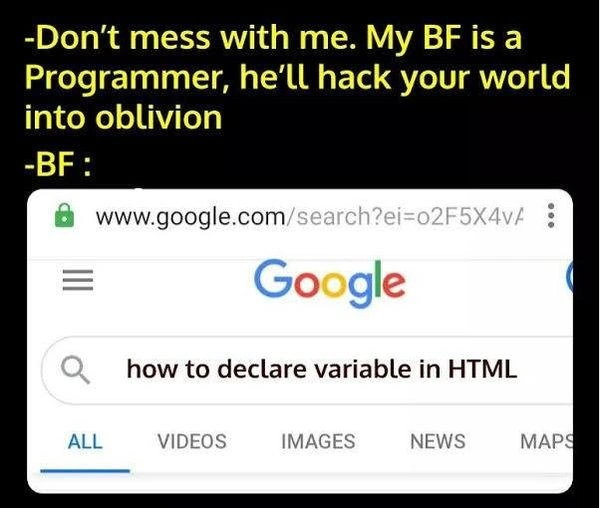
Meme with a black background and bright yellow text at the top reads: "-Don’t mess with me. My BF is a Programmer, he’ll hack your world into oblivion" followed by "-BF :". Beneath the text is a mobile screenshot of a Google search page; the address bar shows "www.google.com" and the search query typed in the Google search field is "how to declare variable in HTML". The joke contrasts the girlfriend’s boastful claim about her boyfriend’s hacking prowess with his beginner-level question, highlighting a common misunderstanding that HTML is a programming language with variables. For seasoned engineers, it pokes fun at early-career googling habits, the gap between non-technical expectations and actual skill, and the classic confusion between HTML markup and real programming logic

Comments

12
Anonymous ★ Top Pick When the SOC flags “potential nation-state actor,” but it’s just the intern with prod creds asking Google how to declare a variable in HTML
  1. Anonymous ★ Top Pick

    When the SOC flags “potential nation-state actor,” but it’s just the intern with prod creds asking Google how to declare a variable in HTML

  2. Anonymous

    Nothing says 'elite hacker' quite like someone who thinks HTML has variables - next they'll be threatening to hack the mainframe by aggressively refreshing the CSS cache and declaring war through semantic markup

  3. Anonymous

    Ah yes, the classic 'my boyfriend is a hacker' threat, immediately undermined by searching how to declare variables in a markup language. This is the technical equivalent of threatening to rebuild someone's engine while Googling 'where does the gas go.' HTML doesn't have variables because it's not a programming language - it's markup. If the boyfriend were actually dangerous, he'd be searching 'how to exfiltrate session tokens via XSS' not 'how does the internet work.' The real hack here is convincing someone that Googling HTML basics qualifies as having the skills to 'hack your world into oblivion.' At least he's using Google instead of asking ChatGPT to write his entire codebase - that's the 2024 version of this meme

  4. Anonymous

    “How do I declare a variable in HTML?” - the first step toward accidentally using the DOM as your database, where hydration is the transaction manager and consistency is “whatever React felt like today.”

  5. Anonymous

    Threat model: “he’ll hack your world”; reality: Googling variables in HTML - where the only declaration is <var> and it declares semantics, not state

  6. Anonymous

    Elite hackers these days: pwning worlds by first confusing <div> for a REPL

  7. Deleted Account 5y

    <var></var>

  8. @lord_nani 5y

    Well

  9. @NiKryukov 5y

    How to declare var to Israel

    1. @lord_nani 5y

      right click -> declare var

    2. @lord_nani 5y

      need to have admin priveleges

      1. @AndrewEastwood 5y

        right click -> declare var as an admin

Use J and K for navigation