JSON Homies Reject HTML
Why is this DataFormats meme funny?
Level 1: Favorite Boxes
This is like a group of kids yelling, “We hate envelopes! All our friends use lunchboxes!” Envelopes and lunchboxes both carry things, but they are good for different jobs. The meme is funny because it acts tough about something very nerdy: whether computers should receive a web page shape or a tidy box of data.
Level 2: Data Versus Documents
For a newer developer, the important distinction is that HTML is for pages and JSON is for data. If a website is a restaurant menu, HTML is the printed layout with sections, item names, and buttons; JSON is the list of dishes and prices in a neat structure that software can read.
JSON stands for JavaScript Object Notation, but it is used far beyond JavaScript. APIs commonly return JSON because it is easy for programs to exchange: a backend can send { "user": "alice", "role": "admin" }, and a frontend can quickly turn that into visible interface elements. HTML, meanwhile, is what tells the browser what exists on the page. The meme mocks the way developers sometimes act as if one tool winning popularity means the older tool is useless.
The people in the image are visually framed like they are backing up a bold slogan. That contrast is the humor: the caption sounds aggressive, but the conflict is between two boring web standards. Anyone who has built a frontend, consumed an API, or argued over data formats recognizes the absurd seriousness programmers can attach to syntax.
Level 3: Markup Loyalty Test
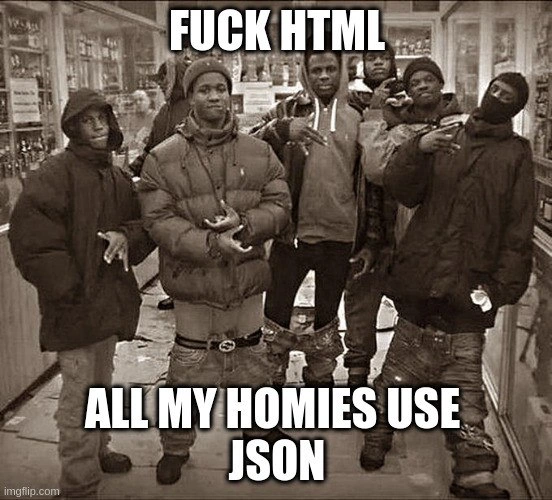
FUCK HTML
ALL MY HOMIES USE JSON
The joke works because it treats web data formats like a street-level allegiance test. The five people posing in the black-and-white store aisle make the caption feel like a crew declaration, but the declared enemy is not a rival group; it is HTML, the markup language that made the web visible in the first place. The preferred side is JSON, the compact object notation that became the default handshake for modern APIs. It is developer tribalism in its purest form: pick a serialization format, make it your identity, and pretend the other one personally broke your build.
The funniest part is that the comparison is deliberately unfair. HTML and JSON do different jobs. HTML describes documents and interface structure: headings, links, forms, tables, buttons, the stuff browsers render. JSON carries structured data: strings, numbers, arrays, objects, and nested fields that programs can parse. A frontend app often needs both: the browser loads an HTML shell, then JavaScript fetches JSON from an API and turns it into interactive UI. So the meme is not making a serious architectural argument; it is exaggerating the very real shift from server-rendered pages toward API-driven applications.
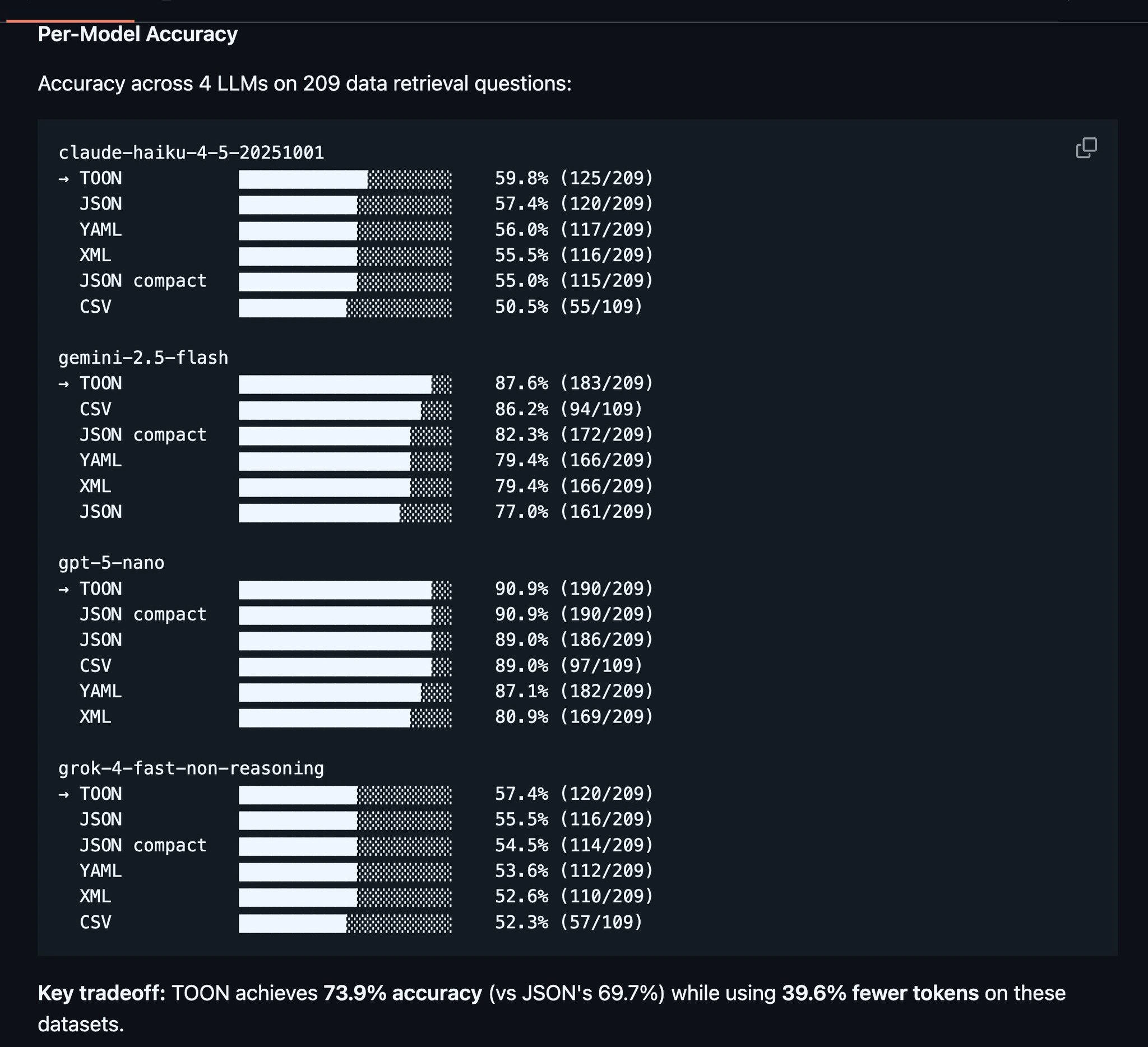
The post message, “Next step is YAML, right?”, pushes the joke one layer further. Developers who graduate from raw web pages to JSON often eventually run into YAML in configuration files, CI pipelines, Kubernetes manifests, and other places where indentation becomes a lifestyle choice. That is how format preferences become a ladder of suffering: HTML feels old, JSON feels clean, YAML feels human-readable until one invisible space ruins the deployment. Naturally, the correct enterprise solution is a meeting to standardize all three and then ship XML by accident.
Description
A black-and-white meme photo shows five young men posing in a store aisle, with large Impact-style white text outlined in black. The top caption reads "FUCK HTML" and the bottom caption reads "ALL MY HOMIES USE JSON," with a small imgflip.com watermark in the lower-left corner. The humor turns a street-crew loyalty format into a web development data-format rivalry, framing JSON as the preferred lingua franca for APIs while dismissing HTML as old-school page markup.
Comments
4Comment deleted
Somewhere an API is returning text/html with a JSON body and calling it backward compatibility.
So deep, so true... Comment deleted
Xml* Comment deleted
+ Comment deleted