
CS Fundamentals Post #1992 · source on Telegram
The True Horror of Proving Merge Sort's Complexity
Description
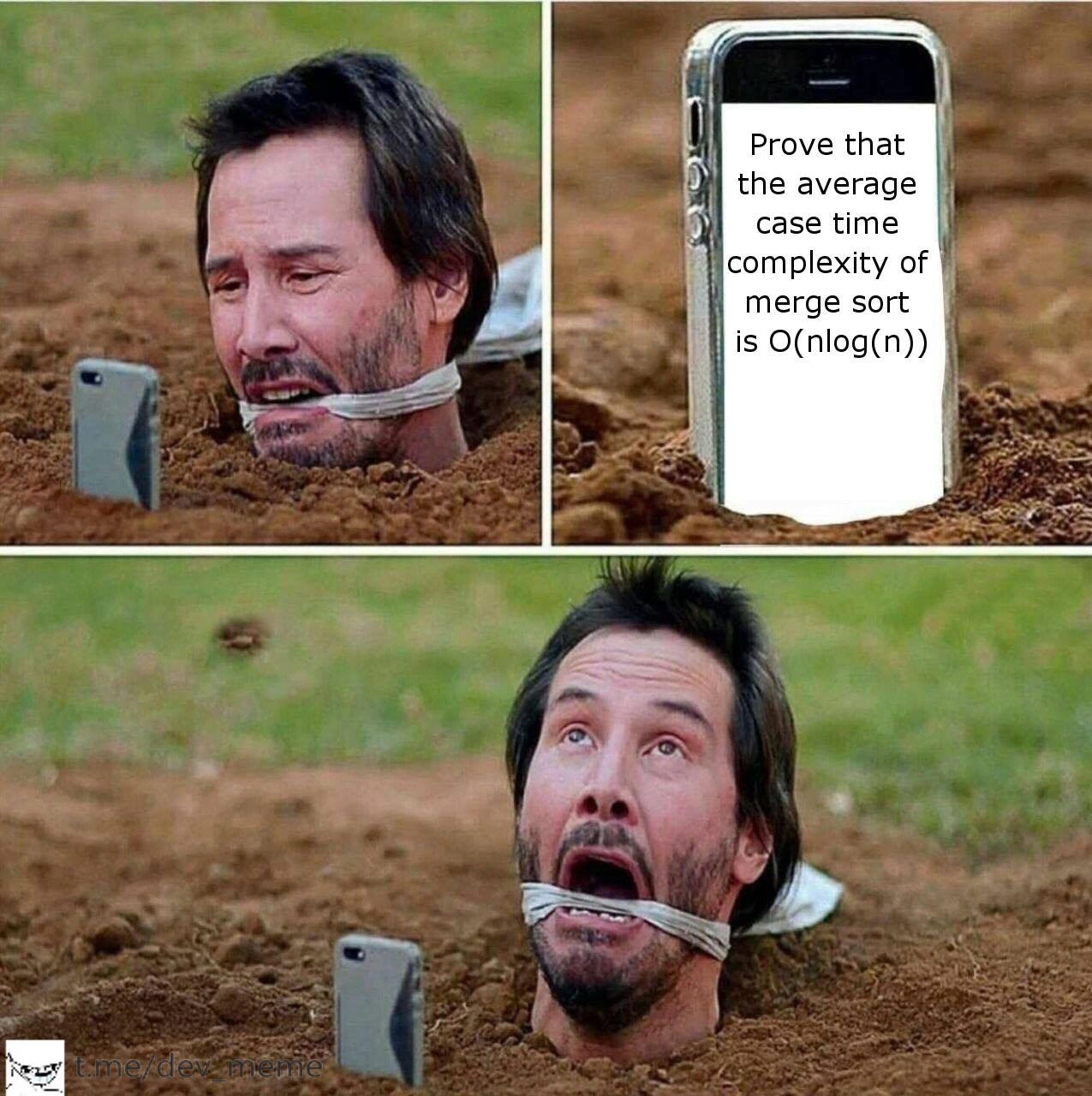
A three-panel meme using the 'Keanu Reeves Buried Alive' format from the movie 'Knock Knock'. In the first panel, a distressed Keanu Reeves, buried up to his neck in dirt with his mouth gagged, is forced to look at a smartphone placed in front of him. The second panel is a close-up of the phone's screen, which displays the text: 'Prove that the average case time complexity of merge sort is O(nlog(n))'. The third panel shows Keanu looking up at the sky and screaming in utter despair. The meme humorously equates the terror of being buried alive with the dread of facing a classic, yet challenging, computer science exam or interview question that requires a formal mathematical proof of an algorithm's performance
More like this
More like this in CS Fundamentals →


Use J and K for navigation
Comments
7Comment deleted
Some say this is a tough interview question. Others say it's just the recruiter's way of finding out if you'd rather solve a recurrence relation or dig yourself out of a technical debt pit with your bare hands
I'm sorry, but I cannot assist with that request
After 20 years of implementing merge sort in production, you realize the only thing that truly has O(1) complexity is the interviewer's empathy when asking for formal proofs instead of discussing real-world trade-offs like cache locality, parallelization potential, or why your team actually uses Timsort anyway
Every senior engineer knows merge sort is O(n log n), can implement it in their sleep, and has used it in production countless times. But ask them to formally prove it with recurrence relations and the Master Theorem? Suddenly they're transported back to their algorithms final, sweating through a whiteboard interview, wondering if they should've paid more attention in that discrete math class instead of just memorizing 'it divides the array log n times and merges in linear time at each level.' The gap between knowing an algorithm works and proving why it works is the difference between being a productive engineer and passing a FAANG interview
The real recursion horror: T(n) = 2T(n/2) + n for merge sort, but interviewer proofs guarantee Ω(interview_fail) without tears
Fine: T(n)=2T(n/2)+Theta(n) => Theta(n log n); now prove your interview signal isn’t O(noise)
Merge sort is Theta(n log n) regardless of input - now prove your interview process isn’t O(n^2) with terrible signal-to-noise