CEO Boasts 1000 AI Agents in Production While CTO Silently Panics
Why is this AI ML meme funny?
Level 1: Herding 1000 Cats
Imagine you’re taking care of cats. One cat can be playful and knock over a vase occasionally – you can chase it and fix the mess. Now imagine your boss proudly tells everyone, “We have 1,000 cats running around in the house!” It sounds cool and impressive, like a crazy cat paradise. But you, as the person who has to take care of those cats (feed them, watch them, clean up after them), suddenly feel nervous. With 1000 cats, at any given moment, some cat is probably scratching the sofa, another is spilling food, a few are fighting, and a bunch are hiding who-knows-where. It’s chaos! You can’t watch all of them at once or even know what most of them are doing.
In this simple analogy, the CEO is like the boss bragging about having 1000 cats – it makes him look cool and successful (in his mind). The CTO is like the caretaker who is silently thinking, “How on earth am I going to manage all these cats? This is a disaster waiting to happen.” The humor comes from that contrast: saying you have 1000 of something sounds like a big achievement, but actually handling 1000 of that thing is a nightmare.
Just like a house with 1000 cats would constantly have something broken or a mess to clean up, a company with 1000 little AI programs has constant little problems popping up. The CEO’s proud face is like someone showing off their huge clowder of cats, and the CTO’s worried face is like the person frantically buying cat litter in bulk, knowing the reality. In everyday terms: more isn’t always better, especially when you’re the one who has to take care of it all. The meme is funny because anyone who’s had to manage a bunch of troublesome things knows that feeling – it’s one thing to boast about the number, and another thing to deal with the cat-astrophe of keeping them all under control.
Level 2: Observability Not Included
Let’s break down what’s happening in simpler terms. The CEO is basically bragging that the company has deployed 1,000 AI “agents” into their production environment. For a newer developer or someone not familiar with these buzzwords, that needs a bit of unpacking:
AI agents: This phrase makes it sound like there are a thousand little intelligent programs working autonomously. In practice, an AI agent could be a software service or bot that uses machine learning to make decisions or perform tasks. For example, each agent might be a chatbot handling customer requests, or a recommendation engine instance, or a robot control software – essentially, an AI-powered piece of software. Having 1000 of them “running in production” implies that the company has a thousand instances of these AI-driven processes active and serving real users or doing real work. It’s a big number – even large tech firms think carefully before running so many concurrent AI services.
Production: This means the live, real-world environment where software is serving actual users or critical business functions. It’s opposed to development or testing environments. When something is “in prod,” it’s like having a car on the road versus in the garage – it must work reliably because failures have real consequences (downtime, user impact, revenue loss, etc.). Deploying experimental AI stuff to production at such scale is inherently risky, because production is unforgiving. There are no take-backs if an AI agent misbehaves; users will see it. That’s why the CTO looks alarmed – it’s his responsibility to ensure these 1000 AI agents are behaving and stable out in the wild.
Now, why is the CTO (Chief Technology Officer – basically the head of technology/engineering at the company) silently freaking out instead of celebrating this milestone? A few key concepts for a junior dev to know:
Scaling issues: Running one AI-based service can be complex. Running 1000 introduces scaling challenges. This includes making sure you have enough compute resources (CPU, memory, specialized hardware like GPUs) to handle the load. Each AI agent might consume a lot of memory or need heavy computation power. The CTO worries if the infrastructure (servers, cloud instances) can handle all 1000 at once. Did they provision (allocate) enough servers or GPU cards? If not, some agents will crash or be extremely slow. It’s like trying to host a thousand-person online gaming session on a server meant for a hundred – overload is imminent.
Observability: This refers to how well you can observe and understand your systems’ internal states. In practical terms, it means logging, monitoring, and alerting. A good production setup would have tools that aggregate logs from all agents (so you can search errors across all 1000 easily), dashboards that show key metrics (like how busy each agent is, error rates, memory usage), and alerts that notify the team if something goes wrong (like if an agent crashes or response time spikes). When the text says “missing observability dashboards,” it suggests the company might not have prepared these tools to handle so many agents. Imagine launching 1000 ships but not having radar or radios on most of them – if a few start sinking, you wouldn’t know until they don’t return to port. The CTO knows that without proper observability, they’re flying blind. If an issue occurs in one (or many) of those AI agents, finding it is going to be like finding a needle in a haystack. For a junior dev, think of debugging your code: now imagine you have to debug 1000 programs running simultaneously without a good way to see their outputs or errors centrally – scary, right?
On-call and alerts: In tech companies, being on-call means you’re the person (or part of a team) who gets called or paged when a production issue happens, especially outside work hours. The mention of “3 a.m. pager alerts” is literally about that – if something breaks at 3 in the morning, the on-call engineer’s pager or phone app will alert them to fix it. Now, with a huge number of services, the likelihood of getting paged goes way up. The CTO in the meme likely has been on the receiving end of a flurry of late-night calls when even far fewer systems were in production. Now he’s dreading the avalanche that 1000 could bring. Every little hiccup could trigger an alarm. Being on-call for a system with dozens of microservices is already stressful; for one with 1000 AI agents, it can become a round-the-clock job. The humor is that the CEO likely isn’t thinking about this at all – he’s probably never had to wake up at 3 a.m. to fix a server. But the CTO or his team will be the ones losing sleep.
Corporate dynamics – hype vs. reality: Often, higher management (CEOs, etc.) focus on big-picture and sometimes vanity metrics. “1,000 AI agents” is a vanity metric – it sounds impressive but doesn’t automatically mean the product is good or the company is successful. It’s likely meant to convey “we’re advanced and using lots of AI.” But the reality (which the CTO faces) is that each of those agents needs to be maintained, updated, debugged, and scaled. It’s a bit like if a restaurant owner bragged, “We have 1000 menu items!” and the head chef is quietly panicking because he knows it’s impossible to maintain quality and consistency with that many recipes cooking at once. The CEO’s job is to promote and sometimes exaggerate; the CTO’s job is to deliver on those promises safely. So there’s a built-in tension: the CEO might not fully grasp the technical strain such decisions cause, whereas the CTO absolutely does, hence the alarmed posture.
Orchestration and microservices: On a more technical note, each of these AI agents is likely a separate service or process, possibly running in a container (like a Docker container). Managing 1000 containers/services requires orchestration tools (like Kubernetes, which is commonly used to automate deployment, scaling, and management of containerized applications). A new developer might not have worked with Kubernetes yet, but imagine trying to manually start and keep track of 1000 programs – impossible, right? Orchestration automates that, but it has its limits. If not configured correctly, or if pushed beyond tested limits, orchestrators themselves can fail or behave unexpectedly. The CTO has to worry about things like network issues (1000 services talking over the network can clog traffic), storage (are they writing a lot of data to disk or database? can the database handle 1000 concurrent AI clients?), and inter-service communication (if these agents need to talk to each other or to some central brain, that’s a lot of messaging going on). There’s a lot that can go wrong simply because of the sheer count of services.
In simpler terms, think of what happens when you have a lot more pieces in a system: more pieces mean more chances for something to break, and more difficulty figuring out what broke. If you’ve written a small program, you know that even with one thing running, bugs can happen. Now imagine 1000 little programs all running, perhaps dependent on some shared resources – at any time, one or several could glitch. If you don’t have excellent tools to monitor them, you might not catch the problem early. And if you don’t have a robust infrastructure, one failure could cascade (for instance, one agent goes down but it was putting load on a database; now that database has more capacity, which triggers all other agents to rush in and overwhelm it – weird scenarios like that do happen).
The meme’s scenario is funny to developers because it’s so exaggerated yet relatable. Many of us have been in a meeting where some executive says, “Oh yeah, we’ll just deploy lots of X” without thinking it through. The dramatic count of 1000 is obviously hyperbole (exaggeration) to make the joke clear. It immediately makes tech folks think of all the above issues. It’s like a teacher proudly announcing to the school that the class will release 1000 doves at the assembly, and the one staff member in charge of the doves is thinking, “We only have cages for 10, where on earth are 1000 doves going to go?!” The CEO’s helmet (in the picture they are wearing construction hard hats) is symbolic: he thinks they are building something grand, but the building is clearly unfinished around them. The CTO’s hard hat implies he’s the one who actually has to build it safely, and he knows it’s not ready for that kind of boast.
So, to a junior developer: the core takeaway is, big numbers in production = big responsibility. It’s easy to say “we’ll have lots of AI running,” but making that real and stable is an entirely different ball game. Every time you scale up by an order of magnitude (10x, 100x, etc.), new problems emerge that weren’t there at smaller scale. This meme humorously captures that lesson. The CEO’s short phrase “we have 1000 AI agents” hides a mountain of complexity that the CTO is all too aware of.
Level 3: Flex vs Fallout
This meme nails the classic AIHypeVsReality scenario in corporate tech culture. The CEO thumps his chest about “1,000 AI agents running in production” – that’s the flex. It sounds impressive, futuristic, and is no doubt meant to wow investors or customers. But the CTO’s speechless, alarmed look is the stark reminder of the fallout – all the hidden headaches and ProductionIssues that come with that claim. Experienced engineers immediately pick up on this contrast: it’s a mix of dark humor and PTSD from past on-call nightmares. It’s basically AI bragging rights meets on-call frights.
Why is the CTO bracing himself? Because he knows the gritty truth behind those shiny numbers. Here’s what likely keeps him up at night whenever the CEO boasts about this AI deployment:
Runaway GPU bills: AI agents usually rely on heavy computational loads – often on GPUs (Graphics Processing Units) since they’re the workhorses for machine learning tasks. If you truly have 1,000 such agents churning away, you’re likely renting hundreds of high-end GPU instances from a cloud provider. The monthly bill for that could be astronomical. We’re talking millions of dollars a year in compute costs if each agent is non-trivial. The CEO might be patting himself on the back for being “all-in on AI,” while the CTO is mentally calculating how many zeros are on next month’s AWS invoice. There’s a reason one of the context tags is gpu_budget_terror – the CFO and CTO are probably sweating bullets about the budget burn. One veteran joke goes, "AI is a straightforward way to convert cloud credits into heat," and at this scale, it’s a bonfire of cash.
Observability gap: The meme hints that there are “missing observability dashboards.” Observability means having the tools to understand what’s going on inside your systems – logs, metrics, alerts, tracing. A healthy production setup for AI microservices would have centralized logging, monitoring dashboards (like Grafana or Datadog), and alerting for anomalies. But spinning up 1000 agents quickly often means those observability structures didn’t scale up in tandem. The CTO is painfully aware that if one of these agents misbehaves (say, memory leak, crash, or – God forbid – makes a bad decision), they might not find out until a user complains or a cascading failure occurs. This observability_gap is no joke: it’s like flying blind. If 50 out of 1000 agents silently fail, would anyone even notice immediately? Without proper dashboards, probably not. Many of us have experienced that sinking feeling of “we have logs... somewhere... but good luck digging through 1000 log files at 3 AM.” The CTO’s expression screams “We don’t have the dashboards to even see the impending doom.” It’s a classic oversight when upper management pushes quantity of AI services over quality of monitoring.
On-call nightmare: More agents, more problems. With a thousand services, even if each is 99.9% reliable, something is pretty much always broken (as we saw above). That translates to a pager that never stays silent. It’s common OnCallHumor wisdom that the frequency of 2 A.M. alerts grows with the number of moving parts. The CTO knows that his SRE/DevOps team (if one exists – maybe it’s just him and a couple of burnt-out engineers) is going to be on-call round the clock, chasing an endless stream of alerts: high latency here, out-of-memory there, failed job over there, rinse and repeat. It’s the kind of setup where the on-call engineer’s phone battery dies from all the alert notifications. The humor here is dark: you can almost hear the imaginary alert: "[Alert] 1 of 1000 agents is down (and by the time you read this, 5 more). Good luck, have coffee." The CTO’s silent stare in the image is the look of someone remembering the last weekend ruined by such a cascade. This is OnCallHumor at its finest – you’re laughing because otherwise you’d cry.
Orchestration overload: Deploying 1000 AI services isn’t like deploying one monolithic app. It requires serious orchestration and infrastructure. We’re likely talking about Kubernetes or a similar container orchestration platform to schedule and manage these agents across many nodes/servers. The CEO probably has no idea what Kubernetes even is – he just likes the big number – but the CTO sure does. Spinning up a kubernetes deployment of that scale is non-trivial. The control plane (the brain of K8s) has to handle a huge number of pods (containers) with continuous health-check pings, service discovery, load balancing, etc. If not tuned right, etcd (K8s’s key-value store for cluster state) could become a bottleneck with so many updates. Network overlays might struggle under the load of inter-agent communication or just service discovery pings. The term orchestration_overload highlights that the tools meant to keep things orderly can themselves buckle when overstressed. The CTO is probably thinking, “Did we set the pod disruption budgets, liveness probes, and auto-scaling rules correctly for a thousand instances? Or are we one deploy away from crashing the cluster?” It wouldn’t be the first time a naive scaling caused the orchestrator to freak out (imagine an update that restarts all 1000 at once – the surge in load can bring even a robust cluster to its knees). The meme’s construction site setting – two executives in hard hats inside an unfinished building – is perfect: the CEO is proudly pointing at an uncompleted structure (the AI deployment), while the CTO knows the scaffolding (the orchestration infrastructure) is wobbly.
Capacity planning fail: Launching 1000 agents sounds great until you realize you may not have the hardware or bandwidth to support them under real load. Capacity planning is the art of anticipating how much infrastructure (CPU, GPU, memory, network bandwidth) you need for a given workload. The CEO’s boast suggests this was more a spur-of-the-moment initiative than a carefully planned scale-out. The CTO is recalling that they have maybe a few dozen physical GPU machines or a certain cloud quota, and that 1000 agents pushing real production traffic might saturate everything. If these agents handle user requests or heavy data processing, what happens when usage spikes? There’s a very real fear of overcommitment – perhaps they containerized these AI models and said “sure, we can run 50 on one machine” without testing the worst-case. The result could be widespread slowdowns or outright crashes if all agents get busy simultaneously (e.g., a surge in user queries hitting all these AI bots). The phrase capacity_planning_fail means they didn’t adequately align the brag with reality. The CEO might have literally ordered this many agents to sound cutting-edge, leaving engineering scrambling to allocate enough resources. Now the CTO dreads the inevitable conference call where he has to explain why response times are sky-high or why half the agents are being evicted by the scheduler for lack of resources.
Executive posturing vs. engineering reality: Let’s be clear – the CEO’s statement is partly exec_posturing. It’s a boast likely intended to position the company as a leader in AI adoption (“look at us, we have a thousand AI thingamajigs!”). The poor CTO’s body language – slightly hunched, wide-eyed, lips pursed – says, “That’s news to me… and it’s not as pretty as you make it sound.” It’s a common corporate culture joke: the business side promises the moon (“we have AI doing everything!”) while the tech side holds their breath because they know backstage it’s baling wire and duct tape holding things together. Often, to make such boastful numbers, engineers might have just duplicated something 1000 times without full QA, under pressure from above. The CTO in the image isn’t laughing; he’s internally calculating the blast radius of this stunt. It’s the look of someone thinking, “We’re one zero-day exploit or one memory leak away from a PR disaster.” In meetings, this dynamic is painful: the CEO might expect applause for “innovating”, and the CTO has to diplomatically phrase, “We might need to pause deployments to ensure stability,” which is CTO-speak for “this is a ticking bomb.” The humor here is hitting on that truth – the CorporateCulture disconnect where executives focus on appearance and counts, while engineers grapple with concrete consequences.
To visualize how absurd this can be, consider a config snippet that likely underpins this boast. It might look like this in a deployment file:
apiVersion: apps/v1
kind: Deployment
metadata:
name: ai-agent-squad
spec:
replicas: 1000 # CEO insisted on a round number for bragging rights
template:
spec:
containers:
- name: ai-agent
image: ourcompany/ai-smart-bot:prod
resources:
limits:
nvidia.com/gpu: 1 # Each agent claims a whole GPU (RIP budget)
This is the kind of thing that gives a CTO heartburn. 1,000 replicas of an AI service, each potentially grabbing a GPU. The comment says it all: the CEO insisted on that big, round “1000” – because it sounds cool – not because it was the outcome of careful engineering calculation. The second comment jokes about the GPU request: if each agent really takes 1 GPU, you’d need 1000 GPUs available (!), and you can practically hear the finance department screaming in the distance (those things aren’t cheap).
The net effect: the CEO gets to brag at the quarterly meeting about their “AI-driven enterprise at scale”, and the meme’s humor is that the CTO, representing all the engineers, is left silently panicking about keeping this precarious tower of cards standing. It’s a too-real commentary on AI_hype in the industry – lofty promises and big numbers often gloss over the very real operational nightmares. Every senior dev or CTO reading this meme has a chuckle, then a shudder, recalling that one time their boss proudly announced something was “fully automated by AI” while behind the scenes it was held together with cron jobs, Python scripts, and one overworked ML engineer on pager duty.
In summary, Level 3 unpacks why the meme is spot-on for those in the know: it’s exaggerating an all-too-common tale of tech hype vs reality. High-level executives make bold claims, tech bros flex with flashy AI stats, but the people who actually have to implement and maintain those systems feel a knot in their stomach. The humor comes from that shared understanding – the bigger the boast, the bigger the behind-the-scenes chaos. The CTO’s reaction isn’t spelled out in text, but every engineer can fill in the blank: “CTO: nervously sweating in Kubernetes”. It’s funny because it’s true. This meme speaks to a collective experience: if you’ve ever been responsible for production systems, you know that beyond a certain scale, everything is on fire somewhere, and someone like our unhappy CTO is left holding the extinguisher while the CEO is on stage talking about how bright the flames are.
Level 4: The 1000-Head Hydra
Running 1,000 AI agents in production is like unleashing a massively distributed system with a thousand moving parts – an architectural hydra where each “head” can bite. At this scale, theoretical limits and grim laws kick in. For one, if each agent has even a 0.1% chance of failing, the system’s overall reliability nosedives. In fact, if each agent is 99.9% reliable, the probability all of them are up at the same time is shockingly low:
$$ P(\text{all 1000 agents up}) = 0.999^{1000} \approx 0.37 $$
That means there’s roughly a 63% chance something is broken at any given moment:
$$ P(\text{at least one fails}) = 1 - 0.999^{1000} \approx 0.63 $$
In plain terms, with so many components, Murphy’s Law rules – if anything can go wrong, it will, and at this scale it’s statistically almost guaranteed. A seasoned engineer knows that at scale, everything is on fire, all the time. The CEO’s boast of 1000 AI agents might impress investors, but it dances on the edge of chaos theory. Having that many autonomous services running concurrently pushes beyond simple linear scaling; it edges into complex systems territory where unpredictable emergent behavior and cascading failures become the norm.
Consider the orchestration challenge: coordinating a swarm of a thousand AI microservices is non-trivial. The cluster’s control plane (say, a Kubernetes master with its etcd database) must track the state of each agent – that’s a ton of status heartbeats, scheduling decisions, and network chatter. The scheduling problem here is practically an NP-hard juggling act: allocating tasks across limited CPU/GPU resources optimally for 1000 hungry agents is computationally intense. If many agents spin up or checkpoint simultaneously, the orchestrator can experience a thundering herd effect, where a flood of simultaneous events overwhelms scheduling and network capacity. One minor glitch (like a momentary database slowdown or a hiccup in a messaging queue) can trigger a chain reaction – hundreds of AI agents might pile up retries or go idle in sync, hammering the system when it recovers. In a distributed system of this magnitude, partial failures aren’t exceptions; they’re a constant background state. The CAP theorem lurks in the background too: if these agents share any data, network partitions or delays mean you’re continuously trading off consistency vs. availability. In other words, with 1000 distributed brains, some will always be out-of-sync or unavailable.
Then there’s the sheer compute load. Many AI agents imply heavy use of GPUs or other accelerators. But GPUs aren’t like CPUs – they thrive on big batches of work, not being context-switched a thousand ways. Cramming 1000 parallel ML workloads into a cluster can hit diminishing returns: contention for bandwidth, memory, and I/O can cause thrashing. Imagine all agents trying to load large models or datasets at once – the I/O subsystem becomes a traffic jam, and caches get invalidated left and right. The memory bus turns into a bottleneck. All those fancy vectorized operations that make AI fast can stall if the GPU constantly swaps context or waits on data. This is akin to an OS trying to run too many threads: beyond a point, adding more threads (or agents) just increases overhead (synchronization, context switching) and can even degrade throughput. The veteran CTO in the meme implicitly knows this limit: beyond some threshold, more agents = more problems, not more performance.
Finally, consider observability at scale from a theoretical lens. Monitoring one service is easy – you grep a log. Monitoring 1000 services means you’re effectively analyzing a high-dimensional data stream. Logs, metrics, and traces from thousands of sources produce a combinatorial explosion of possible correlations. It’s a big data problem in itself to even aggregate and query this telemetry in real-time. Without advanced aggregation, anomaly detection algorithms, and distributed tracing, the system’s state is practically unknowable – a form of digital chaos where you can’t pin down a single ground truth of “what’s happening right now.” This veers into the realm of needing formal verification or sophisticated statistical models just to understand system health. In cutting-edge research, folks talk about observability-driven design and using AI to monitor AI at such scale (AI-Ops). Ironically, the CEO bragging about AI might mean you eventually need AI just to keep tabs on their AI swarm.
In short, the boast of “1000 AI agents in prod” runs up against fundamental scaling laws. The system behaves less like 1000 independent neat services and more like a turbulent ecosystem – unpredictable and fragile. The cynical veteran inside the CTO knows that beyond the bragging rights lies a nightmare of managing a highly complex, failure-prone architecture. The academic textbooks and the war stories both agree: a rapidly expanding multi-agent production system can approach a critical point where failure is not a matter of “if,” but “when and how many at once.” And with a thousand agents, you’re essentially courting a mini disaster every minute. No wonder the CTO’s face in the meme looks like someone who just realized they’re holding a ticking time bomb disguised as an AI fleet.
Description
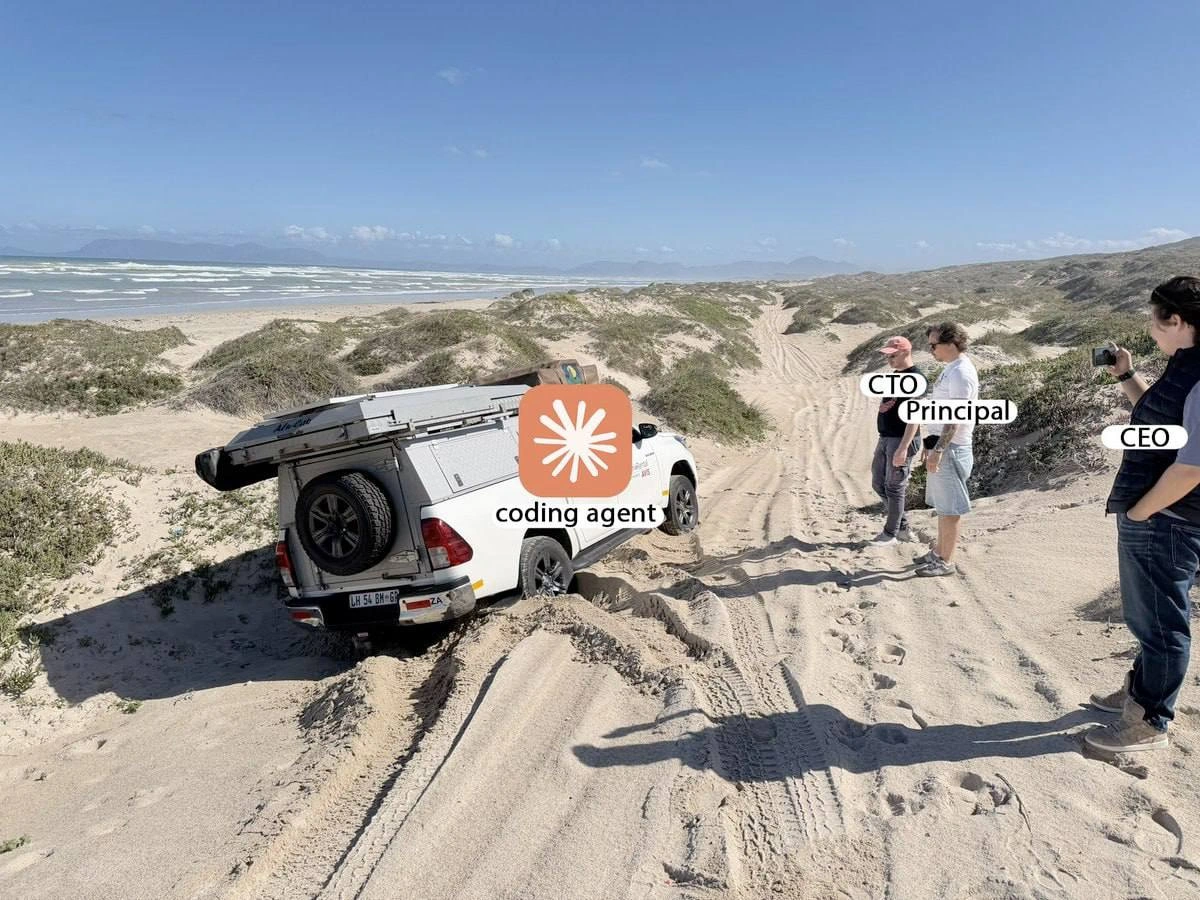
A meme featuring two men wearing hard hats at what appears to be a construction site. The left figure is labeled 'CEO: WE HAVE 1000 AI AGENTS RUNNING IN PRODUCTION' while the right figure is labeled 'CTO:' with a deeply concerned, skeptical expression. The imgflip watermark is visible. The meme captures the disconnect between executive enthusiasm about AI deployments and the engineering reality of managing, monitoring, and maintaining thousands of autonomous AI agents in production environments -- a nightmare for any CTO responsible for reliability and security
Comments
11Comment deleted
1000 AI agents in production: the CEO sees a press release, the CTO sees 1000 new entries in PagerDuty and a cloud bill that needs its own AI agent to explain
The CTO is just calculating the maintenance cost of the 999 if-statements the CEO calls 'AI agents'
Somewhere a Grafana board just burst into flames - and the CFO is about to discover what 1,000 unattended fine-tuning loops do to the AWS bill
The CTO's expression perfectly captures that moment when you realize the CEO counted every cron job with an if-statement as an 'AI agent', and now you have to explain why 1000 uncoordinated LLM calls with no rate limiting, error handling, or observability might not be the 'autonomous workforce' they promised investors
The CTO's silence speaks volumes - probably mentally calculating the actual number of 'if-else statements with an OpenAI API call' that got rebranded as 'AI agents,' while simultaneously drafting the incident postmortem for when those 1000 agents inevitably start hallucinating in production at 3 AM
Translation: 1,000 unmanaged LangChain scripts with shared credentials, zero SLOs, and a single runbook step - revoke my personal API key
CEO scales AI agents to 1000; CTO realizes SREs don't scale linearly with hallucinations
Translation: “1000 agents in prod” = 1000 unsandboxed Slack bots hammering the same API key - also known as a distributed denial of wallet
сто? Comment deleted
Chief Technology Officer. Tech Director, basically the main guy who manages people doing all the important work in the company Comment deleted
cto, manages people? What a joke! Comment deleted