Skip to content
DevMeme
5365 of 7435
Mastering bitwise sorcery: the moment you become the one in C
LowLevelProgramming Post #5883, on Feb 11, 2024 in TG

Mastering bitwise sorcery: the moment you become the one in C

Why is this LowLevelProgramming meme funny?

Level 1: Impressing the Teacher

Imagine a student claims to have learned an incredibly hard magic trick overnight. The skeptical teacher says, “Alright, show me.” The student then performs the trick flawlessly, pulling rabbits out of hats and sawing a lady in half without a hitch. The teacher’s jaw drops, eyes wide in disbelief, and then a proud smile creeps in as they whisper, “This kid is the chosen one.” In plain terms, the meme is just like that story, but instead of a magic trick it’s a clever coding trick. The young coder says “I learned something cool,” the mentor challenges them to prove it, and the kid absolutely nails it, leaving the mentor amazed. It’s funny because we all love that moment when someone actually lives up to their big claims and wows the crowd – it’s the classic tale of a student astonishing the master with a surprising skill.

Level 2: Bit by Bit Breakdown

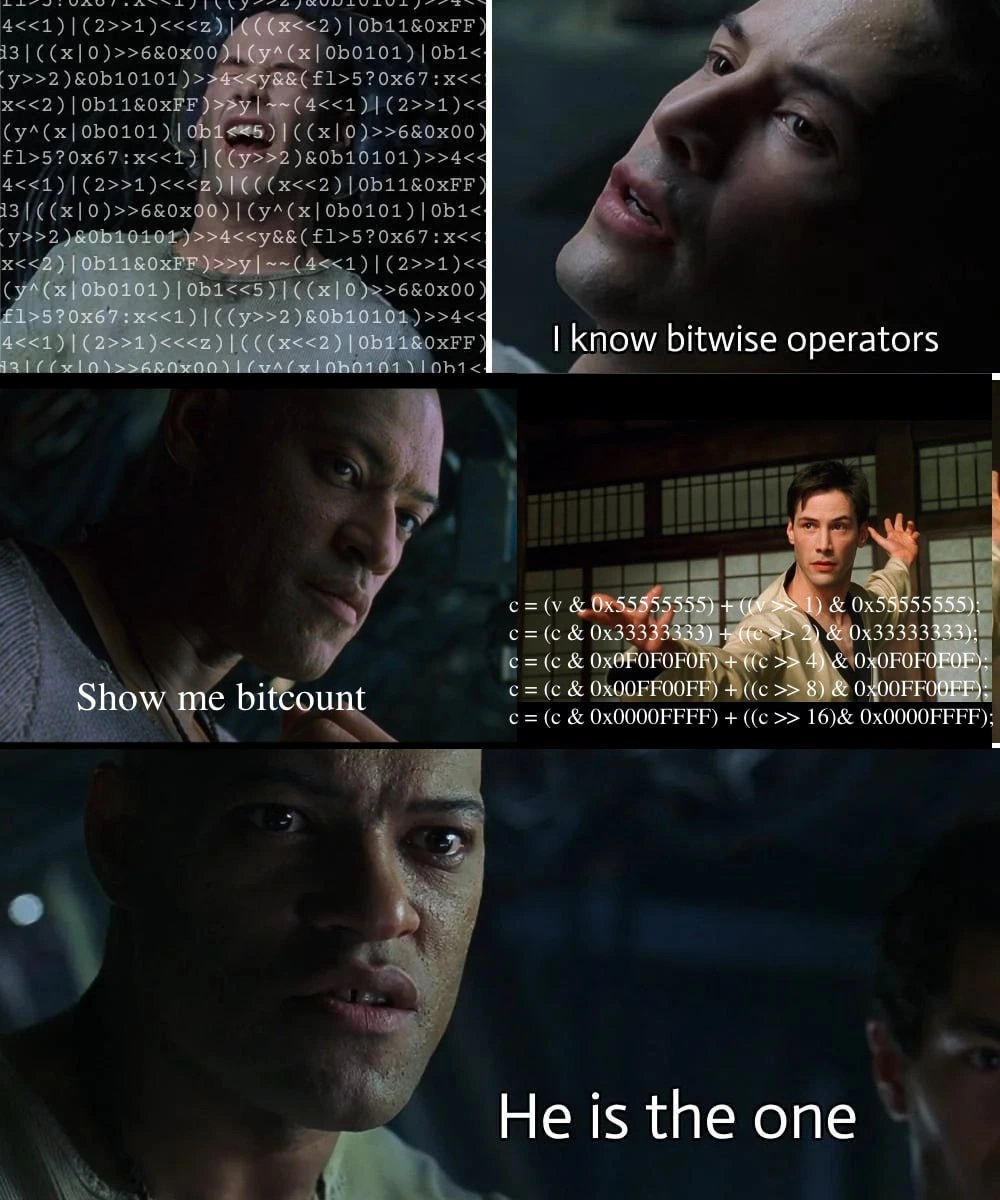
Let’s decode this meme in plain terms. It’s a parody of a famous scene from The Matrix where a character, Neo, learns Kung Fu in seconds and amazes his mentor, Morpheus. In the meme, Kung Fu is replaced with coding skills, specifically knowing bitwise operators in C. Bitwise operators are tools in languages like C (and many others) that let you manipulate the individual bits (0s and 1s) that make up numbers. Using bitwise operations is common in low-level programming because they map closely to actual CPU instructions and can be extremely fast for certain tasks. The trainee in the meme says “I know bitwise operators,” which is like a programming student proudly saying they’ve learned a tricky new skill. The mentor replies “Show me,” basically saying “prove it” – just like in the movie’s dojo fight scene where skills must be demonstrated.

In the next panels, instead of a martial arts fight, we see a snippet of C code and a very impressed mentor. The code shown is implementing a function to count the number of 1s in a binary number, often called counting set bits or popcount. For example, if you have a number (in binary) 1011, it has three 1 bits. Counting these efficiently is a common programming task and a classic exercise in computer science. A beginner might do this by looping through each bit with something like a for loop and checking each bit using & 1 or shifting the number one bit at a time. But the code in the meme does it in a super-optimized way, crunching multiple bits at once with clever bit tricks. That’s why the mentor is stunned – it’s like the student didn’t just do a basic move, they pulled off an advanced technique that only seasoned pros usually know.

Let’s break down some terms and what that C code is doing in simpler language:

  • Bitwise AND (&): This operator compares two numbers bit by bit and produces a new number. A bit in the result is 1 only if both original bits were 1. For example, 5 & 3 in binary is 0101 & 0011 = 0001 (which is 1 in decimal).
  • Bitwise OR (|): This gives a 1 in each bit position where at least one of the inputs has a 1. e.g., 5 | 3: 0101 | 0011 = 0111 (which is 7).
  • Bitwise XOR (^): Stands for “exclusive or.” Each bit is 1 if the two input bits are different (one 1 and one 0). e.g., 5 ^ 3: 0101 ^ 0011 = 0110 (which is 6).
  • Bitwise NOT (~): Flips every bit (0 becomes 1, 1 becomes 0). It’s like a negation at the bit level.
  • Shift left (<<) and shift right (>>): These move bits left or right, which multiplies or divides the number by 2 for each shift position (discarding bits that go out of range). For example, 1 << 3 is binary 1 shifted left three places to 1000 (which is 8 in decimal). Shifting right does the opposite (with some details about sign for negatives, but for unsigned it’s straightforward).

Now, in the meme’s code, you see a lot of &, >>, <<, and weird numbers like 0x55555555. Those numbers starting with 0x are in hexadecimal (base-16) notation, which programmers often use as a compact way to represent binary patterns. For instance, 0xF in hex equals 1111 in binary. 0x55555555 is a 32-bit number in hex which in binary looks like 01010101... repeated. It’s being used as a mask. A mask is a pattern of bits that you use with AND or OR to isolate or combine certain bits of another number. Think of a mask like a stencil — it lets some parts through and blocks others. Here, 0x55555555 (binary 0101 pattern) is used to separate the bits into pairs. Similarly, 0x33333333 is a mask with binary pattern 00110011... and 0x0F0F0F0F is 0000 1111 0000 1111 ..., and so on. Each mask is designed to group bits and help add them together in stages.

So what is the code doing, step by step? It’s essentially dividing the 32 bits of the number into ever larger groups and summing those group bits at each step:

  1. First, add adjacent bits pairwise (using the mask 0x55555555 to separate even and odd positioned bits). Now in each 2-bit sub-group, you have the count of ones for those two bits.
  2. Next, add those 2-bit results into 4-bit results (mask 0x33333333 helps with grouping every 2 bits together). Now each 4-bit group contains the count of ones in that group of the original number.
  3. Then do the same into 8-bit groups (mask 0x0F0F0F0F), so each byte (8 bits) holds the count of ones in that section.
  4. Then 16-bit, and finally 32-bit. By the end, one 32-bit number holds the total count of ones from the original number, effectively completing the popcount.

Importantly, this is done with just a handful of operations without any explicit loop like while(n>0){ ... }. To a newcomer, the code looks like gibberish – it’s dense. But to a seasoned C developer, this is a known idiom for bit counting. It’s the kind of thing you might see in optimized libraries or old academic papers on bit hacks. In some cases, people would even put this into a macro or inline function in C so they could reuse it whenever they needed a fast bit count routine. It’s all about performance optimization: doing the job faster by using the computer’s bit-level parallelism instead of slow, step-by-step checking.

Now, why is the mentor so impressed, saying “He is the one”? It’s both a direct quote from The Matrix and a cheeky acknowledgment that the student surpassed expectations. In the story of the meme, the student really proved his claim – he not only knows what bitwise operators are, he can apply them in a very sophisticated way. It’s as if a martial arts student said they knew a move and then demonstrated the most advanced technique perfectly. The phrase “the one” in programming context is also a pun: we spend all this effort to count the ones (1s) in the number, and here our hero is literally the one who can do it elegantly. It’s that triumphant moment in a developer’s journey when you demonstrate a tricky skill and everyone around goes “Whoa.” Even if you’re relatively new to C, you can appreciate that energy – it’s the exhilaration of mastering something complex and getting recognition for it. This meme is basically a techie way of saying, “look how far I’ve come in my coding dojo.”

Level 3: Binary Black Belt

To an experienced developer, this meme hits like an inside joke on multiple levels. It perfectly parodies the iconic dojo training scene from The Matrix, replacing martial arts with C language bitwise operators. In the film, Neo downloads Kung Fu into his brain and confidently exclaims, “I know Kung Fu.” Here we have a coder (Neo) who’s apparently just had a torrent of hexadecimal and bit-fiddling knowledge uploaded (as seen by the cascade of cryptic expressions like ((y&(-y))<<1)|(x>>2)>>1|0b110xFF in the first panel). He gasps, “I know bitwise operators.” For seasoned programmers, that line alone is gold: bitwise operations (&, |, ^, ~, <<, >>) are often considered a kind of fundamental combat training in low-level programming. Many of us remember the moment we truly grasped shifting and masking – it felt like unlocking a new combat skill in the battle against complexity.

The mentor figure (Morpheus) replies, “Show me,” upping the ante just as in the movie. This leads to the “fight” – but instead of fists, Neo showcases code. The panel with Neo striking a pose is overlaid with a legendary C snippet for counting bits (often called counting set bits or popcount). This is not just any code; to veteran eyes, it’s a known feat of strength. It’s the programming equivalent of doing a gravity-defying crane kick – something you pull out to prove you’ve reached the next level of mastery. The code uses a series of bit masks (0x55555555, 0x33333333, 0x0F0F0F0F, etc.) and bit shifts to sum up the bits in parallel. In simpler terms, Neo isn’t just showing he knows basic moves like a simple AND or OR; he’s demonstrating a full bit-manipulation kata – a refined routine that computes a result with maximal efficiency and minimal instructions. This is why Morpheus’s face in the final panel is one of stunned respect, captioned “He is the one.” In the movie, that meant Neo might be the prophesied savior. In the meme, it humorously implies this developer is “The One” in C – the chosen one who has mastered the arcane art of bit-level optimization. It’s also a pun: being “the one” alludes to mastering the ones (1-bits) in binary. He literally knows how to find the ones, count the ones, and perhaps become one with the ones.

This meme resonates because it exaggerates a real developer experience. In the programming world, knowing your way around bitwise operations is like earning a black belt. It’s not everyday stuff for most high-level application developers, but in systems programming, embedded development, or performance-critical code, such knowledge is revered. We’ve all met that engineer who can read a hexdump like the Matrix’s falling code or who knows off the top of their head that y & -y isolates the lowest set bit or that x & (x-1) clears it. These little warlock incantations of bit-fu separate the initiates from the masters. So when the trainee in the meme blasts out a flawless popcount implementation – which is famously described in documents like “Bit Twiddling Hacks” – it’s the perfect “drop the mic” moment. In a code review or tech talk, such a demonstration would elicit exactly the face Morpheus is making: equal parts astonishment and admiration.

On a practical note, this meme also pokes fun at the culture of Performance Optimization and micro-optimizations. Here we have a highly optimized solution to counting bits. Any senior dev knows that modern compilers or hardware can do this for you (__builtin_popcount in GCC or a CPU POPCNT instruction), but writing it out longhand is a rite of passage and a flex. It shows intimate knowledge of how data flows at the bit level. It’s akin to showing you can manually perform a task that most people would rely on a tool for – not always necessary, but undeniably cool. The humor is that Neo doesn’t just say “I know how to count bits” – he demonstrates it in the most show-off way possible, and Morpheus reacts as if witnessing an impossible feat. Every developer who’s spent nights squeezing cycles out of a routine or delved into algorithm design for bitfields can relate to that mix of pride and hilarity. This meme is essentially saying: “Remember that crazy bit hack you felt proud to finally understand? Imagine busting that out in a dramatic fashion – you’d feel like THE ONE.” It’s a celebration of low-level prowess with a big wink to our shared pop culture and programming lore.

Level 4: There Is No Loop

At the deepest level, this meme celebrates a piece of bitwise sorcery steeped in computer science fundamentals. The code shown is a famed population count algorithm (popcount) implemented in pure C bit-twiddling style. Population count—also called Hamming weight—is the total number of 1 bits in a binary representation of a number. It might sound simple, but doing it ultra-fast, without looping through each bit, is a classic challenge in Low-Level Programming. The solution here is a branchless, five-step sequence using carefully chosen hex masks and bit shifts to count set bits across a 32-bit integer in parallel. In other words, it leverages the inherent parallelism of binary arithmetic: a single 32-bit addition can effectively add 32 pairs of bits simultaneously at the hardware level. This micro-optimisation uses a divide-and-conquer approach on the bits themselves—halving the problem at each step, much like a tournament bracket for bits. After five combining operations, every bit’s contribution has been tallied into the final count. No loops, no conditionals, just pure binary kung fu. In this bit counting dojo, there is no loop.

Let’s break down the bit-twiddling hack at play. Each hexadecimal constant is a mask selecting specific bit positions. For clarity, here’s a slightly annotated version of the code from the meme:

unsigned int v;  // input: the number whose bits we want to count
unsigned int c;  // output: number of set bits (1-bits) in v

c = v - ((v >> 1) & 0x55555555);
    // Mask 0x55555555 = 0101...0101 in binary. 
    // This line subtracts the bits shifted right (dividing by 2) from the original, 
    // effectively computing pairwise bit sums (each 2-bit group in c now holds the count of two bits from v).

c = (c & 0x33333333) + ((c >> 2) & 0x33333333);
    // Mask 0x33333333 = 0011...0011 (groups of 2 ones). 
    // Now each 4-bit group in c holds the count of four bits from v.

c = (c + (c >> 4)) & 0x0F0F0F0F;
    // Mask 0x0F0F0F0F = 00001111... (groups of 4 ones).
    // After this, each 8-bit group contains the count of eight bits from v.

c = c + (c >> 8);
    // Adds each 8-bit group to the next, so 16-bit groups have the count of 16 bits.

c = c + (c >> 16);
    // Adds each 16-bit group to the next, so the 32-bit word's lower 16 bits now contain the total count.
    
c = c & 0x7F; 
    // 0x7F (01111111) to mask out everything but the lower 7 bits, which is where the result fits (max 32).

This is one variant of the popcount bit hack (there are others; the one in the meme image uses addition with masks in a slightly different order but achieves the same result). It shows how algorithm design can exploit binary representation: essentially performing a parallel sum of bits by amalgamating them in powers of two. Each mask like 0x55555555 or 0x33333333 is a binary pattern that helps partition and sum bits in chunks of 2, 4, 8, etc. Notice how the masks are halving the binary space: 1-bit alternating pattern, then 2-bit pattern, 4-bit pattern, and so on. This corresponds to adding up bit counts in progressively larger blocks. By the end, the number in c has become the total count of 1s in the original v. This popcount trick executes in a fixed number of operations (on the order of log₂(word_size) steps, here 5 steps for 32 bits) regardless of how many bits are set – a form of constant-time efficiency that avoids branching. In modern CPUs, there’s often a dedicated POPCNT instruction to do this in one go, but before that existed, these kinds of clever sequences were the holy grail of bit-level optimization. It’s the sort of code you’d find in the famous book Hacker’s Delight or the classic “Bit Twiddling Hacks” article. For those deeply versed in performance optimization and CPU architecture, this meme is a nod to that zen-like understanding of data as bits. It’s about attaining a mastery so profound that you can manipulate bits with the same ease and fluidity as Neo dodging bullets. When Morpheus’s shocked face captioned “He is the one” appears, it’s not just echoing The Matrix – it’s proclaiming that the developer has achieved the one-ness with the machine’s binary soul, conjuring results with a few hex incantations that others might achieve with clumsy loops. This is low-level wizardry at its finest, turning an everyday operation (counting) into a moment of awe through elegant bitwise math.

Description

Five-panel meme overlaying a famous dojo fight scene. Panel 1 shows a trainee’s shocked face covered by cascading white text like “((y&(-y))<<1)|(x>>2)>>1|0b110xFF” on a black background reminiscent of a disassembler dump. Panel 2, the trainee says in subtitle-style white text: “I know bitwise operators.” Panel 3 cuts to the mentor who replies, half-hidden: “Show me.” Panel 4 freeze-frames the trainee mid-pose with an overlaid C snippet for counting set bits: “c = (v & 0x55555555) + ((c >> 1) & 0x55555555); … c = (c & 0x0000FFFF) + ((c >> 16) & 0x0000FFFF);”. Panel 5 shows the stunned mentor’s face in dim lighting with caption “He is the one.” Visually, the joke riffs on the Matrix “I know kung fu” sequence, subbing martial arts with hardcore bit-twiddling hacks, celebrating low-level mastery, micro-optimisation, and those legendary 32-bit popcount tricks every systems engineer envies

Comments

15
Anonymous ★ Top Pick When your junior claims to "know bitwise," you hit him with a five-line popcount and suddenly HR is asking if you’re hiring a compiler instead of a developer
  1. Anonymous ★ Top Pick

    When your junior claims to "know bitwise," you hit him with a five-line popcount and suddenly HR is asking if you’re hiring a compiler instead of a developer

  2. Anonymous

    The real 'red pill' moment isn't seeing through the Matrix - it's when you realize that bitcount implementation is just repeatedly masking and shifting to sum bits in parallel, and suddenly those magic hex constants like 0x55555555 make perfect sense as binary patterns 01010101...

  3. Anonymous

    When someone casually implements bitcount using SWAR (SIMD Within A Register) with those beautiful 0x55555555 and 0x33333333 masks instead of the naive loop-and-count approach, you know they've transcended from mere mortal developer to The One. Bonus points if they can explain why this divide-and-conquer approach is faster than __builtin_popcount() on architectures without native POPCNT instructions - though let's be honest, in 2024 we're all just using the intrinsic and letting the compiler figure it out

  4. Anonymous

    Anyone can shift left; the chosen ones have 0x55555555, 0x33333333, and 0x0F0F0F0F cached in L1 - and still argue whether to use std::popcount or keep the SWAR for portability

  5. Anonymous

    Bitwise popcount: portable across ancient CPUs, no POPCNT instrinsic needed. True elite status

  6. Anonymous

    You know it’s the chosen one when they hand‑roll the 0x55555555 SWAR popcount and then check the disassembly to confirm LLVM emitted a single POPCNT - while the rest of us call builtin_popcount and call it “readability.”

  7. @M4lenov 2y

    nand2tetris course makes everyone the one

  8. @ygerlach 2y

    There is an asm instruction for that and a gcc builtin i think its name is popcount

  9. @dsmagikswsa 2y

    For one moment, I thought it is brain fuck

    1. Deleted Account 2y

      I thought the same. and i still kinda feel like it is brain fuck.

  10. @ismailgaleev 2y

    Я один ничего тут не понял????? Ощущаю себя умственно отсталым

    1. @sylfn 2y

      please use English in this chat

    2. @MDSPro 2y

      source: http://graphics.stanford.edu/~seander/bithacks.html#CountBitsSetParallel

    3. @MDSPro 2y

      Magic = Magic Its not smth that we’re supposed to understand 🥤

  11. @ZgGPuo8dZef58K6hxxGVj3Z2 2y

    Just asking those above are the “most efficient way” right? I always thought there must be a better way💀

Use J and K for navigation