Skip to content
DevMeme
1135 of 7435
The Legend of the Load-Bearing Tomato
Bugs Post #1270, on Apr 6, 2020 in TG

The Legend of the Load-Bearing Tomato

Why is this Bugs meme funny?

Level 1: Wobbly Tower

Imagine you built a big tower out of toy blocks and it’s kind of shaky. Somewhere in the middle of the tower, there’s a silly little block shaped like a tomato (funny choice, right?). It doesn’t seem to belong, and you didn’t plan on keeping it there. But the tower is old and wobbly, and somehow that tomato-block is exactly what’s helping everything stay balanced. Every time you try to pull it out, the whole tower starts to tip and crumble, so you quickly push it back in. In the end, you just leave the weird tomato-block in place because the tower stands tall only as long as it’s there.

This meme is basically laughing about that kind of situation in a video game. The tomato in the game is like that odd block in your tower. It’s a part that seems random and unnecessary, but if you remove it, uh-oh! the game (the tower) falls apart. It’s funny and a bit absurd – who would think a tiny tomato could hold up an entire game? But it captures a feeling developers know well: sometimes the strangest little thing turns out to be super important. The humor comes from the surprise that something so small and goofy is actually the hero keeping everything from breaking.

Level 2: Spaghetti Code Surprise

For a less experienced developer or someone new to GameDevelopment, let's break down what's happening. In many games, developers use placeholder objects during development. A placeholder could be a simple model (like a tomato) placed in a level just to test things out or mark a spot. Ideally, that placeholder gets removed or replaced before the final game ships. But in this meme, that random tomato ended up staying buried in the game’s level because removing it caused big problems. This is a prime example of LegacyCode and TechnicalDebt creating a weird situation: a seemingly useless item has become unexpectedly important due to messy dependencies.

So why would taking out a single tomato model break “the entire game build”? It comes down to dependencies and what we call spaghetti code. Dependencies in software are when one piece of the system relies on another. In a well-organized project, these relationships are clear and controlled. But in a messy project (we call that spaghetti code because it’s all tangled up), you get a lot of hidden, unintended dependencies. That tomato might be referenced by some game logic or script. For example, maybe some code checks for the nearest object and expects something to be there, or the level’s lighting or physics were tweaked with the tomato in place, and removing it changes timing or positions enough to cause a glitch. It’s like those movies where removing a small artifact triggers a booby trap – here removing the tomato triggers a cascade of software errors.

HiddenComplexity means there are complicated things happening under the hood that aren't obvious just by looking. A new developer might see an extra tomato file in the level data and think, “We don’t need this, let's clean it up,” only to find that the game suddenly crashes or characters start falling through the floor. Oops! That tomato was actually preventing a bug, perhaps by accident. In game engines, all objects have connections: maybe the tomato was unintentionally filling a slot in an array or keeping an AI routine from running too early. These are the spooky ghost-like effects of DependencyHell — when everything is linked in convoluted ways, removing one piece has unpredictable results.

This is also about TechnicalDebt: that’s a term for when developers take a shortcut or quick fix that later creates more work or problems. Leaving the tomato in was a shortcut. Instead of rewriting the level or fixing the physics properly (which could be hard and time-consuming), the devs discovered that if they just keep that silly model hidden out of player view, the game doesn’t break. It’s not a clean solution, but it works and meets the deadline. Over time, these dirty fixes accumulate, and the codebase becomes fragile – like a Jenga tower where every piece, even a tiny tomato piece, is load-bearing.

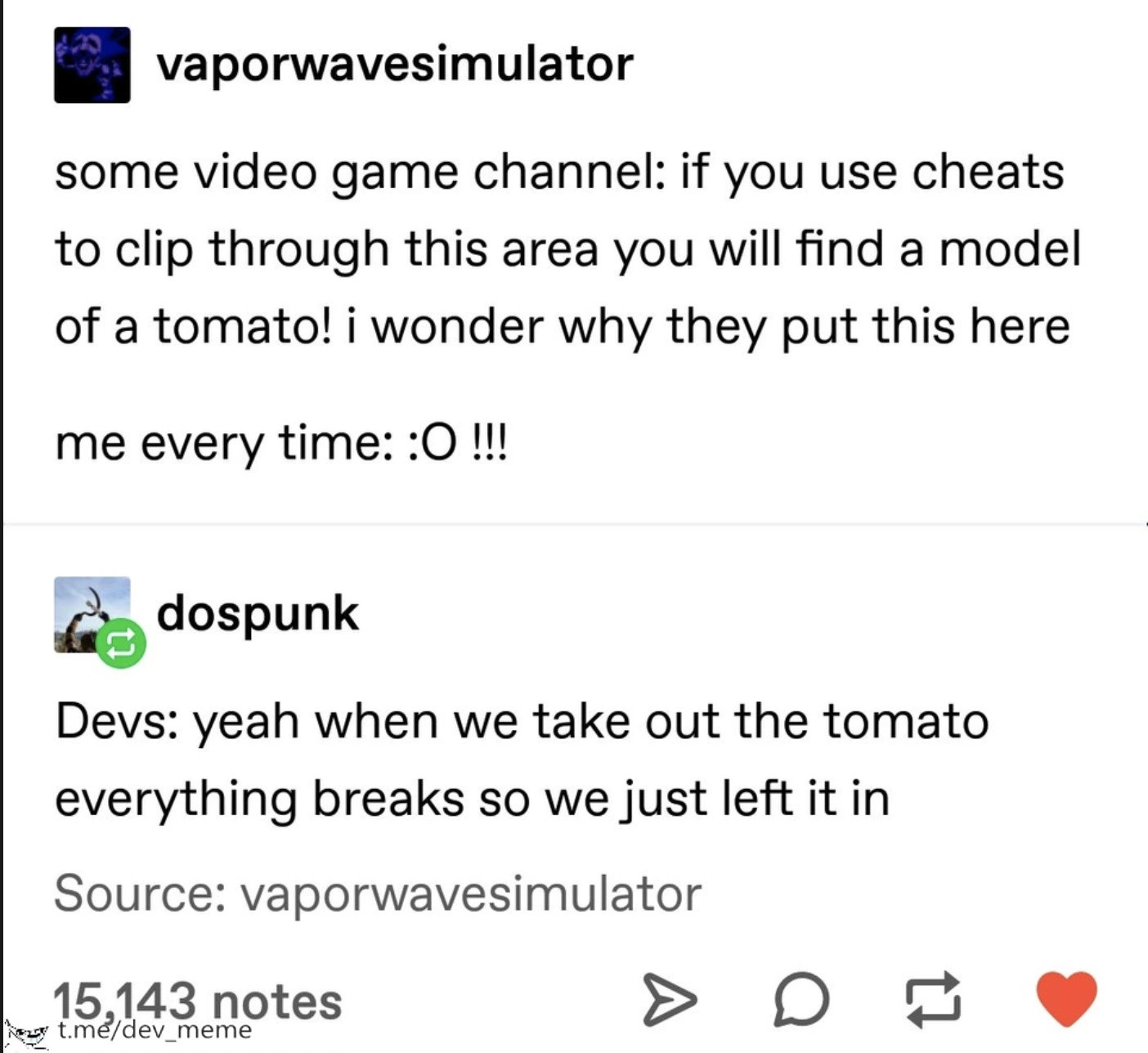
The first part of the meme mentions a video game channel using cheats to clip through an area. To clip through means to use cheats or debug modes to go through walls or barriers (basically moving the camera or player outside the intended boundaries). It’s how curious gamers find hidden stuff in levels. So a gamer does this and finds a random tomato model floating somewhere off-camera. They react with “:O !!!” (surprised face) because they think they discovered a cool secret or Easter egg. The reply reveals the comedic truth from the devs: "when we take out the tomato everything breaks, so we just left it in." In other words, it’s not an Easter egg, it’s a band-aid!

For a junior developer, the lesson (and the joke) here is that games (and software in general) often have these weird quirks. You might imagine game worlds are perfectly crafted, but behind the scenes there’s often some clumsy fix or workaround like this. The meme is funny because it pulls back the curtain: what looks like a deliberate hidden treat is actually just bug fixing shenanigans. It highlights the gap between how things look and how they really work in a complex system with deadlines. As a newcomer, it’s a reminder to be cautious when altering seemingly unimportant parts of a codebase — that “unused” thing might be the very thing keeping the whole program from crashing! It’s a surprise, just like finding out a random tomato is basically a secret linchpin in the game.

Level 3: Load-Bearing Tomato

In the depths of game development, you'll occasionally stumble on a seemingly useless object propping up an entire level — like a random tomato model hidden under the map that’s actually holding the spaghetti together. This meme hits senior developers right in the TechnicalDebt: it's a classic case of a bizarre dependency that nobody dares to remove. Why? Because touching that one stray asset (the “innocent tomato”) causes the entire build to collapse. It’s the ultimate HiddenComplexity Easter egg, except it’s not a fun secret at all – it’s a fragile hack left in place to prevent a catastrophe. Seasoned devs chuckle (or cringe) because they’ve all seen that one weird LegacyCode quirk or magic number that must remain for things to work.

Think of it as a load-bearing wall in a ramshackle house of code. Remove it, and the whole structure starts shaking. In theory, nothing in a well-designed game engine should hinge on an unused placeholder asset, but reality laughs at theory. Over years of rushed fixes and last-minute patches, a trivial object can accidentally become mission-critical. Perhaps some physics calculation or spawn logic quietly references the tomato's presence (maybe as a convenient anchor or index placeholder) such that without it, you get a null reference and a crash. The humor here is dark: the DeveloperHumor comes from recognizing that behind polished games lie wild hacky solutions held together with chewing gum and tomatoes.

This is DependencyHell at its finest. The game’s object graph is so tightly coupled that a harmless fruit model ends up as a keystone. The dev comment in the meme (“yeah when we take out the tomato everything breaks so we just left it in”) drips with the sarcasm of experience. It’s funny because it’s true – we’ve all left a dumb fix in place because the proper fix would require untangling a decade’s worth of SpaghettiCode. The term spaghetti code itself means code so entangled that everything touches everything else (appropriately, here spaghetti comes with a tomato). Removing the tomato causes unexpected side effects, like pulling a single noodle that knots up the whole bowl.

From a senior perspective, this scenario is painfully relatable. No one is proud of these “tomato” solutions, but when you’re on a tight deadline and the build is on fire at 3 AM, you do what you must. GameDev history is full of such tales: placeholder graphics that became permanent, “temporary” hacks that shipped in the final product, and weird artifacts hidden just out of bounds. The reason we find this hilarious is because it’s a shared secret among developers – the players think it’s an intentional secret or an easter egg, while the dev team knows it’s actually a ticking time bomb that they’ve decided not to disturb. The meme perfectly encapsulates the absurdity of unintended dependencies: a trivial tomato turning into a Jenga block holding up a towering system.

To put it in code terms, it wouldn’t be surprising if somewhere in the game’s source you find something like:

// 🚧 Temporary hack: the level will break without this tomato present
GameObject tomato = Find("TomatoPlaceholder");
if (tomato == null) {
    throw new InvalidOperationException("Removing Tomato breaks the game!");
}

It’s a tongue-in-cheek exaggeration, but not far from reality. The Bug here is effectively institutionalized: it’s easier to leave the bug in (make it a feature!) than to refactor the whole system. Seasoned devs laugh (and maybe cry a little) because they’ve lived this — where deleting one “unused” line or asset causes a cascade of bugs. In short, the load-bearing tomato is a comical emblem of how brittle software can become when quick fixes outweigh proper architecture. It highlights that funny gap between how we wish we could engineer systems (clean, modular, no weird side effects) and how we often end up doing it in practice (duct-tape and prayers).

Description

A screenshot of a Tumblr thread humorously contrasts the perspective of a gamer with that of a developer. The first post, by user 'vaporwavesimulator,' describes a video game channel finding a hidden tomato model by clipping through the game area, expressing wonder about its purpose. The reply, from 'dospunk,' gives the developer's grim reality: 'Devs: yeah when we take out the tomato everything breaks so we just left it in.' The image also shows '15,143 notes' and a small watermark for 't.me/dev_meme'. This meme perfectly encapsulates the concept of a 'load-bearing' component in software - an seemingly random piece of code, asset, or configuration that cannot be removed without causing catastrophic, inexplicable failures. It's a deeply relatable scenario for senior engineers who have worked on complex legacy systems where bizarre dependencies and technical debt are a fact of life

Comments

7
Anonymous ★ Top Pick We have a production issue where a random, forgotten feature flag from 2012 can't be removed because it's somehow become the primary source of entropy for our encryption key generation. It's not tech debt; it's 'emergent architectural stability.'
  1. Anonymous ★ Top Pick

    We have a production issue where a random, forgotten feature flag from 2012 can't be removed because it's somehow become the primary source of entropy for our encryption key generation. It's not tech debt; it's 'emergent architectural stability.'

  2. Anonymous

    The tomato.fbx isn’t an Easter egg; it’s the accidental service locator gluing together three coordinate systems, the save-game schema, and a decade of globals - touch it and the build pipeline becomes interpretive dance

  3. Anonymous

    That tomato is now a critical microservice handling authentication, payment processing, and somehow the entire WebSocket layer. The junior who added it left three years ago

  4. Anonymous

    Ah yes, the classic 'load-bearing tomato' problem - when your game's entire physics engine is mysteriously coupled to a vegetable model hidden outside the playable area. It's the architectural equivalent of discovering your microservices can't start without a deprecated Redis key named 'potato' that nobody remembers creating. Every senior engineer has encountered this: that one seemingly innocuous asset or config value that, when removed, causes a cascade failure through tightly-coupled systems. The real question isn't why the tomato is there - it's how many production systems are currently held together by the digital equivalent of duct tape and a prayer to a hidden tomato god

  5. Anonymous

    Not an Easter egg; it’s a load-bearing tomato - the sentinel asset that primes the render pipeline and keeps the occlusion culler from crashing. Remove it and you discover our “loose coupling” was just READMEware

  6. Anonymous

    Every big game has a load‑bearing tomato - a dummy FBX whose GUID is hard‑coded into the navmesh bake, loot tables, and a “temporary” analytics event; delete it and six subsystems and your burndown chart collapse in unison

  7. Anonymous

    The load-bearing tomato: that one asset no refactors touch because the whole engine's secretly depending on it

Use J and K for navigation