Skip to content
DevMeme
2438 of 7435
The Existential Rage of Failing a CAPTCHA
UX UI Post #2709, on Feb 1, 2021 in TG

The Existential Rage of Failing a CAPTCHA

Why is this UX UI meme funny?

Level 1: Yelling at a Machine

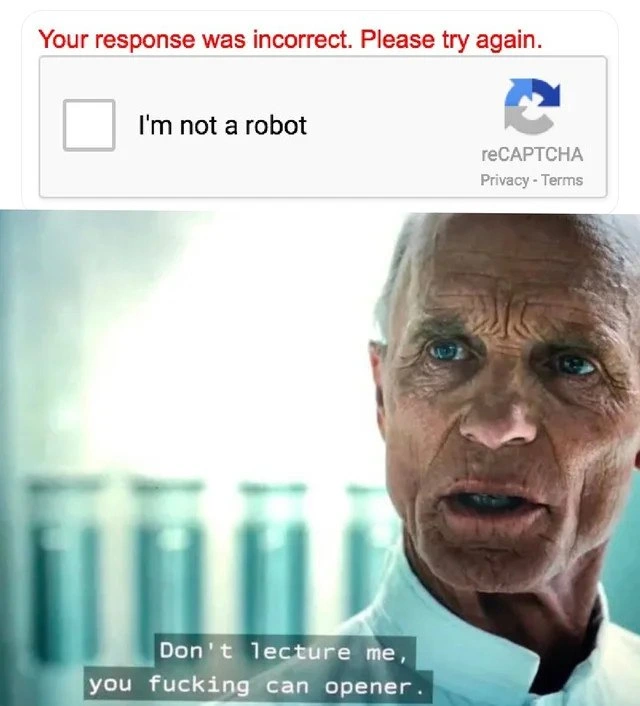
Imagine you have an automatic door that’s supposed to let people into a building, but it doesn’t open for you. You wave your hands, jump around, do everything a normal person would do, but the door’s sensor just doesn’t believe you’re really there. Eventually, in a fit of frustration, you might stomp your foot and yell, “Open up, you stupid door!” even though you know it’s just a machine. That’s basically what’s happening in this meme. The computer on the website gave the person a little test to make sure they’re human. For some reason, the test said, “Hmm, I’m not convinced, try again.” Being told “you might be a robot” when you’re very much a real person feels really irritating – kind of like a door refusing to acknowledge you. So the person gets mad and shouts a silly insult at the computer, calling it a “can opener” (which is like calling it a dumb kitchen gadget). It’s a funny over-the-top reaction: the human is so fed up with the uncooperative computer that he’s treating it like a person who did something wrong. We laugh because we know the feeling – anyone can get annoyed at gadgets that don’t work right – and here the poor guy is basically arguing with a robot gatekeeper. It’s a everyday scenario turned up to cartoon level: a real person trying to prove they’re real, and when the little robot test doesn’t believe them, the person just loses their cool and starts yelling at the machine.

Level 2: The Not-a-Robot Test

Let’s break down what’s happening in this meme for those who haven’t wrestled with CAPTCHAs before. A CAPTCHA is a little test on websites that asks you to do something like click a checkbox or identify objects in pictures to prove you’re not an automated program (a bot). The idea is that humans find these tasks easy (like reading distorted text, or recognizing a cat in an image), but bots and scripts find them hard. reCAPTCHA is Google’s popular version of this. You’ve probably seen the checkbox that says “I’m not a robot.” When you click it, a few things happen behind the scenes: the site might be analyzing how you moved your mouse or tapped (humans have quirky, varied motions, while bots are often perfectly linear or instant). If everything looks good, you pass immediately. If the system isn’t sure you’re human, it might throw a secondary test at you – like “Select all images with a crosswalk” or “Type the characters you see.” Only after you get those right does it let you through. It’s basically a human verification gate in the website’s frontend (the part of the site running in your browser). Once you pass, the browser sends a code to the website’s server saying “Verified human ✅,” and the site then allows your form (login, signup, comment, etc.) to go through.

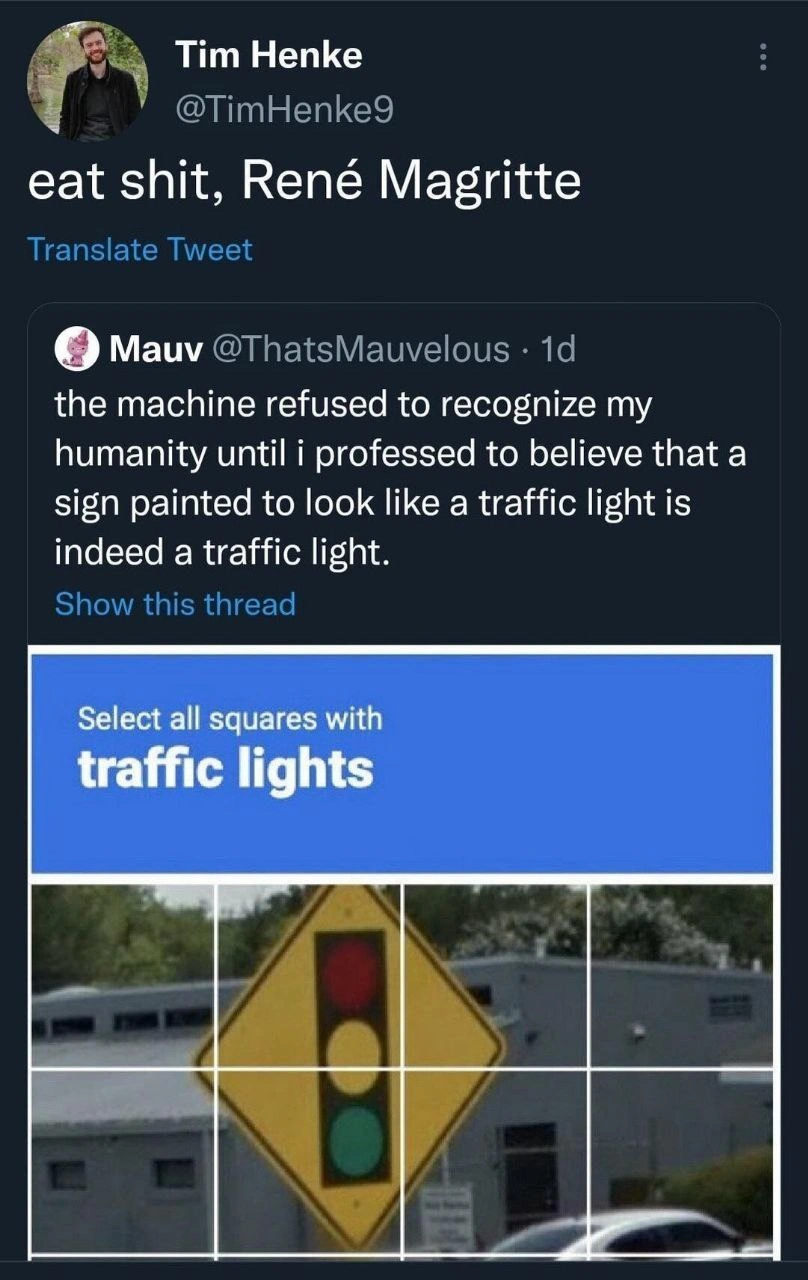
Now, in the top half of the meme, the reCAPTCHA is showing an error in red: “Your response was incorrect. Please try again.” This means the person didn’t pass the test. Maybe they clicked the checkbox and Google thought their behavior was fishy, or they messed up the image selection somehow. It’s essentially a fail message for the “I’m not a robot” test. This is where the frustration kicks in – because if you are actually human and you get told you failed a bot test, you’re going to feel a mix of confusion (“Wait, why does it think I’m a bot?”) and annoyance (“Ugh, now I have to do another challenge”). This situation is known as a captcha_false_positive – “false positive” meaning the system got a positive detection (it thought it caught a bot), but it was wrong (the user is actually human). It’s like a smoke alarm going off when there’s no fire – a safety mechanism triggering by mistake. Not super common, but it definitely happens. Sometimes it’s due to user error (those picture grids can be genuinely tricky – who hasn’t squinted at a tiny bit of traffic light on the edge of a photo and wondered if they should click it or not?). Other times it could be because of technical reasons: maybe the frontend_validation token expired or something glitched, so the server treated the attempt as invalid. Either way, our poor user is told to “Please try again,” which can feel patronizing when you did try correctly the first time.

Enter the bottom panel of the meme: a furious guy in a lab setting shouting with subtitles: “Don’t lecture me, you fucking can opener.” This is a line from a movie/TV scene (the image looks like a high-tech lab confrontation), and in that original context he’s probably yelling at a robot or AI. In the meme, it’s perfect because the user is essentially yelling at the reCAPTCHA system. Let’s unpack that insult: calling the sophisticated Google security system a “can opener” is him saying “you stupid machine” in the most derogatory way. A can opener is a very simple device – so he’s basically reducing an advanced algorithm to a dumb metal tool. It’s a salty (very angry and sarcastic) comeback to being lectured by a computer. The phrase “Don’t lecture me” fits because the error message probably felt like a scolding to him (like the system is saying “Wrong, do it again, and this time do it properly”). Humans really don’t like being scolded by a machine – it feels absurd, right? So he snaps. This is obviously an overreaction played for laughs – most of us just sigh and mutter under our breath when we fail a CAPTCHA, but the meme exaggerates it by having him outright shout a comedic insult.

From a WebDev and UX_UI standpoint, this scenario highlights a famous balancing act: security vs. user experience. The whole reason Authentication flows often include CAPTCHAs is to keep bad actors out. For example, without CAPTCHAs, a malicious bot could create thousands of fake accounts or spam a forum automatically. The CAPTCHA is there to say “Hold on, prove you’re a real person by doing something only a person can do.” That’s a Security measure. But the downside is what we see here: it’s irritating and slows people down. It’s not exactly a fun part of using a website; it’s more like a necessary speed bump. Developers (the people who build the site) and designers try to minimize this friction – nobody wants to drive users away. However, they also know that if they remove the CAPTCHA, the site might get overrun by spam or abuse, which creates other problems for user experience. So it’s a bit of a damned-if-you-do, damned-if-you-don’t situation. In this meme, clearly the user’s patience has run out. That’s the broader DeveloperExperience (DX) lesson here: every safeguard we add (CAPTCHAs, 2FA, security questions) has a cost in convenience. Good systems try to be smart – like reCAPTCHA often won’t even prompt you at all if it’s very sure you’re human (you may have noticed sometimes you click “I’m not a robot” and it just checks green without any puzzle – that’s when things worked perfectly). But when things go slightly off or the user’s environment is unusual, the system can err on the side of caution and make the human jump through hoops. And if the human stumbles or if the system itself hiccups, you get that red-text error and one very annoyed user. The meme is basically a dramatization of that annoyed user moment. It’s funny to developers because we’ve been on both sides: we’ve been the user cursing at an inconvenient CAPTCHA, and we’ve also been the developer who set up the CAPTCHA thinking “this will help secure the site,” only to realize later that it’s causing headaches for real people. It perfectly captures a relatable pain in tech: sometimes in trying to prove we’re not robots, we end up feeling like we’re in a battle with robots. And when a simple checkbox starts to feel like an adversary, you know the UX has taken a hit.

Level 3: Rage Against the CAPTCHA

Every seasoned web developer and internet veteran has felt the sting of a CAPTCHA false-positive. It’s that moment when you’re just trying to log in or submit a form, and the website’s bot detector decides you might be an automation. The meme perfectly captures this DeveloperFrustration: a security measure meant to be a silent guardian suddenly turns into an accusatory bouncer, and the genuinely human user absolutely loses it. In the top panel, the familiar Google reCAPTCHA widget politely declares, “Your response was incorrect. Please try again.” – which is a clinical way of saying “I think you might be a robot, so I’m not letting you through.” For developers who have implemented this, it’s a cringe-worthy scenario: you add a CAPTCHA to keep spam out of your site (a necessary evil in modern WebDev), but now your user authentication flow has a new failure mode where real users get caught in the net. It’s a classic case of a captcha_false_positive. We can practically hear the collective groan of devs everywhere, because we know what’s coming next: support tickets from confused (and irritated) users, A/B test data showing an uptick in drop-offs, or that one QA engineer who keeps getting flagged as a bot during testing. The UX_UI trade-off is on full display – yes, we’re bolstering security, but at the cost of a frustrated, insult-hurling user in this case.

From a senior developer perspective, this meme is too real. The user’s angry retort — “Don’t lecture me, you fucking can opener.” — is an over-the-top expression of the kind of RelatablePain we usually suppress with a forced laugh and a facepalm. It’s the kind of salty comeback you’d love to deliver to uncooperative technology at 2 AM. In the meme’s context, the man in the lab (a scene pulled from some sci-fi confrontation) is effectively treating the CAPTCHA like a misbehaving robot underling. Calling it a “can opener” demotes this sophisticated piece of AI-powered security to the level of a dumb kitchen appliance. That insult is both hilarious and telling: only a truly exasperated human would personify a program and swear at it. No bot is going to shout back “you can opener” when challenged – this meltdown is uniquely human. In fact, the outburst ironically confirms his humanity in a way the CAPTCHA couldn’t: genuine anger and creative profanity are hard to imitate convincingly by an AI (at least for now!). It’s a great example of UX Irony – the tool designed to distinguish human from robot forced the human to behave in a way that no robot ever would.

Why is this scenario so familiar to developers? Because we’ve all walked that tightrope between Security and User Experience. We implement things like reCAPTCHA to stop credential-stuffing bots, spam comments, and fake sign-ups – important security work. But every added layer of defense (two-factor auth, CAPTCHAs, rate limiters) is also an added layer of friction for real users. This meme zeroes in on that friction: the user’s patience has been ground down by one too many “select all the fire hydrants” challenges. It’s the Security vs. Sanity showdown. In real projects, devs discuss this all the time: How many hoops can we ask a legit user to jump through before they rage-quit? Here, apparently, one checkbox was one hoop too many. The DeveloperExperience_DX angle is there too – as the developer, you might be gritting your teeth watching this play out, knowing that the feature you added for protection is now chewing out the very people you intended to protect. You can almost hear a DevOps engineer muttering, “Great, now our login page is roasting our users. Just what we needed…”

There’s also a bit of industry cynicism hidden in the humor. Google’s reCAPTCHA has a habit of enlisting users to train its AI – every time you identify street signs or storefronts, you’re helping improve Google’s machine vision for self-driving cars or Maps. So not only is our poor user delayed by the CAPTCHA, they’re effectively doing free micro-work for Big Tech. No wonder he’s irate! It’s like the system is lecturing him and putting him to work. The subtitle “Don’t lecture me” fits perfectly because that red error text does feel like a condescending rebuke. The dev community knows that implementing a CAPTCHA is always a delicate balance: you want to ask just enough to verify “Are you human?” but not so much that the human feels insulted or overwhelmed. When that balance tips, you get scenes like this – a fed-up user essentially going Rage Against the Machine (or rather, Rage Against the CAPTCHA). And let’s be honest, we’ve all been there: clicking and re-clicking images, wondering if that tiny corner of a traffic light counts, muttering under our breath at the screen. This meme just takes that relatable moment and cranks it to 11 with a cinematic, profanity-laced punchline. In summary, the meme is poking fun at the anti_bot mechanisms we rely on: when they work, nobody notices, but when they glitch out and call a real person a robot, it’s peak frustrating and absurd – the kind of situation where a developer can only shrug and say, “Well, the robots think I’m one of them now… time to prove my humanity by screaming at a checkbox.”

Level 4: Inverted Turing Test

At its core, a CAPTCHA is essentially an inverted Turing test – a twist on Alan Turing’s famous idea of distinguishing humans from machines. Originally, the Turing test imagined a human judge deciding if they were conversing with a person or a computer. In a CAPTCHA (which tellingly stands for Completely Automated Public Turing test to tell Computers and Humans Apart), it’s the machine doing the judging, quizzing the user to prove their humanity. The technical irony here is rich: we have built algorithms sophisticated enough to challenge us with tasks that exploit gaps in artificial intelligence. Early CAPTCHAs used distorted text because humans excelled at reading messy letters while bots struggled. As AI pattern recognition improved (OCR algorithms eventually learned to read those squiggly letters better than some humans), CAPTCHA evolved to use image recognition tasks – like picking out all the traffic lights or crosswalks in a grid of photos – tasks that still stump many automated scripts. Modern reCAPTCHA systems (like Google’s v2 shown in the meme) even analyze your cursor movements and browsing behavior to calculate a probability score of your humanness. Under the hood, it’s essentially a real-time classification problem with some machine learning: the system is evaluating signals to decide “bot or not?”. Inevitably, with any classifier, there are false positives and false negatives. A false positive in this context means the system incorrectly flags a legitimate human as a bot (as happens in this meme), whereas a false negative would be a bot sneaking through as a “human.” Tuning such systems is an exercise in balancing security sensitivity – tighten the rules to catch more bots, and you’ll accidentally snag more real users too. It’s a probabilistic trade-off where an aggressive anti-bot stance will occasionally challenge or block actual people. This fundamental tension is practically a law of WebSecurity and anti-abuse engineering: if you make the gates strong enough to stop almost every trespasser, now and then an innocent traveler gets misidentified at the gate. The humor here draws on that theoretical irony: a human being has essentially failed a robot’s test for humanity. It’s a reversal of roles worthy of sci-fi – the human verification mechanism casts doubt on an actual person. In an abstract sense, the user in the meme is a victim of an algorithmic identity crisis, caught on the wrong side of a blurry line that math and code draw between human-like and too robotic. The frustrated outburst (“Don’t lecture me…”) is more than just comedy – it’s the Turing test turned on its head, highlighting the imperfect nature of these AI-driven gatekeepers. In a world where bots are getting smarter and anti_bot mechanisms more convoluted, sometimes real humans feel like they have to prove they’re not imposters to our own machines. This false-positive fiasco underscores a deeper truth: as our systems get more autonomous, we occasionally find ourselves performing for the algorithms – a bizarre homage to how far AI has come, and how it still messes up in very human ways.

Description

A two-panel meme contrasting a common web frustration with a comically aggressive reaction. The top panel shows a standard Google reCAPTCHA checkbox with the text 'I'm not a robot'. Above it, a red error message reads, 'Your response was incorrect. Please try again.' This depicts the infuriating scenario of a human user failing a test designed to prove their own humanity. The bottom panel features a screenshot of Ed Harris as the Man in Black from the TV series 'Westworld'. He stares intently, with the subtitle below reading, 'Don't lecture me, you fucking can opener.' The meme perfectly captures the user's indignant and irrational anger when a machine has the audacity to question their identity, escalating a simple UI failure into a full-blown existential conflict. For developers, it's a humorous take on flawed bot detection and the often-broken user experiences they are sometimes forced to implement
Comments

11
Anonymous ★ Top Pick The modern Turing test isn't about proving a machine can think, it's about proving to a machine that *you* can
  1. Anonymous ★ Top Pick

    The modern Turing test isn't about proving a machine can think, it's about proving to a machine that *you* can

  2. Anonymous

    Twenty years of tuning anomaly detectors, and reCAPTCHA still tags my mouse entropy as “too Gaussian” - apparently I’ve optimised my motor neurons into synthetic data

  3. Anonymous

    After 20 years of implementing OAuth, JWT, and biometric auth, the ultimate irony is being told by a script that you've failed to prove you're human because you clicked the traffic lights 0.3 seconds too fast - clearly only a bot could have that kind of efficiency from years of muscle memory

  4. Anonymous

    When your end-to-end test suite fails because reCAPTCHA decided your perfectly valid Selenium WebDriver is 'suspicious activity' - nothing quite captures that 3 AM deployment blocker feeling like being lectured on humanity by a glorified checkbox. Bonus points when you're running headless Chrome in your CI/CD pipeline and Google's ML model is absolutely convinced you're a bot, which, to be fair, in that context you technically are. The real kicker? You'll spend more time implementing CAPTCHA bypass strategies than actually testing your application logic

  5. Anonymous

    reCAPTCHA: our anti-bot stack blocks the CFO and lets 2Captcha stroll in - yet the ROC curve looked fantastic in the QBR

  6. Anonymous

    reCAPTCHA's mouse entropy heuristics mistaking your 15-YoE keyboard fury for bot precision - classic false positive

  7. Anonymous

    reCAPTCHA: the only ML gate where a noisy risk score can overrule a paying human - tune the threshold to 0.9 and you’ve DDoS’d your own conversion funnel

  8. @Roman_Millen 5y

    I'm not a robot, your argument is invalid.

  9. @its_sauce 5y

    Mark Zucc can't ever pass the I'm not a robot

  10. @p4vook 5y

    LMAO

  11. @its_sauce 5y

    ma ducc

Use J and K for navigation