One-in-a-million bugs appear fast when computers run billions of operations
Why is this Bugs meme funny?
Level 1: Bound to Happen
Imagine you have a huge bag of 1,000,000 gumballs, and you’re told only one of those gumballs is super spicy (the kind that makes you scream "Yowch!"). If you eat just one gumball from the bag, it’s really unlikely you’ll pick the super spicy one – you’d have to be very unlucky. But now suppose you start gobbling gumballs really, really fast – hundreds or thousands every minute. What do you think will happen? Before long, you’re definitely going to chomp on that one awful gumball. You’ll get that nasty surprise, start yelling in pain, maybe spit fire like a cartoon character.
This is exactly what the meme is joking about. The “one-in-a-million” bug is like that one spicy gumball in a million normal ones. It’s super rare on a single try. But a computer is like a crazy-fast candy-eating machine – it’s doing so many operations (so many tries) that sooner or later it’s going to hit the bad one. Boom! The bottom line: if something can go wrong, and you give it enough chances, it will go wrong eventually. The meme makes us laugh by showing someone saying “Eh, it almost never happens” and then quickly showing the giant explosion and Homer Simpson yelling “D’OH!” when it does happen. It’s funny in the way a cartoon is funny when a character says “What could possibly go wrong?” and then everything immediately goes wrong. The lesson? Even a tiny chance isn’t zero, so don’t be too surprised when eventually it happens!
Level 2: Little Chance, Big Impact
Let’s break down the idea in simpler terms. A software bug is a mistake or flaw in a program that can cause it to act in unexpected ways. Sometimes a bug might only show up in a very specific or uncommon situation – that’s what we call an edge case (meaning it’s at the edge of what’s expected, a rare scenario). Now, “one-in-a-million chance” literally means something is very unlikely to happen. It’s like saying there’s only a 0.0001% chance of the bug showing up each time the program runs a certain operation. Sounds pretty safe, right?
But here’s the catch: computers are insanely fast and do billions of operations per second. Billions. That’s 1,000,000,000+ operations every second in a high-performance system! So even if each operation has a one-in-a-million chance to go wrong, when you do a million operations, statistically one might fail. And in a billion operations, you could expect around a thousand failures if that probability holds. Essentially, the computer is giving that rare bug a million chances to rear its head over and over. What was almost impossible in one try becomes quite likely when repeated so many times.
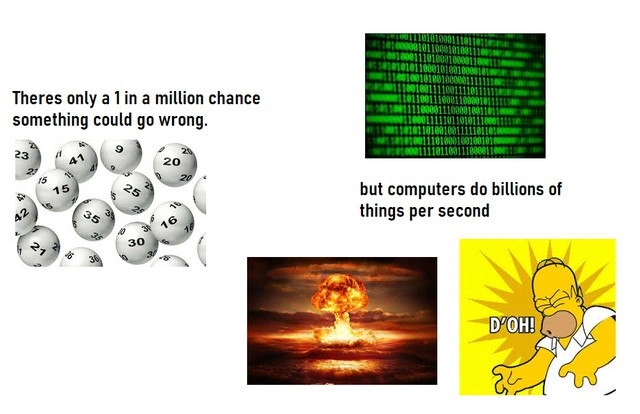
The meme uses pictures to get this point across. The pile of lottery balls (top-left) is an example of something with long odds: winning the lottery is very unlikely, maybe around a one-in-a-million chance or worse. The text there says “There’s only a 1 in a million chance something could go wrong,” as if someone is shrugging off the risk. The Matrix-style green code image (top-right) represents the computer doing countless operations at lightning speed – basically “millions of picks from the lottery drum every second.” The caption reminds us "but computers do billions of things per second." In real life, a program might be looping, processing data, handling user requests, etc., at an incredibly fast rate. With so many chances, that tiny probability of error starts to loom larger.
Now look at the bottom-left: a dramatic orange mushroom cloud explosion. This over-the-top image stands for a catastrophic failure in the software – in other words, the bug finally happened and it wasn’t trivial. It’s like saying, “Kaboom! The rare bug struck and it brought everything down.” Of course, real bugs don’t usually cause literal explosions, but if a critical system crashes or data gets corrupted, it feels like a big explosion for the team responsible. It’s an exaggeration to make us laugh and say “uh oh.”
Finally, bottom-right, we see Homer Simpson yelling “D’OH!”. Homer Simpson (from The Simpsons TV show) is famously clumsy and often says "D'OH!" when he makes a mistake or something goes wrong. In the context of the meme, Homer is like the developer or the ops engineer reacting when that “impossible” bug actually happens. It’s a cartoon way to show the facepalm moment: “I can’t believe it blew up!” It’s both funny and relatable – the character is basically us when we realize that tiny chance event we ignored has come true.
So, tying it together: The text on the meme is essentially a conversation. First panel: “Don’t worry, the chance of a bug here is one in a million.” Second panel: “Well, the computer is doing millions of operations constantly, so…” Third panel: “BOOM!!” (the bug causes a huge crash), and fourth: “D’OH!” (the team’s shocked reaction). It’s highlighting a typical production issue scenario in tech. Engineers might be on call to handle such emergencies – that means if something breaks in the middle of the night, someone gets paged to fix it. This meme is a cheeky reminder that if you dismiss a low-probability bug, you might be the one getting that 3 AM call when the “low probability” catches up with you.
In simpler terms: even a tiny risk per operation becomes a big deal when you have a huge number of operations. It’s like having a massive jar of jelly beans with one poisonous bean. If you only eat one bean, you’re almost certainly safe. But if you plan to eat the whole jar (or thousands of beans a second!), odds are you’ll eventually bite into the bad one. That’s why developers learn not to ignore edge cases or rare bugs – in large-scale systems, those “rare” events happen regularly. The meme humorously teaches that lesson with a lottery metaphor and a cartoon explosion. It resonates with anyone who’s seen a “very unlikely” bug crash a system.
Level 3: When Rare Becomes Routine
Seasoned developers immediately smirk at this meme because we’ve all heard some optimistic junior or manager say, “Oh, it’s a one-in-a-million chance. It’ll never happen.” Never, huh? In production, “one-in-a-million” translates to “happens 10 times a day” once your system is at scale. The humor (tinged with horror) comes from that gap between theoretical safety and real-world ProductionIssues. High-Performance systems execute so many operations and handle so many users that rare bugs become almost routine occurrences. In other words, what should be an EdgeCase ends up being a frequent case. This meme perfectly captures that irony with the lottery visual and the Matrix code: the computer is effectively buying lottery tickets at lightning speed, so it’s bound to hit the unlucky number before long.
Each quadrant tells part of the story. The lottery balls in the top-left represent someone assuring us a bug is as unlikely as winning the lottery (one-in-a-million chance). It’s the classic ignorant confidence before disaster. The top-right’s green binary Matrix screen shouts back, “Surprise! This machine guns through millions of operations per second.” In other words, the system is relentlessly iterating that chance over and over. The result? That “impossible” bug surfaces much sooner than anyone hoped. By the time we reach the bottom-left, we see the mushroom cloud explosion – a comically exaggerated catastrophic failure. This is what it feels like when that fluke bug actually triggers in a live system: an unexpected, blazing nuclear_meltdown_bug that could take the whole service down. And finally, bottom-right, we have Homer Simpson clutching his head, yelling “D’OH!”. Homer is the perfect avatar for the developer on call: the moment of shock and regret when the “very unlikely” scenario happens and you realize you should’ve seen it coming. Homer’s famous D’OH! — essentially “I screwed up!” — is exactly how it feels when that edge-case you dismissed comes back to bite you in production.
Every experienced engineer has lived this. It might have been a SoftwareBug that only manifests with a certain rare combination of inputs, or a race condition timing bug that requires just the wrong microsecond alignment. In testing, you never hit it. But then your application goes live, handles millions of requests or runs for months continuously, and suddenly that bug pops up out of nowhere — usually at 3 AM on a weekend, naturally. Cue the on-call pager and some choice expletives. It’s basically Murphy’s Law for software: anything that can go wrong, will go wrong, given enough time and traffic.
Why is this so funny (and painful)? Because the setup is so relatable: someone downplays a risk (“1 in a million chance, what could go wrong?”) and then reality (the computer’s blistering speed) says “Hold my beer.” The edge_case that was “theoretical” becomes a Sev-1 outage. The rare_but_inevitable bug doesn’t care that you thought it wouldn’t happen – it just needed enough iterations. Those billions of operations per second are essentially risk_compounding on overdrive. Even a tiny fault_probability per operation, when multiplied by outrageous speed and scale, guarantees that eventually something will hit the fan.
In practice, this is why seasoned devs insist on error handling, monitoring, and not ignoring even low-probability failure modes. If there’s a one-in-a-million chance a server will miscompute a value, and you’re doing tens of millions of computations, you will see that glitch sooner or later. Maybe on day one, maybe after a few months – but it’s coming. And if that glitch is not contained (say it triggers a chain reaction or an unhandled exception), it can feel like that mushroom cloud went off in your data center. Picture an overflow that no one expected: “We never thought a user would hit 10 million followers” or “We assumed this counter would never wrap around.” Well, given enough users or enough runtime, it happened, and boom – CriticalBugs galore.
The meme exaggerates to make the point: a nuclear explosion and Homer panicking are cartoonish, but any dev who’s been on-call during a production outage can relate to the emotional equivalent of that imagery. You deploy some code thinking “chances of failure are practically zero,” and then the system does what systems do – churn through billions of operations – and smack! that microscopic chance materializes as a very real bug. D’oh! The lottery you never wanted to win just paid out. Next time someone says “it’s a million-to-one chance,” experienced folks know to respond: “Those odds will happen by Tuesday – let’s put in a check or fail-safe before we have a meltdown.”
// Pseudocode for a "one-in-a-million" bug scenario:
if (Math.random() < 0.000001) {
// Uh-oh, the 'impossible' just happened
triggerProductionMeltdown(); // catastrophic failure path
}
Above is a playful pseudo-code representation: a tiny random chance triggers a major failure. In a tight loop running millions of times, that triggerProductionMeltdown() is not as unlikely as it appears! This snippet is basically the nightmare hidden in some corner of your system: a bug that should never execute…but given enough runs, it does. The meme brilliantly communicates this with visuals and humor, and every senior dev chuckles (or winces) because we’ve been there.
Level 4: Certainty at Scale
At the ultra-granular level, this meme highlights a truth of reliability math and large-scale computing: even a minuscule fault probability will produce failures when executions are numerous enough. Let's formalize the scenario: suppose an operation has a probability $p = 10^{-6}$ (one-in-a-million) of causing a bug. If a computer performs $N$ independent operations, the expected number of failures is $N \times p$. Modern systems often execute billions_of_operations per second. So for $N = 10^9$ (one billion), we get an expected $N \times p \approx 1000$ failures per second. The probability of zero failures in those billion tries is extremely low:
$$ P(\text{no bug in N tries}) = (1 - p)^N \approx e^{-N p} = e^{-1000} \approx 0. $$
In other words, a "one-in-a-million" bug is effectively guaranteed to occur when you’re doing billions of things. This is the risk_compounding effect: tiny per-operation risk becomes near certainty at scale. It’s analogous to a lottery_odds_metaphor flipped on its head – if you buy enough lottery tickets, you’re almost sure to hit the “jackpot” (except here the prize is a production crash!).
This isn’t just theoretical. Rare_but_inevitable events plague large systems all the time. In hardware, each transistor or memory bit has an infinitesimal chance of flipping due to cosmic radiation. With trillions of bits flying around, cosmic-ray probabilistic_failure isn’t sci-fi – it’s a well-documented cause of real errors. That’s why servers use ECC memory and CPUs have parity checks: to guard against these one-in-a-billion glitches that will happen eventually. In distributed computing and high-performance clusters, engineers talk about mean time to failure for large deployments – as you add more components or operations, the time until some rare bug or fault hits drops dramatically. Essentially, at a big enough scale, rare events become statistically inevitable. The meme’s nuclear explosion panel is a tongue-in-cheek nod to what happens when those odds catch up with you: one stray bit flip or unhandled edge case and boom, there goes your uptime.
So the top-left text, “There’s only a 1 in a million chance something could go wrong,” is a dangerously naive statement in a world where computers brute-force probabilities. The top-right matrix-style binary rain (“computers do billions of things per second”) underlines the billions_of_operations avalanche that makes a one-in-a-million chance far from safe. The horrifying math is clear to any seasoned system designer: $(1 - 10^{-6})^{10^9} \approx 0$ means that “one_in_a_million_bug” will strike, likely sooner than later. The system is effectively rolling a million-sided die every microsecond, and eventually it will roll the disaster number. That’s the darkly funny, almost paradoxical reality this meme is illustrating: given enough attempts, the statistically “impossible” becomes a near certainty.
Description
The meme is arranged on a white canvas with four quadrants. Top-left shows a pile of lottery balls alongside the caption “Theres only a 1 in a million chance something could go wrong.” Top-right displays a green Matrix-style screen of binary digits with the caption “but computers do billions of things per second”. Bottom-left features a dramatic orange mushroom cloud from a nuclear explosion, implying catastrophic failure. Bottom-right has a yellow background image of Homer Simpson clutching his head and shouting “D’OH!”. Together it humorously illustrates how tiny per-operation failure probabilities quickly materialize in software systems executing billions of instructions per second, a reminder of how error rates compound in production at scale

Comments
8Comment deleted
PM: “Failure odds are one in a million.” SRE: “Perfect - at 120k req/sec that’s a brand-new incident every 8.3 seconds; I’ll script the post-mortem template right after I automate the coffee.”
That moment when you realize your 'statistically impossible' race condition has been happening 86 times per day in production, but the retry logic has been silently masking it until that one perfect storm when all three data centers hit it simultaneously during a cache invalidation
Ah yes, the classic distributed systems paradox: 'This race condition has a one-in-a-million chance of occurring' - which means it'll happen approximately 3,600 times per hour in production when you're processing a billion requests. The real kicker? It only manifests at 3 AM on weekends, never reproduces in staging, and the stack trace points to a library that was deprecated in 2015 but somehow still runs 40% of your infrastructure
At scale, '1‑in‑a‑million' isn’t an edge case - it’s a steady‑state metric; at 1B ops/sec that’s ~1,000 faults/sec, and your error budget evaporates before standup
PM: “Only a one-in-a-million failure.” SRE: “At our scale that’s 1e-6 × 1e9 ops/sec = 1,000 failures per second - should I write a runbook or a press release?”
That 10^{-6} race condition? At 10^9 ops/sec across a cluster, it's not rare - it's your 99.99% SLA breach
X~B(1000000000000, 0.0000001) P(X>0) Comment deleted
Parity and error correction: Comment deleted