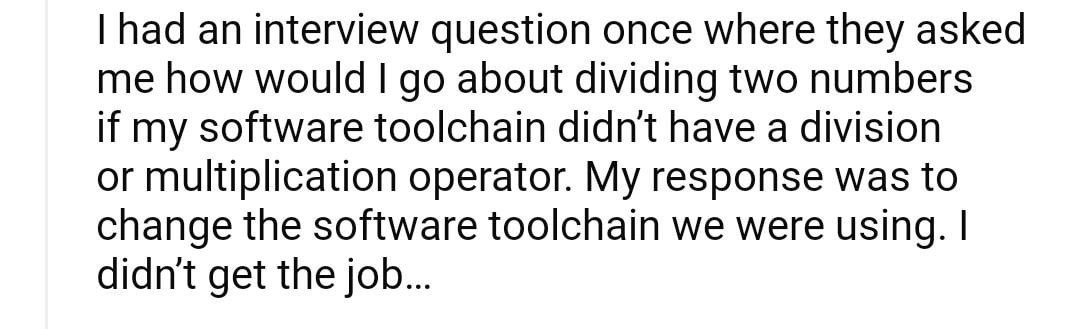
Interviewer forbids division; dev suggests new toolchain and still gets rejected
Why is this Interviews meme funny?
Level 1: Using a Calculator
Imagine a teacher asks you to solve a division problem but says you’re not allowed to use the normal way of dividing or multiplying. The teacher wants to see if you can do it the long way – maybe by subtracting one number over and over from another to see how many times it fits. That’s like testing if you truly understand what division means. But instead of doing that, you reply, “I’d just use a calculator that can divide for me.” In real life, that answer makes a lot of sense (why struggle if a calculator can do it, right?), but it’s not following the teacher’s special rule. The teacher probably wouldn’t accept that answer because it skips the exercise they wanted you to try. In this meme’s story, the interviewer is like that teacher and the developer is the student with the clever calculator idea. It’s funny because the developer’s solution is sensible and practical, yet it wasn’t the answer the interviewer wanted. The result? The interviewer didn’t give them credit for it – or in other words, they didn’t get the job – all because they didn’t solve the problem the hard way as asked.
Level 2: Reinventing Division
At its heart, this meme describes a classic coding interview scenario with a twist. The interviewer asks: “How would you divide two numbers if you aren’t allowed to use the division (/) or multiplication (*) operators in your code?” This kind of question tests your understanding of basic math operations and algorithms. In normal programming, we rely on the language’s built-in division operator (the / symbol) to do that math for us. But here, the interviewer is forbidding those shortcuts. It’s like they’re saying, “Imagine your programming language didn’t have a divide function—how could you still figure out the answer?”
To solve this, you’d have to reinvent division using more basic steps. For example, one simple method is using repeated subtraction. If you need to compute A / B without the / operator, you could keep subtracting B from A until what’s left is smaller than B. The number of times you subtracted is the quotient (how many times B fits into A), and whatever is left over is the remainder. This is basically how you might do division on paper if you only had addition and subtraction. There are other clever techniques too, like using addition in a loop or multiplying and dividing by 2 using bit shifting (since shifting bits left is like multiplying by 2, and shifting right is like dividing by 2). The key point is that the interviewer wants to see that you can come up with an algorithm – a clear step-by-step solution – to perform division from scratch without relying on the language’s built-in trick.
Now, here’s the funny part: the person being interviewed didn’t follow this plan at all. Instead, their answer was basically, “I’d just use a different programming toolchain that does have division.” The term software toolchain refers to the set of tools and environment you use to write and build software – for example, the programming language, its compiler or interpreter, and any libraries or frameworks. By saying they’d change the toolchain, the candidate was suggesting just using a different language or system where dividing numbers is straightforward (essentially, where the / operator exists normally). In a real software project, if you somehow found yourself lacking such a basic feature, switching to a better tool or adding a library would be a pretty reasonable move. It’s the kind of practical, no-nonsense solution developers use all the time in real life: if one tool can’t do the job, use a tool that can.
However, in the context of an interview (especially one focused on CS fundamentals), this answer missed the mark. The interviewer set up this odd constraint to see how you’d handle it, not to see if you would run away from it. It’s a common theme in tech interviews to impose an artificial rule or limitation precisely to force you into problem-solving mode. They were expecting the candidate to demonstrate some creativity and knowledge by coding a manual division method. So when the candidate answered with “I’d change the toolchain,” it came off as not playing along with the exercise. It’s a bit like if a teacher gave a test where calculators aren’t allowed, and a student responded, “Well, I’d just use a calculator from home.” It might be logical, but it’s against the spirit of the test. That’s why the meme says “I didn’t get the job…” – unsurprisingly, the interviewer wasn’t impressed by an answer that effectively dodged their question.
For many developers, this scenario is humorous because it highlights the gap between interview puzzles and real-world problem solving. In a real job, you aim to solve problems in the most efficient and reliable way – often by using the best tools available. But in a coding interview, you’re often expected to solve problems under made-up constraints to prove you understand the underlying concepts. The meme captures that little absurdity. It’s a piece of InterviewHumor that says: what makes perfect sense in everyday coding (pick the straightforward solution) can be the “wrong” answer in an interview setting if it doesn’t follow the unwritten rules of the puzzle.
Level 3: Algorithm vs Reality
This scenario highlights a clash between theoretical algorithm design and pragmatic engineering. In a technical interview setting, the interviewer posed what seems like an impossible question: “How would you divide two numbers if your programming environment (toolchain) didn’t have a division or multiplication operator?” This contrived constraint is common in algorithmic interviews – they remove a basic feature to test your CS fundamentals. Essentially, it’s the classic divide-two-numbers problem with the usual / operator deliberately removed. The expected solution is to demonstrate knowledge of how division works under the hood: for instance, using repeated subtraction, binary long division, or bit shifting to manually calculate the result. These methods show you understand division at a low level, similar to how a CPU might perform it if there were no hardware divide instruction.
However, the punchline (and the humor) comes from the candidate’s practical answer: “I would just change the software toolchain so we have a division operator.” This response – effectively changing the toolchain – is a cheeky way of sidestepping the puzzle entirely. It’s basically saying, “Why reinvent the wheel when I can use a better wheel?” From a real-world engineering perspective, this answer is perfectly sensible. If your current tools are oddly missing basic functionality, you’d likely switch to better tools rather than implement arithmetic from scratch. In everyday software development, nobody deliberately uses a crippled environment that lacks core operations like multiplication or division – unless they’re coding on an extremely low-level system or doing an academic exercise.
Yet, in the context of the technical interview process, this pragmatic answer missed the point. The interviewer wasn’t looking for a way to escape the constraint; they created that constraint to see how you’d cope within it. They wanted you to demonstrate a solution using pure logic and algorithmic thinking (maybe expecting something like: “I’d subtract the divisor from the dividend repeatedly until what remains is less than the divisor, counting how many times I subtracted – that count is the quotient”). To illustrate, an answer they sought might look like this pseudo-code:
function divide(a, b):
if b == 0:
throw Error("division by zero")
quotient = 0
sum = 0
# subtract b from a repeatedly
while sum + b <= a:
sum += b
quotient += 1
return quotient # remainder is a - sum
This simple loop implements division by repeated subtraction. It’s not efficient for large numbers (linear time complexity $O(n)$, where n is the quotient), but it meets the no-division-operator requirement. A more optimized solution could use bit shifting to double the divisor and subtract in larger chunks (achieving roughly $O(\log n)$ performance), but the core idea is the same: build division from more primitive operations. The key is that the interviewer’s question was testing understanding of such an algorithm and low-level problem-solving.
From a seasoned developer’s perspective, the candidate’s answer of switching toolchains is a tongue-in-cheek demonstration of engineering practicality. It’s the sort of dry humor a jaded dev might throw out after a frustrating whiteboard session: “You don’t have a division operator? Well, just use a language that does, problem solved.” This resonates as CodingHumor because it exposes the absurdity of certain interview questions. It also subtly critiques the interview for focusing on a puzzle disconnected from real-world priorities. In truth, knowing how to implement division from scratch is a nice exercise in theory, but in day-to-day coding you’d rarely need to do this – you trust your language’s built-in operators or libraries. The meme gets a laugh by contrasting the ideals of computer science purity with the practical engineering mindset. It’s a nod to every developer who has sat through a contrived interview problem and thought, “In real life, I would handle this completely differently.” Here, that thought was said out loud, and the result – “I didn’t get the job…” – delivers the final ice-cold punchline that ties the humor together.
Description
White background image with a single paragraph of black text. The text reads: "I had an interview question once where they asked me how would I go about dividing two numbers if my software toolchain didn’t have a division or multiplication operator. My response was to change the software toolchain we were using. I didn’t get the job…" The meme pokes fun at algorithm-style interview questions that impose artificial constraints, expecting the candidate to devise a manual division algorithm (e.g., repeated subtraction or bit shifting). Instead, the candidate gives a pragmatic engineering answer - switch the toolchain - highlighting the tension between theoretical problem-solving and real-world developer practicality
Comments
6Comment deleted
Interviewer: “How would you divide two numbers without / or *?” Me: “Open a P0 JIRA - migrate to a toolchain built after the moon landing.” Apparently they wanted bit-shifts, not budget-shifts
After 20 years of choosing the right tool for the job, you discover that interviews still want you to implement quicksort on a whiteboard using only cosmic rays and good intentions
The candidate demonstrated perfect production engineering instincts - when faced with inadequate tooling, you fix the toolchain, not implement Newton-Raphson division in assembly. Unfortunately, the interviewer was testing for 'can you implement division using bit shifts and subtraction loops,' not 'do you understand that choosing the right tools is more valuable than algorithmic gymnastics.' Classic case of optimizing for the wrong metric: they wanted someone who could suffer through constraints, not someone who'd eliminate them. In the real world, this engineer would save the company weeks of debugging obscure arithmetic edge cases, but in interview-land, they failed to perform the expected algorithmic theater
Expected: bit shifts + binary search for O(log n) div. Delivered: toolchain upgrade. Darwinian filtering at its finest
They wanted non‑restoring division with shifts; I proposed an RFP so 'division' isn’t a Q3 deliverable of the compiler - turns out we were solving different problems
Asked how to divide without / or *; I said “upgrade the toolchain.” They wanted “repeated subtraction.” Translation: they were hiring a human FPU