The Inevitable 'Build Me an App' Request
Why is this Stakeholders Clients meme funny?
Level 1: Just Wants Help
Imagine you have a classmate who almost never talks to you. They don’t sit with you at lunch, they never call or text to hang out. Then one day, out of the blue, they suddenly come up to you and say hi very sweetly. The next thing they say is, “You’re good at math, right?” You can already guess what’s coming next — they’re going to ask if you’ll do their homework or help them with a big project. You kind of sigh inside because you realize they’re not reconnecting to be friends; they just want your help with something difficult. It’s a bit funny and a bit annoying at the same time. Funny, because you could predict exactly what they were going to ask even before they said it (like a magic mind-reading trick: “I knew you only came over to ask for homework help!”). And annoying, because it feels like the only time they remember you is when they need a favor. This meme is showing that feeling: the moment you just know an old friend only messages you because they want you to do a big task for them. It’s using a silly cartoon picture to make it dramatic and humorous, but really it’s like when someone only calls you when they need your skills. You can’t help but roll your eyes and laugh because it happens so often.
Level 2: You Are a Programmer, Right?
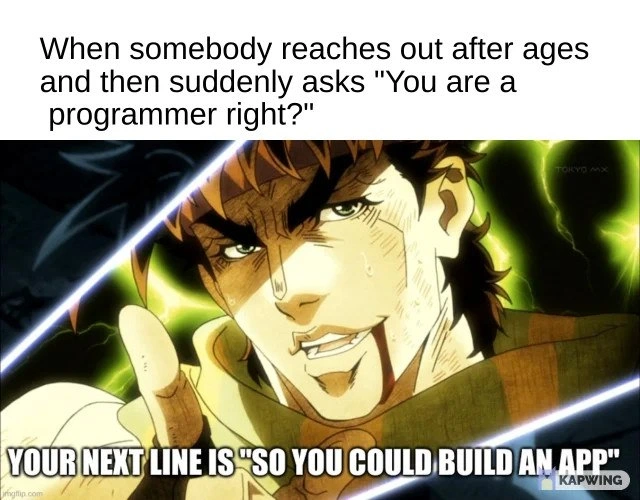
For a less seasoned developer (or someone new to these kinds of interactions), let’s break down what’s happening. The top text of the meme sets the scene: “When somebody reaches out after ages and then suddenly asks ‘You are a programmer right?’” In plain terms, this means a person who hasn’t contacted you in a very long time suddenly messages you and, almost immediately, brings up the fact that you do programming. It’s like them saying, “Hey, long time no talk! By the way, you write code, correct?” This is a red flag in developer circles because it often foreshadows a request for help or free work. The meme-maker already knows (and assumes we know) that the next thing out of this person’s mouth will be a favor ask – likely to build an app for them.
The big image with the anime character (from JoJo’s Bizarre Adventure) dramatizes the scenario. In that anime, one hero has a quirky habit of predicting exactly what his opponent will say next, declaring “Your next line is…” followed by the opponent’s imminent words. In our meme, the developer is effectively that hero: as soon as the friend says “You’re a programmer, right?”, the dev internally is going “Ah, I know what’s coming next.” Thus the bottom caption “YOUR NEXT LINE IS ‘SO YOU COULD BUILD AN APP’” is the dev preempting the friend’s follow-up question. It’s written in bold Impact font (the classic meme font with white text and black outline) to deliver the punchline loudly and clearly. The humor here comes from the anime_reaction_format exaggeration and the spot-on accuracy of that prediction. Even if you’ve never seen JoJo, the meme still works because it shows a confident, smug character calling out what the other person is about to say. That’s exactly how it feels when a friend only contacts you to get some programming done – you can practically finish their sentence.
Now let’s talk about why this is awkward and funny from a junior developer’s perspective. In software development, anyone asking for a feature or project is often called a stakeholder or a client. In a professional setting, a stakeholder might be a paying client or a manager who has a request (StakeholderExpectations are usually documented, with timelines and compensation). But here, an old friend is acting like a stakeholder – they have an idea (a desired app) and they know you have the skill to execute it. The twist is, they’re presumably expecting you to do it as a favor (for free) because you’re friends or because they think it’s just a small ask. This is where MisalignedExpectations come in. The friend probably assumes that since you enjoy coding or do it for a living, you could “just whip up” their app idea quickly, as if it’s no big deal. They might say things like, “It’s a simple concept, shouldn’t take you long, right?” Meanwhile, you as the developer know that even a “simple” app can represent weeks or months of work depending on complexity. There’s a mismatch: the friend’s expectation (quick and free) doesn’t line up with the reality (complex and time-consuming).
A new developer might feel flattered at first — “Oh, they thought of me because I’m a programmer!” — but that feeling fades once it becomes clear they’re basically looking for free labor. This situation can be tough to handle. On one hand, you want to maintain a good relationship (it’s awkward when someone you know asks for help and you have to say no). On the other hand, you recognize this is work, not a tiny favor like watering plants or lending a book. It’s software development with all its challenges: designing the interface, writing thousands of lines of code, debugging errors, and so on. If you’re early in your career, you might not yet have a solid sense of how to assert boundaries, so memes like this are a lighthearted way of warning, “Hey, watch out – this happens a lot!” and you’re not alone in feeling hesitant about it.
Let’s clarify some terms and tags in simple language:
- ClientExpectations / StakeholderExpectations: This refers to what the person who wants the project done expects to get. In a job, a client expects a certain outcome for the money or time they invest. Here, your friend (acting as a client) expects a fully working app, possibly without realizing how much they’re asking for.
- MisalignedExpectations: This means one side’s expectations don’t match the other’s. Your friend might expect a quick free app; you expect that if you build something for someone, there should be proper planning, maybe payment, and realistic timelines. Those expectations are misaligned — not in agreement.
- Scope Creep: “Scope” in a project is the defined list of features or tasks. Scope creep is when that list keeps growing uncontrolled after the project has started (“Oh, can we also add this? And that? And one more thing…”). In our context, if you agreed to make a “simple” app for your friend, the scope could creep when they keep asking for more features or changes beyond the original plan. It’s mentioned because once a friend isn’t paying, they might feel free to keep tweaking the idea, since from their perspective, “you’re just doing this in your spare time, why not add a few more things?”
- Stakeholders_Clients (category): This meme is categorized under Stakeholders/Clients because it deals with someone requesting a project (like a client would). Even though it’s a friend, the dynamic is similar to client work – except informal and uncompensated. It’s also under Communication because it’s about how people communicate (or miscommunicate) needs and favors, and how developers have to navigate those conversations.
The entire meme is super relatable to developers because many of us have been in this situation: someone from our personal life asks us to “help” with a tech project, not realizing how much they’re actually demanding. It highlights a common communication challenge—explaining to non-technical folks what’s involved in building software. The image uses an anime confrontation to playfully exaggerate the moment of realization. When you see “You are a programmer, right?” pop up in a message from a distant friend, it can feel like a dramatic boss battle is about to begin. Will you be able to deflect the request politely? Will they insist? The meme’s answer is to cut straight to the inevitable ask with humor. DeveloperHumor like this makes light of the situation: it’s funny because it’s true, and because predicting it (like a mind-reader) is both comical and a little cathartic for those who’ve been there.
Level 3: Pro Bono Prophecy
The humor hits experienced developers right in the gut because this scenario is absurdly predictable. Seasoned programmers have all developed a sixth sense for when an old acquaintance’s friendly “Hello” is about to morph into a free coding request. The meme’s punchline “YOUR NEXT LINE IS ‘SO YOU COULD BUILD AN APP’” is a direct nod to this clairvoyant feeling. It parodies JoJo’s Bizarre Adventure where a character dramatically predicts his opponent’s next words. Here, the programmer is effectively a Joestar, foreseeing the true motive lurking behind the casual “You are a programmer, right?” intro. It’s a lightning-charged confrontation in the developer’s mind: we’ve seen this exact script play out so many times that we could write the dialogue ourselves (in fact, we practically have, as code or comedy).
In the tech industry, such encounters are a running joke precisely because they’re so common. This meme satirizes the ClientExpectations vs DeveloperReality gap in its rawest form. A long-lost friend reaching out “after ages” just to rope you into an unpaid project is basically a client engagement without the contract (or the payment, or the project manager... you get the idea). The person asking often has MisalignedExpectations about what it takes to “just build an app.” From a senior engineer’s perspective, an app isn’t a trivial little nugget you whip up in an afternoon—it’s a full product. It requires requirements gathering, design, coding (front-end and back-end), testing, deployment, and maintenance. However, the requester usually sees it as just a few screens on a phone, underestimating the complexity beneath the surface. StakeholderExpectations in professional settings are managed through scope documents and budgets; here there’s none of that formality, yet the expectation of a polished end-product remains. It’s this chasm between what they think it entails and what it actually demands that senior devs find equal parts hilarious and infuriating.
Scope creep is another demon hiding in this scenario. These “quick favor” app ideas tend to balloon uncontrollably once work starts. At first it’s “just a simple app for my business,” but as any veteran knows, nothing stays simple. Soon the friend might chirp, “It would be cool if it also had login, and a chat feature, and maybe AI to do X…”—all still presumed to be easy add-ons. There’s no formal change control or stakeholder meeting here; just your acquaintance excitedly piling on features in your DMs. It’s the ultimate scope creep trap that experienced developers dread. We’ve all learned (the hard way) that “quick side projects” for friends often spiral into nightmare commitments. The meme captures the relatable developer experience of recognizing that trap the moment the conversation begins. The JoJo anime imagery amplifies this recognition with humor: the dramatic pose, the crackling energy, it’s how a developer’s brain feels internally—“Oh no, I know exactly where this is going...”
From an industry history viewpoint, this pattern is practically a rite of passage. The idea-guy friend with the “next Facebook” pitch has been around since the first app stores appeared. Many senior devs have war stories of being approached for programmer_free_labor: “I’ve got this great idea; you do the coding and we’ll split the profits!” Over time, you develop a bit of a cynical armor. The meme’s anime_reaction_format exaggerates the defensive stance we take, as if fending off an enemy Stand user. There’s a shared understanding in the dev community that our skills can make us a target for well-meaning but clueless acquaintances. The humor comes from that collective groan: here we go again. Everyone from backend engineers to UX designers has encountered someone who thinks their tech friend can build the next hit app “on the side.” It’s practically a software engineering trope at this point, just like the classic “it’s always DNS” joke – an outcome so common you bet on it every time. In fact, if we translated this scenario into code, it might look like:
function onMessageFrom(oldFriend) {
if (oldFriend.includes("programmer, right")) {
// We already know what's coming next...
return "so you could build an app";
}
}
Above, our tongue-in-cheek pseudo-code shows how deterministic this situation feels. No complex algorithm needed – just one if statement to capture that entire social interaction! The senior sarcasm here is thick: of course the next line is asking for a free app. Why else would this person suddenly remember their dear programmer pal? The phrase “Pro Bono Prophecy” in the heading sums it up: pro bono is Latin for work done for free, and we prophesize that demand coming a mile away. It’s a cynical veteran’s way of coping with a frustrating reality: outside the structured world of product roadmaps and paid contracts, you’re going to get these out-of-the-blue “favor” requests. This meme nails the TechHumor by combining a niche anime reference with a universally acknowledged developer annoyance. We laugh because it’s true – and because if we didn’t laugh, we might actually scream.
Description
A two-panel meme using the "Your Next Line Is" format from the anime JoJo's Bizarre Adventure, featuring the character Joseph Joestar. The top text reads, "When somebody reaches out after ages and then suddenly asks 'You are a programmer right?'". The bottom panel shows Joseph pointing confidently at the viewer, with the caption, "YOUR NEXT LINE IS 'SO YOU COULD BUILD AN APP'". The meme humorously captures a common and often frustrating experience for developers, where old acquaintances reappear solely to ask for free or cheap labor for their "next big app idea." For senior developers, this resonates deeply as it highlights the public's general lack of understanding about the complexity and value of software engineering, reducing their entire profession to a simple, transactional request
Comments
13Comment deleted
My 'next line' prediction is pretty good too. It's usually: 'Sure, my consulting rate is $150/hour, with a 40-hour minimum retainer.' The conversation mysteriously ends
“Absolutely - I’ll queue your ‘quick’ app right after the monolith-to-microservices migration and just before the 3 AM Sev-1 post-mortem; friendship clearly has the highest RICE score.”
After 20 years in tech, I've learned that "it's like Uber but for..." is just a polite way of saying "I need you to solve distributed systems, payment processing, real-time geolocation, and regulatory compliance for equity that'll vest after the heat death of the universe."
The pattern recognition is so strong here it could train a neural network: Step 1) Radio silence for 3+ years. Step 2) 'Hey! Long time no talk!' Step 3) 'You're still doing that computer stuff, right?' Step 4) The inevitable pivot to their 'million-dollar app idea' that just needs 'a quick weekend to build.' Bonus points if they offer equity in their non-existent company instead of actual payment. At this point, experienced devs can predict the entire conversation tree with better accuracy than a Markov chain - Joseph Joestar's Stand ability has nothing on a senior engineer's pattern matching for incoming free work requests
Scope: 'simple app'. Reality: full-stack monolith with payments, auth, and 'it should scale like Netflix'
Twenty years in, that opener autocompletes to: MVP = marketplace on iOS+Android+web, timeline = two weeks, budget = “equity”; response = send SOW template and rate card
Sure, I can “build an app” - did you want the weekend PoC, or the production version with authn/authz, billing, telemetry, SLOs, GDPR, and a 3 AM pager?
"Could you repair my boiler?" Comment deleted
о админ насмотрелся гейских мультиков Comment deleted
I will start an investigation of how it happened and will post findgings as soon as I will have any Comment deleted
Could you fix my pc? Comment deleted
could you hack a facebook account? Comment deleted
One taxi driver literally asked me this lmao Comment deleted