Trying not to explain that HTML is a markup language
Why is this DevCommunities meme funny?
Level 1: Master Chef or Microwave?
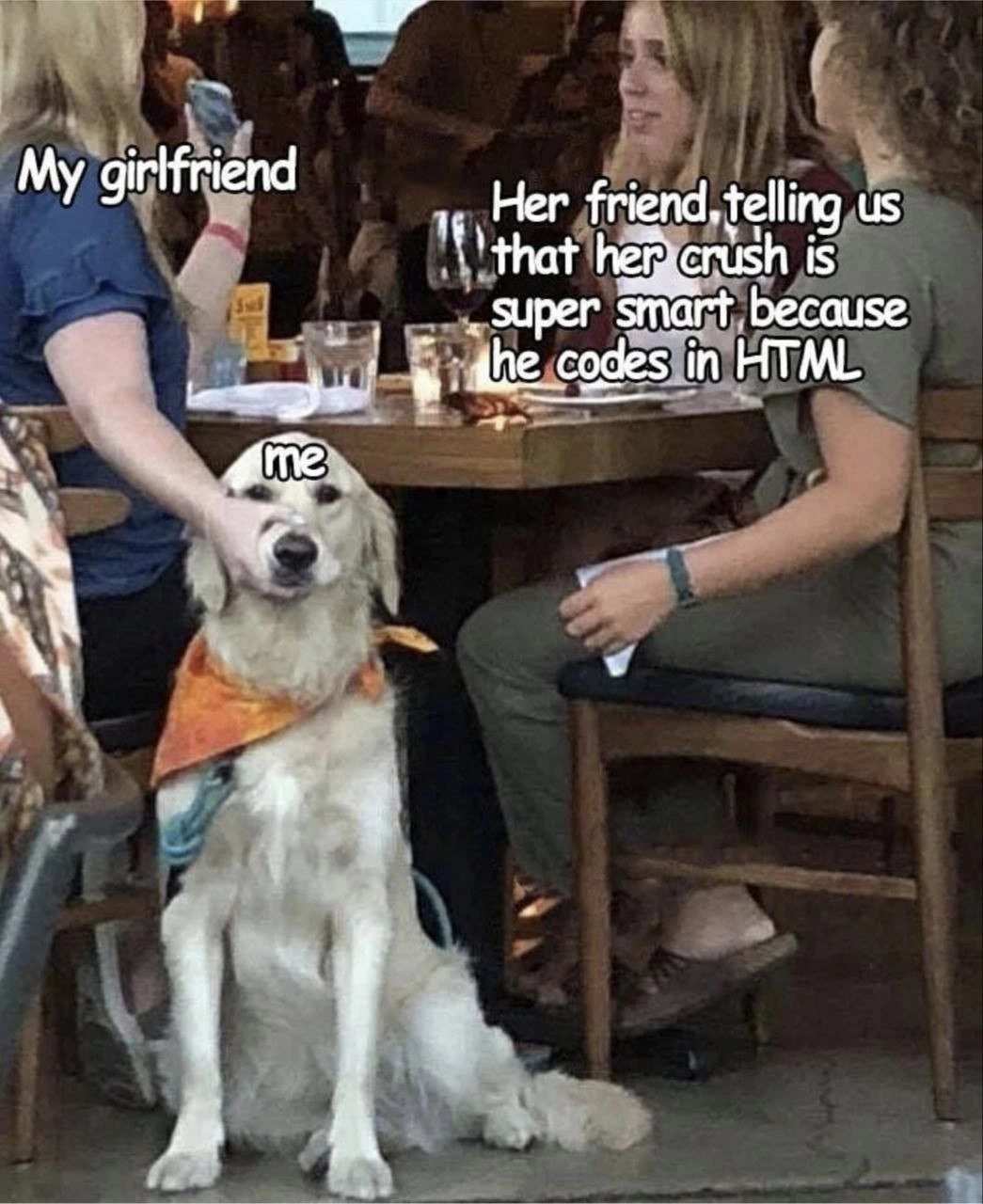
Imagine your friend calls someone a brilliant chef just because that person can heat up a frozen pizza in the microwave. A real chef would probably smile politely, but inside they’d know that microwaving isn’t the same as real cooking. In this meme, the developer feels the same way. The friend is saying “Wow, he’s super smart because he can make a web page!” But writing a simple web page (using HTML) is a bit like just warming up pre-made food — it’s a start, but it’s not full cooking. The developer (shown as the dog being patted calmly) is holding back an eye-roll, just like a chef might if someone confused basic heating with gourmet cooking. It’s funny because the friend is sweetly impressed for the wrong reasons, and the developer is amused and a tiny bit frustrated, but mostly it’s all in good spirit. Anyone can see the humor: it’s praising someone for a very simple task as if it were a huge accomplishment, and the poor “expert” (the dog/dev) has to just sit there and take it with a grin.
Level 2: HTML Does Not Compute
Let’s break down what HTML really is, and why calling it “coding” can cause confusion. HTML stands for HyperText Markup Language. It’s the standard language used to create the structure of web pages on the Internet. When you write HTML, you use tags (keywords in angle brackets like <p> or <h1>) to mark up content. For example, <h1>Hello World</h1> tells the browser “display Hello World as a big heading.” HTML is a markup language, which means it’s all about labeling pieces of content (like “this is a paragraph,” “this is an image here,” “this is a list”). Think of it like writing an outline or a skeleton for a page. The web browser reads these tags and knows how to organize and show the text and images accordingly.
Now, importantly, HTML by itself is not a programming language. A programming language (like Python, Java, or JavaScript) lets you write instructions that the computer can execute – things like making decisions (if...else logic), doing calculations, or repeating actions (loops). HTML doesn’t have those capabilities. There are no if statements or loops in HTML. You can’t write HTML to say “if user is logged in, show this message, otherwise do something else.” You also can’t perform calculations like 2 + 2 in plain HTML – it just doesn’t have that logic built in. For instance, if you put a math problem in an HTML file, it won’t solve it:
<p>2 + 2</p>
<!-- This will literally display "2 + 2" on the webpage.
HTML will NOT compute the answer "4" because it has no calculation ability. -->
All that HTML will do is tell the browser to display the characters "2 + 2" on the page as a paragraph. The browser isn’t doing the math; it’s just showing exactly what you wrote, formatted according to the tags. In contrast, a real programming scenario (using JavaScript, for example) could actually calculate 2+2 and output 4.
So why does the developer in the meme react like that dog with the funny face? Because saying someone “codes in HTML” mixes up the idea of programming with simply writing content structure. It’s a common misconception from non-technical friends. HTML is an essential skill in front-end web development – you definitely need to know it to make any website – but it’s also one of the first and simplest things web developers learn. Many people who aren’t programmers might not realize that writing HTML is more like designing a document rather than programming an application.
In the meme, the friend is very impressed and calls her crush “super smart” for doing HTML. From a new developer’s perspective, this might be a little confusing or even funny because if you’ve started learning to code, you quickly discover that writing HTML is just the tip of the iceberg. It’s like learning the alphabet of web development. After HTML, you usually also learn CSS (Cascading Style Sheets) to style the page (colors, layout, fonts) and JavaScript to make the page interactive and add logic. When someone only knows HTML, we don’t usually call them a "software engineer" or "programmer" in the strict sense — we’d say they know how to make a basic webpage. That’s why the developer (the dog in the meme) has that bemused, restrained look. It’s a TechHumor situation because the friend’s comment, while very positive, unintentionally inflates a basic skill into something it’s not.
Let’s also interpret the image: The golden retriever labeled “me” represents the developer hearing this praise. The developer is depicted as a calm dog being petted, which is a funny way to show “Easy there, don’t get upset.” The girlfriend patting the dog’s head is like a friend in real life giving you a signal to relax or not to jump in with a correction. She’s basically saying, “I know and you know that HTML isn’t hardcore coding, but let’s not spoil her excitement.” It’s a relatable scenario if you’re the token “computer person” in your social circle. You’ve likely been in a conversation where someone says “Wow, you’re a coder? You must be a genius for making a website!” and you just smile, knowing it’s more complicated than that. The meme takes that everyday WebDevelopment confusion and makes it visual and funny.
So, for a junior developer or someone learning coding: this meme is highlighting a tiny culture clash. On one side, non-tech people often use “coding” to mean anything techie, including writing HTML. On the other side, developers use “coding” to mean writing actual code with logic. The dog’s face = the developer gently thinking, “Well, HTML is important, but it’s not really programming.” It’s a little joke that becomes pretty relatable humor once you’ve written a bit of code and understand the difference.
Level 3: HyperText Overhype
For a seasoned web developer, this scenario is a classic piece of developer humor and a bit of an eye-rolling moment. Imagine sitting at a dinner and hearing someone enthusiastically brag, “My crush is super smart – he codes in HTML!” The developer (represented by the golden retriever in the meme) instantly recognizes the markup misconception here. Inside the developer’s mind, alarms are going off because WebDev 101 tells us that HTML is just a basic building block of websites, not the kind of coding that typically earns genius status. The dog's slightly pained, confused expression perfectly captures that internal struggle: Do I politely smile and nod, or do I launch into a gentle rant about what programming really means?
The humor hits home for anyone in tech because we’ve all been in this awkward spot. Non-technical friends or family often latch onto buzzwords like “coding” and can sometimes overestimate what a simple skill entails. In this case, the friend is over-hyping HyperText skills, treating the ability to write <div> and <span> tags as if it’s rocket science. The developer’s brain is doing an internal short-circuit not out of malice, but because calling HTML editing an act of brilliance just doesn’t compute with our experience. It’s RelatableHumor: we collectively cringe (affectionately) when someone says HTML is programming, because it reminds us of those early days when we thought making a webpage with a <blink> tag was hacking the matrix.
Look at the meme’s setup: the woman labeled “My girlfriend” is gently patting “me” (the dog) on the head, as if to calm the developer down. This is a hilarious detail implying that the girlfriend knows exactly how her developer partner reacts to such statements. The pat on the head says, “Stay cool, don’t start explaining the entire web stack.” Meanwhile, the friend on the right is excitedly gushing about her crush’s “coding” prowess. This juxtaposition is comedy gold for engineers. It pokes fun at the non_tech_friend_misconception where people think that anything involving angle brackets must be advanced programming. The developer, like the dog, feels a mix of resignation and confusion – how do you even begin to explain that crafting HTML is more like arranging content than solving complex algorithms?
From a senior developer’s perspective, there’s an extra layer of ironic insight: HTML is just one part of Frontend work. Real front-end development also involves CSS (for styling) and JavaScript (for interactivity and logic). If the friend had said “he builds web apps in React” or “he writes Python back-end services,” the dev might have nodded along impressively. But “he codes in HTML” as a mark of brilliance is like praising someone for knowing how to use a text editor. It’s not that HTML isn’t important – every webpage needs it – but it’s the lowest bar to clear in terms of coding skills. Most of us learned basic HTML in a few afternoons, long before we dared call ourselves programmers. It’s often the first step in learning WebDevelopment, akin to learning the alphabet before writing a novel. That’s why this meme resonates in TechHumor circles: it’s gently poking fun at how outsiders can idolize a fairly simple skill, and how developers have to exercise saintly patience to not break into a smirk. We recognize the situation instantly and think, “Oh boy, here we go – someone thinks making a <p> tag is wizardry.” The dog’s resigned face is our collective internal eye-roll.
Ultimately, the meme’s joke highlights a gap in understanding. The friend’s well-intentioned compliment is cute but misguided, and the dev is caught between appreciating the enthusiasm and correcting the record. It’s a social facepalm moment. Seasoned devs find it funny because it’s true: outside the tech bubble, people often have no idea what’s hard or easy in coding. We laugh because we’ve survived plenty of these conversations, responding with a polite “Haha, yeah HTML, cool!” while inside we’re thinking about how HTML is to programming what assembling IKEA furniture is to architecture. The meme nails this dynamic with just an image and a caption – and every experienced coder feels seen (and slightly amused) by that golden retriever’s expression.
Level 4: Turing-Incomplete Markup
At the most fundamental level, the humor in this meme stems from the computer science distinction between a markup language like HTML and a true programming language. In theoretical terms, HTML (HyperText Markup Language) is not computationally powerful – it’s essentially Turing-incomplete. That means you can’t use plain HTML to write arbitrary algorithms or perform logic the way you can with a Turing-complete language (like Python, Java, or even JavaScript). HTML is a declarative language: it declares the structure and content of a webpage (headers, paragraphs, links, etc.) but it doesn’t tell the computer how to make decisions or perform calculations. There are no loops, no conditional statements, no functions or variables in pure HTML. It’s designed to describe what should appear on a page, not how to compute something.
From a theoretical perspective, calling HTML “coding” is like calling an architectural blueprint a fully built machine – the blueprint describes what the structure looks like, but it can’t actually perform anything on its own. Similarly, HTML outlines a webpage’s skeleton (the Document Object Model, or DOM tree) but relies on a browser engine to render it and on other languages (like JavaScript in the front-end or server-side code) to implement behavior and logic. In formal language terms, HTML’s grammar defines a document format (the set of valid tags and nesting rules), but it has no concept of algorithmic execution. This fundamental limitation is why seasoned developers might chuckle: describing someone as “coding in HTML” doesn’t fit the classic definition of coding that involves problem-solving and computations. It’s a category error that makes a developer’s brain momentarily short-circuit because it trips a nerdy semantic alarm—kind of like a type error in code (TypeError: "HTML" is not a ProgrammingLanguage). The meme’s absurdity is rooted in this deep truth: HTML is an essential technology for the web, but by itself it’s not a general-purpose programming language, so equating it with brilliant coding skill is scientifically (and comically) misguided.
Description
A three-panel reaction meme featuring a golden retriever sitting under a dinner table with three women. The first panel is labeled 'My girlfriend', pointing to a woman on the left. The second panel, labeled 'me', points to the dog, whose mouth is being held shut by a hand, giving it a strained, silent expression. The third panel is labeled 'Her friend, telling us that her crush is super smart because he codes in HTML', indicating the woman on the right. The humor arises from the internal conflict experienced by developers when non-technical people misunderstand technical concepts. In this case, the friend's admiration for someone who 'codes in HTML' is funny to experienced engineers because HTML is a markup language, not a programming language, a distinction that often feels important but is too pedantic to correct in a casual social setting. The dog's expression perfectly captures the feeling of wanting to interject with a correction but being forced to stay silent to avoid being 'that guy'

Comments
9Comment deleted
That dog is every senior dev at a dinner party, mentally debating whether correcting 'codes in HTML' is worth deploying the 'actually, it's a markup language' clarification and dealing with the resulting social merge conflicts
“Hearing ‘he codes in HTML’ triggers the same reflex as when marketing claims our 2-million-line monolith is ‘definitely microservices now’ because it runs inside a single Docker container.”
After 20 years in the industry, you learn the hardest part isn't debugging race conditions or designing distributed systems - it's maintaining that exact same frozen smile when someone's LinkedIn says 'Full Stack Developer' but their only skill is 'HTML/CSS Expert'
The dog's expression perfectly encapsulates every senior engineer's internal monologue when someone conflates markup with programming. It's the same look we give when a PM says 'just change the CSS' to fix a race condition, or when a recruiter lists 'HTML coding' as a primary skill requirement. HTML is to programming what a shopping list is to writing a novel - both involve putting words on a page, but the Turing completeness gap is... substantial. Though to be fair, after wrestling with CSS specificity cascades and browser compatibility issues for 15 years, sometimes I wish HTML *was* the hardest part of web development
HTML: super smart to civilians, but not even Turing-complete to those slinging assembly in the browser
He “codes in HTML” - great; the only layer that still renders when our SPA fails to hydrate finally has an owner
Calling HTML “coding” is like calling OpenAPI a microservice - it's the contract, not the behavior
isn't HTML turing-complete? Comment deleted
best declarative language ever Comment deleted