The Loop Loop: A Programmer's Nightmare Fuel
Why is this Languages meme funny?
Level 1: Monster Under the Bed
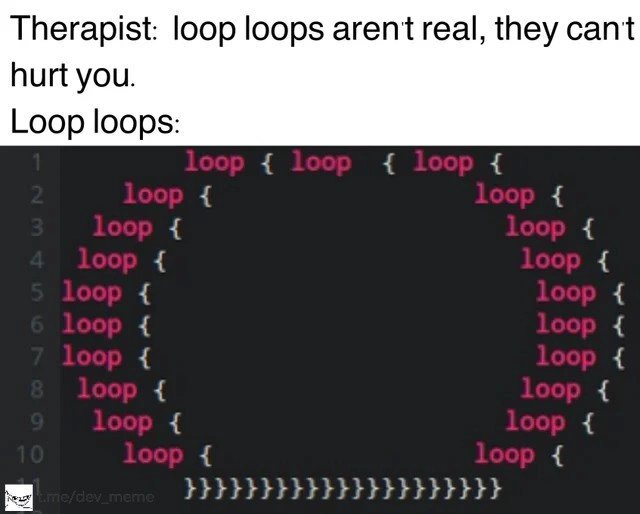
Imagine your parent or teacher tells you, “Don’t worry, the monster under your bed isn’t real. It can’t hurt you.” That makes you feel better for a moment… until you peek under the bed and actually see a monster staring back at you! 😨 In a funny way, that’s what this picture is about, but with computer code. The “therapist” (like the comforting adult) says to the programmer, “Those super scary endless loops aren’t real, don’t worry.” But then the programmer’s computer screen shows a huge, crazy loop that goes on forever – the scary thing is real after all! It’s both silly and relatable: the very thing the programmer was afraid of is right there in their code editor, like a cartoon monster saying “Hello.” It’s funny because we all know therapists are supposed to be right about imaginary fears, but here the joke is that the therapist was totally wrong. The loop monster is real, and it’s lurking in the code, ready to cause trouble (like making the program run in circles forever). So it’s like a kid’s nightmare come true in a programmer’s world – scary at first, but we laugh because it’s an exaggerated, make-believe scenario. The poor programmer might need a hug… and maybe some bug fixes to chase that loop monster away!
Level 2: Round and Round
Let’s break this down in simpler terms. In programming, a loop is a way to repeat a set of instructions multiple times. You can think of it like telling a kid, “keep taking one step forward until you’ve taken 10 steps” – that’s a loop that runs 10 times. Now, a nested loop is when you put one loop inside another. It’s like saying, “for each shirt I have, try it on with each pair of pants I have” – you loop over shirts, and inside that, you loop over pants. This means the inner action repeats a lot more because for every single shirt, you go through all the pants. If you have 5 shirts and 5 pants, that’s 25 dress-up combinations – loops inside loops multiply the work.
An infinite loop is a loop that never ends. Imagine if you told someone “keep taking steps forward forever.” They’d just keep going and going without stop. In code, an infinite loop happens when the loop’s stopping condition is never reached or missing entirely. For example, in Python, if you write while True: print("Hi"), the program will print “Hi” over and over forever (or until you force it to quit). This is usually a bug, because it means the program gets stuck doing the same thing and can’t continue to the next task. It’s one of the classic bugs new programmers encounter – you run your program and it just hangs, stuck in a never-ending circle because your loop logic was wrong. Trust me, seeing your app freeze due to an infinite loop is scary the first time – it feels like the computer is ignoring you (and technically, it is, because it’s busy looping endlessly!).
Now, the meme jokingly uses the phrase “loop loops.” That’s not a real technical term; it’s just the meme’s playful way to say “a loop of loops” – basically, loops repeating inside loops, maybe going on forever. The top text says, “Therapist: loop loops aren’t real, they can’t hurt you.” This is a tongue-in-cheek reference to a popular meme format where someone (here, a therapist) assures you that something you’re afraid of isn’t real. The implication is that the programmer is traumatized by loop loops (obsessively nested or infinite loops), and the therapist is like, “Calm down, that’s just in your imagination.” But then the meme immediately shows the code editor with the frightening thing right there, proving the therapist so wrong. The line “Loop loops:” introduces the screenshot of code that is basically a nightmare in code form.
In the image, we see what looks like actual code. There are line numbers on the left (1 through 10), and on each line the word loop appears, highlighted in bright pink (because code editors often color keywords to help you see the structure). There are also curly braces { and } galore. In many programming languages (like C, C++, Java, and others), { } are used to group the code inside loops or other structures. Every { opened needs a matching } to close that block. So when you see a whole bunch of } in a row, it means a whole bunch of loops (or other blocks) were opened and now they’re all closing. The bottom of the code snippet in the meme literally has a long sequence of }}}}}}}}}}}}}}}}}} – probably one } for every loop { that was opened above. It’s like the code had 10 layers deep of loops and finally ended them all. This would be extremely hard to read in a real program! Normally, you’d indent the code inside each brace so you can match things up, but here it’s drawn like a big rectangle or oval. The code is actually arranged to form a visual shape (kind of like a zero or an O) made out of the word “loop” repeated. It’s like ASCII art – using text to draw a picture. So the shape you’re seeing is a bunch of loop { ... } arranged to literally look like a loop. It’s a silly visual gag: a loop drawn with loops!
So, what’s the joke? It’s that the therapist is saying “loop loops aren’t real,” trying to soothe a frazzled developer, but the code editor is showing a horrifying example of nested_loop_abuse that feels very real. It’s basically one big “What if?” of bad code quality. The developer’s nightmares have come true on the screen. If you’ve ever written a loop, you know you usually only nest a couple deep at most. Seeing the word loop on every line, nested inside each other, is absurd. It implies a program that’s doing something ridiculously repetitive or complex. This kind of code would be very slow and probably break things. It’s also called spaghetti code because it’s tangled and twisted like a bowl of spaghetti. That term is often used when code logic is all over the place or overly complicated, just like a pile of noodles that’s hard to untangle. If someone actually wrote code like this, other developers would cringe – it’s not a good practice at all. They’d probably step in and say, “Hey, let’s rethink this,” or “Maybe break this into smaller functions,” or even “Are you trying to mine Bitcoin with nested loops or what?” (Programmer joke, since infinite repetitive tasks could be mining cryptocurrency as a gag).
In summary, the meme is using an exaggerated code example to poke fun at a fundamental CS concept: that unchecked loops can get out of hand and become a real problem. It’s highlighting a developer pain point in a humorous way. The text and image together create a little story: the authority figure (therapist) dismisses the programmer’s fear, but then we see the fear manifest – a terrifying indentation_horror of loops within loops. For a junior developer, it’s a cheeky reminder: yes, infinite loops and crazy nested loops do exist and they’re bugs you want to avoid. And for an experienced dev, it’s an over-the-top illustration of something we dread seeing in any code review. The code_as_ascii_art style just makes it extra memorable – once you’ve seen a loop drawn out of the word "loop", you won’t forget the message. This is developer humor at its finest: it takes a basic concept (loops) and turns it into a ridiculous visual pun that actually teaches a lesson about code complexity and why we should keep our loops in check.
Level 3: Spaghetti Infinity
This meme hits experienced developers right in the PTSD-flavored coding humor. It parodies the classic “Therapist: X isn’t real, it can’t hurt you” format, and swaps in a programmer’s boogeyman: infinite loops (or insanely nested loops). The therapist tries to reassure, “loop loops aren’t real; they can’t hurt you.” But every senior dev knows that’s a lie we tell ourselves to sleep at night. The punchline is the code editor screenshot, labeled “Loop loops:”, revealing a monstrous block of code made of loop { ... loop { ... }} repeated over and over, literally forming a loop shape. It’s as if the code itself said, “Surprise! I am real,” in the most grotesque way possible. We immediately recognize this as a depiction of spaghetti code gone berserk – a loop-of-loops, so to speak. The humor is dark: it implies that no amount of therapy can erase the trauma of encountering code like this in the wild. It’s the kind of developer pain point that triggers memories of being trapped in debugging sessions at 3 AM, watching a program spin its wheels infinitely and feeling your sanity slip away with each iteration.
Why is this so funny (and painful) to seasoned devs? Because we’ve all been there. Maybe not this extreme, but close enough. Infinite loops and absurdly nested loops are the stuff of real-world horror stories in software development. Imagine a production server suddenly maxing out CPU – you dive into logs and discover a forgotten while(true) that never breaks out. Or you open a legacy code file and see loops nested 5, 6, 7 levels deep, indented so far to the right that the code forms a “pyramid of doom.” That’s a genuine term for when nested structures (often loops or if statements) keep indenting further, eventually looking like an arrow or pyramid shape made of code. It’s a notorious code quality anti-pattern. Normally, each level of nesting should be handled with caution (or refactored out), but here someone went wild, creating what the meme jokingly visualizes as a full closed-loop shape of code. It’s a visual loop shape drawn with the text – an ASCII art oval made of the word "loop". This absurd image is basically every readable-code guideline violated on purpose. It’s so bad it loops back around to being an art form. The indentation horror is real: the code in the screenshot is indented in a big O shape (fittingly, “O” for Big O notation nightmare fuel!).
Seasoned developers also catch the subtle details, like the syntax highlighting: the word loop is colored in candy pink, standing out like neon lights on each line. In many editors, keywords are highlighted, so seeing loop painted everywhere feels like the editor itself is screaming “Loop! Loop! Loop!” repeatedly at you. It’s like the code editor is complicit in the horror, emphatically disagreeing with the therapist by highlighting the nightmare in pretty colors. And then there are all those closing braces }}}}}}}}}}}}}}}}}} along the bottom – a train of curly braces so long it looks like a centipede crawling across your screen. Every } means “end of a loop block,” so a dozen of them in a row is a sure sign you’ve descended into loop nesting hell. Reading such code is practically an extreme sport: you have to match each { with a } mentally, which is tedious and error-prone. Lose count and you’ll go cross-eyed. No wonder the meme implies these loops can hurt you – they hurt your brain and your project’s performance.
This meme exaggerates a common cautionary tale in programming. Nested loop abuse is when developers stack loops within loops without restraint. In real life, maybe you see triple or quadruple loops when dealing with, say, multi-dimensional data. But by the time you hit 8-10 levels, something’s seriously wrong with your design (or you’re trying to brute-force solve an NP-hard problem by checking every combination of everything – which is also probably wrong). Deeply nested loops make code harder to understand and maintain, a hallmark of spaghetti code. They also multiply the runtime like crazy (each extra loop is a multiplier on work). The meme just cranks this up for comic effect – turning it up to 11, literally making an infinite loop icon out of code. It’s a software-developer horror movie condensed into a single image.
And let’s talk about the bugs and performance disasters this hints at. An infinite loop bug will freeze your program in its tracks, chewing CPU cycles endlessly. Many of us have had a program suddenly hang, and the culprit was a loop that never ended – maybe a loop condition that stayed true forever due to a logic mistake (e.g., forgetting to increment a counter or using the wrong comparison). That moment when you realize your app isn’t responding because it’s stuck in a code whirlpool is terrifying. You have to hit Ctrl+C or kill the process to stop it – effectively performing an exorcism on your code. Meanwhile, nested loops that aren’t infinite but run excessively long can be just as lethal in slow motion. For example, a naive sorting or searching algorithm that uses multiple loops might work on small data, but shove a big dataset at it and it might take hours or days to finish (if ever). Seasoned devs have learned to dread that “it works on my machine” scenario, where a piece of code (perhaps with too many loops) seems fine in testing with 100 items but times out in production with 100,000 items. The meme’s gargantuan loop structure is a caricature of that scenario – it’s like a visual warning of how not to code if you value your sanity.
In team settings, encountering code like this triggers a mix of horror and dark laughter. You might hear a cynical veteran mutter, “Who the heck wrote this loopy monstrosity?” Perhaps it was a rushed junior developer who kept adding one more loop to handle a new requirement, stacking them like Jenga blocks until the whole thing’s ready to topple. Maybe no one ever did a code review, or the original author left and everyone’s too scared to refactor the beast. It’s a shared industry joke that such code could even pass code review – any decent reviewer would scream and grab the nearest 🔥 fire extinguisher. Tools like linters or static analyzers might flag excessive cyclomatic complexity or too many nested blocks, essentially saying “This code is complex to the point of absurdity.” But if those warnings were ignored, you’d end up with exactly what the meme shows. In essence, the meme is a cathartic laugh for developers: it takes a very real problem (runaway loops and code complexity) and exaggerates it into a ridiculous picture. We laugh because otherwise we’d cry – it’s funny developer humor because it’s true enough to be scary. As the saying goes in dev circles, “It’s not a bug, it’s a feature,” but in this case it’s neither – it’s a cautionary tale drawn in stark, loopy detail.
Level 4: The Halting Horror
At the most theoretical level, these endless loop loops evoke the Halting Problem – that fundamental computer science nightmare that says you can’t always tell if a program will finish running. An infinite loop (a loop that never ends) is literally a program that doesn’t halt. Alan Turing proved back in 1936 that there’s no general algorithm to detect all such non-terminating programs. In other words, a sufficiently sneaky loop can hide its endless nature from your compiler or static analyzer – a ghost in the machine that won’t reveal itself until runtime. The meme’s monstrous rectangle of loop { ... } is like a Turing Trap, a wry nod to the fact that detecting a truly non-terminating, self-referential “loop loop” in the general case is as hard as solving a proven unsolvable problem. It’s a CS fundamental truth: sometimes the only way to know a loop never ends is to run it and find out (or rather, never find out because it keeps running forever). 😱
From a computational complexity perspective, even if those loops do end, we’re looking at extremely polynomial time (or worse) behavior. Ten nested loops means if the loop runs n times, you endure on the order of $O(n^{10})$ iterations. To put that in perspective, if n is just 100, the total iterations are $100^{10}$ (a one with 20 zeros!). That’s an astronomically large number of operations – effectively impossible to complete before the heat death of the universe (or at least before your patience runs out). This meme’s code complexity is cranked up beyond reason, illustrating a combinatorial explosion of work. It’s both comical and horrifying to seasoned developers: the “loop loop” in the image isn’t just a joke, it’s a computational bogeyman that would grind any machine to a halt. The performance hazards here aren’t simply hypothetical – they’re guaranteed by mathematical growth rates. No amount of CPU or memory can save you from an exponential or high-degree polynomial blow-up; that’s computer science law. So in this warped code snippet, we have a perfect storm of theoretical doom: a likely non-halting infinite recursion of loops (invoking Turing’s worst fears) and a ridiculous time complexity that would overwhelm all resources. In short, this is spaghetti code woven into a Möbius strip – a twisted loop that mathematically can’t do anything useful except run forever.
Description
A two-part meme following the 'Therapist: X isn't real, they can't hurt you' format. The top part has white text on a black background that reads, 'Therapist: loop loops aren't real, they can't hurt you.' Below this, the punchline 'Loop loops:' introduces the bottom image. The image is a screenshot of a code editor with a dark theme, displaying a horrifying piece of code. Numerous instances of the Rust keyword 'loop {' are arranged to form a large, oval-shaped loop. The keyword 'loop' is highlighted in pink. The code is deeply nested, with each 'loop {' opening a new block, creating a visual loop out of code loops. At the very bottom, a long, single line of closing curly braces '}}}}}}}}}}}}}}}}}}}}}}}}' completes the structure. The humor is a visual pun on 'loop loops' and evokes the programmer's fear of complex, infinite, or deeply nested loops that can crash a program or be impossible to debug
Comments
7Comment deleted
This isn't a loop loop, it's a visual representation of a dependency cycle in a monorepo's build graph
When your nested loops are tidy enough to double as ASCII art, the profiler stops generating flame graphs and just files an incident report labeled “O(n^existential dread)”
That's just the junior dev's attempt at implementing matrix multiplication after the senior architect said "we don't need a linear algebra library for this simple operation."
This is what happens when someone takes 'iterate until you get it right' a bit too literally. Ten levels of nested loops - that's not code, that's a cry for help wrapped in O(n^10) time complexity. Any architect reviewing this would immediately recognize it as a career-limiting move. The real horror isn't the loops themselves; it's knowing that somewhere in production, there's a junior dev who thinks this is how you 'optimize for performance' because 'the computer can handle it.' Meanwhile, your CPU is filing for workers' compensation and your code reviewer is updating their résumé
Call it the Ouroboros pattern: nested Rust loop { }s forming a giant O - self-documenting performance, Big-O of "doesn't terminate"
Nested loops: the fractal where O(1) dreams go to spawn exponential nightmares in prod
When your codebase literally draws an O with nested loops, Big-O stops being analysis and becomes typography