The Ultimate 'Meet the Parents' Technical Screening
Why is this Interviews meme funny?
Level 1: Dinner Table Pop Quiz
Imagine you’re at your new friend’s house for dinner, and you want to impress their family. Suddenly, their dad decides to give you a little pop quiz! Not a school quiz exactly, but a brain-teaser puzzle. You’re surprised – you didn’t think meeting the parents would turn into a test! In this meme story, the boyfriend’s girlfriend’s dad loves computer puzzles (because he’s a big engineer). So during dinner, the dad casually asks him to solve a coding puzzle about a list of numbers (an array of numbers, in computer terms). It’s as if the dad said, “Hey, let’s see how you solve this riddle.” The boyfriend gets nervous for a moment (who wouldn’t?) but then remembers he’s actually practiced these kinds of problems a lot for his job. He treats it just like one of those exam questions from school or an interview. He first explains a simple way to solve it (that might take longer) and then a smarter way to solve it (faster and better). He even talks about how long each method would take to finish and how much memory it might use – basically, he’s explaining the why behind his answer to show he really knows his stuff. The dad listens and at the end seems pretty satisfied, maybe thinking “Okay, this kid knows his basics.”
It’s a funny situation because usually when you’re having dinner with someone’s parents, you expect to talk about ordinary things like hobbies or movies or what you do at work in general. Here, they ended up talking about a specific work puzzle, almost like a mini job interview right at the dinner table! The boyfriend probably felt like he was back in a classroom or an interview room, solving a test question, while he was actually just trying to eat dinner politely. The line at the end, where he wonders if he should study system design for the next visit, is a joke: “system design” is like an even bigger, harder type of puzzle about building entire systems (imagine planning a whole city versus just solving a riddle). He’s kidding that next time, the dad might ask an even tougher question, so maybe he should be ready to answer that too!
In simple terms, the meme is funny because it shows a meet-the-parents moment turning into a surprise test. Think of it like if your friend’s dad is a math teacher and suddenly says, “Solve this math riddle for me,” or if they’re a chef and say, “Cook this dish right now!” You’d be caught off guard. Here it’s a coding riddle. The boyfriend did well (since he had practiced a lot), and everyone can laugh at how over-the-top the situation is. It highlights how people in the programming world sometimes can’t help but talk about programming, even in casual family moments. The humor comes from that mix of feeling nervous, wanting to impress, and the sheer silliness of treating dinner like it’s an exam.
Level 2: Brute Force Over Brisket
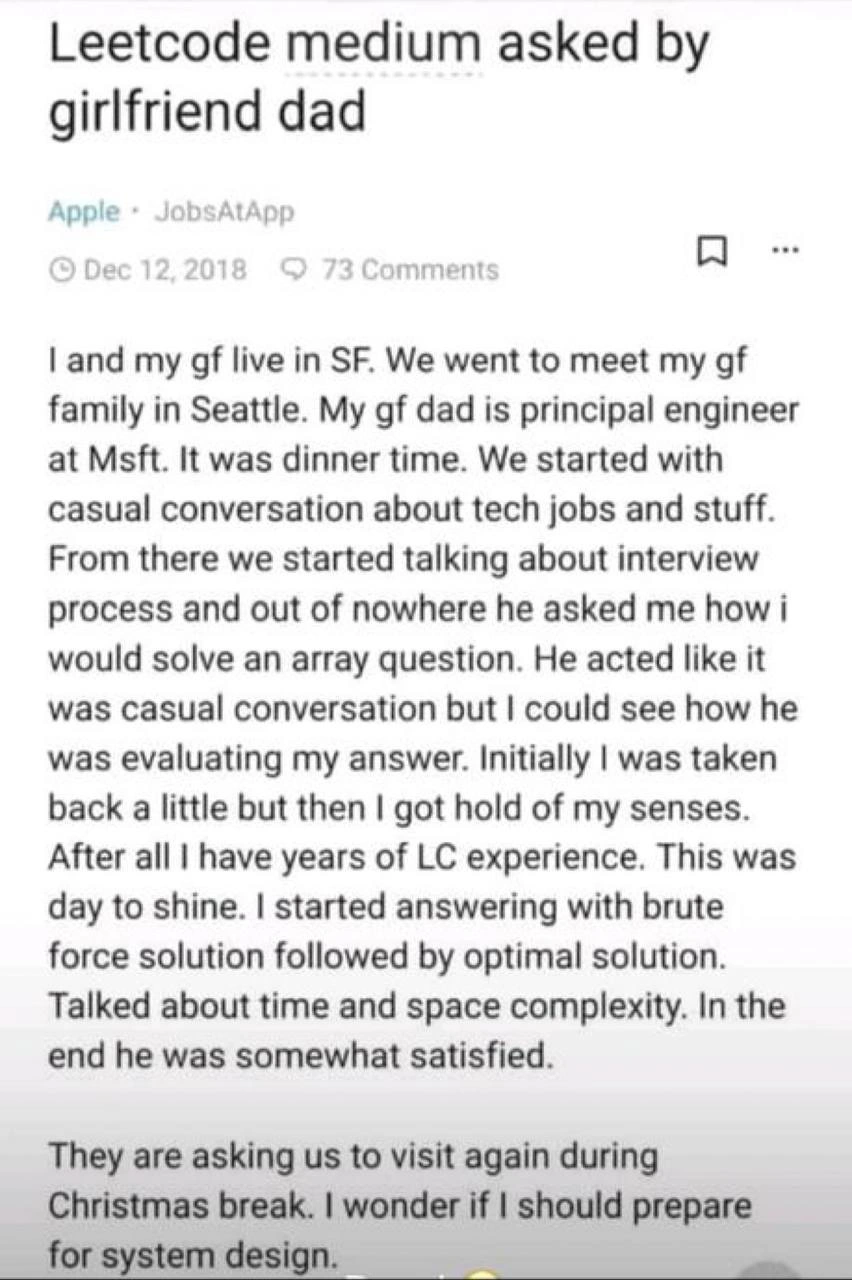
Let’s break down what’s happening in this meme scenario in more straightforward terms, especially for those newer to the technical interviews scene. The story: a software developer goes with his girlfriend to meet her parents. Her dad just happens to be a very senior engineer (Principal Engineer means he’s at a high technical rank, likely with many years of experience, possibly leading teams or important projects at Microsoft). Over dinner, the conversation drifts to tech topics (which isn’t unusual if both you and your girlfriend’s dad are into tech). Then, seemingly out of the blue, Dad asks a coding question about arrays – basically giving the boyfriend a coding interview question right there at the table! He presents it like it’s just a casual question, but of course the boyfriend realizes he’s being tested in that moment (no pressure, right?). This is why the meme is titled “Leetcode medium asked by girlfriend dad” – it literally describes a LeetCode medium-difficulty problem being posed by the girlfriend’s father.
Now, LeetCode is an online platform where programmers practice coding problems, often in preparation for job interviews. Problems on LeetCode are labeled by difficulty (Easy, Medium, Hard). A “LeetCode medium” problem is of moderate difficulty — the kind that tech companies love to ask to see if you can solve coding challenges under pressure. Common topics include things like array manipulation, string handling, or basic algorithms. Since the dad asked an array question, it means the problem likely involved some operation on a list of numbers (like finding a certain combination, sorting something, or detecting a pattern). These are exactly the kind of questions you’d get in a WhiteboardInterview – traditionally, that’s when an interviewer asks you to solve a coding problem by writing on a whiteboard (or paper or live coding editor) during an interview. In this case, imagine doing that but at a dinner table, possibly with no actual whiteboard – just verbally or on a spare piece of paper. Awkward!
The boyfriend says “initially I was taken aback… but then I got hold of my senses. After all I have years of LC experience. This was my day to shine.” This tells us he’s been through the InterviewProcess many times (or at least practiced a lot). “LC” stands for LeetCode. Having “years of LeetCode experience” means he’s spent a lot of time solving those practice problems. Many developers do this to prepare for tough TechnicalInterviews at big companies. So even though he was surprised by the dad’s quiz, he quickly recovered because, hey, he’s been training for this kind of thing! It’s like a reflex for him to go into “solve mode.”
He starts by giving a brute force solution and then an optimal solution. Let’s explain that:
- A brute force solution in programming is the straightforward, naïve approach. It often means you try all possible ways to solve the problem, which usually works but isn’t efficient. For example, if the problem was “find two numbers in this array that add up to 10,” a brute force method would be to check every possible pair of numbers until you find the combination that gives 10. This might involve a double loop through the array (which has a higher time cost). Brute force solutions are easy to come up with but can be slow for large inputs.
- An optimal solution is a smarter, more efficient approach that uses a better algorithm or data structure to solve the problem faster (or using less memory). In the two numbers example, an optimal solution might use a hash set to remember numbers as you go through the array, allowing you to find the needed pair in one pass instead of nested loops. Optimal solutions aim to reduce the computational work needed.
When discussing these solutions, the boyfriend also talked about time complexity and space complexity – these are measures of how efficient an algorithm is. Time complexity (often expressed with Big O notation) describes how the running time of an algorithm grows as the input size grows. For instance, a solution might be O(n) time (meaning if you double the number of input items, it roughly doubles the time it takes – linear growth) or O(n^2) (if you double the input, it takes four times as long – quadratic growth) etc. Space complexity is similar, but for how much extra memory an algorithm uses. Talking about time and space complexity is very typical in technical interviews to show you understand the trade-offs of your solution. It sounds like the dad specifically wanted to hear how efficient the boyfriend’s solutions were, which is exactly what an interviewer would want to know after hearing your approach.
To visualize the difference between a brute force and an optimal solution, here’s a quick example in Python with the classic "two-sum problem" (find if two numbers in an array add up to a target). First is a brute-force approach, then an optimized one using a set:
# Brute force approach: check all pairs (time complexity O(n^2))
def two_sum_bruteforce(arr, target):
for i in range(len(arr)):
for j in range(i+1, len(arr)):
if arr[i] + arr[j] == target:
return True # Found a pair that sums to target
return False # No pair found
# This brute force method tries every possible pair of numbers in the array.
# If the array length is n, there are about n*(n-1)/2 pairs to check.
# That leads to roughly O(n^2) time complexity (quadratic time).
# It uses only a few variables for checking, so its space complexity is O(1) (constant extra space).
# Optimized approach: use a set to find complements (time complexity O(n))
def two_sum_optimized(arr, target):
seen = set()
for num in arr:
# Check if the complement (target - num) is in the seen numbers
if target - num in seen:
return True # Found two numbers: num and (target - num)
seen.add(num)
return False
# This optimized method goes through the array once (that's O(n) time).
# It uses a set to store numbers we've seen, which also gives O(1) average lookup time.
# The space complexity here is O(n) because in the worst case we might store all numbers in the set.
In the context of the meme, we don’t know the exact array question asked, but the pattern was the same: first do it the simple way, then do it the efficient way, and explain the Big O complexity of each. The dad was “somewhat satisfied” with these answers – which is how an interviewer might react if you solve a problem correctly and explain your reasoning. Not overly enthusiastic, but approving. You can almost picture the boyfriend breathing a sigh of relief that he passed this unexpected quiz.
Now, why would the girlfriend’s dad do this? It might have been a bit of nerdy fun for him, or he genuinely wanted to gauge the boyfriend’s skills (perhaps to see if he’s a “good engineer” and, by extension, a worthy partner for his daughter – in a tongue-in-cheek way). It’s unconventional, for sure. Most people meeting their partner’s parents might expect questions like “So, what do you do for work?” or “Where are you from?”, not “How would you optimize an array sorting algorithm?” 😅. This contrast is exactly what makes the situation comedic. It’s taking a TechnicalInterviewProcess norm (like solving algorithms under scrutiny) and plopping it into a casual family setting where it normally doesn’t belong. The meme resonates especially with junior developers and students because it plays on that anxiety: you must be ready to code on the spot anywhere, anytime! It’s a hyperbole, but one that highlights how intense and pervasive tech interviews can feel.
Finally, the developer jokes, “They are asking us to visit again during Christmas break. I wonder if I should prepare for system design.” In tech, after you clear coding interviews, the next stage (especially for higher level positions) is often a system design interview. That’s where you’re asked to design or architect a larger system (for example, “How would you design a social media app backend?”). These questions are less about writing code and more about high-level architecture: choosing appropriate technologies, designing databases, ensuring the system can handle lots of users, etc. The boyfriend quips that maybe he should study up on those topics next – implying that on the next visit, the dad might up the ante and quiz him on even more advanced tech topics. It’s a humorous exaggeration, suggesting that visiting her family could turn into a multi-round TechnicalInterviewProcess. For a junior dev, the idea of having to essentially “interview” for the approval of your in-laws (complete with coding and design questions) is both amusing and terrifying. But don’t worry – in real life, it’s unlikely you’ll have to literally do algorithms at dinner. This meme just cleverly mixes the stress of meeting your significant other’s parents with the stress of tech interviews to create a laugh-worthy scenario. It’s poking fun at how being a software engineer sometimes means you end up talking shop (or solving puzzles) even when you’re off the clock.
Level 3: Whiteboard Ambush at Dinner
Seasoned engineers might chuckle (and shudder) at this scenario: a casual family dinner turns into an impromptu technical interview. The girlfriend’s dad – a Principal Engineer at Microsoft – just can’t resist dropping a LeetCode array puzzle between the salad and the main course. This is the ultimate whiteboard interview ambush, and it hits home because many of us have lived through something similar (though usually in conference rooms, not dining rooms).
Why is this funny to an experienced dev? It’s lampooning the pervasive technical interview culture in our industry. Big tech companies (Microsoft included) are famous for grilling candidates with algorithmic brainteasers. Over years, it becomes second nature for veteran engineers to talk in terms of algorithms and Big O notation even outside work. Here, Dad treats discussion over dinner like a mini coding exam – likely out of habit. As a principal engineer, he’s probably conducted dozens of interviews, so when he meets the new boyfriend (also a developer), his reflex is to test the kid’s coding chops “just casually.” It’s like he subconsciously flipped into interviewer mode while carving the roast.
The poor boyfriend recognizes exactly what’s happening. One minute they’re chatting about tech jobs, next minute he’s solving a “LeetCode medium” array question on the spot. Cue the nervous laughter. Any developer who’s been through the grind knows this drill: you start with the obvious brute-force solution, then you improve it to the optimal solution, all while analyzing time and space complexity out loud. In the story, he literally did just that – as if he were at a whiteboard interview on a first date with the family. It’s both hilarious and cringe-worthy: hilarious because we recognize the overkill of discussing runtime complexity at a dinner table, and cringe-worthy because we’ve felt that pressure to perform. The humor comes from that too-real blend of personal life and whiteboard interviews. Essentially, the guy’s years of prepping for coding interviews (his “LC” or LeetCode experience) suddenly paid off in the most unexpected setting. Talk about being ready to deploy at all times!
This meme also pokes fun at our community’s obsession with algorithmic one-upmanship. We’ve created this environment where even a principal engineer in-law might size you up by the efficiency of your array search. The dad asking for the solution’s complexity (Big O) is a classic interviewer move – it’s how we gauge if someone understands why their solution is efficient. To see it happen over family dinner is absurdly funny. Imagine passing the gravy while debating if your algorithm is O(n) or O(n log n)! Seasoned devs can’t help but laugh because yeah, that sounds like something that would happen in our world. The shared understanding is that tech folks sometimes struggle to “turn off” work brain. A normal parent might ask about your job; this one basically said “prove you deserve my daughter by solving this in linear time.” WhiteboardInterviews meet in-law approval test – it’s a perfect storm of awkward.
And then there’s the kicker: “They are asking us to visit again... I wonder if I should prepare for system design.” 😂 This line is pure gold to anyone who’s been through a full technical interview loop. In real tech hiring, after you pass coding quizzes, the next stage for a more senior role is often a system design interview. So the boyfriend jokes that next time he visits her family, Dad might crank it up to System Design 101: “So, how would you design a scalable photo-sharing service, son?” It’s a sly nod to how relentless and escalating the InterviewProcess can be. Today’s dinner was the coding round; the Christmas visit might be the architectural design round. By Easter, who knows – maybe a behavioral interview with Mom (“Describe a time you disagreed with product requirements – perhaps when choosing wedding plans?” 🙃). It’s an exaggeration, but not without truth: we often joke that dating a programmer means dating the whole interview process! The meme brilliantly exaggerates a common tech anxiety – that we’re forever being evaluated – and mixes it with the classic meet-the-parents trope. For senior devs, it’s a comedic reminder that in this field, sometimes InterviewHumor follows us everywhere... even to the dinner table.
Description
A screenshot of a text post from an app titled 'JobsAtApp', posted under the 'Apple' section on December 12, 2018. The post's title is 'Leetcode medium asked by girlfriend dad'. The author recounts meeting his girlfriend's father, a principal engineer at Microsoft, who unexpectedly turns a dinner conversation into an impromptu technical interview by asking him to solve an array problem. The author describes recovering from the initial surprise, explaining the brute force and optimal solutions, and analyzing time and space complexity, which leaves the father 'somewhat satisfied'. The post ends with a humorous, anxious thought: 'They are asking us to visit again during Christmas break. I wonder if I should prepare for system design.' The meme humorously captures the high-pressure culture of tech interviews, where professionals feel they can be evaluated anywhere, anytime, and the escalating nature of technical screenings from algorithms to system design
Comments
14Comment deleted
He passed the data structures and algorithms round. For the next family gathering, he'll have to design a fault-tolerant, horizontally-scaled system for managing holiday dinner seating arrangements
Solved his array question in O(n) over dessert, but I know the Christmas visit is the real on-site: a 90-minute system-design on “How would you shard household chores without violating eventual marital consistency.”
Nothing says 'welcome to the family' quite like a principal engineer father-in-law who treats dinner like a FAANG screening round - at least he didn't ask for a whiteboard between the appetizer and main course
Nothing says 'meet the parents' quite like being ambushed with array manipulation problems over mashed potatoes. At least he didn't ask about the time complexity of getting his daughter home by curfew - that's O(n) where n is the number of 'just five more minutes' negotiations. The real question is whether Christmas will bring system design or if he'll escalate to distributed systems architecture while carving the turkey. Pro tip: if he starts asking about CAP theorem during dessert, just remember that in this relationship, you can have Consistency and Availability, but Partition tolerance means sleeping on the couch
When Principal Eng at MSFT skips small talk for LeetCode mediums - next Christmas: distributed cache design over pie
You know it’s serious when meet-the-parents has a brute‑force baseline, an O(n log n) improvement, and a holiday onsite for SLOs and a rollback strategy
Meet-the-parents, but it’s an onsite: start with constraints, offer the O(n) path, and prep for the Christmas round’s system design - where the relationship runs on eventual consistency
no nudes? Comment deleted
Cheat with gf dad Comment deleted
Bro need to learn English before doing leetcode Comment deleted
Was that a formal procedure for the parents to approve their engagement and marriage? Comment deleted
straight up adoption process Comment deleted
Old but gold Comment deleted
Almost as old as "To date a Korean girl you first need to defeat her dad in StarCraft" Comment deleted