Peak Male Performance in Tech, 2024 Edition
Why is this IndustryTrends Hype meme funny?
Level 1: Too Many Toys
Imagine a kid who really wants to do well at everything in school. He hears about a bunch of cool new tools that are supposed to help, so he decides to use all of them at once. He comes to class wearing a big virtual reality helmet on his face, huge headphones with an air mask, and special glasses. He has a little talking robot clipped to his shirt that he chats with instead of real friends. He even carries a voice recorder necklace because he daydreams so much that he forgets what the teacher just said. In one hand, he’s holding a super fancy coffee drink with so much sugar and syrup that it’s basically a dessert (he thinks this crazy drink will make people talk to him because it’s so unique). He also wears a ring that tells him if he slept enough, since he stayed up late doing homework and is really tired. In other words, this kid has too many toys and gadgets all over him, thinking they will make him perform better. But in reality, he looks kind of silly and he’s probably distracting himself more than helping. The joke is that sometimes people try to use every new gadget or trick to be “the best”, when really they might just need to get some rest, focus on one thing at a time, and go outside to play a bit. In plain terms: you don’t become a super student (or super developer) just by piling on more devices – at some point you’re just carrying a lot of stuff! It’s a funny reminder that being balanced and not overdoing it is important.
Level 2: All the Gear, No Idea
Let’s break down all the high-tech items this developer is wearing, and why they’re funny in this context. The meme basically turns him into a walking technology showcase, so understanding each piece will help explain the joke:
Apple Vision Pro – This is Apple’s advanced AR/VR headset (augmented reality/virtual reality). It looks like big ski goggles and lets you see digital screens and 3D objects in your environment. The meme says he’s using it for a quarterly all-virtual-hands meeting, meaning every few months when his whole company meets online, he puts on this $3000+ device. Normally, people would just use a laptop webcam for a video call. Using an AR headset for a meeting is over-the-top, which is why it’s funny. It suggests he wants the most high-tech experience even for a basic work meeting. It’s referencing RemoteWorkCulture – since many developers work from home now, there’s a trend of trying fancy solutions for virtual meetings. But picturing everyone in a VR headset for a company meeting is pretty silly (and currently very uncommon).
Dyson Zone Headphones – These are a real pair of high-end headphones made by Dyson (better known for vacuums). They don’t just play audio; they also have a detachable air purifier that sits in front of your mouth, filtering the air you breathe. They’re meant to cancel noise (measured in dB, decibels) and improve air quality around you (measured by AQI, Air Quality Index). The meme jokes that he needs a “perfect dB/AQI ratio to reach flow-states.” A flow state is when you’re super focused and “in the zone” while coding. It’s poking fun at the idea that he believes he needs perfect silence and pure air to concentrate fully. In reality, while good headphones help, this is an extreme gadget. It looks kind of like a sci-fi mask. The joke is that he’s going to such lengths – wearing this bulky, bizarre device – just to maintain concentration while coding. It’s an exaggerated take on developers wanting quiet, distraction-free environments.
AI Pin – This refers to a wearable AI device (the company Humane is working on one). It’s like a little badge you clip to your clothes that has an AI assistant built in. Think of it as Alexa or Siri, but pinned to your shirt, always listening and ready to help or chat. In the meme, the AI Pin is labeled as a way for him to “keep in touch with the online waifu”. Waifu is a term (from anime fandom) meaning a fictional girlfriend, often an anime character someone is very fond of. Here it specifically says “on a role-play LLM model Discord server”. This means he’s interacting with a chatbot (powered by an LLM, which stands for Large Language Model — the tech behind AI like ChatGPT) on a Discord chat server, and that chatbot is acting as his pretend girlfriend. The footnote “he thinks she is in love with him” underscores the joke: he might be getting a bit too emotionally attached to an AI character. So the AI Pin allows him to talk to this AI “girlfriend” anytime, anywhere, hands-free. This is funny and a bit absurd – instead of having a real relationship or even an online human friend, he’s chosen an AI companion, and he’s literally wearing a device to talk to her constantly. It highlights both the current AI hype (people are using AI for very personal things now) and a stereotype of socially awkward tech guys who might struggle with real dating, so they turn to technology for comfort.
Rewind Pendant – This is a gadget designed to record everything you hear (and sometimes say) throughout the day. The idea is you can “rewind” your life to replay conversations or recall information you might have forgotten. In the meme, it notes he uses it because he’s “too engrossed in the metaverse to recall the conversation he just had.” The metaverse here refers to immersive virtual experiences (like VR or AR worlds). So if he’s in an AR meeting or daydreaming in some virtual simulation, he might not pay attention to something someone told him in the real world. The Rewind Pendant is his backup for memory – he can replay what he missed. This is humorous because normally, if something is important, you’d try to pay attention or at least ask the person to repeat it. Instead, he’s relying on a device to do that for him, meaning he can afford to completely tune out and just review it later like a DVR for conversations. It’s a very high-tech (and somewhat over-engineered) solution to a common human thing (forgetting or missing something someone said). Plus, wearing a device that records everything is a bit sci-fi and overkill for everyday life, which is why it seems silly.
Rabbit r1 – This gadget might be the least obvious, but from the description, it’s a device with a roller and a button, used for fidgeting. Many people, including developers, like to fidget with small objects (fidget spinners, stress balls, clicking pens) especially if they’re feeling restless or have ADHD (Attention Deficit Hyperactivity Disorder). The meme implies he has ADHD or at least trouble sitting still, and instead of a simple toy, he’s got this special electronic doodad around his neck to fiddle with. If the name Rabbit r1 doesn’t ring a bell, that’s okay – it could be a niche product or even a made-up name for the joke. The key point is: he has yet another gadget, this time to address his concentration issues by giving his hands something to do. It’s funny because it’s one more device in an already ridiculous lineup. Imagine coding while also occasionally rolling a little wheel on a mini-gadget – it’s multitasking that’s supposed to help him focus. It shows how even something as simple as keeping your hands busy has been “optimized” with tech in his world.
Coffee (with 204 pumps of cinnamon syrup) – The developer is holding a gourmet coffee cup, presumably from a coffee shop. The label says it has a wild recipe: 2 pumps of peppermint, 204 pumps of cinnamon, and 2 pumps of hazelnut syrup. This is an obvious exaggeration meant to be funny (nobody actually puts 204 pumps of syrup; that would be undrinkable sludge!). The point is to show he orders a ridiculously sweet, complicated coffee. Why? The caption says, “to start convos with girls.” So he’s hoping the absurdity of his coffee order could spark a conversation if a girl notices it. This is poking fun at a couple of things: one, the stereotype that developers often have very specific coffee orders or depend heavily on coffee (coffee_overload). Two, it jokes about his lack of social skills – instead of just saying “hi” or chatting normally, he’s relying on a gimmicky coffee to do the talking for him. It’s both a tech-world joke (how some tech folks overcomplicate things) and a general humor about dating awkwardness. Also, mentioning “girls” in a meme about a tech guy can be referencing the cliché that some tech guys have difficulty approaching women, so they might try these odd strategies. In simpler terms, it’s making fun of him for thinking a drink order will be the magic trick to get attention, when it’s more likely just absurd.
Ultrahuman Ring – This is a smart ring, similar to an Oura Ring or Fitbit, that tracks health metrics like sleep, heart rate, etc. The meme specifically notes he checks it to see if he got his REM sleep after a late Friday deployment. In developer life, a deployment means pushing new code or features to the production environment (the live app or site). Doing this late on Friday is generally avoided because if things go wrong, it could mean working all weekend to fix it. So including that detail tells us: this guy worked late into the night at the end of the week. REM sleep is the stage of deep sleep important for feeling rested and for memory. The Ultrahuman Ring would show how much REM sleep he had. So basically, he likely sacrificed sleep to get code out the door, and now the next day he’s eagerly checking his ring’s app to see how badly that affected him. The humor or point here is that he’s using a high-tech solution (a ring with an app) to realize something obvious – that all-nighters and late deployments are tiring. It also highlights how developers are into quantifying themselves: tracking sleep, diet, steps, etc., using wearables. It’s a good habit in moderation, but in this meme it’s part of the pattern: instead of changing his behavior (not working so late), he just measures the damage after the fact. It’s like an FYI: “Yep, only 4 hours of sleep, as expected.” So the ring is a symbol of tech folks trying to optimize their health/performance via data.
Meta Smart Glasses – These are glasses developed by Meta (formerly Facebook) in partnership with Ray-Ban. They function like normal sunglasses but have tech features: built-in cameras to take photos/videos, speakers to listen to music or calls, and some limited display/notification abilities (though they’re not full AR like Apple’s headset). The meme says he uses them to #livelifeinthemoment and post on social media whenever he goes out to “touch grass”. The phrase “touch grass” is slang urging someone to go outside and get off their computer. The meme jokingly says he does this only once a month. So, when our super-geared developer finally leaves his house to get some fresh air or do something non-digital, he still brings tech along – these smart glasses – to record it and prove to the world he has a life. The hashtag #livelifeinthemoment is ironic here: the whole idea of living in the moment is to experience things directly, yet he’s literally filming or augmenting every moment through gadgets. So even his rare outdoor experiences are filtered through tech and turned into social media posts. This part lampoons how some people (not just devs) can’t just be outside or on vacation without constantly posting about it. It also ties back to the RemoteWork era issue: some people have gotten so used to being indoors or online that going outside becomes a bit of an event. And of course, Meta’s push for AR and capturing “moments” is part of the current tech trend, so the meme slides that in too.
Now, putting it all together: the meme is showing a developer wearables overload. Each item on its own is a bit fancy or quirky, but plausible – there are indeed developers who might have a VR headset, or who buy expensive headphones, or who track their sleep. But having all of them at once is what makes it cartoonish and funny. It suggests that the character in the meme believes the more tech and gadgets he uses, the more productive or “optimized” he will be – literally “peak performance.” It’s a tongue-in-cheek commentary on the tech industry’s obsession with hype and new toys.
For someone early in their tech career (or learning about this culture), a few insights:
- Developers often joke about the “hype cycle” – where something new comes out and everyone says it’ll change the world, then reality hits and it’s not that big a deal. Here, devices like the Vision Pro, AI pins, and such are in the hype phase in 2023/2024. The meme humorously shows the “peak hype” scenario.
- Remote work has made people try creative solutions to feel connected or focused. But sometimes the simplest solutions (like a good schedule or taking a break from screens) are overlooked. The meme kind of hints at that by showing extreme solutions.
- There’s an element of AI humor: talking to an AI waifu, having an AI always listening – these are things that would have been pure fiction years ago, but now are real enough that we joke about them.
- This image also pokes fun at the stereotype of a certain kind of tech worker (perhaps the stereotypical Silicon Valley type): a coffee-loving, gadget-collecting, socially awkward but highly tech-savvy individual who tries to hack every aspect of life with technology. If you’re new to tech, you might meet a few people who fit bits of this description (though rarely anyone as extreme as the meme character!).
In simpler terms, the meme is saying: “Look at this guy – he’s got every device and app thrown onto him under the guise of being the ultimate productive developer. It’s pretty ridiculous, right?” Each caption on the image is a joke that highlights why it’s over-the-top:
- AR headset for meetings – regular video call wasn’t enough.
- Ultra-headphones with air filter – can’t have a single bit of noise or dust while coding!
- AI companion – can’t be lonely or offline for even a second.
- Memory recorder – no need to pay attention now, just re-listen later (which is absurd).
- Fidget gadget – even his nervous habit has a dedicated device.
- Sugary coffee trick – trying way too hard to seem interesting socially.
- Smart ring – quantifying his tiredness instead of sleeping more.
- Smart glasses outside – even nature time is tech time.
The humor comes from recognizing each of these behaviors as something real people do, but the meme dials it up to 11. For a junior dev or someone not deeply familiar with these, the takeaway is also a bit of a gentle warning: it’s easy to get caught up in chasing tools and gadgets, but that alone doesn’t make one a “peak” performer. Often, it might just make you the person with a lot of toys. The meme is a comedic reminder to keep perspective.
So, in summary, this meme is a lighthearted roast of the current tech lifestyle. It combines trending AI_ML gadgets, AR/VR gear, and the quirks of RemoteWorkCulture into one exaggerated scenario. It’s funny because it’s absurd, but it’s also funny because there’s truth behind each absurdity. As a new developer, you can laugh at it and also see it as advice: technology is great, but balance and basics still matter. You don’t actually need to become a gadget-covered cyborg to be a good programmer (and trying to do so might just turn you into a joke like this meme). Sometimes, less is more – a message hiding in the humor. 😄
Level 3: Full-Stack Cyborg
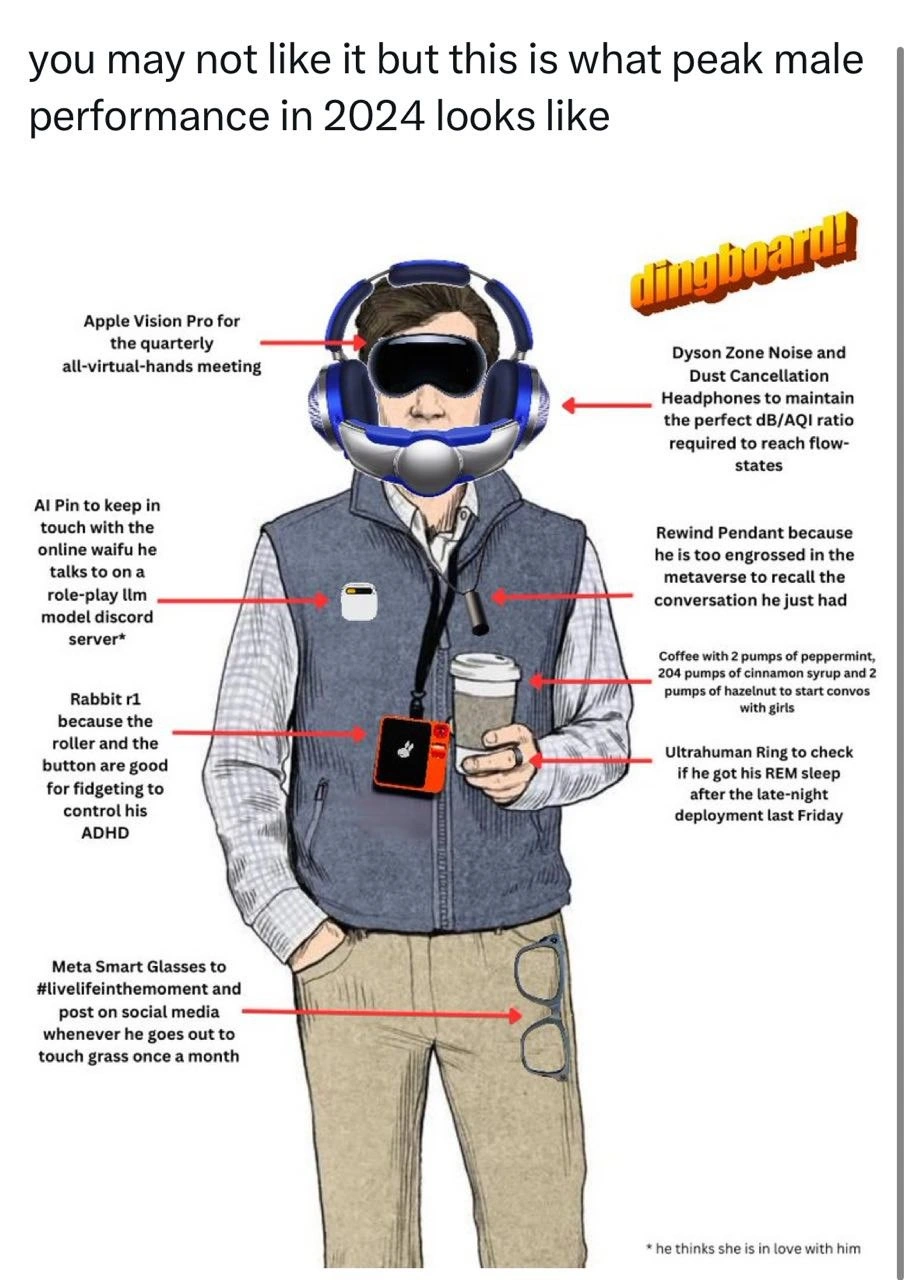
This meme paints a picture of a 2024 developer who has basically become a full-stack cyborg. The top caption jokes, “you may not like it but this is what peak male performance in 2024 looks like”, and the image shows our hapless dev strapped with every trendy gadget imaginable. It’s a satirical take on IndustryTrends_Hype: the idea that to achieve peak developer productivity, you must equip yourself with the latest AI wearables, AR/VR gear, and biometric trackers until you’re more silicon than human. A seasoned engineer will immediately recognize the humor here – it’s TechHumor that exaggerates real tendencies in tech culture. Each labeled device is a nod to something real, something hyped in the current tech scene, and something slightly absurd when all combined. Let’s unpack why this combination is so extra and why experienced devs are smirking at it.
First off, front and center on his face is the Apple Vision Pro. This is Apple’s ultra-high-end augmented reality headset, essentially a pair of futuristic ski goggles with built-in computers. The meme notes he’s wearing it “for the quarterly all-virtual-hands meeting.” That’s poking fun at remote work culture: an all-hands meeting is a company-wide meeting, and in a remote-first world they happen over video calls. But using a $3500 AR headset for a Zoom-style meeting? That’s overkill. It’s riffing on how companies like Meta (Facebook) have promoted VR meetings as the future of RemoteWork, despite most developers preferring a simple webcam. A veteran dev remembers earlier attempts at “virtual offices” in VR and how clunky they were. Seeing him with the Vision Pro strapped on is both a status symbol (look, he’s an early adopter of fancy tech) and a joke – it’s as if he’s over-optimizing something simple (attending a meeting) with heavyweight tech. It’s the AIHypeCycle and AR hype rolled into one: we’ve been told AR/VR will revolutionize work, so here he is, taking it to the extreme. The practicality, of course, is questionable (enjoy having a brick on your face for a 2-hour meeting). A seasoned engineer might chuckle recalling how Google Glass or VR meetings were touted as “game-changers” in the past but never truly caught on. The Vision Pro here represents the latest hope in that arena, so naturally our “peak performance” guy is using it even for routine tasks.
On top of that, covering his ears and mouth, he’s got the Dyson Zone Noise and Dust Cancellation Headphones. Yes, these are a real thing – Dyson (the vacuum company) made a bizarre headset that combines high-end noise-canceling headphones with an air-purifying mask. The meme description says it maintains “the perfect dB/AQI ratio required to reach flow-states.” This is wonderfully sarcastic. dB is decibels (sound level) and AQI is Air Quality Index. He believes he needs perfectly calibrated quiet and clean air to code at his best (to achieve the coveted flow state of deep concentration). It’s a send-up of the obsession with flow_state_optimization – the idea that if only we fine-tune our environment (silence, air, coffee, you name it), we’ll get in the zone and churn out code like a machine. The senior perspective here: while a good environment does help productivity, strapping a sci-fi air-filter helmet on your face is a hilariously over-engineered solution. It screams hype. Experienced devs know that real productivity often comes from mundane things like a good night’s sleep or an interruption-free hour, not necessarily a $949 Dyson contraption. The humor also lies in the visual: with the Vision Pro goggles and the Dyson Zone, our guy’s face is completely enveloped in tech – he looks more like a fighter pilot or perhaps Bane from Batman than a programmer. It’s a classic case of tech overkill, and anyone who’s seen the modest setups most of us actually code in (probably just headphones and a laptop on a messy desk) will find this contrast ridiculous. The little orange “dingboard!” logo next to the headphones in the image adds to the parody – it’s like this whole ensemble is being presented as a featured gadget list on some trendy tech board (dingboard might be a playful fictional brand or just the meme artist’s signature). Either way, it reinforces the idea that this is a curated stack of hype.
Moving down, attached to his chest is something called an AI Pin. This refers to a recently hyped gadget (the Humane AI Pin) – a small wearable device that uses AI to act as a personal assistant or communicator. The meme text explains it’s “to keep in touch with the online waifu he talks to on a role-play LLM model Discord server” and cheekily footnotes “he thinks she is in love with him.” Translation: he’s basically wearing a device so he can constantly chat with his AI waifu (a slang term for a virtual girlfriend, usually an anime-inspired persona). In 2024, with advanced LLM (Large Language Model) chatbots, people actually do form relationships with AI personas on platforms like Character.AI or Replika, often via Discord communities. The meme is highlighting an extreme case: our developer is so isolated or so deep in AIHumor territory that his closest relationship is with an AI language model that role-plays as his girlfriend. He truly believes “she” loves him back, which is simultaneously funny and a bit sad. This hits on the AIHypeVsReality theme – AI can simulate conversation and affection, but the reality is it’s not a real relationship (something he’s conveniently ignoring). The Enthusiastic Educator side of me notes: the Humane AI Pin (if you haven’t heard) is literally a device meant to project AI assistance in your daily life without needing a phone screen – sounds cool in theory. But the Cynical Veteran side sees this and thinks: “Great, now we can be glued to our AI companions 24/7, even away from the keyboard.” The meme uses it to show how absurd things get: he’s basically never unplugged, even emotionally – his companion is an algorithm. For a senior dev, there’s a dark chuckle here about social skills in the remote era: instead of going out to meet real people, he’s invested in a high-tech imaginary friend.
Around his neck, there’s another odd gadget: the Rewind Pendant. This one is real as well (from a startup called Rewind AI) – it’s essentially a wearable microphone/recorder that records everything you say and hear, so you have a searchable record of your life conversations. Why would someone want that? In theory, so you never forget anything – you can literally rewind and find out what was said in a meeting or what idea you had while walking. The meme says he has it “because he is too engrossed in the metaverse to recall the conversation he just had.” In other words, he’s so distracted by his virtual worlds (the metaverse being the concept of an immersive virtual reality/internet) that he can’t even remember a chat he had moments ago in real life. Rather than trying to be present, he slaps on a device to do the remembering for him. This is a punchy commentary on how tech like this might actually encourage not paying attention. A senior dev might recall countless meetings where someone wasn’t listening because they were multitasking – this pendant is like enabling that habit to the max (“It’s fine, I’ll just replay it later”). Of course, the irony is if you’re too distracted to remember a conversation, are you really going to bother re-watching it later? Probably not, unless it’s mission-critical. There’s also an undercurrent of privacy concern humor here: recording everything is a bit dystopian (imagine everyone in a meeting wearing these – you’d never speak freely!). The experienced perspective recognizes that while tools to augment memory can be useful (we’ve all forgotten an important detail now and then), relying on them is a slippery slope. The meme exaggerates it perfectly: he’s literally living in VR and outsourcing his brain’s basic functions to AI and recordings. It’s both hilarious and a tiny bit Black Mirror-esque.
Now, hanging off a lanyard on his vest is a bright orange device labeled Rabbit r1. This one might not be instantly familiar to everyone; it appears to be a gadget for fidgeting. From the description: “the roller and the button are good for fidgeting to control his ADHD.” Many developers (and frankly many people in tech) identify with having ADHD or at least with the habit of fidgeting while thinking – clicking pens, bouncing knees, or playing with desk toys. There was a whole fidget-spinner craze a few years back. Well, the Rabbit r1 looks like a purpose-built electronic fidget toy (possibly inspired by a real-world device or just a parody that every little quirk needs its own gadget). It has a roller wheel and a tactile button, presumably to give your hands something to do while your brain concentrates on code. The meme is joking that instead of, say, a $2 stress ball, our guy has a fancy, probably expensive, gizmo around his neck to serve that purpose. It’s another layer of the HardwareHumor: turning a simple need (coping with restlessness) into a tech product. The experienced dev might laugh remembering all the goofy productivity toys that have trended in offices – from Newton’s cradle desk ornaments to app-controlled cubes that do breathing exercises. The dingboard! logo by the Dyson in the image might imply this Rabbit r1 and other gadgets are part of a tongue-in-cheek “board of gadgets” – like a showcase set. In any case, the Rabbit r1 is emblematic of how even our developer_wearables now include things to manage our focus and neuroses. A senior engineer might wryly note: “If you need that much gear to concentrate, maybe the real issue is your task or your environment.” But hey, in peak 2024, why not buy another device?
Let’s not ignore the coffee he’s clutching. It’s labeled as “Coffee with 2 pumps of peppermint, 204 pumps of cinnamon syrup and 2 pumps of hazelnut to start convos with girls.” This part of the meme highlights a classic developer trope: caffeine addiction, with a twist of social awkwardness. The coffee order is obviously absurd – 204 pumps of cinnamon syrup is a comical exaggeration. (As a reference, a typical sweet Starbucks drink might have 4 pumps of syrup; 204 is physically like an entire bottle or more!). The meme is drawing on a real event: there have been viral stories of people ordering drinks with ridiculously high number of syrup pumps either as pranks or exploits. Here it’s for humor, implying he’s intentionally ordering a ridiculous coffee concoction hoping it will be a conversation starter with women. In plainer terms, he doesn’t know how to talk to girls, so he over-engineers a reason for them to approach him (“Wow, is that really 204 pumps of cinnamon in your cup?!”). It’s social interaction via gadget/consumable, which fits the theme: relying on tech or gimmicks for basic human things. The senior perspective sees a few jabs rolled into this: one, the stereotypical coffee_overload that coders treat coffee as lifeblood (there’s truth in that — late nights and caffeine go hand in hand in our field). Two, the slightly cringe idea that extremely customizing your Starbucks order might impress someone; in reality it might just weird them out. It also hints that our “peak performance” guy might have a bit of an immature palate (that’s basically a cup of liquid sugar with a dash of coffee) – a gentle roast of those who treat Starbucks like a customizable candy store. And three, it’s just a funny contrast: he’s all about optimizing productivity with cutting-edge devices, yet his idea of a social hack is a ridiculously sweet coffee. This mix of high-tech and juvenile strategy underlines the meme’s message: he’s optimizing all the wrong things.
On his finger, we spot the Ultrahuman Ring. This is a real product (similar to the Oura Ring) – a smart ring that tracks your fitness and health metrics, including sleep. The meme annotation explains he’s using it to check if he got his REM sleep after a late-night deployment last Friday. This is rich with context. In software engineering, deploying on Friday late is widely considered a bad practice because if something breaks, you’re likely scrambling during the weekend when many team members are off. Seasoned devs have a half-joking rule: “No deploys on Fridays.” So reading that, any experienced engineer smirks – clearly this guy either is so gung-ho he deployed on Friday night (maybe that’s why he’s “peak performance” in his mind, burning the midnight oil), or his job forced it. Now he’s concerned about his REM sleep? REM sleep is the deep sleep stage important for feeling rested. The ring can tell him how much REM he got. The irony the meme points out: he’s working late enough to jeopardize his sleep, and instead of not doing that, he’s checking a gadget to quantify just how badly he slept. It’s a bit of dark humor about our modern approach to health – track and measure, even if you don’t actually change the behavior. The senior perspective definitely relates: how many devs burn out or ruin their health for work, then try to “bio-hack” their way back to wellness with devices and data? It’s common in tech circles to wear fitness trackers, use standing desks, follow strict diets – sometimes to compensate for stress and bad schedules. The Ultrahuman Ring here symbolizes that trend. It literally puts a number on his burnout. And from a humor standpoint, imagine him bleary-eyed Saturday morning, looking at an app: “yep, only 3 hours of REM, no wonder I feel like a zombie” – a problem he created himself. The meme is gently saying: maybe the solution was not doing the late deploy, rather than adding another wearable. But of course, peak performance dude chooses gadgets over common sense.
Lastly, near his pocket we see the Meta Smart Glasses with a caption about #livelifeinthemoment and posting on social media when he touches grass once a month. “Touch grass” is internet slang urging someone to go outside and get off their computer. It’s highly relevant to developers and gamers who spend long hours indoors. The meme claims he does this only once a month (so he’s very much an indoor creature), and even then, he’s wearing smart glasses to document it. Meta (Facebook) has been pushing AR-capable smart glasses (like Ray-Ban Stories) that can take photos, videos, and show notifications – a sort of lightweight alternative to full AR headsets. The idea is to enhance or capture your real-life moments. The meme irony is strong: he has to remind himself to live in the moment via a hashtag, but he’s literally not living in the moment because he’s busy posting about it whenever it rarely happens. This highlights how RemoteWorkCulture and always-online habits can lead to a life where going outside is a novelty. Our guy is so deep in tech and the digital world that nature is just a backdrop for content creation. For a senior observer, there’s a mix of amusement and maybe a twinge of “ouch, that hits close to home.” We’ve seen colleagues or ourselves get so absorbed in projects or online life that we forget to step outside. And when we do, many of us do take a photo or something – the meme just exaggerates it to once a month with AR glasses on. It’s the ultimate depiction of imbalance. Technologically, it also pokes at Meta’s attempt to make #LiveLifeInTheMoment their marketing slogan for smart glasses. The meme is saying: if you have to wear glasses to augment your reality and share everything, are you truly present? It’s a critique of how social media and tech gadgets often take us out of the moment we’re supposed to be enjoying. The tag touch_grass_moment fits perfectly here.
When you add all this up, you get an incredibly layered joke that resonates on many levels with tech folks. It’s lampooning the AIIndustryTrends of 2023-2024: massive hype around generative AI (hence the AI Pin and LLM waifu), a big push in AR/VR (Vision Pro, Meta glasses, “metaverse” meetings), the explosion of new hardware startups making odd productivity gadgets (Dyson’s weird headphones, Rewind’s device, Humane’s pin, various health wearables), and the continuing stereotype of the caffeinated, socially awkward coder. The meme exaggerates to make a point: are we taking this “optimize everything” approach a bit too far? A grizzled dev knows that there’s no silver bullet for productivity – certainly not one you can buy and wear on your face or finger. Yet the current tech marketplace is full of promises that this or that device or AI will transform your workflow or life. The humor comes from seeing all those promises literally worn at once. It’s the ultimate hardware humor meets hype satire.
Another dimension is how it highlights personal issues that many devs can relate to, but shows the silliest possible “solution” for each:
- Difficulty focusing or noisy environment? Instead of simple noise-canceling headphones, he’s got the Dyson Zone Bane-mask to also purify his air.
- Struggling to engage in virtual meetings? Instead of maybe scheduling fewer meetings or using a normal webcam, he’s in a full mixed-reality headset.
- Lonely or socially awkward? Instead of trying to chat with friends or coworkers, he’s fallen in love with a chatbot waifu, aided by a wearable AI pin so he’s literally never without her voice.
- Afraid of forgetting info? Rather than jotting notes or paying attention, he records everything like a walking surveillance camera.
- Restless energy or possible ADHD? Rather than adapting habits or using a cheap fidget (or seeking medical advice if severe), he buys a gadget with knobs to turn.
- Need a pick-me-up or social crutch? Rather than casually getting a normal coffee or saying hello to someone, he concocts a Frankenstein drink as a gimmick.
- Worried about health due to poor work-life balance? Instead of addressing the root cause (overwork, bad timing), he slaps on a fitness tracker to monitor the damage.
For each problem, the meme shows the most over-engineered solution. This is something seasoned developers find hilarious because we see parallels in software and architecture all the time: complex solutions to simple problems, shiny tools used where a basic approach would do. It’s essentially making fun of the very human tendency (especially prevalent in tech) to throw gadgets or code at a problem that sometimes doesn’t need that level of complexity. It’s also reflecting how marketers target developers with products that promise to make their life exponentially better – “You’ll code 10x faster wearing our AR glasses!” or “Never miss a detail with our AI memory pendant!” etc. The truth on the ground: most of these are marginal improvements at best, and at worst, new distractions.
To really drive home the joke, let’s consider each gadget’s promise vs. reality:
| Gadget & Purpose | Promised Productivity Boost | Reality Check |
|---|---|---|
| Apple Vision Pro (AR headset for meetings) | Immersive virtual workspace and next-level remote collaboration (you’ll feel present in the meeting). | Turns a simple meeting into a sci-fi ordeal. You’re juggling a bulky headset; coworkers just see a weird avatar or your face covered by goggles. After an hour, your battery (and face) are drained. |
| Dyson Zone Headphones (noise cancel + air filter) | Total sensory optimization: silence + clean air = deep flow state unlocked, higher code throughput. | You look like a cyberpunk welder. Slight improvement in focus, sure, but now you have a heavy visor blowing air on you. Any actual flow might be broken by the thought, “Do I really need to cosplay Darth Vader to concentrate?” |
| Humane AI Pin (wearable AI & chatbot buddy) | AI assistant on demand, plus never feel alone – your AI friend/wife keeps you motivated and “loved.” | Constant distraction. You’re getting pinged by your AI or talking to it when you should be working. And that “love”? It’s just predictive text trained on romance novels, my friend. |
| Rewind Pendant (life recorder for memory) | Never forget any detail – recall conversations, code reviews, ideas verbatim. You’ll essentially have a second brain for recall. | Encourages zoning out. Why listen now if you can replay later? You end up with hours of recorded chatter you’ll rarely actually sift through. Also, enjoy explaining to colleagues why you’re recording them – awkward! |
| Rabbit r1 Fidget Gadget (ADHD focus helper) | Keeps your hands busy and mind focused; increases concentration by channeling restless energy into the gadget. | It’s a fancy fidget toy. Could help, or become a new obsession (tweaking its settings, showing it off). Worst case, you’re now distracted by the very device meant to help you focus (polishing the rabbit, as it were). |
| Custom 204-Pump Coffee (extreme caffeine fix & icebreaker) | Ultimate caffeine kickstart for coding marathons, plus a quirky conversation starter to make you seem interesting. | Diabetes in a cup. After the sugar rush, you crash. Colleagues or that cute barista aren’t flocking to ask about your drink; they’re more likely silently concerned for your sanity. |
| Ultrahuman Ring (sleep and health tracker) | Optimize your bio-rhythm: get data-driven insights to adjust your work, sleep, and exercise for peak performance. | You check the app groggily: “Yep, slept like garbage.” The ring told you what you already knew. You might intend to sleep earlier next time… or you’ll ignore it and keep pushing, but now with extra guilt data. |
| Meta Smart Glasses (#LiveLifeInTheMoment camera glasses) | Capture inspiration and share moments on the fly, all while staying present; no need to pull out a phone – productivity and life seamlessly blend. | Reality: You venture outside so rarely that when you do, you treat it like a museum exhibit, recording everything. You’re not actually disconnecting. The glasses mostly collect dust until that monthly outing, then make you look like a lifelogger tourist in your own city. |
As this table shows, the AIHypeVsReality gap for each item is comedic. The meme distills this: the sum of all these futuristic solutions is a developer who is arguably less free and effective. He’s tethered by cables (literally or figuratively), drowning in data about himself, and constantly stimulated by gadgets. The punchline is that this is supposedly “peak performance.” It’s a tongue-in-cheek way of saying the tech industry’s idea of maximizing productivity can be a total caricature.
For those of us who’ve been around the block, there’s also a bit of “we’ve seen this before”. Remember the eras of tech hype: the 90s had the PDA (personal digital assistant) mania – folks thought a PalmPilot or BlackBerry would make you a super-employee (until everyone got tired of being on a leash 24/7). The early 2010s had Google Glass and fitness trackers boom – some early adopters wore them everywhere and were jokingly called “Glassholes”. In the mid-2010s, the Quantified Self movement had developers tracking every calorie, every step, every sleep cycle, aiming for ultimate efficiency. And of course, the craze for fancy noise-canceling headphones and ergonomic everything in open-plan offices was a response to workplace distractions. Each of those trends had a grain of truth and benefit, but taken to extremes they became laughable. This meme is basically compressing all those waves into one image – the ultimate hype beast developer.
Importantly, none of this is to say technology or these devices are useless – it’s the excess and dependency that’s funny. The meme resonates especially if you work in tech because you’ve likely encountered colleagues with one or two of these habits or gadgets. Maybe you even tried a couple yourself (bought a fancy keyboard to code faster, or started talking to ChatGPT to help with ideas, or wore an Oura ring to track sleep). But seeing everything all at once is a reality check – at some point, it’s parody. It reminds us not to take tech (or ourselves) too seriously. After all, coding is ultimately done in your head; a good developer can be effective with just a simple setup. The best “tool” might be some quiet time and concentration – you can’t buy that in a box, no matter what the latest startup claims.
So, the senior engineering perspective on this meme is a hearty laugh with a side of “yep, that’s about right”. It captures how developers in 2024 are bombarded with AI hype, hardware hype, and the pressure to optimize every facet of work and life. It also subtly nods to the downsides: isolation, distraction, health trade-offs, and the absurdity of believing any gadget will be a magic bullet. In a world that’s constantly pitching new productivity hacks, the meme reminds us of a classic truth in software (and life) – complex solutions can create their own problems. Or put more bluntly, no amount of gear can substitute for the basics. It’s a comedic caution wrapped in relatability: peak performance might just be a myth we tell ourselves while we procrastinate by tinkering with our toys. And that’s why every seasoned dev from the on-call veteran to the gadget-loving architect can chuckle at this image – we see a bit of ourselves and a lot of our industry’s silliness reflected back at us.
Description
A satirical meme based on the 'you may not like it but this is what peak male performance looks like' format, updated for 2024. The image displays an illustration of a man wearing a plaid shirt and a vest, laden with an absurd number of contemporary tech gadgets. Each device is labeled with a red line pointing to it and a sarcastic description of its purpose. The gadgets include an Apple Vision Pro for virtual meetings, Dyson Zone headphones for achieving 'flow-states', an AI Pin to talk to an 'online waifu', a Rabbit r1 for fidgeting, Meta Smart Glasses for performatively 'touching grass', a Rewind Pendant to recall conversations missed while in the metaverse, and an Ultrahuman Ring to monitor sleep after late-night deployments. The meme humorously critiques the tech industry's obsession with over-engineering solutions for everyday life, bio-hacking, and the hype cycle of new gadgets, ultimately portraying a dystopian and isolated figure
Comments
7Comment deleted
He's wearing $10,000 worth of hardware to solve problems that a good night's sleep, a notebook, and an actual conversation could probably fix. The ultimate form of tech debt is the one you wear
We’ve turned devs into walking sidecars - seven wearable telemetry agents, continuous LLM prompts, 204 pumps of trace caffeine - yet the only thing still unobserved is the 2007 cron job that pages us at 3 AM
The real peak performance is convincing your manager that you need a $3,500 Vision Pro for Zoom calls while your actual monitor is a 2014 Dell you found in the server room - but hey, at least your coffee order complexity matches your Kubernetes config files
This is what happens when your entire tech stack becomes your wardrobe - when you've optimized your environment so thoroughly that you've accidentally containerized yourself. The real tragedy isn't the $15,000 in wearables; it's that he's still using synchronous communication for quarterly all-hands instead of just reading the Notion doc summary. Also, that coffee order has worse complexity than a nested callback hell - O(n³) where n is pumps of syrup. At least the Rabbit r1 serves a purpose: it's the perfect fidget spinner for when your Kubernetes cluster is auto-scaling and you're pretending the on-call alerts aren't your problem
His wearable loadout has stricter SLOs than our microservices - dB/AQI for focus, REM metrics for Friday deploys, and an AI Pin doing stakeholder management - yet the only throughput gain is 204 pumps at the coffee gateway. Productivity theater, but with a vest
Stacking wearables like microservices: promises distributed productivity, delivers Bluetooth CAP theorem failures
His wearable stack has better observability than prod, yet it still can’t stop a Friday deploy - only emits a postmortem on his REM outage