Trying to dive into machine learning until mathematics stops me cold
Why is this AI ML meme funny?
Level 1: Eat Your Vegetables
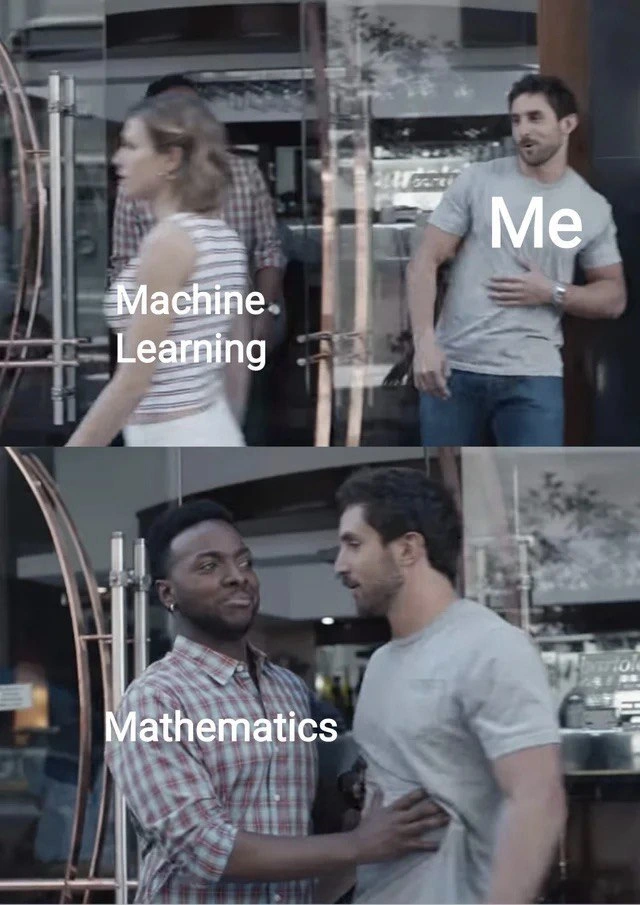
Imagine you want to eat an ice cream sundae so badly because it looks delicious and everyone’s talking about how great it is. You reach out for the dessert (that’s the exciting new thing, like learning machine learning), but suddenly someone stops you — let’s say your parent or teacher. They gently push you back and say, “Wait, you have to eat your vegetables first!” In this story, the ice cream is the fun part (doing cool AI stuff) and the vegetables are the basic lessons you need to learn first (the math and fundamentals). It’s a funny comparison because we’ve all been in that situation where we want the reward right away, but we find out we have to do the not-so-fun stuff before we can get it. The meme shows exactly that feeling. The person labeled “Machine Learning” is like the tempting dessert passing by, and the person labeled “Mathematics” is like the strict but caring adult saying “not so fast, do your homework (or eat your veggies) first.” We laugh because it’s true in so many parts of life: you can’t skip the boring but important steps and jump straight to the super fun part. No dessert until you’ve had your veggies, no amazing ML project until you’ve learned a bit of math — it’s a light-hearted way to say “put in the basics, then enjoy the reward!”
Level 2: First, Do the Math
Let’s break down what’s happening in this meme in simpler terms. Machine learning is a popular area of computing where we teach computers to make predictions or decisions by example instead of explicit programming. It sounds exciting (and it is!) – who wouldn’t want to build a program that can recognize faces or predict stock prices? In the meme, Machine Learning is personified as an attractive figure walking by, catching “Me” (the developer) completely entranced. That represents our eagerness to jump into this hot field.
But then comes the catch: Mathematics steps in as the blocker. This is because to really do machine learning, you need some solid basics from math. It often surprises newcomers that becoming good at ML isn’t just about writing code; it’s also about understanding the math behind the algorithms. When people talk about “math fundamentals”, they’re referring to a few key topics you typically need to learn first (the prerequisites):
- Linear Algebra – This branch of math deals with vectors (think of a list of numbers), matrices (a grid or table of numbers), and how to do operations on them. In machine learning, your data (say a bunch of images or a table of house prices) is often represented as big matrices. The calculations a model does – for example, combining inputs with weights in a formula like $output = W \cdot x + b$ – are basically matrix operations. So if you see notation like $X W + b$ or hear about multiplying matrices, that’s linear algebra at work.
- Calculus – Calculus is the math of how things change. In ML, one of the most common techniques to train a model is to slowly adjust the model’s parameters (the numbers inside the model) to make the predictions more accurate. How do we know which way to adjust them? That’s where calculus comes in. We use derivatives (which you can imagine as the slope of a curve at a point) to figure out if increasing or decreasing a weight will make the model output closer to what we want. This process is done by an algorithm called gradient descent – picture yourself trying to find the bottom of a hill by always walking in the downhill direction. If you see terms like gradient, learning rate, or symbols like $\frac{\partial}{\partial w}$ (partial derivative), that’s calculus popping up in ML.
- Probability & Statistics – These help us deal with uncertainty and evaluate how well our models are doing. Probability is used in ML to answer questions like “What’s the chance this email is spam?” or “How confident is the model in this prediction?”. Statistics comes in when we measure results and improvement: for instance, we split data into a training set and a test set and then use statistical metrics (like accuracy, precision/recall, or error rates) to see if the model is performing well. You might encounter terms like distribution (e.g. a normal distribution is the classic bell-curve of data), or mean and variance (basic stats concepts), or even Bayes’ theorem (a formula for updating probabilities after getting new information). All of that is part of the probability/statistics foundation.
Now, why does the meme resonate with so many budding developers and students? Because it’s so relatable: a lot of us try to skip straight to the fun part (like using a library to recognize images or to make a chatbot) and then hit a wall when the tutorial or documentation starts talking math. It’s like being excited to drive a fast car, but then realizing you first have to learn how the engine works and how to drive stick shift. In the image, the guy labeled “Me” represents any developer new to ML. The woman labeled “Machine Learning” is the cool project or dream job in AI we’re chasing (the exciting part). And the other guy labeled “Mathematics” represents all those math lessons we didn’t realize we’d need — he’s basically the teacher or rule enforcer saying, “Hold on, you need to learn this first.”
People often refer to this hurdle as the machine learning learning curve. It can be steep at the beginning, because there’s a lot of theory upfront. If you’re new and you feel a bit overwhelmed, don’t worry — you’re definitely not alone. Every expert in ML once had to sit down and grapple with these same concepts. In fact, many online courses and books start with a refresher on linear algebra and calculus for exactly this reason. The meme just puts it in a funny way: it’s highlighting that moment of realization with a visual joke. We find it funny (in a friendly way) because we’ve all been that eager person who thought they could dive right in, and then had a “oops, time to hit the books” reality check. The good news is, once you spend some time learning these fundamentals, that scary gatekeeper (math) isn’t so scary anymore — and you can walk right past into the awesome world of machine learning.
Level 3: Do You Even Math?
For seasoned developers, this meme hits a nerve because it captures a shared industry experience. Machine learning is the shiny new tech every programmer wants to tinker with — the hype is off the charts, job postings are everywhere, and success stories make it look like magic. The top frame shows “Me” gawking at Machine Learning like it’s the next big thing (because it is!). But the twist comes in frame two, where Mathematics quite literally puts a hand on your chest and says “Not so fast.” The humor stems from how real this moment is: many of us have eagerly opened an ML tutorial or a TensorFlow notebook, only to freeze at an equation $\left(\sum\nolimits_{i} x_i w_i + b\right)$ or a mention of “take the derivative with respect to $\theta$”. It’s that sudden sinking feeling of “Uh oh, I actually need to remember calculus for this!”
This scenario is a rite of passage in the developer community. We joke about it because it’s practically a meme in itself: the enthusiastic coder diving into a Kaggle competition or a deep learning course and promptly hitting a wall of linear algebra. Why is it so relatable? Most software development roles don’t demand heavy math day-to-day. You can build websites, mobile apps, or back-end systems using mostly logic and programming skills, rarely touching a matrix or an integral. So a lot of devs (even very good ones) haven’t solved a system of equations or computed a derivative since college. Machine learning changes that equation (pun intended). All of a sudden, those dusty math chapters become barriers to entry. It’s a classic learning curve moment: the curve isn’t just steep, it’s filled with Greek letters!
In real-world teams, this plays out frequently. A company hears the AI hype and tells the dev team, “Let’s add some ML to our product!” The developers, proficient in Python and JavaScript, happily import scikit-learn or TensorFlow and start coding. But very quickly, questions arise: How do we choose the right model? What does it mean to “normalize” our data? Why is our neural network not converging? These aren’t purely coding questions — they’re math questions in disguise. If nobody on the team knows the underlying math, progress stalls. Experienced folks even joke that the vast majority of work in ML is actually gathering/cleaning data and tuning parameters, and only a tiny sliver is running the learning algorithm itself. In other words, so much effort goes into understanding and preparing the numbers that the actual model-building can feel like the easy part. Without a grasp of those fundamentals, you’re basically doing cargo-cult programming — copying code you found online and praying it works, without truly understanding why.
The meme’s labels make the situation comically literal. Machine Learning is personified as that attractive new thing walking by — it represents the excitement and big career opportunities we imagine. Me is every developer with big dreams and a bit of FOMO (Fear Of Missing Out) on the AI revolution. And Mathematics is the firm friend blocking your path, almost like a bouncer at the exclusive AI club checking if your credentials (math skills) are in order. We laugh because it’s true: math can feel like a gatekeeper. In online communities, you’ll even see a bit of “math gatekeeping” where experts insist you must master certain topics before you touch ML. While that can sound harsh, it comes from real experience — diving in blind leads to painful surprises and wasted effort.
Every senior engineer knows the punchline here: there are no shortcuts. Sure, you can use high-level libraries and get a basic model running (thanks to other people packaging the math under the hood). But the moment something goes wrong or you need to customize the solution, you slam into that wall again. It might be as simple as a cryptic error message (looking at you, LinAlgError: matrix is singular 😬) which basically translates to “the math went wrong because you set up the problem incorrectly.” Many of us have had to pause an exciting ML project to go back and brush up on linear algebra or watch a few statistics videos to figure out what’s going on. It’s a humbling experience. The meme is essentially laughing at that humble pie we all eat: Me trying to swagger into the world of AI, and Mathematics stopping me like, “Do you even math, bro?”
What makes this so poignant is that it reflects a broader truth in tech: flashy new technologies often rest on sturdy old foundations. It’s easy to get caught up in the glamour (who doesn’t want to build the next smart chatbot or image classifier?), but at the end of the day, those old textbook chapters eventually demand their due. Seasoned devs nod and chuckle at this meme because they remember hitting that exact barrier — and perhaps wish they had paid a bit more attention in those math classes. The pain is real, but by turning it into a joke we also reassure each other: it’s okay, everyone hits this snag. It’s a form of collective commiseration and encouragement. After all, even the experts had to start by learning the basics. This meme just captures that moment in a perfectly visual, tongue-in-cheek way.
Level 4: Chain Rule Checkpoint
At the core of this meme is a stark realization: machine learning isn’t just about plugging data into a fancy library — it’s applied mathematics wearing a coder’s jacket. The "Me" in the image wants to embrace ML’s shiny tools and high-level frameworks, but gets stopped short by a wall of equations and Greek letters. In advanced ML, you quickly run into concepts like the chain rule from calculus and matrix factorizations from linear algebra. These are not optional: a modern neural network learns by repeatedly applying the chain rule (the derivative of a composite function) to update its weights. If you don’t speak calculus, this training process might as well be black magic. Similarly, linear algebra is everywhere: those weight matrices W and input vectors x in the equation $y = W \cdot x + b$ are fundamental abstractions. Operations like matrix multiplication and eigenvalue decomposition drive algorithms from simple linear regression to complex deep learning models.
Even probability theory stands guard at this checkpoint. Core ML concepts — like treating a model’s output as a probability distribution or the idea of maximizing a likelihood — require comfort with statistics. You’ll encounter formulas that mix these ideas together. For example, $\hat{\theta} = \arg\min_{\theta} \frac{1}{N}\sum_{i=1}^N L(f_\theta(x_i), y_i)$ is a compact way of saying “find the parameters $\theta$ that give the smallest average loss over all $N$ data points.” This single expression packs in calculus (finding a minimum of a function) and statistics (averaging over data) at the same time. There’s even a famous principle known as the No Free Lunch theorem in ML: mathematically, it tells us no single algorithm is best for every problem. This isn’t just trivia; it’s a reminder that understanding the assumptions behind each model (often written in math form) is crucial. The humor here comes from how inevitable all this is: you can’t cheat these principles. No matter how high-level your keras.fit() call, under the hood there’s calculus and linear algebra doing the heavy lifting.
In fact, many breakthroughs in AI are essentially breakthroughs in math or algorithm theory. The backpropagation algorithm that powers training of deep networks was a clever application of the chain rule and dynamic programming. Support Vector Machines rely on convex optimization and geometry in high-dimensional spaces. Even tuning a simple neural network involves grappling with concepts like learning rates, which tie back to numerical stability and calculus. So the meme’s blocker “Mathematics” isn’t just gatekeeping for the sake of it — it’s pointing out a fundamental truth: genuine understanding of ML demands stepping onto some heavy theoretical terrain. It’s a playful nod to the fact that behind the sexy AI demos are decades of math and learning theory. And if you try to sprint ahead without acknowledging that, mathematics will be waiting at the door to say “Hold up, show me you know the basics first.”
Description
Two stacked movie-still frames form a meme. In the first frame, a casually dressed man exiting a modern glass-door café is labeled with large white text “Me”; he clutches his chest while admiring a woman walking past who is labeled “Machine Learning.” In the second frame, a different man in a plaid shirt plants his hand firmly on the first man’s chest, blocking his path; this blocker carries the white label “Mathematics.” The background shows polished metal doorframes, reflections in the glass, and urban sidewalk scenery. The joke plays on developers’ eagerness to jump into trendy ML tooling only to be confronted by the prerequisite of solid mathematical foundations - linear algebra, calculus, and probability - before making meaningful progress

Comments
30Comment deleted
Machine Learning looks like the perfect mid-career fling - until mathematics shows up as the bouncer demanding the linear-algebra ID I misplaced around JDK 1.4
After spending three months debugging a neural network that wouldn't converge, you finally understand why your linear algebra professor kept saying 'this will be useful someday' - turns out, eigenvalues weren't just academic torture, they're why your PCA is crying and your optimizer is having an existential crisis
Every ML engineer's journey: spending months tuning hyperparameters with frameworks they barely understand, only to realize that Mathematics has been standing there the whole time, patiently waiting to explain why their model actually works - or more often, why it spectacularly doesn't. Turns out you can't just import numpy and call it a day when your gradient descent is converging to the wrong local minimum because you skipped the calculus lecture on convex optimization
Everyone wants to skip to 'import sklearn; model.fit', but the moment it diverges, the linear algebra bouncer demands ID: eigenvalues, gradients, and a convergence proof
About to “do ML,” then Mathematics grabs me: “Define the loss, check identifiability and condition numbers, and stop pretending random_state=42 is a methodology.”
ML: the shiny microservice. Math: the monolith dependency you can never migrate away
но математика ведь топ😢 Comment deleted
please speak english in this chat or provide a translation alongside your original text Comment deleted
also, I do agree with that statement (maths is top) Comment deleted
"Слишком математично, я зря родителям говорил, что математика в программировании не нужна и что я справлюсь без универа...." "Too mathematical, I was wrong to tell my parents that mathematics is not needed in programming and that I can do it without a university degree ...." Comment deleted
mate Comment deleted
bruh google translate got stuck Comment deleted
Those are chat rules. If you violate them, you'll get kicked. I didn't make 'em Comment deleted
no problem Comment deleted
and you don't enforce them either - please don't argue with people over it when a mod is here Comment deleted
I'm not arguing, just explaining, bro Comment deleted
Nah, that didn't look like an explanation, but nvm, I got it Comment deleted
Sorry if I sounded harsh. That wasn't my goal Comment deleted
also not needed - that's what us mods are for. @pavel_the_best knows the rules, he's been active in this chat for quite some time. Comment deleted
Cool, ok Comment deleted
speak English or provide a translation Comment deleted
that's pinned message in a Russian chat about algorithms Comment deleted
which chat? Comment deleted
oh, fuck Comment deleted
no worries, just remember this rule :) Comment deleted
dude, I understand u Comment deleted
I think it's mainly statistics right? Or are there other branches of math that ml uses? Comment deleted
If you're going for regression or classification models, you might want to review your linear algebra and calculus notes Much of the math there is based on matrices and partial derivatives Comment deleted
Also calculus and linear algebra Comment deleted
learn js, make money without math Comment deleted