Gru's Plan Meme: AI Coding Assistant Works Perfectly on First Try
Why is this AI ML meme funny?
Level 1: Winning by Mistake
Imagine a teacher who wants to show the class that a new robot student isn’t as smart as everyone thinks. The teacher gives the robot a really hard puzzle that he’s sure the robot will get wrong, just so he can point out the mistakes and prove his point. But to everyone’s surprise, the robot solves the puzzle completely correctly on the very first try. The teacher is stunned – his plan has backfired! He was all set to explain why the robot was wrong, but the robot didn’t mess up at all. In fact, the teacher ended up doing the opposite of what he intended: instead of proving the robot was unreliable, he accidentally proved the robot was actually pretty clever. It’s funny because the teacher wanted to show a failure, and he got a success instead, leaving him looking surprised and a little embarrassed.
Level 2: Mentor vs Machine
Think of a scenario in a programming team: there’s a senior developer (the mentor) and a newer developer (the junior) pair programming with an AI helper. The AI helper here is something like the Cursor IDE extension – basically a tool that uses an AI model to help you write code. The senior has been warning the junior, “Hey, don’t trust the AI blindly. It might sound confident, but AI isn’t always right.” To drive this point home, the senior comes up with an idea: ask the AI to build a small application that’s just complicated enough to likely confuse it. In other words, set the AI up for a failure so they can demonstrate its shortcomings.
The task he chooses is to have the AI generate a tiny microservice with multiple files. Now, a microservice is like a small independent application that does one thing. For example, it could be a little web service that takes in a request and returns some data (imagine a mini app that just handles user login, or just processes orders). Usually, even a simple service like that isn’t written in one single file; you split the code into parts to keep things organized. Perhaps one file will handle the incoming web requests or API calls, another file will contain functions for database operations, and a third file might have some utility code or data definitions. This is what we mean by a multi-file project: the code is divided into several files, each responsible for a piece of the functionality, and they all have to work together.
For an AI, juggling a multi-file project is harder than handling a single code snippet. The assistant has to be consistent across all those files. For instance, if it creates a function called saveUserData in one file, and another file needs to use that function, it must call it with the exact name saveUserData and the correct parameters. If it mismatches the name (even a tiny typo like saveUserData vs saveUserDetails) or forgets to create it altogether, the code won’t run correctly. Human programmers might plan this out or write and test each part one by one, but when an AI generates everything in one go, there’s a lot of room for something to go wrong. The senior is banking on this – he expects the AI to produce code that looks okay at first glance but has some wiring wrong under the hood. Maybe the program won’t compile (meaning it won’t even convert to a runnable form because of an error), or maybe it will run but immediately crash because one part is calling something that isn’t there.
Now, here’s the kicker: after the AI does its thing, they run the program and it works on the first run. This is a huge surprise. In programming, getting something right on the very first try is almost like spotting a unicorn. Typically, when you write new code (or especially if an AI generates code for you), the first run reveals at least one bug or mistake. Maybe a variable is not defined, or two pieces of the code aren’t talking to each other correctly, or you get a slightly wrong output that you need to adjust. Then you go back, fix that issue, run it again, find the next issue, and so on. The first-run success is so rare that it’s a common joke among developers – if someone claims “It worked perfectly on the first try,” their colleagues might playfully respond, “No way, what kind of dark magic is that?”
So in the meme, when the AI’s code works immediately, Gru (the stand-in for the senior developer) is completely taken aback. In panel 3 of the comic, you see his shocked face as he realizes there are no errors at all. By panel 4, he’s literally slumping because he’s defeated by his own plan’s outcome. Remember, his whole aim was to show the junior developer that the AI would mess up a complex task. Instead, the AI did an amazing job. The senior essentially accidentally succeeded at building a working service, which is funny because it’s the opposite of what he wanted to show. In tech terms, he inadvertently shipped a flawless feature – “shipping” means delivering or finishing a piece of software. He was expecting a failure to point at, but ended up with a fully functional mini-application. Oops!
Let’s break down why this is humorous in simpler terms: The mentor tried to set a trap to prove the AI was dumb (or at least not reliable), but the trap didn’t spring. It’s like he shouted, “Watch me catch this thing messing up!” and the thing didn’t mess up at all. The Gru meme format makes this very clear: Gru’s Plan = show AI’s mistake. Reality = AI doesn’t make one. Gru’s Reaction = stunned and then sad because his plan failed. The use of Gru from Despicable Me is just a popular internet way to illustrate someone formulating a plan and then that plan backfiring comically. Even if you don’t know Gru, the pictures convey the emotions: confident planning, then surprise, then defeat.
For a junior developer (or anyone newer to this), the lesson here ends up a bit different than intended. The senior wanted to say “See, the AI can’t do this perfectly.” The twist is that, in this one case, the AI did do it perfectly. Does that mean the AI is always right? Definitely not! AI assistants still make plenty of mistakes and weird suggestions – and the senior’s caution is usually valid. But this meme shows a funny exception to the rule. The junior witnessing this might laugh because the mentor’s trick kind of blew up in his face, and also feel a bit of awe seeing an AI generate a working program so quickly. It highlights how far these AI coding tools have come in helping with Developer Experience (DX): sometimes they can deliver working code in an instant, something that still surprises even the experts. The whole situation turns into a light-hearted lesson of its own: don’t underestimate new technology, because it might just embarrass you by doing a great job!
Level 3: Flawless Backfire
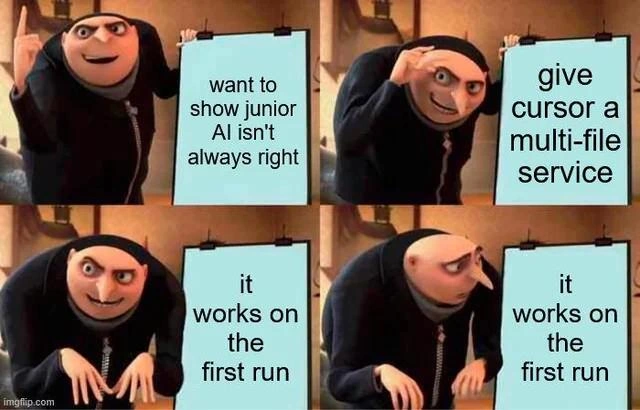
On the surface, this meme is a joke about a mentoring plan going terribly wrong (or terribly right, depending on how you see it). It uses the popular four-panel Gru plan format from Despicable Me to tell the story. In the first panel, Gru (the senior engineer, acting as the mentor) confidently states his goal: “want to show junior AI isn’t always right.” In the second panel, his plan is unveiled: “give Cursor a multi-file service.” Here Cursor refers to the AI pair-programming extension in the IDE, and a “multi-file service” means asking it to generate a small application that spans multiple source files (essentially a tiny microservice or multi-module project). The senior is assuming that if he asks the AI to produce something a bit complex – something that involves several pieces of code that must work together – it will surely stumble. This is a setup many experienced devs can relate to: let’s push the AI to its limit and watch it fail, then use that failure as a teaching moment about the technology’s limitations.
But the punchline comes in panel 3. Gru’s smug grin disappears, replaced by blank shock as he reads the result: “it works on the first run.” In the meme, this text appears both in panel 3 (when the realization hits) and panel 4 (as he slumps in defeat, the phrase repeating for emphasis). “It works on the first run” is basically the last thing our mentor expected to see. It means the AI-generated code didn’t crash, didn’t throw errors, and passed any tests on the very first try. For developers, that outcome is hilariously unexpected. We’re used to new code having something wrong on first execution – maybe a variable name mismatch or a misconfigured setting. The senior planned to see exactly those kinds of flaws and proudly point them out. Instead, his plan backfired flawlessly: the AI’s solution was so good that there were no obvious mistakes to harp on. Gru’s defeated pose in the final panel says it all – the mighty mentor was upstaged by the very tool he intended to discredit. The humor here is a mix of schadenfreude (seeing the know-it-all mentor knocked down a peg) and genuine surprise at the AI’s success. It’s the kind of inside joke seasoned devs share about how sometimes reality doesn’t follow our cynically prepared script.
This scenario lands especially well with senior engineers because it plays on our collective experience with new tech and skepticism. Many of us have encountered AI assistants like Cursor or GitHub Copilot suggesting code. Often, we do catch them making mistakes: using an outdated API, missing a null check, or misordering arguments. So we develop a healthy doubt and maybe a touch of pride that “a human expert still knows better.” In the meme, the senior embodies that skepticism and pride. He deliberately chooses a tough test (building a coherent multi-file application) thinking the AI will reveal its limitations. After all, handling a whole project’s architecture is hard – it’s not just a one-function answer, but coordinating multiple components (maybe routing, business logic, and data storage) together. The expectation is that the AI will produce a bunch of code that looks plausible but fails to run correctly, thus proving the mentor’s point that “AI isn’t always right.”
Instead, the AI knocks it out of the park. Suddenly the mentor has inadvertently demonstrated the opposite of what he intended. You can imagine the junior developer’s reaction in that moment: astonishment, maybe a suppressed giggle, as their attempt at a live lesson turns into a bit of a humbling moment for the teacher. The phrase “accidentally ship flawless micro-service” in the title captures this perfectly: the senior meant to dunk on the AI, but he accidentally ended up shipping (delivering) a perfect piece of software with the AI’s help. In other words, he was trying to do a bit of show-and-tell about AI’s failings, and instead he got a ready-to-use program without any fuss. It’s an outcome that’s simultaneously enviable (who wouldn’t want their code to work right away?) and comically frustrating for the person whose pride was on the line.
What really sells the joke is the universally understood Gru meme format. This format is famous for depicting a plan that backfires on the planner. In the context of developer humor, it’s often used to show how our clever schemes can go wrong due to unexpected tech quirks. Here, the unexpected quirk was that the AI actually performed better than anticipated. Gru’s progression from smug to stunned to slumped is basically the mentor’s ego deflating in real-time. And let’s be honest, in the developer community, we’ve all heard the phrase “works on my machine” said jokingly, because things rarely go that smoothly elsewhere. Seeing “it works on the first run” taps into that same vein of absurdly good outcomes – it’s funny because it never happens... until it does. This meme is a light-hearted reminder that sometimes our assumptions, especially the cynical ones, can be proven wrong by new technology in the most embarrassing way possible. The senior set out to prove a point, and the AI flipped the script, delivering a moment that’s equal parts educational and entertaining for everyone watching.
Level 4: Zero-Shot Microservice
From an advanced AI/ML perspective, this meme highlights a near-miraculous feat of program synthesis. A senior engineer sets up an adversarial test for an AI coding assistant: generate a non-trivial, multi-file microservice from scratch. In theory, getting a multi-module codebase correct in one go is extremely unlikely. It’s like asking a machine to solve a complex programming puzzle without ever debugging – a problem that in the general case borders on an NP-hard search through possible implementations. Normally, even humans don’t nail a multi-file architecture on the first attempt; there are so many ways for functions, classes, and modules to misalign. The AI not only had to produce syntactically correct code in each file, but ensure semantic consistency across them – if one file defines a function processData(), another file that uses processData() must call it with the right parameters and casing. Achieving this coherence without iterative feedback is essentially doing a one-shot solution to a problem that usually requires refinement. It’s a bit like solving a jigsaw puzzle blindfolded, guided only by having solved thousands of similar puzzles before.
Under the hood, tools like the Cursor IDE extension are powered by Large Language Models (LLMs) trained on massive amounts of code. These models operate on probability and pattern recognition, not formal understanding – they predict the most likely next chunk of code given what’s already written. Yet, intriguingly, they can exhibit an emergent ability to maintain context over long outputs. Modern transformer-based LLMs (circa 2025) have huge context windows, meaning the AI can “see” and remember thousands of lines as it generates. In this scenario, the model managed to internally plan out a correct program structure: it kept track of function names, modules, and data flows across multiple files purely in its hidden state. The result – “it works on the first run” – implies the AI performed a kind of implicit, zero-shot integration test. This is something researchers measure with metrics like pass@1 (the chance an AI gets a solution right on the first try). For a complex multi-file task, a perfect pass@1 is startling. It suggests the model’s training distribution contained very similar patterns or that its learned representation of code is rich enough to enforce consistency even without compiling. Essentially, the AI’s neural network weights encoded a successful solution in one forward pass, drawing on likely code idioms and frameworks it has seen before.
For veteran developers and computer scientists, this outcome borders on the uncanny. Writing a flawless multi-component service without a single runtime error asks the AI to thread multiple needles at once – something we’d normally consider requiring logical reasoning or even formal verification. Yet here it’s done via massive pattern recognition and statistical prediction. It’s a real-world echo of that old joke: “Did I just witness it compiled on the first try? Is this sorcery?” On a serious note, it showcases how far these AI models have come in software development tasks. They’re not formally proving the code correct (there’s no guarantee of perfection), but through exposure to countless examples, they can hit on a correct design by coincidence and pattern alone. This meme cleverly exaggerates a scenario that fascinates AI researchers and engineers alike: the day an AI assistant defies our expectations by producing production-ready code in one shot. It’s both an impressive technical achievement and a bit of a reality check for experts who assume that an AI will always need a human to iron out the details.
Description
A four-panel Gru's Plan meme from Despicable Me. Panel 1: 'want to show junior AI isn't always right'. Panel 2: 'give cursor a multi-file service'. Panel 3 (smiling): 'it works on the first run'. Panel 4 (shocked/disturbed): 'it works on the first run'. The joke subverts the expected outcome -- the senior developer wanted to demonstrate that AI coding tools like Cursor are unreliable, but the AI-generated code works perfectly, undermining their point and threatening their job security. The imgflip.com watermark is visible
Comments
13Comment deleted
Senior dev spent 3 years mastering architecture patterns. Cursor spent 3 seconds ignoring all of them and shipping working code anyway
The most humbling part of pair programming with an AI is when it generates a perfect multi-file service, and the only feedback you can give is suggesting it add a comment explaining its own genius for your future reference
Proof that the true Turing test is persuading the staff engineer his demo failure was actually a deployment success
After 20 years of explaining why distributed systems need careful orchestration and why junior devs shouldn't trust their first implementation, an AI casually refactors your entire service layer correctly on the first try - making you question if you've been the junior all along
When you try to teach a junior about AI limitations by giving Cursor a complex multi-file service refactor, but it works perfectly on the first run - suddenly you're the one learning about humility and updating your priors on LLM capabilities
Planned to demo hallucinations; Cursor scaffolds a multi-file service that passes CI, so the lesson becomes writing the ADR for architecture you didn’t design
AI aced multi-file service first run? Senior's next refactor: convincing the team it needs 'human validation layers'
next page is "it breaks the moment junior focuses their attention on something else" Comment deleted
... on the first only run Comment deleted
yeah the lie generator is gonna take real good care of a complex service with lots of interconnected parts Comment deleted
AI: Actual Indian Comment deleted
🎵 It works on first glance, But there is nuance — It might fail when the moon starts to rise… One careless refactor, And logic goes after, The bug in disguise! Code as a Slop… Like scripts in tmux… They shimmer and crash When you don’t understand… Code as a Slop… So clever, so cursed… It runs like a charm Till it blows up headfirst. Comment deleted
Slop poetry about slop code? Idk Comment deleted