Big Tech is a Little 'Sus'
Why is this Games meme funny?
Level 1: Find the Impostor
Imagine you have a group of seven friends, and each friend is wearing a T-shirt with a big letter on the front – the first letter of their name. They all stand in a line to take a photo. To everyone’s surprise, when you look at the order of the letters on their shirts, they spell a word! Not just any word, but the name of a popular game you all know, where one of the friends playing is secretly pretending to be innocent but is actually the one causing mischief. All the kids see that word and start giggling. It’s as if the game has come to life right there with your friends. They begin pointing at each other, joking “Which one of us is the sneaky impostor?” It’s funny because it was totally unplanned – your friends’ initials just happened to form that game’s name – and now a simple lineup of letters has everyone playfully suspecting each other, just like in the game.
Level 2: Corporate Alphabet Soup
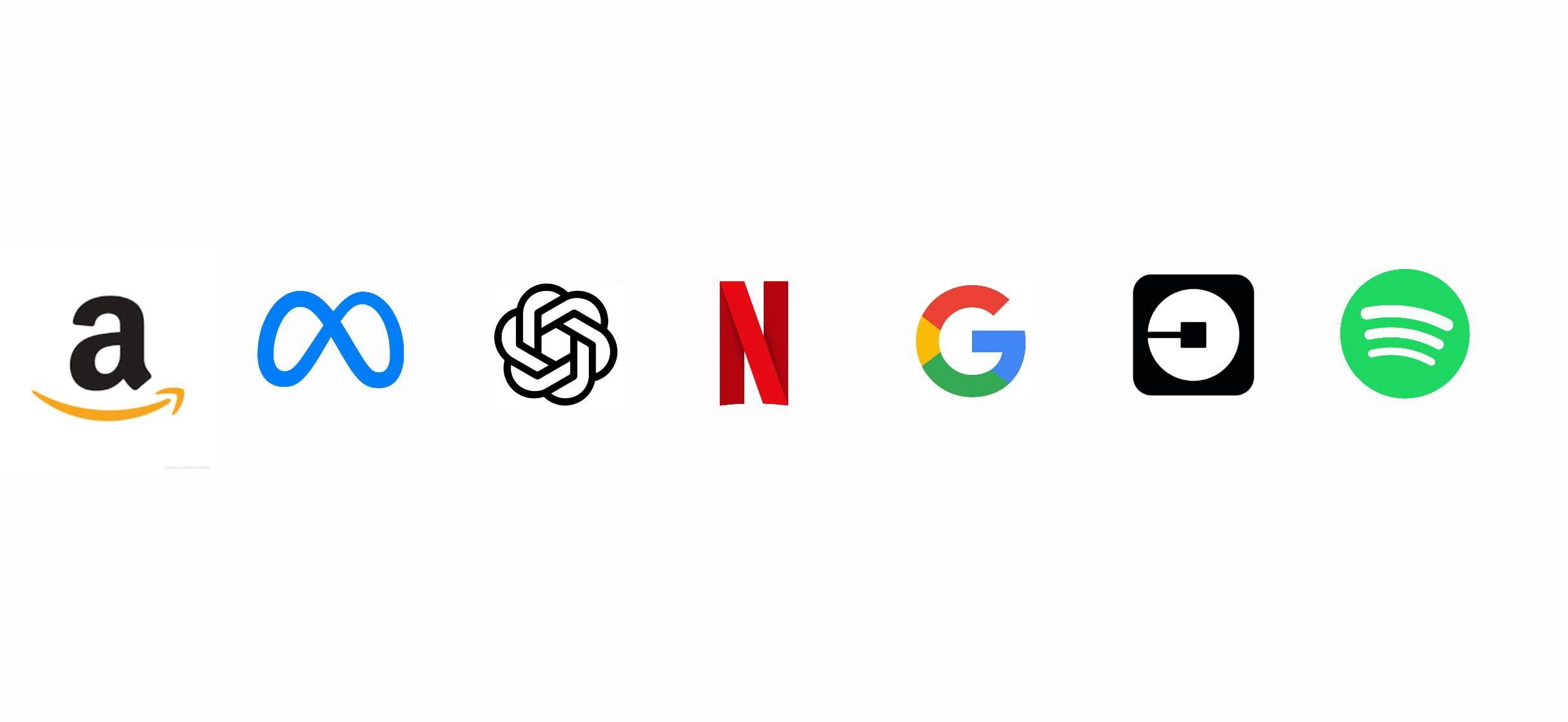
Let’s break down the joke in a more straightforward way. We have seven famous tech company logos lined up on a white background. Each logo is basically a fancy symbol for a company name. From left to right, the companies are: Amazon, Meta, OpenAI, Netflix, Google, Uber, and Spotify. If you take the first letter of each of these companies (A, M, O, N, G, U, S) and string them together, you get “AMONGUS”. That looks just like “Among Us” – which is the title of a massively popular video game. Now, why on earth would someone line up tech logos to spell “Among Us”? That’s where the tech humor kicks in: it’s a playful twist on the idea of grouping big tech firms under one catchy acronym (like FAANG), and it creates a sneaky GamingReference in the process.
First, a quick primer on FAANGCompanies. FAANG is an acronym that stood for Facebook, Apple, Amazon, Netflix, Google – basically the big five tech giants that were dominating the stock market and our lives in the 2010s. Developers and tech industry folks often referred to those companies as a group using that term. But things change: Facebook renamed itself to Meta in 2021 (to emphasize its “metaverse” vision), Google’s parent company name became Alphabet (though we still just say Google), and other big players rose in prominence. There have been attempts to update the acronym – you might hear MAANG (with Meta instead of Facebook) or even additions like Microsoft to make something like FAAMG. The meme jokingly calls this lineup “FAANG 2.0,” implying it’s an updated set of major companies. But instead of carefully picking firms by market cap or influence, it seems they were picked for their initials spelling a fun word. This is why I call it “corporate alphabet soup” – it’s a mix of letters from company names cooked into something new.
Now, on to Among Us, the game reference. Among Us is a social deduction game that became a hit a few years back. In the game, a group of players (little cartoon astronauts) work together on a spaceship, but one of them is secretly an “impostor” trying to sabotage the mission. The fun (and often chaos) comes from discussions where players accuse each other trying to find out who’s the fake. A big meme from the game is calling someone “sus,” which is slang for “suspicious.” If a player is acting weird or seems likely to be the impostor, people say “Red is sus” (if the player with the red character seems guilty, for example). The words “Among Us” and “sus” became part of internet lingo. Even if you haven’t played the game, you might have heard kids or streamers saying things like “that’s sus” to mean something’s fishy or not quite right.
So when these seven tech company logos spell out “Among Us,” it’s immediately bringing that whole idea of hidden impostors into the world of tech companies. The meme caption even says the acronym is “very sus” – it’s joking that this new grouping of companies is suspiciously spelling a game about deception. PopCultureReferences like this are common in tech humor: many developers grew up with or at least lived through the hype of games like Among Us, so it’s a shared reference we find funny.
Let’s identify each logo, since that’s part of the fun:
- Amazon – represented by the black lowercase “a” with an orange curved arrow (that arrow looks like a smile from A to Z, hinting Amazon sells everything from A to Z).
- Meta – the blue symbol next to Amazon’s is like an infinity loop or a curvy letter M; that’s Meta (the company formerly known as Facebook).
- OpenAI – in black, there’s a circle made of interlocking shapes (kind of like a knot or a flower); that’s the logo of OpenAI, an artificial intelligence research company known for creating ChatGPT. It starts with O.
- Netflix – the big red letter N is Netflix’s iconic logo (the streaming service for movies and shows).
- Google – the multi-colored “G” (blue, red, yellow, and green) is Google’s letter.
- Uber – here they used Uber’s older logo (a black square with a white circle and a smaller square inside). It’s not the most obvious “U” shape, but it was a stylized design from when Uber was rebranding its look. It represents Uber (the ride-sharing company) and stands in for the letter U.
- Spotify – the green circle with three curved white lines is Spotify’s logo (the audio waves symbolizing music streaming), corresponding to S.
Put those first letters together: A M O N G U S. It spells “AMONGUS.” You might read it as “Among Us” if you naturally separate the last two letters (since in the game title, “Among” and “Us” are separate words). It’s a perfect accidental homage to the game.
Why is that funny to a developer or someone in tech? On one hand, it’s just silly wordplay – seeing serious corporate logos unintentionally form the name of a lighthearted game is like seeing your calculator spell HELLO upside-down. On the other hand, it resonates because of the whole impostor_metaphor. People often joke about big tech companies being sneaky or not what they seem. For instance, you might hear “Which tech giant will be the next to betray its users?” in discussions about privacy or policy changes. The meme takes that idea and maps it to Among Us: a game literally about finding a betrayer among a trusted group. So the question “which hyperscaler will be the next impostor in the industry stack” is basically asking, “which big tech company might turn out to be the bad actor next?” Hyperscaler is a term usually used for huge companies that run massive cloud infrastructures (like Amazon, Google, Microsoft – companies that can “scale” services to billions of users). In context, it means any of these gigantic tech firms. So if one of them is the “impostor,” it implies one could cause trouble or undermine the rest in some way, perhaps through anti-competitive moves or tech that blindsides the others. It’s a tongue-in-cheek way to personify corporations as if they’re players in a game, where one might break the unspoken rules.
In simpler terms: this meme is funny because it combines a TechIndustry in-joke (constantly reinventing acronyms like FAANG to group the biggest companies) with a Gaming in-joke (Among Us and the idea of a “sus” impostor). Developers love both these things – keeping track of big tech trends and goofing off with video game references – so smashing them together doubles the humor. Plus, there’s something relatable about always being a tiny bit suspicious of big tech. Just as in Among Us you’re side-eyeing your teammates, in real life we sometimes side-eye tech giants and think, “Hmm, what are they up to now?” Seeing them literally spelled out as “Among Us” encapsulates that feeling in one quick visual gag.
Level 3: Impostor Among Giants
From an industry historian’s perch, this meme is a delightful convergence of BigTechCompanies lore and MemeCulture. A decade ago, everyone in tech tossed around the acronym FAANG – that succinct badge for Facebook, Amazon, Apple, Netflix, Google – to talk about the dominant players. But in the fast-paced world of tech, acronyms age like hardware. Facebook morphed into Meta, Google tucked itself under an Alphabet umbrella, and newcomers knocked on the clubhouse door. Enter “FAANG 2.0,” where our roster of titans isn’t just five companies or even a coherent Wall Street index – it’s whatever collection of logos an enterprising dev can line up to form an inside joke. In this case, seven well-known tech logos spell out AMONGUS, an unmistakable nod to the viral game Among Us. The humor is multi-layered: it’s a bit of IndustryIrony that the ultra-serious branding of these corporations can be rearranged into a sus phrase straight out of a social deduction GamingReference. It’s as if the corporate brand alphabet we revere for stock portfolios and résumés has been hijacked by a meme. The image playfully suggests that our beloved tech giants might secretly be playing a game of “find the impostor” among themselves.
Plotting company logos to spell a hidden word is the kind of geeky wordplay developers adore (who among us hasn’t secretly hoped to find an Easter egg in a codebase or a conference lineup?). The logos here are instantly recognizable: Amazon’s smile-arrow “a” leads to Meta’s ∞-loop M, then OpenAI’s knot-like emblem for “O”, followed by Netflix’s red N, Google’s multi-colored G, the old Uber glyph as a stand-in for U, and finally Spotify’s green circle for S. This specific combination is no accident – it’s like carefully choosing letters in Scrabble to spell a mischievous word. In the original FAANGCompanies acronym, Uber and OpenAI and Spotify weren’t invited to the party (while Apple and Microsoft got left out here ironically – their initials didn’t fit the joke!). But tech commentators love coining new acronyms whenever one of the original members gets acquired, rebrands, or simply falls out of cultural hype. We went from FANG (Facebook, Amazon, Netflix, Google) to FAANG (adding Apple) to countless permutations: GAFAM, FAAMG, or even “MAMAA” (one tongue-in-cheek update after Meta’s name change). Each revision tries to keep up with who’s on top – or simply who has a convenient first letter. So when a meme arranges Meta (formerly Facebook) plus new stars like OpenAI into the lineup, it’s riffing on that trend: acronym soup as a mirror of industry hype. It’s IndustryTrends_Hype distilled into a visual pun – the brands may be chasing serious market share, but their letters accidentally spell a whimsy. It suggests that in our effort to catch all the new hyperscalers and unicorns, we might end up with an alphabet soup that’s a little too on the nose.
Now Among Us – if you missed the pandemic-era craze – is a multiplayer game that exploded in popularity around 2020. In it, a crew of cartoonish astronauts work together on tasks, but one of them is secretly an impostor trying to sabotage and eliminate the others. The cultural footprint of this game was huge: even in programming circles you’d hear jokes like “that code looks sus” (short for suspicious) or see little astronaut avatars popping up in chat threads. The phrase “There is 1 impostor among us” became a meme template for any scenario involving hidden trouble. This meme capitalizes on that shared knowledge. By spelling AMONGUS, it instantly taps into the collective memory of venting in-game (“Red is sus!”) and the larger idea of hidden malfeasance. We’ve all grown a bit suspicious of tech giants’ motives in recent years – from data privacy scandals to monopolistic behavior – so the question “Which one of these is the impostor?” lands as a darkly humorous metaphor. CorporateCulture in tech can sometimes feel like an impostor_metaphor: companies wear friendly public faces (the colorful, playful logos in our meme) but might have secret agendas (like the impostor in the game). The meme flips the script: instead of an innocent crew with a secret villain, we have a lineup of powerful corporations ironically casting themselves as potential villains in each other’s midst.
On a technical level, developers might joke about writing a quick script to detect the sus acronym. After all, pattern recognition is our forte, and spotting “AMONGUS” in the wild triggers an almost Pavlovian response in meme-savvy engineers. Consider this Python snippet that a curious dev could run:
brands = ["Amazon", "Meta", "OpenAI", "Netflix", "Google", "Uber", "Spotify"]
acronym = "".join(company[0] for company in brands) # Take first letter of each
print(acronym) # Outputs: AMONGUS
if acronym.upper() == "AMONGUS":
print("🚨 There's an impostor among us! 🚨")
In true TechHumor fashion, the code confirms the hidden message and jokingly raises an alert. It’s a playful way to merge the meme with a bit of actual coding. And it underscores why this combination of logos is funny to engineers: we’re trained to look for signals and anomalies. When the corporate_brand_alphabet spells out something as culturally loaded as Among Us, alarms go off – not real production alarms this time, but the kind that make you spit out your coffee in laughter.
So, why is this so hilarious to those steeped in developer and internet culture? MemeCulture loves a mashup that feels almost conspiratorial. It’s that sensation of “How did nobody notice this before? It was hiding in plain sight!” We relish the idea that serious brands – ones we interact with daily via AWS consoles, npm install commands, social feeds, rideshares, and music streams – have unknowingly formed a meme Voltron. This image is essentially a logo_wordplay puzzle, and solving it (realizing the first letters form AMONGUS) gives a rush of geeky satisfaction. It’s the same kind of delight one gets from discovering an acronym that spells a actual word (like how REST in software architecture conveniently stands for Representational State Transfer, forming an English word). But here the acronym creep has gone into overdrive, pulling in extra companies just to hit the comedic jackpot.
Beyond the wordplay, there’s a wink at the impostor_metaphor: big tech companies often leap into each other’s territory, prompting developers to wonder “Ok, who’s playing us now?” For example, when a social media company pivots to the “metaverse” or an e-commerce giant starts offering AI cloud services, it can feel like someone on the team flipped allegiance – the way an Among Us impostor would. The meme’s subtitle about the “next ‘impostor’ in the industry stack” captures that perpetual caution we have: that one of these major players might upend our stack or tools with a surprise move (an API change, a sudden framework takeover, a new platform that renders others obsolete). It’s sus detection algorithm meets market analysis – developers and tech pundits are always sniffing out which company might stab another in the back (or stab us in the back, by deprecating a beloved free tier service, for instance). The meme slyly implies that even as these corporations collaborate and compete openly, one might secretly be plotting a disruption, just like a hidden traitor. It’s a comedic exaggeration, of course – Amazon’s not literally ejecting Google into space – but it resonates with anyone who’s watched the tech giants unexpectedly encroach on each other’s domains.
In summary, at this senior perspective, the meme works on several levels: logo_wordplay that yields a pop culture reference, commentary on IndustryTrends_Hype (where we constantly revise which companies matter most), and a dash of cynicism about corporate motives, all packaged in a simple lineup of icons. It’s the kind of joke that makes seasoned devs smirk and think, “Ha, there really is an impostor among us – and it might just be whatever new FAANG 2.0 member we’re hyping this week.”
Description
The image displays a series of seven prominent tech company logos arranged horizontally on a white background. From left to right, the logos are: Amazon, Meta, OpenAI, Netflix, Google, Uber, and Spotify. The meme is a clever rebus where the first letter of each company's name (A-M-O-N-G-U-S) spells out 'AMONG US.' The humor is derived from using the ubiquitous logos of major tech corporations to reference the popular social deduction game 'Among Us.' This juxtaposition creates a witty, insider joke for the tech community, contrasting the serious, corporate world of big tech with a playful, trendy gaming reference. It's a visual pun that relies on the viewer's familiarity with both the tech landscape and modern gaming culture
Comments
18Comment deleted
This is the only 'Among Us' game where you try to figure out which service is secretly sunsetting a critical API, not who the imposter is
Looks like FAANG finally adopted OpenAI, Uber and Spotify - now every all-hands feels like an on-call shift where someone’s definitely **sus** but the incident review says “no clear RCA.”
Seven logos, seven different ways to collect your data, but only one of them will actually tell you they're training an AI on it while the others just update their privacy policy at 3am hoping you won't notice
When your entire tech stack's vendor lock-in can be summarized in seven logos - and you realize your infrastructure, AI models, authentication, streaming breaks, ride to the office, and debugging playlist all depend on companies that could change their pricing model tomorrow. At least when one goes down, you can still use the other six... until they all decide to have an outage on the same Tuesday
FAANG was deprecated and replaced by AMONGUS; same interview loops, new package name - and the impostor is the GPU inference bill hiding under “R&D.”
Resume flex: these logos bulk the 'experience' section more than any monolith refactor
FAANG got refactored into AMONGUS - AWS billing, Meta reorgs, OpenAI prompt‑golf, Netflix Chaos Monkey, Google ladder math, Uber surge pagers, and Spotify A/Bs - and the only ‘sus’ part is the comp plan’s eventual consistency
among ♂️Ass♂️ Comment deleted
amcngus Comment deleted
OpenAI Comment deleted
ClosedAI Comment deleted
amOpenAIngus Comment deleted
Amount anus Comment deleted
sus Comment deleted
Who's the U Comment deleted
Uber Comment deleted
Kinda sus Comment deleted
I expect nigger there. What have you done 😭? Comment deleted