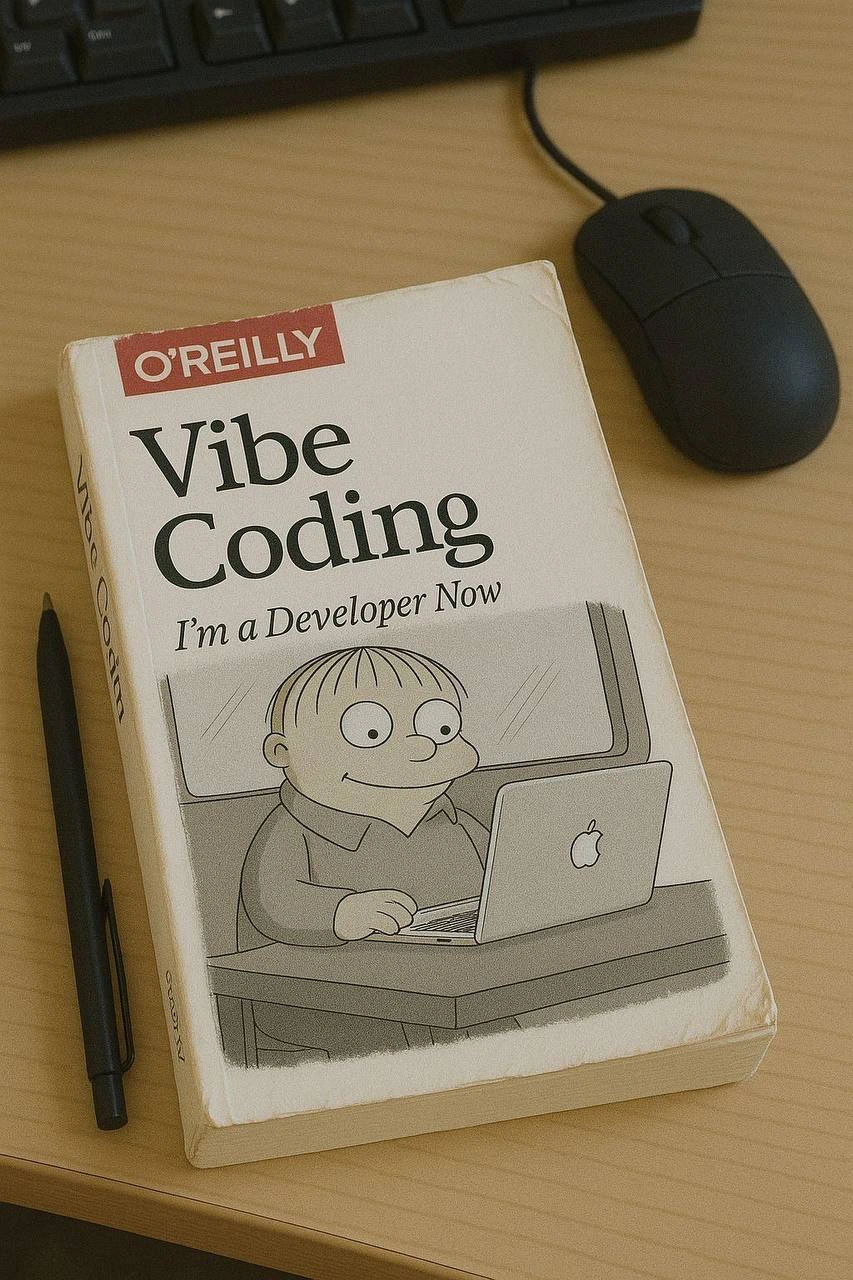
The Ancient Tomes of Web Development
Why is this Learning meme funny?
Level 1: Library vs Google
Imagine your grandma tells you that when she was young, she had to go to a library and read big heavy encyclopedia books to learn new things. She might say, “We didn’t have the internet, so I learned everything from books.” Now, you as a kid today might find that hard to believe because whenever you have a question, you just grab a tablet or computer and search on Google or Wikipedia. It sounds super slow and old-fashioned to hear that someone would flip through hundreds of pages just to find information, right? You might even giggle and pat Grandma on the arm and say, “Okay, sure Grandma, that’s interesting – let’s get you comfy for bed.” You’re not trying to be mean; it’s just such a funny idea that learning had to be done without any online help. That’s exactly the feeling this meme creates, but for web developers: it’s joking that learning to build websites from paper books (the way it used to be) seems as strangely antique to modern kids as using a library instead of Google. It makes us laugh because it shows how quickly times change – what was normal for Grandma feels like a fairy tale to kids now.
Level 2: Books vs Stack Overflow
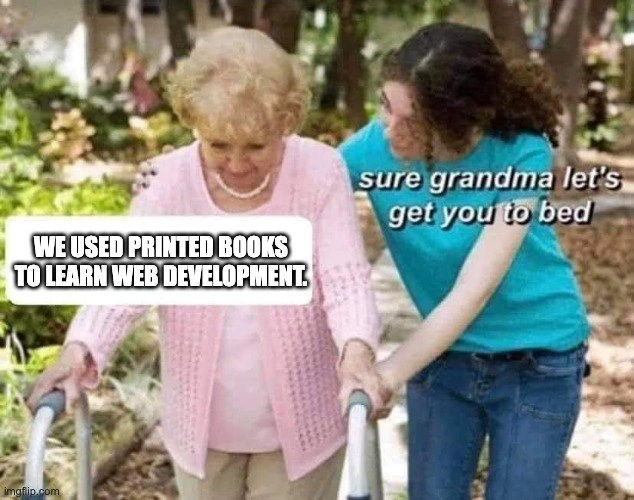
Think of web development learning methods as old school vs new school. The meme’s joke comes from comparing how developers used to learn versus how they learn today. The "grandma" in the picture says “We used printed books to learn web development,” and the younger person replies “sure grandma, let’s get you to bed,” in a playful, sarcastic way. This response suggests “That sounds crazy or outdated, but okay!” It’s a gentle way of saying the idea is old-fashioned. This format is a well-known internet meme: the younger character humors the older character’s unbelievable story, much like you’d humor a grandparent who’s reminiscing about “the good old days.”
So why is it funny to say you learned web development from printed books? To a modern developer (or student learning to code now), that statement feels outdated. Today if you want to learn HTML, CSS, or JavaScript, you probably use interactive websites, watch YouTube tutorials, read official online documentation, or search for answers on Q&A forums. Stack Overflow is a hugely popular question-and-answer site where developers post errors or questions and get answers from the community. It launched in 2008 and quickly became a go-to resource for troubleshooting code. Many new developers have gotten used to simply googling their problem and finding a Stack Overflow page or an online guide that already has the solution.
But the “grandma” represents an earlier time — the pre-Stack Overflow era — when such instant online help wasn’t widely available. Back then, learning web development often meant buying or borrowing a book (yes, a physical paper book!) on the subject. For example, you might have a big book titled "Learn HTML in 21 Days" or "JavaScript Basics" and you would read it chapter by chapter. These books had all the explanations, examples, and best practices of the time. However, web technology changes quickly. A book might not get updated every month, so some information in a printed book could become outdated as web standards evolved or new techniques emerged. Despite that, in the 1990s and early 2000s, printed manuals and books were among the best (and only) ways to learn programming on your own. Developers also relied on documentation that came with software or on slower forms of online help like forums, which could take days to get a response.
The younger person’s sarcastic reply, “Sure grandma, let’s get you to bed,” is a lighthearted way to acknowledge the statement but also suggest it’s a bit out-of-touch. It’s as if they are saying, “You must be tired or confused, talking about things from ages ago!” Of course, reading books to learn isn’t actually senile – many people still do it – but the joke exaggerates the generation gap. In the context of web development, it highlights how learning resources have shifted:
- Then (Grandma’s time): You learned from printed documentation and programming books. You might follow a structured course from page 1 to 300. If you hit a snag, you’d look at the book’s index or glossary, or maybe ask a question on an early internet forum or mailing list and wait patiently for help.
- Now (Modern dev’s time): You learn from online resources. This could be official docs on a website (like the Mozilla Developer Network for web standards), interactive coding platforms (which let you practice code in the browser), or Q&A communities (like Stack Overflow, Reddit, etc.). If you don’t know something, you can immediately search for it. There’s likely a blog, a tutorial, or an answer that addresses your exact question. You can copy example code, test it instantly, and move on.
Stack Overflow in particular is so popular that many developers almost treat it like an extension of their memory. Instead of remembering every detail or reading a whole chapter, they recall “I saw a Stack Overflow answer for this problem” and go find it. That’s a very different style from memorizing facts out of a book. Each approach has pros and cons. Reading a whole book can give you a strong foundation in a topic, while searching online is faster for solving specific problems on the spot.
The meme gently makes fun of the older approach by framing it as a grandma’s tale. It’s not mean-spirited; notice the wording “sure grandma” – the younger dev isn’t saying “OK whatever, dinosaur.” They say it kindly, as if to an elderly relative, but with a bit of an eye-roll. This reflects a common feeling among modern devs that the tech world they know is so internet-centric that pre-internet methods feel very distant. Learning to code has changed so much that using only books sounds almost like folklore to someone who grew up with Google and YouTube. The joke lands because it’s true – things really have changed that quickly – and it’s amusing to imagine a seasoned developer’s real experiences being treated like a bedtime story.
In summary, the meme is highlighting how web development education has evolved:
- Older generation: spent hours reading printed books and manuals to learn coding.
- New generation: uses fast, online tools and communities to learn the same things.
The result is a humorous comparison that resonates with anyone who’s aware of both worlds. If you’re new to coding, it lets you chuckle at how things were done “in the old days.” If you’re an older coder, you laugh because you remember those days – and maybe feel a tiny bit “old” when the youngsters act like that was the Stone Age of tech.
Level 3: Pre-Stack Overflow Era
Grandma: "We used printed books to learn web development."
Young Dev: "Sure grandma, let's get you to bed."
This meme uses the classic "sure grandma, let’s get you to bed" template to highlight the tech generation gap in learning. The elderly "grandma" character proudly recalls an era when aspiring web developers relied on printed manuals and hefty programming books as their primary web dev resources, while the younger developer responds with gentle sarcasm. The humor comes from treating the statement as if it were the rambling of someone out of touch with reality – a playful exaggeration, since using books to learn programming is technically true but feels archaic in the fast-paced context of modern web development.
In the pre-StackOverflow era (think late 90s and early 2000s), a newcomer's LearningToCodeJourney looked very different from today. Back then, if you wanted to master HTML, CSS, or JavaScript, you likely started by buying a 800-page dead-tree manual (slang for a printed tech book) or borrowing one from the library. Developer knowledge was literally bound in paper: comprehensive tomes like HTML 4.0 Complete, JavaScript: The Definitive Guide (with its famous rhino cover), or a thick Wrox Press book on ASP.NET. These books, often sporting dog-eared pages and scribbled notes in the margins, were the web developer’s bible. You’d meticulously work through chapters, one by one. Solving a problem meant flipping to the index in the back of the book and hoping the keyword you had in mind was listed. It was a slower, more linear learning process. Veteran coders still feel a pang of TechNostalgia recalling the DeveloperNostalgia of spending late nights poring over Chapter 17, grateful to finally discover how to center text with a <div> after hours of reading.
By contrast, today’s web developers have a buffet of instant knowledge at their fingertips. Need to figure out a CSS trick or a JavaScript bug? You simply Google the error message or search on Stack Overflow, and within seconds you’ve got copy-paste ready answers. Modern web_dev_resources include MDN Web Docs (Mozilla’s exhaustive online documentation for web standards), countless YouTube tutorials, interactive coding sandboxes, and developer blogs – all updated continuously. The meme exaggerates this contrast: to a junior dev who grew up with high-speed internet and infinite Stack Overflow answers, the idea of learning solely from static, year-old printed books sounds as dated as using punch cards.
The humor really lands because web development moves ridiculously fast. A printed book on a hot JavaScript framework can be outdated by the time it’s published. (Imagine a 2015 AngularJS book sitting next to a 2023 Angular developer – it's practically a historical artifact.) So when Grandma dev says, “We learned web dev from books,” the young dev’s gentle sarcasm – “Sure, grandma…” – conveys “Okay, that’s a cute story, even if it’s hard to believe now.” It’s poking fun at how quickly learning resources have evolved. Ten or twenty years isn’t a long time, but in web tech it feels like eons. The meme’s subtext is that those who were coding in the late 90s might as well be prehistoric creatures to today’s newcomers, who can’t imagine coding without Stack Exchange or real-time documentation.
There’s also an implicit nod to how the learning curve has shifted. Old-school devs often had to build a deeper foundational knowledge (reading entire chapters on browser quirks and CSS gotchas) before they could even see something work in a browser. Modern devs, enabled by instant answers and stackexchange snippets, tend to learn in a more ad-hoc, problem-driven way: you encounter an error, you search for that specific error, you patch the fix, and move on. This is efficient, but it can lead to a sort of “Google-driven development”. Seasoned coders sometimes joke about newcomers being great at assembling solutions from Stack Overflow without fully understanding them – a sharp contrast to the older method of digesting a whole book to grasp concepts. That tension underlies the meme’s playful ribbing: the young dev is effectively teasing, “Sure thing, Grandma, those must have been wild times,” as if the old-timer is recounting walking uphill both ways to school in a snowstorm.
The "sure grandma" meme format itself (the source image of a kindly woman with a walker and a caretaker) is internet shorthand for “the old person is talking nonsense again.” Here it’s used affectionately. The “grandma” in question isn’t really senile – she’s just talking about an earlier era of tech that modern devs find almost mythological. The gentle sarcasm is key: it’s not a brutal takedown, but a lighthearted “okay, let’s get you to bed” as if telling a bedtime story. And in a sense, these are like fairy tales to the new generation of developers. An old hacker spinning a yarn about how “back in my day, we had to manually write <table> tags for layout and read actual books to learn new <font> tricks,” is downright charming (and a little unbelievable) to someone who can now find a CSS Grid tutorial on YouTube in five seconds flat.
To put the shift in perspective, consider a few differences between learning web dev then vs now:
| Early 2000s (Books Era) | Today (Online Era) |
|---|---|
| 📚 Stack of books on your desk – HTML, CSS, JS guides, maybe a hefty reference manual. | 🌐 Stack Overflow and online docs open in browser tabs; maybe an e-book or two on a tablet. |
| Learning by chapters: Start at page 1 and follow a structured path through a technology. | Learning on-the-fly: Search any error or “How do I…?” and jump straight to a solution snippet on a forum. |
| Updates via new editions (wait for next year’s book version to learn new features). | Updates via blog posts, documentation websites, and tweets – knowledge refreshes in real time. |
| Asking questions meant hoping a colleague or a Usenet/forum user might answer in a few days. | Asking questions is as easy as posting on Stack Overflow or Reddit and getting answers in minutes/hours. |
| Reference = Book Index. Flip to the back index or use sticky notes to find a topic. | Reference = Google. Type your question, land on official docs or Q&A answers instantly. |
(Above: A comparison highlighting why “printed books for web dev” feels like ancient lore to juniors.)
For many of us who lived through it, this meme is both hilarious and a tad bittersweet. The older generation did indeed spend evenings under a desk lamp, immersed in printed docs and paperback programming books. There’s a certain satisfaction and clarity that came from those cover-to-cover study sessions – like reading a narrative of a technology, instead of today’s bite-sized Stack Overflow answers. But there’s no denying the convenience we have now. As one senior dev quipped, the only Stack Overflow they knew in the 90s was the literal stack of books overflowing their desk. 📖💻 The meme captures this absurd speed of change: what was standard learning practice just a couple decades ago now sounds like a TechHistory legend you’d humor your grandparent about. In short, “we learned web dev from books” has transformed from a simple statement of fact into a punchline – a code learning curve story so old-fashioned that it’s told as a joke to the new generation.
Description
This meme uses the 'Sure Grandma, Let's Get You to Bed' format. The image shows a young woman gently guiding an elderly woman who is using a walker. A text box over the elderly woman reads, 'WE USED PRINTED BOOKS TO LEARN WEB DEVELOPMENT.' The young woman replies with condescending pity, 'sure grandma let's get you to bed'. The meme humorously highlights the rapid pace of technological change in the software industry. It frames the once-common practice of learning web development from physical books as an archaic method from a bygone era, akin to a grandparent's rambling stories. For senior developers, it's a nostalgic and slightly melancholic joke about how quickly their foundational knowledge and learning methods become obsolete to newer generations
Comments
13Comment deleted
Learning web dev from a book today is like trying to navigate a city with a map from 2005. The street you're looking for is now three microservices and a serverless function, and the map is written in jQuery
Explained to the intern that before Stack Overflow, our ‘read replica’ was a Xeroxed chapter from the 900-page Wrox ASP book - he immediately opened a Jira to migrate it to Aurora
Back when 'stack overflow' meant your bookshelf collapsed under the weight of O'Reilly animal books, and the only dependency hell was waiting 6-8 weeks for the errata edition to ship after you discovered the code examples were written for a browser version that never existed
Ah yes, learning React from a book published in 2019 - by the time it hit the shelves, three major versions had dropped, hooks became standard, class components were legacy, and the entire build toolchain had been rewritten twice. That O'Reilly animal on the cover? Extinct, just like the patterns inside
Printed books: zero 404s, eternal uptime, but updating for the next browser version meant a bookstore run and $60 lighter
We learned web dev from printed books - when the errata arrived yearly, not every npm install
Back then our package manager was a backpack, and dependency resolution was three dog-eared O'Reillys arguing about IE6 quirks
legend Comment deleted
THIS Comment deleted
Do we need this book for web development? Comment deleted
no Comment deleted
Back in the days we had an SQL course and exam online bc covid-19 We used to write down on a notebook our query and show it ti the camera so fucking funny our professor couldnt even start recording lessons ma gad Comment deleted
Wait books are not just for decoration like those manga thingies after you watch an anime? Comment deleted