Skip to content
DevMeme
1736 of 7435
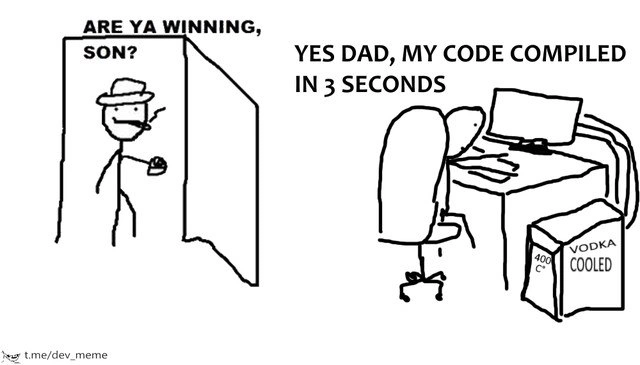
When your over-clocked vodka-cooled rig finishes a build in 3 seconds
BuildSystems CICD Post #1940, on Aug 20, 2020 in TG

When your over-clocked vodka-cooled rig finishes a build in 3 seconds

Why is this BuildSystems CICD meme funny?

Level 1: Winning with Overkill

Imagine a dad asking his son if he won his race at school, and the kid beams and says: “Yes, I finished the race in 3 seconds because I strapped a rocket to my bike!” 😄 He did win, and ridiculously fast at that, but only because he used a crazy, over-the-top method. That’s exactly the kind of joke this meme is making. In the picture, the dad asks if the son is winning (expecting something like a game win), and the son proudly replies that he got his code to finish building super quickly – 3 seconds! To the son (who’s a programmer), that’s like a big victory. But the way he achieved it is comically excessive: he made his computer run dangerously hot and tried cooling it with vodka (which is a funny, impractical idea) just to get that speed. It’s funny even if you don’t get the tech details, because the son is basically saying “Yes, I’m winning, I did my task unbelievably fast by using a wild trick!” and the dad is left scratching his head. The meme makes us laugh at how far someone might go to accomplish something a little faster – it’s winning with overkill, in the most amusing way.

Level 2: Turbocharged Dev Rig

Let’s break down the meme in plain terms. We have a dad peeking in and asking his son, “Are you winning, son?” – a popular internet meme catchphrase. Usually, the dad means “are you winning the video game you’re playing?” But here the son isn’t gaming; he’s coding. His excited reply is, “Yes Dad, my code compiled in 3 seconds.” This swaps out the usual gaming victory with a programmer achievement: getting code to compile really fast.

What does “code compiled in 3 seconds” signify? Well:

  • Compiling code is the process of turning the human-readable instructions (source code) into machine code that the computer can execute. It’s done by a program called a compiler. When the son says “my code compiled,” it means he ran his code through a compiler and it completed without errors, producing an executable program. That alone is a happy moment for a programmer (no compiler errors – yay!).
  • The 3 seconds part is emphasizing speed. For many projects, compiling can take a while – sometimes several minutes or more, especially if the program is large or the computer is average. Finishing a build in just 3 seconds is extremely fast, almost unreal for anything significant. It implies something special is going on with his computer’s performance.

Now, how did he achieve that speed? Enter the over-clocked vodka-cooled rig:

  • An over-clocked rig means a computer (rig = setup) that’s been tuned to run faster than normal. Usually, a CPU has a default clock speed (say 3.0 GHz), but some enthusiasts push it to 3.5 GHz, 4.0 GHz, or higher. This is like pressing the gas pedal extra hard in a car – the engine (CPU) runs faster and does more work per second. The result: tasks like compiling code go quicker. The downside: the CPU gets much hotter when it’s running out of spec.
  • To deal with the extra heat from overclocking, people use enhanced cooling. Most PCs use air cooling (fans blowing on heat sinks). Serious overclockers use liquid cooling – pumping water or coolant through tubes to carry heat away faster than air can. It’s analogous to a car radiator cooling an engine.
  • Vodka-cooled is a joke version of liquid cooling. Vodka is mostly water and alcohol; nobody really uses it to cool computers (it’s electrically conductive if it’s not absolutely pure, it evaporates, and it’s flammable!). But it’s a funny image – maybe the kid didn’t have proper coolant and grabbed a bottle of vodka from the freezer. It suggests a DIY, slightly crazy solution to keep the PC cool.
  • The PC tower is labeled “400 °C”. That is an insanely high temperature (400 °C is about 752 °F, hotter than a pizza oven!). If a computer’s insides were actually 400 °C, something is very wrong (CPUs usually try to stay below ~100 °C before they shut themselves off). So, saying the rig is “vodka cooled” yet running at 400 °C is pure silliness. It implies the cooling isn’t really working at all – the machine is effectively on fire. It’s like saying “I put ice on it, but it’s still burning up!” The absurd label is there to make us laugh at how over-the-top this setup is.

So, putting it together: the son is thrilled because he managed to compile his program in record time, just 3 seconds, thanks to his wild supercharged PC. That’s his idea of “winning.” The dad, on the other hand, probably doesn’t understand any of those technical words – he’s just stood there in the doorway, pipe in hand, expecting to hear about a game. The humor comes from that contrast and exaggeration. It’s poking fun at developer culture: we get excited about things like build speeds and are willing to engineer crazy solutions for it. BuildSystems and CI/CD pipelines (the automated processes that compile and test code in professional projects) put a lot of emphasis on speed, because faster builds mean more productivity. This meme takes that to a wacky extreme: the kid essentially turned his computer into a turbocharged monster just to save time on compiling. It’s both ridiculous and relatable to anyone who’s waited too long for a code build to finish.

Level 3: Booze-Fueled Build Blitz

From a senior developer’s perspective, this meme nails the absurd lengths we’ll go to for faster build times. If you’ve ever twiddled your thumbs during a 30-minute build or watched a CI/CD pipeline grind along, you know why a 3-second compile sounds heavenly. The joke exaggerates that obsession: the son in the comic has cobbled together a ridiculous high-performance build rig that’s vodka-cooled and running so hot it hits “400 °C”. It’s a hyperbolic nod to every engineer who’s thought, “What if I just throw more hardware at the problem?” – taking that idea to comical extremes.

The classic “Are ya winning, son?” format usually features a dad checking if his kid is victorious in a video game. Here, the “victory” is wildly niche: the kid proudly announces his code compiled in 3 seconds. To a developer, that’s a legitimate achievement – shaving build time is a big deal in daily development. But to the fedora-wearing dad (representing an outsider or older generation), the response is gibberish. He expected his son to be playing Fortnite or Minecraft; instead he’s hearing about compilation speeds and some bizarre PC cooling method. That mismatch is part of the humor: the son is “winning” in a geeky way that Dad can’t even begin to fathom.

For seasoned engineers, there’s an extra layer of comedy in the over-engineering at play. The PC tower emblazoned with “VODKA COOLED 400 °C” mixes two absurdities: it riffs on fancy liquid-cooling setups, and it showcases a wildly overclocked machine far beyond safe temperatures. In reality, yes, hardcore PC builders do use liquid cooling (usually water or special coolant, not actual Smirnoff) to keep overclocked rigs stable. But even the best cooling in the world shouldn’t ever see 400 °C on a CPU – that number screams catastrophic overheating. That’s the deadpan punchline: the son probably disabled every thermal safeguard to push his PC to ludicrous speed, just to shave off those extra seconds of build time. It’s the ultimate “works on my machine” flex – and indeed, his machine is one-of-a-kind (half high-end PC, half mad science experiment).

This scenario lampoons a real developer habit: when builds are slow, we get creative (or desperate). We tweak our build processes, add parallel jobs, upgrade hardware – anything to iterate faster. Maybe we’ve scripted our BuildAutomation to use make -j16 or we’ve moved to faster SSDs, all in pursuit of a shorter wait after hitting compile. In the meme, that tuning is taken to cartoonish heights. The solution wasn’t cleaner code or a better build script, but raw hardware brute force: make the computer insanely fast by any means necessary. For example, a compile command on a beastly overclocked machine might look like:

$ make -j64   # Spawn 64 parallel compiler processes to utilize a mega multi-core CPU
[Compiling 1000+ source files in parallel...]
[Linking all objects into one program...]
Build finished in 3.2 seconds.

For any veteran programmer, seeing “Build finished in 3.2 seconds” for a huge project is both awe-inspiring and a bit suspicious – usually it takes serious power (or trickery) to get times like that. That’s why we laugh: the meme is basically saying “look how far a dev might go just to avoid waiting on a compile.” It pokes fun at the PerformanceOptimization mindset. Instead of fixing slow code or improving algorithms, this dev literally poured alcohol into the machine and cranked everything to 11. It’s reckless, it’s overkill, but it sure is relatable to anyone who’s dreamed of instant builds. We’ve all joked about needing a nuclear reactor for our IDE or strapping a turbocharger to our Jenkins server. Here, the son actually did it (in spirit, at least), and for one brief, shining moment, his build time was legendary. It’s a hilarious high-five to the inner engineer that loves insane hacks, and a gentle facepalm at how far we’ll go to “win” the build-speed race in DeveloperHumor fashion.

Level 4: Liquid Courage Overclocking

In this over-the-top scenario, the developer has essentially turned their PC into a boiling cauldron of silicon in the name of speed. Overclocking a CPU means pushing it beyond its rated clock frequency (and often upping the voltage) to get more instructions executed per second. Because of physics, that extra speed comes at the price of exponentially higher heat. The dynamic power consumption of a chip roughly follows $$P \propto C \cdot V^2 \cdot f$$ (capacitance C, voltage V squared, and frequency f). Crank up the frequency f (and the voltage V to maintain stability), and power skyrockets – releasing a lot of energy as heat. Typically, processors have safe operating temperatures (often below ~100 °C); beyond that, transistor behavior becomes erratic and materials start to fail. At an insane 400 °C, we’re way past the point where the chip’s solder would melt and the transistors would stop switching properly. Magic smoke release is imminent!

To combat heat, enthusiasts usually employ exotic cooling solutions. Instead of basic fans, some use water cooling or even liquid nitrogen (which is −196 °C!) for extreme overclocking runs. Vodka (about 40% ethanol) is not a standard coolant, but here it’s used as a punchline. Ethanol actually boils at ~78 °C and is flammable; by the time the tower hits hundreds of degrees, the “coolant” would vaporize or even ignite (ethanol’s auto-ignition point is ~363 °C). So a “vodka-cooled” 400 °C rig is a tongue-in-cheek impossibility – the machine would literally be on fire (truly the ultimate hot-rod PC). The meme is winking at the fact that our intrepid coder is willing to flirt with the laws of thermodynamics for the sake of a fast build.

So why chase a 3-second compile? Compiling code is a CPU-intensive process: the compiler must lex and parse source files, optimize them, and generate machine instructions, then link everything together. On a normal setup, a large project might take minutes or hours to build. With a brutally overclocked CPU (and likely many cores working in parallel), those compilation steps can run much faster – assuming the hardware doesn’t thermally throttle or explode first. In real life, developers usually achieve faster builds with smarter methods: incremental compilation (rebuilding only what changed), caching object files (using tools like ccache), or distributing work across a cluster of build servers. But none of that is as viscerally amusing as supercharging a single machine with “liquid courage.” The 3-second build here is like compressing supercomputer-level throughput into one PC tower by sheer brute force. It’s a nerdy celebration of performance where, instead of working smarter, the hero works harder (or hotter) – gleefully defying the normal limits of silicon just to say the job got done blazingly fast.

Description

Black-and-white stick-figure meme. Left panel: a father in a doorway with a fedora and pipe asks, “ARE YA WINNING, SON?” Right panel: the son, head down on his desk beside a monitor and PC tower, replies in bold text, “YES DAD, MY CODE COMPILED IN 3 SECONDS.” The tower is labeled “VODKA COOLED 400 °C,” hinting at an absurdly over-heated yet ‘cooled’ machine. The joke riffs on the classic “Are ya winning, son?” format, but replaces gaming with software build performance, poking fun at developers who celebrate ultra-fast compile times even when the hardware is running ridiculously hot or over-engineered

Comments

6
Anonymous ★ Top Pick Build finishes in 3 s on a 400 °C vodka-cooled box - great, compile’s no longer the bottleneck; now fire suppression is on the critical path
  1. Anonymous ★ Top Pick

    Build finishes in 3 s on a 400 °C vodka-cooled box - great, compile’s no longer the bottleneck; now fire suppression is on the critical path

  2. Anonymous

    After 20 years in the industry, you realize the real achievement isn't getting your code to compile in 3 seconds - it's explaining to stakeholders why the perfectly compiled code still manages to bring down production every third Tuesday at exactly 3:47 AM

  3. Anonymous

    When your definition of 'winning' has degraded from shipping features to production, to passing code review, to having tests pass, to finally just celebrating that your C++ template metaprogramming nightmare compiled in under 5 seconds. Next sprint's goal: getting it under 2 seconds so you can upgrade from vodka to whiskey

  4. Anonymous

    Yes Dad, it compiles in 3 seconds; DORA still says we’re losing - vodka-cooling the build farm doesn’t fix a distributed monolith

  5. Anonymous

    Vodka-cooled overclock with ccache warm and LLD plus unity builds gives a 3-second local compile; shame CI still runs -O3 LTO with a cold cache and takes 47 minutes

  6. Anonymous

    3-second compiles in a Bazel monorepo? That's not winning, that's rewriting Nix from scratch

Use J and K for navigation