Skip to content
DevMeme
2794 of 7435
Task Failed Successfully: The Accidental Bug Fix
Bugs Post #3090, on May 13, 2021 in TG

Task Failed Successfully: The Accidental Bug Fix

Why is this Bugs meme funny?

Level 1: Magic Fix

Imagine you’re stacking blocks to build a tall tower, and the tower keeps wobbling and falling. You’re about to add more blocks or support to fix it, because that’s what you normally do to make it stronger. But then you spot one funny-looking block in the middle that seems a bit off. You take out that one block, and magically, the whole tower becomes stable and sturdy! It’s totally unexpected – you thought removing a block would make it weaker, but instead it fixed the problem. You feel happy and a little confused, thinking “Huh, that’s odd, but hey, it worked!”

That’s exactly what’s happening in this meme, but with a computer program. The program was like a wobbly tower (it wasn’t working right). The developers found out that one piece of the program – one line of code – was the troublemaker (like that funny block). When they removed that one line, the program started working perfectly, as if by magic. It’s funny because normally when something is broken, you expect to add something to fix it (like glue for a broken vase or more blocks to support a tower), not take something away. So the developers are baffled and amused – they’re scratching their heads and laughing, thinking “No way, was it really that simple? We just needed to get rid of that?!”

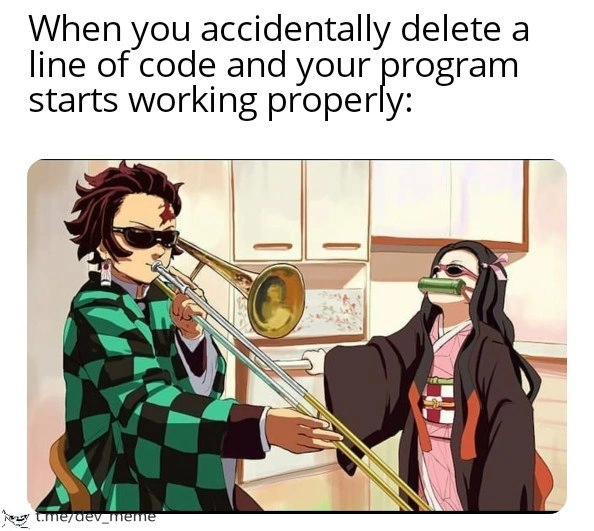
The picture with the boy blasting a trombone at the girl is a silly way to show this feeling. The boy making loud music all of a sudden is like the surprise of the quick fix, and the girl being calm is like the program quietly getting better. In simple terms, the meme is saying: Sometimes the best solution to a big problem is to remove just one little thing. It’s a happy surprise, and that’s why it makes developers laugh and share a knowing nod – they’ve all been in that situation where a puzzling problem had a surprisingly simple ending.

Level 2: Spaghetti Code Surprise

This meme is highlighting a surprise every programmer eventually encounters: you delete one line of code by accident, and suddenly your program starts working correctly. It feels almost magical the first time it happens. After all, when something is broken, we expect to add or change code to fix it, not remove code! Yet here we are – a bug was fixed by simply taking something away.

Why does this happen? The short answer is that the removed line was doing more harm than good. In a messy codebase (often nicknamed spaghetti code because it’s all tangled up like a bowl of spaghetti), one piece of code can unexpectedly affect another. For instance, that line might have been changing a value that other parts of the program use, causing confusion – this is what we call a side effect. A side effect is when a piece of code does something that isn’t obvious from its name or purpose, like secretly modifying a global variable or a shared setting. In well-structured code, you try to avoid spooky action at a distance (where one line here magically affects something way over there). But in spaghetti code, everything’s tangled, so a single stray line can indeed make the whole thing act weird.

Think of it this way: maybe that line set a flag that told the program “Hey, do the complicated error routine now,” even though everything was actually fine. Or perhaps it called a function twice by mistake, as in our example, meaning the second call messed up the result of the first. When you remove that wrong line, the chain reaction stops. The program goes back to doing what it was supposed to do. Problem solved! Accidentally stumbling on this fix is both amusing and a bit puzzling – you’re happy it works, but also thinking, “Why was that line there in the first place?!”. This is a sign of a code smell, which means there was something off in the code’s design (in this case, a line that shouldn’t have been there or was doing something weird).

There’s actually a term developers use for bugs that seem to change or disappear when you do something trivial: Heisenbug. It’s a play on the Heisenberg Uncertainty Principle from physics – the idea that the act of observing something can change it. In programming, a Heisenbug might vanish when you try to debug it, like when you add a print statement or run the program in a debugger. In our scenario, removing a line changed the program’s behavior enough that the bug went away. It’s like the bug was shy and ran off when we started messing around. Seasoned programmers joke about these because they can be really frustrating to pin down. You might hear a developer mutter, “Great, it’s a Heisenbug… the bug disappears when I need to show it to someone.” In our case, the unexpected_fix was deleting some code – a bit like tricking the bug into leaving.

Now, about the image: it uses an anime scene to dramatize this coding moment. The characters are from Demon Slayer, a popular Japanese anime. The boy in the green and black checkered robe is Tanjiro (the hero), and the girl with the bamboo muzzle is Nezuko (his sister, who happens to have demonic powers but is generally calm and kind). In the original context, Tanjiro isn’t actually a trombone player – this is a meme mashup – but here he’s shown blasting a golden trombone right at Nezuko. This trombone gag is an existing meme template (usually it’s just some random guy annoying a girl with loud trombone music). Developers love mixing pop culture with coding jokes, so they took this silly trombone scene and captioned it with our debugging scenario.

So what does it mean in meme terms? Tanjiro blasting the trombone = the developer’s wild action of deleting a line of code, done with enthusiasm but maybe a bit of absurdity. Nezuko standing there peacefully with her bamboo muzzle = the program now working properly (the “demon” bug is restrained and the app is calm) despite the craziness that just happened behind her. The contrast is what’s funny: something extreme or unexpected (trombone noise! deleting code!) leads to a calm, positive result (a happy, working program / a chill Nezuko). It’s an exaggeration of that baffled joy a developer feels. You’re almost suspicious about it – like Nezuko with her muzzle, the program isn’t explaining why it’s fixed now, it just quietly works, leaving the developer scratching their head in amusement.

For a junior developer or someone just learning to code, this meme is a lighthearted lesson. It teaches that sometimes the simplest bug fix is to remove the part that’s causing the problem, even if that part looked correct at first. It’s also a nod to improving CodeQuality: if deleting one line fixes everything, that line probably shouldn’t have been there. As you gain experience, you learn to identify these code smells and avoid them, but even pros get caught off-guard by a sneaky bug like this now and then. And when it happens, it’s definitely a relatable humor moment among programmers – we’ve all done the “I have no idea why that worked, but I’ll take it!” dance at least once.

Level 3: Ghost in the Code

In a chaotic codebase rife with hidden dependencies and spaghetti code, sometimes the most innocuous line can wreak havoc. Deleting that one ghostly line is like performing an exorcism on the program – poof, the mysterious bug vanishes. Seasoned developers have seen this horror movie before: the line you’d least suspect was introducing an unintended side effect or messing with a global state. Removing it miraculously fixes the issue, leaving everyone both relieved and a little unnerved. It feels like encountering a Heisenbug – one of those phantom bugs that disappear when you look directly at them (or in this case, disappear when you remove a seemingly unrelated piece of code).

Often that “ghost” line was doing something subtle but deadly. Perhaps it was an outdated initialization, a duplicate function call, or a flag set at the wrong time. Killing it stops a chain reaction of failures. For example, imagine we had this snippet lurking in the code:

processData(input);
// Ghost line: accidentally doing it twice causes an error
processData(input);  // Removing this duplicate call fixed the bug
finalizeOutput();

In this case, calling processData twice was a mistake (maybe left over from a bad copy-paste). Deleting the redundant call resolved the error. This kind of fix is basically an accidental refactoring – you improved the code by simply removing a bad piece, even if you weren’t sure at first why it helped.

At a senior level, this scenario is equal parts comedy and horror. You’re laughing because the app finally works (cue the “it’s not a bug, it’s a feature” jokes), but you’re also side-eyeing the codebase wondering what other ghost lines are hiding. The humor here taps into shared developer trauma: we’ve all experienced that debugging session where you change something trivial and the bug just… evaporates. There’s an unwritten rule in these moments: if all the tests pass at 3 AM after deleting the cursed line, you commit the fix and quietly back away before the bug returns.

Dev1: “I deleted that one line and now everything works.”
Dev2: “Wait… you removed code to fix the bug? What kind of black magic is this?!”
Dev1: “No clue why it worked, but I’m not complaining. Ship it before it changes its mind.”

The meme’s image brilliantly amplifies this feeling with absurd humor. It references the anime Demon Slayer: the boy in the green-checkered robe (Tanjiro) is enthusiastically blasting a golden trombone, and the girl with the bamboo muzzle (Nezuko) stands there calmly. It’s a wacky twist on a known meme template of someone obnoxiously doing something and another person unbothered. Here, the developer is like Tanjiro blowing away on that trombone – aggressively applying a crazy fix (deleting a line with gusto) – and the program is Nezuko, suddenly calm and issue-free now that the “demon” line of code is gone. The developer’s reaction is over-the-top joy (and a hint of WTF just happened?), while the program’s demons have been silenced by this unorthodox debugging outburst.

This all riffs on real CodingHumor and pain. It highlights a classic BugsInSoftware moment: the code was broken, logic was screeching like bad trombone music, until one tweak instantly turned cacophony into harmony. Developers find this hilarious because it’s so true to life. It underscores a key lesson that often code quality issues (like tightly coupled or poorly thought-out logic) lead to these “remove a strand and the knot finally untangles” outcomes. In theory, we strive for clean fixes and understanding the root cause; in practice, sometimes you literally fix a bug by just deleting a line and then go make yourself a very strong coffee, bewildered but happy.

Description

A meme featuring characters from the anime 'Demon Slayer' set in a kitchen-like environment. The top of the image has the text: 'When you accidentally delete a line of code and your program starts working properly:'. The image below shows the character Tanjiro Kamado, wearing his signature green and black checkered haori, sunglasses, and confidently playing a trombone. Beside him, his sister Nezuko Kamado, with her bamboo muzzle, looks on. A small watermark for 't.me/dev_meme' is visible in the bottom-left corner. The meme humorously captures the surreal and often baffling experience in programming where removing code, rather than adding or fixing it, inexplicably resolves a bug. This counter-intuitive moment of success is both a relief and a source of confusion. For senior developers, this is a relatable phenomenon that points to hidden dependencies, dead code with unforeseen side effects, or a complex issue that was accidentally simplified. The celebratory image of Tanjiro playing the trombone perfectly illustrates the feeling of 'don't question it, just commit and push.'
Comments

7
Anonymous ★ Top Pick That one line of code was the lynchpin of a bug I didn't know existed, holding the entire fragile system together with its sheer wrongness. Deleting it was like pulling the Jenga block that makes the tower stand straight
  1. Anonymous ★ Top Pick

    That one line of code was the lynchpin of a bug I didn't know existed, holding the entire fragile system together with its sheer wrongness. Deleting it was like pulling the Jenga block that makes the tower stand straight

  2. Anonymous

    Deleted one orphaned line, latency dropped 40 %, SLOs turned green, and now leadership thinks I’ve pioneered “negative-LOC optimization” - I just call it manual garbage collection

  3. Anonymous

    That moment when you realize the junior dev's "critical initialization logic" was actually a race condition factory, and now you have to pretend removing it was intentional during the post-mortem

  4. Anonymous

    The most satisfying debugging session is when you achieve a net-negative diff and the system suddenly works. It's the software equivalent of discovering your 'critical infrastructure' was actually just technical debt with a fancy title. Senior engineers know: sometimes the best code is the code you delete - especially when it turns out that mysterious helper function was actually a chaos monkey in disguise

  5. Anonymous

    Deleting that harmless logging line and watching the race disappear is the software equivalent of retracting the trombone slide and calling it performance tuning

  6. Anonymous

    The rare refactor where cyclomatic complexity drops and prod stability soars - no tests required

  7. Anonymous

    Accidentally deleted a line and everything worked; turns out the old “while(true) retry()” hotfix was our self‑inflicted DDoS

Use J and K for navigation