Skip to content
DevMeme
824 of 7435
The Internal Debate on Testing Critical Code
Testing Post #932, on Dec 25, 2019 in TG

The Internal Debate on Testing Critical Code

Why is this Testing meme funny?

Level 1: Works on My Machine

Imagine you’re building something really important, like a big LEGO castle 🏰 that your little brother is going to live in (let’s pretend!). If one piece of that castle breaks, the whole thing could fall down and make a huge mess. Now, common sense says you should probably check and test the castle to make sure it’s sturdy, right? Maybe gently push on the walls, or shake it a bit, to be sure it won’t collapse. But in this funny scenario, the builder’s brain is basically saying, “Eh, don’t bother testing it, just go ahead and let him move in!” It’s like a chef cooking a huge dinner and not tasting any of the food before serving it, or a student finishing a big project and not reviewing it at all before handing it in. It’s obviously a terrible idea not to check something so important, and that’s why it’s funny. The meme is joking that sometimes our brains can be lazy or overconfident and tell us to skip the important step of checking our work. Deep down we all know that if you don’t test something critical, you’re just hoping and praying nothing goes wrong — and hope isn’t a very good plan! So the humor comes from the silly image of a brain going “No tests needed!” when that’s the last thing you’d realistically do if you don’t want everything to crash and burn. In simple terms: it’s funny because the brain is doing the wrong thing on purpose, and everyone can see that’s bound to end in disaster (in a cartoonishly exaggerated way).

Level 2: But Did You Test It?

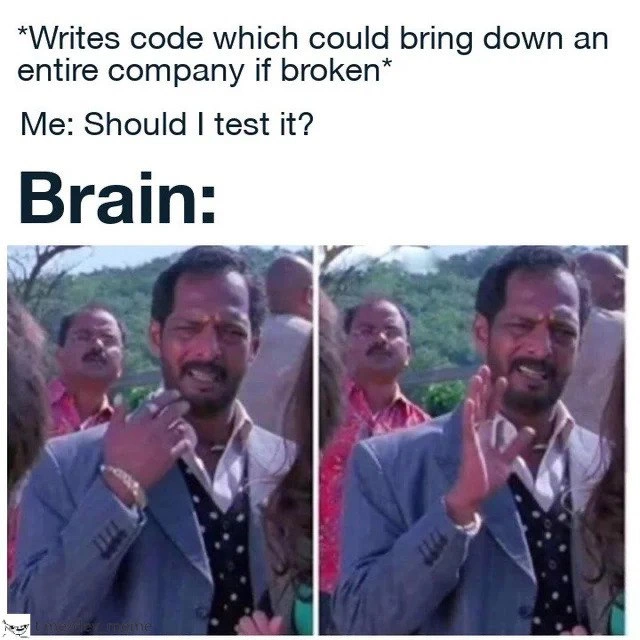
Let’s step back and explain the joke in simpler terms. This meme is highlighting the importance of testing code by showing a situation where someone completely ignores testing (to a ridiculous extreme). The text says the developer has written code so critical that if it’s wrong it could take down the company. We call that kind of code “mission-critical” – meaning it’s super important for the business or system. If mission-critical code breaks, you might get huge outages or losses. Testing such code isn’t just a good idea, it’s absolutely essential. So when the developer asks, “Should I test it?” and their Brain responds with a wordless hand-flip (basically saying “Nope!”), that’s the joke. It’s funny because it’s the exact opposite of what common sense (and every coding handbook) tells us. It’s a bit like a fireman asking “Should I put out the fire?” and his brain saying “Nah, let it burn.” 🔥

In real software development, when you write code — especially something high-risk — you always test it before releasing it to users. There are different kinds of tests:

  • Unit tests: these check small pieces of your code (individual functions or modules) to make sure they do the right thing.
  • Integration tests: these check that different parts of the system work together correctly (for example, does your code work when it talks to the database or another service).
  • Automated tests: usually part of a CI (Continuous Integration) system that runs your test suite every time you commit changes, to catch bugs early.
  • Sometimes, there’s also a QA (Quality Assurance) phase where human testers try to break the new code, or a staging environment which is like a safe copy of the product where you deploy the code first to see if everything’s okay before going to real users.

The meme implies all of these safety steps were just skipped. The phrase “Ship first, test never” in the title is a tongue-in-cheek way to describe a very reckless workflow. Normally, the motto is “Test first, then ship (deploy)”, but here it’s inverted. Skipping tests and directly shipping code is sometimes jokingly called “testing in production” – meaning you only find out if it works by seeing if the real system (production) breaks. That’s obviously not a great strategy, but it happens more than it should.

Why would anyone do that? In reality, no sane developer intentionally wants to skip tests for critical code, but sometimes people get overconfident or rushed. For example, maybe it’s late on Friday and the developer thinks “This change is small, I’m sure it won’t break anything. I’ll just deploy it quickly before the weekend.” This is what the meme refers to with that Friday-afternoon commit scenario. There’s even a bit of cultural folklore in tech: “Don’t deploy on Friday” is a common warning, because if something goes wrong, you might ruin your whole weekend trying to fix a live site with no teammates around. Here the meme’s character is exactly doing the opposite of that wisdom: not only deploying on Friday vibes, but also not testing at all. It’s a perfect storm of bad ideas that junior developers are warned about from day one.

Some terms in the meme might be unfamiliar, so let’s clarify:

  • Production (often just “prod”) is the live environment where the application or website runs for real users. If something breaks in production, actual customers are impacted.
  • Staging is a testing environment that mimics production but isn’t user-facing. It’s where you check things before they go live.
  • CI pipeline stands for Continuous Integration pipeline. This is an automated process that runs tests and other checks on your code whenever you push updates. For instance, if you use GitHub or GitLab, you might see a suite of tests run after each commit. If those tests fail, you typically don’t deploy the code until you fix the problems. It’s a safety net.
  • Code review is the practice where another developer reviews your code changes before they are merged, to catch mistakes or improve the code quality.
  • To “leapfrog CI, code review, and staging” means to bypass all these steps. In other words, the code went straight from the developer’s computer into production with no intermediate checks. 😱 That’s as wild as it sounds. Many teams make it actually hard or impossible to do this (requiring approvals, automated checks, etc.), but if someone is determined (or careless) enough, they might find a way. For example, a developer could push code with a special flag to skip the CI tests (some systems allow a commit message like [skip ci] to do that), or they might manually deploy a hotfix without going through the usual pipeline, especially if they have high access privileges.

The comedic image of the man flicking his hand is basically a visual representation of the brain saying “pfft, testing? not needed.” It’s the same energy as someone waving away a trivial matter — except here it’s anything but trivial. For a junior developer or someone new to coding, the meme is exaggerating to make a point: don’t ignore testing, especially not for critical code! The reason all the experienced folks find it funny is because it’s a hyperbole of a real temptation. Maybe you wrote some code that you think is simple, or you’re just so sure it’s gonna work because it’s similar to something you’ve done before. Your brain might whisper, “We can skip writing tests this time, it’s fine.” The meme takes that whisper and turns it into a loud, hilarious visual punchline.

Another aspect is the idea of DeveloperSelfDeprecation – developers making fun of themselves. The person in the meme (labeled "Me") knows that not testing is a bad idea, hence the very question “Should I test it?” They’re basically calling themselves out. The brain’s sassy “Nope!” gesture is the part of us that’s lazy or in a hurry. It represents that inner voice we have to fight against. When developers share this meme, they’re kind of admitting “Haha, sometimes I do hear this lazy thought in my head,” and by laughing at it, they remind themselves (and their peers) how silly and dangerous that thought is.

In summary, at this level, understand that testing is a crucial part of software development, especially for important (critical) code. The meme is funny because the brain is wrong here — it’s telling the developer not to test when that is obviously a terrible idea. It resonates with programmers because it’s an exaggerated reflection of a common mistake: being too eager to ship code and not spending enough time to verify it. This leads to Bugs and nasty Debugging sessions later. The categories like Testing, CodeQuality, Bugs, Debugging/Troubleshooting all come into play: skipping tests (Testing, CodeQuality) inevitably means more Bugs, which means you’ll be Debugging and troubleshooting those issues under pressure. The meme basically says: “I know I should test, but my brain sometimes just wants to ship it immediately” — and every developer nods and laughs because, yes, we’ve all had that feeling, even though we know better!

Level 3: Deploy and Pray

At the top of this meme, we see a developer admitting they just wrote mission-critical code — the kind of change so important that if it fails, it might bring down the whole company. 👉 In an ideal world, this is when every alarm bell in a senior engineer’s head screams “Test it thoroughly!” But the joke here is that the developer’s Brain has a very different idea. The meme text says:
Me: Should I test it?
Brain:” (followed by an image of a man in a suit flicking his hand dismissively).
Essentially, the brain’s default response is a cocky hand-wave saying, “Nah, skip it.” This is the epitome of what jaded developers grimly nickname “deploy and pray”: you ship the code first and pray nothing breaks. It’s the exact opposite of diligent Testing and CodeQuality best practices, which is why it’s both funny and horrifying to experienced engineers.

Why is this combination of elements so comical to a seasoned dev? Because we’ve all seen this movie before (sometimes literally at 5 PM on a Friday). The meme perfectly captures that forbidden urge to cut corners. Writing code that could break everything and then casually deciding not to test it is a recipe for a late-night disaster. It satirizes a deep truth: despite all our SDLC safeguards (code reviews, CI pipelines, QA stages), sometimes a developer’s overconfidence or deadline-induced panic leads them to temporarily lose their mind. The image from the Bollywood movie shows a character waving off a thought — that’s the Brain effectively saying, “Testing? Who needs testing?” in a smug, dismissive gesture. For any engineer who’s been on-call, that hand flick might as well be the harbinger of an after-hours production bug frenzy. It’s dark humor born from real pain.

In real software development, especially with mission-critical code, there’s a whole safety net to prevent catastrophe. Normally you’d have: peer code review (someone else double-checks your work), a battery of unit tests and integration tests (to catch bugs in individual modules and their interactions), a CI/CD pipeline that automatically runs those tests, perhaps a staging environment to deploy and verify the change, and only then do you release to production (the live system). But here, the meme shows a brain that short-circuits all those steps. It’s a systemic failure in one cheeky snapshot. The developer’s thought process leaps straight from “code complete” to “🚀 ship it now,” bypassing every safeguard. This is an SDLC short-circuit of the worst kind. Seasoned devs find it funny because it’s so outrageously reckless — and yet, it triggers flashbacks of times when something like this actually happened. (As the saying goes in DeveloperHumor circles, “Works in dev, YOLO to prod!” 😅)

Let’s break down the anti-pattern this meme is mocking. It’s essentially a twisted deployment checklist from the underworld:

  1. Write a change that is extremely critical (the kind that could blow up the system if it goes wrong).
  2. Skip writing any new tests for it (why waste time, right?).
  3. Ignore running existing test suites or static analysis. In fact, maybe add --no-verify or [ci skip] to your commit to bypass the CI pipeline entirely.
  4. Merge to master or deploy directly to production on a Friday afternoon. Because if you’re gonna live dangerously, do it when everyone else has logged off for the weekend.
  5. Deploy and… now just pray that everything somehow magically works in prod.
  6. If (when) things explode, debug furiously in real-time on live servers while customers or users are screaming. (Bonus: your brain now goes “I probably should have tested that, huh?”)

This cheeky list is basically what not to do in real life, but the fact it’s recognizable is what makes the meme hit home. Every senior engineer reading it can practically hear the pager buzzing or see the Slack on-call channel lighting up. The humor comes from that shared, cringe-worthy familiarity: “I know exactly how this story ends.” We laugh (perhaps a bit bitterly) because we’ve learned the hard way that skipping tests on critical code leads to nights of frantic DebuggingAndTroubleshooting. As one of those battle-scarred veterans might quip: “Ask me how I know.” 😩

It also pokes fun at the DeveloperSelfDeprecation we often indulge in. The person in the meme (the “Me”) is essentially making fun of themselves — acknowledging that their own brain can be ridiculously irresponsible. It’s like the inner voice that should promote caution instead becomes an agent of chaos. There’s an ironic role-reversal: our brain, which we rely on for rational decisions, is shown as the instigator of a terribly dumb idea. In reality, no developer would openly admit “test never” as a philosophy, but we joke about it precisely because it is a taboo impulse. It’s a bit of gallows humor about our own bad habits or momentary lapses in judgment.

From an industry perspective, this meme touches on why testing and quality processes exist in the first place. BugsInSoftware have real consequences: downtime, data loss, upset customers, lost revenue. A production bug in mission-critical code can literally, as the meme says, “bring down an entire company.” The seasoned perspective recognizes that this “Ship first, test never” mentality is how you get legendary outage stories. (Think of incidents like a single unchecked code change causing a massive service outage — yes, those have happened in real life!). Senior engineers chuckle at the meme, but also wince, because it reminds them of all the post-mortems they’ve read or written. The meme is basically a cautionary tale wrapped in humor: if you skip tests, you’re courting disaster.

In summary, the humor lands so well with experienced devs because it’s TestingHumor turned up to eleven — an absurd exaggeration with a core of truth. The juxtaposition is perfect: the more important the code, the more insane it is not to test it. Yet the meme shows exactly that happening. It’s funny in the way that you laugh when something is so wrong it hurts. We’ve all had that lazy or overconfident little voice in our heads whisper “It’s fine, just deploy it,” and we’ve either smacked it down with discipline… or given in and then debugged all night. This meme immortalizes that internal struggle (and failure) in one image. Bottom line: it’s hilariously relatable to anyone who’s been burned by untested code. You’re laughing at the joke, and laughing at your past self for ever thinking like the guy in the picture. Lesson learned (until the next time the brain says “YOLO” again). 😉

// Brain's decision-making in pseudo-code:
function shouldTest(change) {
    if (change.isMissionCritical()) {
        // Brain says: "This is too important... let's NOT test it!"
        return false;
    }
    return true;
}

(Above: The ironic logic our brain uses in this meme — exactly the opposite of what it should do.)

Description

A two-panel meme format illustrating a developer's internal conflict. At the top, white text on a plain background reads: '*Writes code which could bring down an entire company if broken*'. Below this, 'Me: Should I test it?'. A bold heading 'Brain:' precedes the two image panels below. The first panel shows a man with a mustache and a patterned vest under a blazer, looking distressed and touching his chin in worried thought. The second panel shows the same man, now with a confident and dismissive expression, making a circular 'OK' or 'perfect' hand gesture. This meme humorously depicts the cognitive dissonance developers face when dealing with high-stakes code. It highlights the internal struggle between the rational need for thorough testing and the tempting, risky impulse to skip it and deploy directly. The humor is relatable to experienced engineers who understand that while comprehensive testing is non-negotiable for critical systems, the temptation to take a shortcut is a universal, albeit dangerous, thought

Comments

7
Anonymous ★ Top Pick My brain's test coverage report for critical features is just a single, unchecked box labeled 'Pray'
  1. Anonymous ★ Top Pick

    My brain's test coverage report for critical features is just a single, unchecked box labeled 'Pray'

  2. Anonymous

    Somewhere an SRE just felt a disturbance in the force - your commit skipped staging and their pager pre-acknowledged the incident

  3. Anonymous

    After 20 years in the industry, you learn that the code most likely to bring down production is always the 'simple one-line fix' you deployed on Friday at 4:59 PM without tests because 'what could possibly go wrong with changing this boolean?'

  4. Anonymous

    The classic developer's internal monologue: 'This authentication bypass could expose millions of user records... but the PR is already approved and it's 4:45 PM on Friday. Ship it.' We've all been that person who writes a database migration that could corrupt years of financial data, then convinces ourselves that our mental model of the system is sufficient QA. The real tragedy? This meme hits hardest for those of us who've actually been paged at 3 AM because we trusted our brain's dismissive hand gesture over a proper test suite

  5. Anonymous

    Brain’s deployment plan: skip tests, set the canary to 100%, and use the error budget as our integration environment

  6. Anonymous

    Brain's CI/CD: commit straight to prod, because writing tests is for architects who haven't seen a 3AM postmortem yet

  7. Anonymous

    Brain says 'CI_SKIP'; SRE says 'blast-radius, canary, rollback' - ship the former and your error budget becomes your overtime

Use J and K for navigation