The Entry-Level Internship Paradox
Why is this Career HR meme funny?
Level 1: The Time-Travel Job Ad
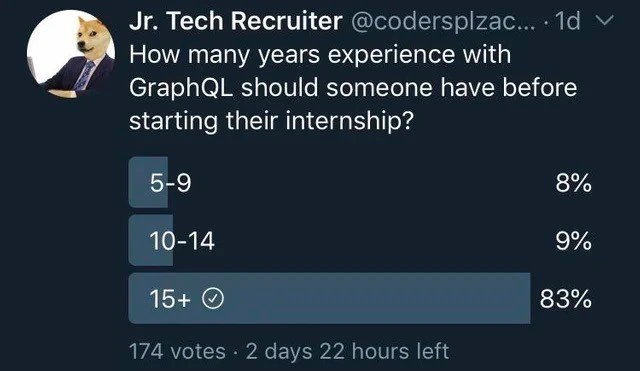
Imagine a poster on a bakery window: "Hiring beginner baker. Must have 15 years of experience baking a cake that was invented 4 years ago." The funny part isn't just that it's demanding — it's that it's impossible. Nobody on Earth, including the cake's inventor, has baked it for 15 years, because the cake hasn't existed that long. The picture shows a pretend job recruiter (with a dog in a suit as their photo, which tells you how seriously to take them) asking the internet how impossible the demand should be — and the internet, as a joke, votes overwhelmingly for "the most impossible option, please." It's funny because everyone who has ever looked for a first job has met this exact poster: wanted — beginner, with a lifetime of experience.
Level 2: Decoding the Poll
- GraphQL: a query language for APIs, created at Facebook and released publicly in 2015. Instead of calling many fixed endpoints (REST style), the client asks for exactly the data shape it wants in one request. Trendy, genuinely useful, and — relevantly — young.
- Internship: the rung below entry level. The whole point is that you arrive with little experience and leave with some. Requiring veteran-level experience for it is like requiring a driver's license to take your first driving lesson.
- Years of experience (YoE): recruiting's favorite proxy for skill, beloved because it's easy to count and despised because it measures calendar time, not competence. Three focused years can beat ten repetitive ones; no checkbox captures that.
- Twitter poll satire: the format here — fake account, absurd question, landslide vote for the most absurd option — is how dev Twitter processes collective grievances. The 83% is the community voting for the bit.
Practical takeaway for anyone job-hunting early in their career: when you see impossible requirements, the error is theirs, not yours. Listings are written by committees and cloned from templates. Treat "requirements" as "things they'd be pleasantly surprised by" and apply.
Level 3: Temporal Impossibility as Hiring Policy
"How many years experience with GraphQL should someone have before starting their internship?" 15+ ✓ — 83%
Every detail of this fake poll is load-bearing satire. The handle is Jr. Tech Recruiter — junior, because gatekeeping the entry level is itself an entry-level job. The avatar is Doge in a business suit, the internet's universal symbol for confident incompetence wearing professional clothing. The checkmark shows the poster voted for "15+" themselves — the recruiter isn't bound by the poll, they're leading the witness. And the punchline is arithmetic: GraphQL was open-sourced by Facebook in 2015. At the time this meme circulated in early 2019, the maximum physically attainable experience was about three and a half years — and that ceiling was occupied by roughly a dozen people, all of whom worked at Facebook and none of whom were applying for your internship.
The joke is a barely exaggerated version of real postings. The genre's greatest verified hit: a job ad demanding more years of FastAPI experience than FastAPI had existed, prompting the framework's own creator to note publicly that he didn't qualify. Swift, Kubernetes, and React all got the same treatment in their youth. The years-of-experience paradox is so reliable it functions as a tech-adoption metric — you know a technology has gone mainstream when recruiters start requiring it for longer than its own lifetime.
Why does this keep happening? The systemic machinery, in order of culpability:
- Telephone-game requirements: a hiring manager says "we use GraphQL"; by the time it traverses HR templates and keyword-matching ATS software, it's "15+ years GraphQL required." Nobody in the chain can sanity-check it because nobody in the chain knows what GraphQL is.
- Copy-paste inflation: job posts are forked from older job posts like everything else in this industry, inheriting "10+ years required" from a Java listing the way legacy code inherits global variables.
- The kingdom-for-a-peasant's-wage gambit: "intern with senior requirements" is sometimes not an accident — it's an attempt to acquire senior labor at internship prices, with "experience required" doing the work that "salary offered" should.
- Defensive over-specification: requirements as a moat against the application flood, even though the moat filters for willingness to ignore requirements rather than competence — which is why every senior eventually tells every junior the same secret: the requirements are a wishlist, apply anyway.
The cruelty being satirized is real, though: entry-level postings demanding years of professional experience are the industry's most public catch-22, and they land hardest on exactly the people — interns, juniors, career-changers — least equipped to know the listing is fiction.
Description
A screenshot of a Twitter poll posted by an account named 'Jr. Tech Recruiter' which has a Doge in a suit as its profile picture. The poll sarcastically asks, 'How many years experience with GraphQL should someone have before starting their internship?'. The options are '5-9 years' (8% of the vote), '10-14 years' (9%), and '15+ years', which has overwhelmingly won with 83% of the 174 votes. The humor is a sharp critique of the unrealistic and often impossible experience requirements listed in job descriptions, especially for junior and intern roles. The joke is layered because GraphQL was only publicly released in 2015, making it impossible for anyone to have '15+' years of experience at the time the tweet was posted. This resonates deeply with senior developers who have witnessed this trend of 'experience inflation' and the disconnect between HR/recruiters and the actual technology landscape
Comments
8Comment deleted
Some job posts ask for 10 years of experience in a 5-year-old framework. I assume the other 5 years are for the emotional damage of dealing with recruiters who write those posts
Given GraphQL is barely eight years old, the only way to hit 15+ years experience is if your version control supports commits to 2010 - maybe try ‘git checkout --timeline-of-requirements.’
Somewhere there's a time traveler who went back to 2009 just to learn GraphQL early enough to qualify for this internship, only to discover they also need 10 years of Kubernetes experience from 2014
15+ years of GraphQL experience means the ideal intern wrote the spec before Facebook did - a strong-consistency requirement from an eventually-consistent recruiter
Ah yes, the classic recruiter paradox: requiring 15+ years of GraphQL experience for an internship when GraphQL was open-sourced in 2015. By this logic, the ideal intern candidate would have started using GraphQL in kindergarten - presumably while also mastering REST APIs during naptime and implementing microservices architecture with building blocks. It's the tech industry's version of demanding time travel capabilities, except instead of a DeLorean, you need a resume that violates the fundamental laws of causality. At least they're being transparent about wanting to hire Lee Byron himself for an unpaid summer position
If your ATS query is years_graphql >= 15 for an internship, the resolver should throw NotFound('GraphQL launched 2015') - not return 'talent shortage'
15+ years GraphQL for interns? That's when you finally N+1 your way to schema enlightenment - good luck sourcing those COBOL resolvers
An internship demanding 15+ years of GraphQL is the ultimate schema mismatch: the ATS validates years ≥ 15 while reality’s GraphQL.age() < 10, so only the folks who wrote the spec pass