Skip to content
DevMeme
2935 of 7435
Some Devs Just Want to Watch the Build Burn
BuildSystems CICD Post #3242, on Jun 14, 2021 in TG

Some Devs Just Want to Watch the Build Burn

Why is this BuildSystems CICD meme funny?

Level 1: Pretending It's Fine

Imagine you’re at home and the smoke alarm starts blaring because something is burning in the kitchen. There’s smoke everywhere – clearly a fire is starting. 😱 You would normally drop whatever you’re doing and go fix the problem, right? Now picture this: instead of fixing it, your older brother just shrugs, smiles, and continues playing video games like nothing’s wrong. He even goes and makes a sandwich while the toaster is literally on fire.

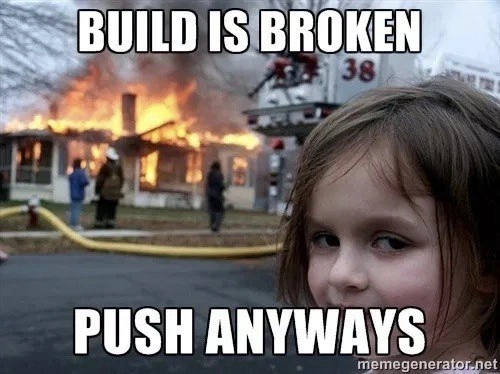
That’s exactly the kind of silly situation this meme is joking about, but in a coding world. The "house on fire" in the picture is like a big warning that something is very wrong. The calm little girl in front is like a person who ignores the big warning and carries on as if everything’s okay. In real life, if someone did that during a fire, it would be ridiculously irresponsible (and pretty funny in a dark way, once everyone was safe).

So the meme is funny because it shows someone acting super calm and mischievous while something very important is going very wrong in the background. It’s like a student in class casually coloring a drawing while the rest of the class is evacuating for a fire drill. The words “BUILD IS BROKEN, PUSH ANYWAY” are a tech way of saying “there’s a big problem, but I’m going to ignore it and do what I want.” It’s the opposite of what we know we should do – and that unexpected bad behavior is what makes people laugh (and shake their heads!).

In simple terms: the picture is making a joke about ignoring warnings. Just like you wouldn’t ignore a fire alarm in your house, developers shouldn’t ignore major warnings in their projects. Seeing someone do so – especially with a little smirk – is both funny and absurd. It’s a reminder that saying "Everything is fine 😇" while the room is actually on fire is a recipe for disaster... and also a pretty good punchline for those who understand the situation.

Level 2: Ignoring Red Flags

Let’s step back and explain what’s going on in simpler terms. This meme is poking fun at developers who ignore a very obvious warning in their workflow. In software development, Continuous Integration (CI) is the practice of automatically building and testing your code every time you commit changes. Think of it like an alarm system for your code: if something goes wrong – say a test fails or the code doesn't compile – the CI system alerts everyone by marking the build as failed (often shown as a big red status). We often call this "the build is broken" when that happens. It’s the software equivalent of a red light or a fire alarm: a signal to STOP 🛑 because there’s a problem that needs fixing.

Now, good teams treat a broken build very seriously. Ideally, when the build pipeline turns red, developers should pause adding new code and first fix the underlying issue. It's a core part of DevOps culture to keep the build pipeline healthy (green). In fact, many teams have a rule: “No pushing new code to the main branch if the build is red.” Why? Because if you keep piling new changes on top of a broken foundation, it becomes much harder to figure out what went wrong. It’s like trying to fix a car engine while people keep tossing more parts into it – chaos!

The meme uses the famous "Disaster Girl" photo to dramatize this. In that picture, a young girl is looking at the camera with a sly, calm smile while a house behind her is on fire. Internet lore jokingly imagines that she might have had something to do with the fire (she didn’t in reality – it was just a chance photo during a controlled fire). This image has become a popular meme template to imply “I caused a disaster, and I’m pleased with myself” or “I’m calmly watching the world burn.” It’s a cheeky way to assign blame or highlight someone being mischievously calm in a crisis.

Now, in our developer meme, the burning house represents the broken CI build (everything is failing, flames everywhere figuratively), and the little girl represents the developer who continues to commit code as if nothing is wrong. The top text "BUILD IS BROKEN" is basically saying "the code integration tests are failing, everything is on fire". The bottom text "PUSH ANYWAY" translates to "I'm going to push my code changes to the repository regardless." So the whole meme is essentially a joke: the developer knows the build is busted but pushes new code anyway, which is widely regarded as bad practice.

Let’s clarify some terms from the tags and context:

  • Build System / Build Pipeline: This is the series of automated steps that run whenever new code is integrated. For example, compile the program, run the test suite, maybe package the application. Tools like Jenkins, Travis CI, or GitHub Actions orchestrate these steps. If any step fails (like a test fails or a compile error happens), the pipeline flags the build as failed.
  • Continuous Integration (CI): The practice of merging code changes frequently and automatically testing each change. CI servers will give feedback (pass/fail) for each code push. A green build (✅ pass) means all tests passed; a red build (❌ fail) means something broke.
  • Build is broken (or broken_ci as tagged): This means the latest integrated code did not pass all tests or checks. It’s a red alert for developers.
  • Push anyway: "Push" means to send your local code changes to the central repository (e.g., using git push). Saying someone pushes anyway in this context means they went ahead with that git push even though they knew the build was currently failing. It implies knowingly ignoring the problem.
  • DevOps/SRE: These are roles/practices around ensuring software runs reliably from development through operations. SREs (Site Reliability Engineers) and DevOps folks are typically very concerned with things like CI stability, deployment safety, and not letting known issues slide. So from a DevOps perspective, pushing on a broken build is almost sacrilegious – it’s considered an irresponsible deployment habit.

Picture a real-world scenario for a junior developer: You commit some code changes and push them to, say, GitHub. Immediately, your project’s CI tool kicks in. Maybe you see on your project’s page a yellow dot turning into a red X after a few minutes. That red X means "Tests failed!" Perhaps a unit test found a bug in your code. Normally, you’d stop and say, "Oops, I need to fix that bug or test and then push again." Now, imagine instead someone says, "Eh, just merge it anyway, we’ll deal with it later." That would probably make you uneasy, right? Because now the main codebase has a known problem in it. This is exactly the uneasy, something’s not right feeling the meme is highlighting, but it does so with humor by comparing it to a child ignoring a house fire.

The line “BUILD IS BROKEN – PUSH ANYWAY” is deliberately outrageous because it’s the opposite of what you’re taught. It resonates with developers because unfortunately, it happens. Maybe a deadline is looming or a team has a poor discipline, so they keep committing new code even though yesterday’s commit broke the tests. Each new push on a red build is like ignoring one more red flag. Those red flags (failing tests, error logs) are important; ignoring them tends to snowball problems.

In the image, notice also the firefighters and the fire truck (with the number 38 on it) in the background trying to douse the flames. They represent the people or processes attempting to fix the broken build. It could be the CI system itself retrying tests or teammates scrambling to troubleshoot. Meanwhile, the developer (Disaster Girl) is calm and even smiling, almost as if saying "Heh, look at that fire... anyway, back to my code push." This contrast is what sells the humor: the absurd calmness in the face of an obvious emergency.

For someone new to this field, the meme is essentially a cautionary joke. It’s saying: Don’t be that developer! Don’t ignore a failing ContinuousIntegration build. The tags like build_is_broken and push_anyway capture this scenario succinctly. Within dev teams, if someone mentions "Don’t push on a broken build," they mean you should resolve the failure first. Pushing anyway is seen as cutting corners, and it can create a lot of extra work:

  • Other developers may pull the latest code and now their environment is broken too, slowing everyone down.
  • The failure that was small can turn into multiple failures because new changes compound the issue (like adding more weight to a collapsing bridge).
  • If this code gets deployed to a production environment without proper testing, it could cause real downtime or bugs for users – the ultimate “fire” that everyone wants to avoid.

The meme exaggerates the situation to make us laugh and cringe at the same time. Developers share such memes as a form of DeveloperHumor – it’s a way to poke fun at our own bad habits or those of our coworkers. It’s funny because we know better, yet many of us have seen someone do this. The DevOpsHumor angle comes from that cultural tension: developers are supposed to care about build status, but when they don’t, it’s the ops teams that often have to clean up the mess (hence the firefighters in the image).

So, at this level, just understand: a broken build is a serious warning in coding, and the joke here is that someone is completely ignoring that warning. The meme uses an infamous image (little girl + burning house) to symbolize how wrong and cheeky that is. It’s highlighting a common DeveloperPainPoint and a bit of office satire: sometimes our teammates act like nothing's wrong even when everything is on fire. Seasoned devs find it funny because it's an extreme caricature of a real issue – and juniors can learn the underlying lesson: don’t push code when the build is red, or you’ll become the “disaster” in Disaster Girl.

Level 3: Pipeline Pyromania

In this meme, an entire CI/CD pipeline is metaphorically ablaze while a developer cheerfully continues to add fuel. The top caption "BUILD IS BROKEN" means the continuous integration build has failed – tests are red, something in the code doesn't compile or a critical check didn’t pass. The bottom caption "PUSH ANYWAY" implies our intrepid developer blithely commits code regardless. Seasoned engineers recognize this as a classic BuildFailure scenario turned up to 11. It’s darkly funny because it highlights an anti-pattern we've all witnessed: ignoring the big red alarm in a BuildPipeline and proceeding as if all is well.

For experienced devs and DevOps folks, this image triggers equal parts laughter and PTSD. We know that a broken build should be treated like a five-alarm fire in production. Best practices (and basic sanity) dictate that when Continuous Integration (CI) tests fail, you stop everything to fix the issue before merging more code. But here, the developer – represented by the smirking Disaster Girl – does the exact opposite. It's a scenario of CI collapse meets willful ignorance. We chuckle because it's so wrong that it's painfully relatable. As the codebase burns (with failing tests and errors), this dev is essentially saying "Whatever, I'm merging my code. YOLO."

Why is this so humorous to veteran engineers? Because it satirizes a real cultural issue in software teams: CI/CD hygiene (or lack thereof). Many of us have seen what happens when someone keeps pushing commits on top of a broken build: it’s like pouring gasoline on a fire. The meme exaggerates it as a literal house fire with a mischievous culprit. In real life, that culprit is often time pressure or sloppy process. A senior dev reading this instantly recalls those 5 PM Friday deploys where someone said "It’s probably a flaky test, let's push anyway" – famous last words before an all-night debugging session. The DevOps/SRE perspective here is basically a nightmare: the pipeline's on fire, and someone is actively fanning the flames by adding new changes. No wonder the firefighters (the CI system or the poor build engineers) can’t get things under control.

Let's break down the elements of the joke from a senior viewpoint:

  • Disaster Girl analogy: The iconic photo shows a little girl smirking while a house burns down behind her. In our context, the house on fire is the broken CI system (failing builds), and the smirking developer is oddly at peace with the chaos. It hints that maybe the dev caused the break (like committing buggy code) and is now grinning while everyone else scrambles to fix it. It's a darkly comic take on irresponsible behavior.
  • "BUILD IS BROKEN" = Serious alert: In any continuous integration setup (Jenkins, Travis CI, GitLab CI, etc.), a broken build (red status) is a big deal. It means something in the recent commits doesn't work. Proper protocol says stop and fix. A broken build is essentially a system screaming for attention – like a blaring siren that code integration has failed.
  • "PUSH ANYWAY" = Ignoring the alert: This is the punchline. Pushing code to the repository despite a failing build is almost heresy to a seasoned developer. It violates the unspoken agreement that red means stop. The humor comes from that reckless disregard. It's like the meme is saying, "CI is on fire? Meh, just commit more changes!".

A veteran engineer will likely nod and sigh, having lived through the fallout of this attitude. They might remember how one broken test, if ignored, leads to a pile of broken tests. There’s even a concept in software quality known as the “broken windows theory”: if you allow one window (or test) to stay broken, people start caring less about other breaks. In CI terms, once folks start ignoring a red build, the entire build process loses credibility. Pretty soon, the team can’t trust the pipeline’s feedback at all, and deployments become a game of Russian roulette. The meme nails this irony by showing someone literally smiling in front of a burning breakdown.

To give a concrete picture, imagine a continuous integration server (say Jenkins) flashing red on build number 38. Logs are scrolling with failures and stack traces. For example:

----------------------------------------------
Jenkins CI - Build #38 **FAILED** 🚨 
----------------------------------------------
Errors: 5, Failures: 3, Skipped: 2
>> TestSuite: PaymentServiceTest ⚠️ 
   - testProcessPayment: AssertionError: expected true but was false
   - testRefundPayment: NullPointerException
>> TestSuite: NotificationServiceTest ⚠️ 
   - testSendEmail: TimeoutException
...

This is the software equivalent of flames billowing out the windows. A responsible dev would drop everything to investigate. But the developer in the meme? They see that build #38 failed and still run:

git add .
git commit -m "Quick tweak - it'll fix itself"
git push origin main --no-verify   # 😬 Pushing changes despite the failing tests

Here --no-verify is that cheeky flag to bypass any pre-push hooks that might stop you. It's like ignoring the safety checks. The comment is basically "I know the tests are failing, but let's pretend they're not."

So why do experienced devs find this both funny and painfully familiar? Because they've seen colleagues (or occasionally themselves, if we're honest) push anyway with all sorts of rationalizations:

  • "It was failing before my changes, so it's not my problem."
  • "Probably a flaky test. We really need to get this feature in."
  • "We’ll fix the pipeline later, but the release can’t wait."
  • "Works on my machine™, so the CI must be wrong."

Each of these excuses is like the child grinning at the fire – an almost innocent audacity. And each excuse often leads to more firefighting down the line. The senior perspective recognizes the systemic issues: maybe management is pushing hard deadlines (so devs feel pressured to ignore tests), or maybe the team lacks discipline in maintaining tests (so red builds become background noise). Either way, the result is technical debt and late-night emergency fixes. The meme’s dark humor comes from exaggerating this habit as literal arson: the dev isn’t just ignoring the fire, they’re practically enjoying it.

Culturally, this points to a breakdown in DevOps practices. Continuous Integration was invented to avoid "integration hell" – where untested code piles up and breaks all at once. In the early 2000s, thought leaders like Martin Fowler stressed: “Always fix broken builds immediately.” Many teams adopt a rule that if the build breaks, no one pushes new code until it's green again. The meme text "PUSH ANYWAY" flips that on its head with a sardonic wink. It's basically showing a developer doing exactly what you're NOT supposed to do, and acting smug about it.

From a Site Reliability Engineer (SRE) or on-call engineer viewpoint, this scenario is terrifyingly real. If new code is continuously merged on a broken foundation, it could slip through to production and cause real outages. The firefighters in the image represent those engineers frantic to contain the damage. Meanwhile, the dev (the little girl) stands by with that “I regret nothing” smirk. The humor is laced with pain: someone has been that firefighter at 3 AM, muttering about how this all could have been avoided if we'd just respected the CI fails.

In summary, at the senior level this meme lands because it captures a well-known DeveloperPainPoint: poor BuildProcess discipline. It’s a tongue-in-cheek reminder that Continuous Integration is only effective if you actually pay attention to it. The disaster imagery underscores the severity – a broken CI is like a house burning down – and the calm child represents the absurdity (or hubris) of ignoring it. As a cynical veteran might quip: "Some devs just want to watch the pipeline burn." 🔥

Description

This meme uses the iconic 'Disaster Girl' template, which features a young girl with a subtle, mischievous smirk looking towards the camera while a house burns in the background. Firefighters and a fire truck are visible, attending to the blaze. The image is captioned with bold, white text: 'BUILD IS BROKEN' at the top, and 'PUSH ANYWAYS' at the bottom. The meme humorously captures a moment of ultimate developer malpractice or nihilism. A 'broken build' signifies that the code fails fundamental checks and cannot be compiled or integrated, effectively halting development for everyone. To 'push anyways' is to knowingly merge this faulty code into the main repository, an act of sabotage that can bring down testing environments or even production. The girl's expression perfectly embodies the attitude of a developer who, due to burnout, pressure, or sheer recklessness, decides to commit chaos
Comments

10
Anonymous ★ Top Pick A junior dev breaks the build and panics. A senior dev breaks the build, blames a race condition in the CI runner, and pushes anyway
  1. Anonymous ★ Top Pick

    A junior dev breaks the build and panics. A senior dev breaks the build, blames a race condition in the CI runner, and pushes anyway

  2. Anonymous

    Around here we call merging on a red pipeline “unscheduled chaos engineering” - legal says rebranding is cheaper than fixing the tests

  3. Anonymous

    After 15 years in the industry, you realize the real continuous integration is continuously integrating hotfixes into production while the original fix is still being debugged in staging

  4. Anonymous

    When your CI/CD pipeline is red but the sprint ends in 10 minutes and the PM is breathing down your neck about that 'critical feature' - so you add '--no-verify' to your git hooks, force push to main, and walk away whistling. The PagerDuty alerts can wait until Monday. After all, it's not a production incident if you're not on-call when it happens

  5. Anonymous

    Red build? That's CI's way of saying 'prod needs excitement' - ship it for the blameless postmortem

  6. Anonymous

    Red pipeline? That’s our org’s feature flag for cowboy mode - git push --no-verify and let SRE practice rollback-driven development at 2am

  7. Anonymous

    Build is broken? Push anyway - trunk-based development where observability is QA and the pager is your linter

  8. @clockware 5y

    Well, why not?) My commit most likely is not gonna make it any worse :)

  9. @azizhakberdiev 5y

    That's why it is told to do not push without testing

  10. Deleted Account 5y

    Don't care just push it

Use J and K for navigation