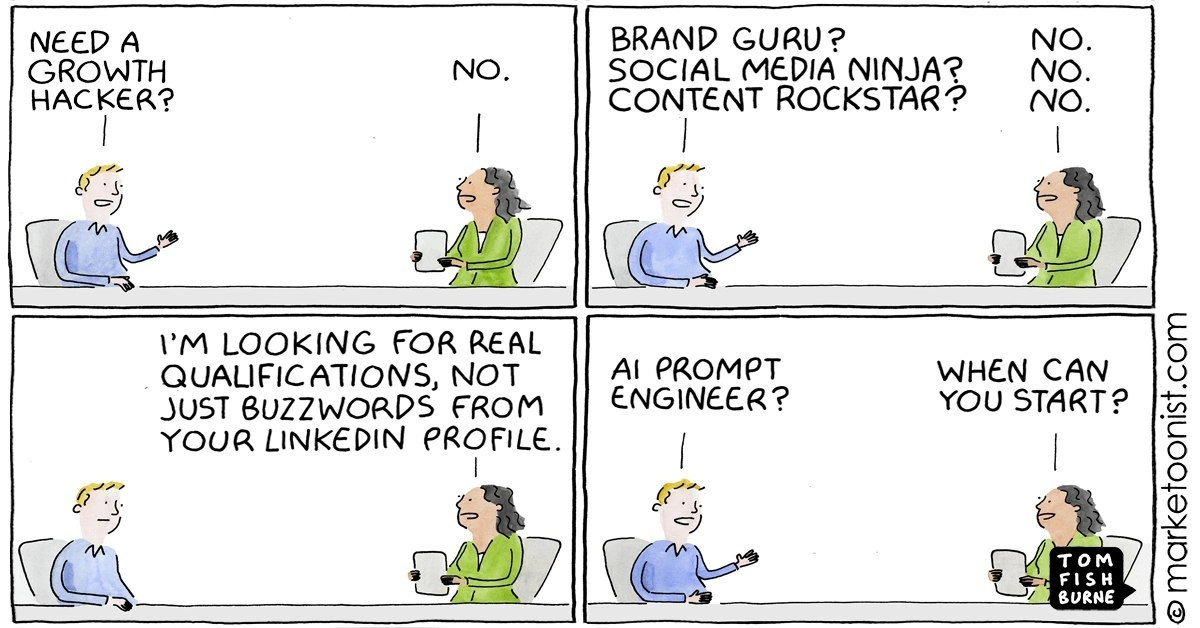
Interviewer dismisses LinkedIn buzzwords - except the trendy 'AI prompt engineer' title
Why is this Career HR meme funny?
Level 1: Shiny New Toy
Imagine you’re showing your collection of toys to a friend. You pick up one toy after another, saying, “How about this cool action figure? Or this ninja turtle? Maybe this rockstar doll?” But your friend just shakes their head each time, not interested. Finally, you mention the newest, most popular toy that just came out – say, a fancy AI robot that everyone’s talking about. Suddenly, your friend’s eyes go wide and they exclaim, “Ooh! When can I play with that one?!”
This meme is like that story, but with job titles in a job interview. The interviewer is like the picky friend who wasn’t impressed by the older “cool” titles (growth hacker, ninja, rockstar – those were yesterday’s trendy toys). They even say they only care about real skills, not fancy names. But the moment the candidate says the latest buzzword – AI Prompt Engineer – the interviewer gets excited and can’t wait to have them. It’s funny because it shows how people claim they don’t like buzzwords or fads, yet they often can’t resist the newest shiny thing. In simple terms, the joke is about chasing trends: all the old fancy titles are like last year’s toys (now not so special), and the new AI title is the hot toy everyone wants to grab. The cartoon makes us laugh at how quickly the interviewer changes tune when the new popular term pops up. It’s a playful reminder that even grown-ups in tech can be a bit like kids who want the latest toy on the shelf, even if they said they’re done with toys a minute ago.
Level 2: Decoding Buzzwords
If you’re newer to the tech world or just started browsing job listings, some of these titles might sound confusing or even silly. Let’s break down what each of these buzzword job titles actually means in plain terms, and why people use them:
Growth Hacker – This is basically a creative marketing specialist focused on growth (usually user growth or sales). Instead of a traditional “Marketing Manager” title, startups began saying growth hacker to imply someone who uses clever, often low-budget tactics and experiments (like a hacker) to quickly grow the business. For example, a growth hacker might find a trick to get thousands of users to sign up for an app by tweaking a signup flow or exploiting a viral social media trend. It became popular on LinkedIn profiles of startup folks, but it’s more of a flair title – the person is essentially a marketer with a focus on metrics and rapid expansion.
Brand Guru – “Guru” is a fancy word for expert. A brand guru is someone really experienced in branding and marketing strategy. Think of a person who can tell companies how to create a strong brand identity or how to make a product’s image stick in people’s minds. Instead of just saying “Brand Strategist” or “Brand Manager,” calling someone a guru makes it sound like they have almost mystical knowledge about branding (though, of course, they’re just human!). On a LinkedIn profile, folks might use “guru” to convey I know my stuff, but it’s an informal term. In an interview, saying you’re a guru might not impress everyone – some prefer you explain what you actually did (like “led a branding campaign that increased recognition by 50%”) rather than using a buzzword label.
Social Media Ninja – No actual martial arts required here! 🥷 This is a fun way to say social media expert. A social media ninja is someone really good at navigating social networks (Twitter, Instagram, TikTok, etc.), creating content that gets lots of attention, and engaging online communities. The “ninja” part implies stealth and skill – as if they can swoop in and make a post go viral with secret techniques. In reality, it’s a Social Media Manager or digital marketer who’s quick and clever with online trends. Startups loved using “ninja” to sound quirky and hip. If you’re a junior developer, imagine someone in your team who always knows the latest hashtag or meme to use for the company’s account – that’s the ninja. It’s a flashy title that was super common a few years ago; now it might feel a bit dated or try-hard.
Content Rockstar – This one jazzes up the role of a content creator or content marketer. A content rockstar is someone who produces awesome content (like blog posts, videos, podcasts) that draws a huge audience – basically a star performer in content creation. The term “rockstar” in job lingo just means “outstanding/high-performing person” in whatever field. So a “JavaScript rockstar” would mean an excellent JavaScript programmer. In our case, a content rockstar could be a writer whose articles always rank #1 on Google or a video creator whose tech tutorials always get thousands of shares. Again, it’s mostly LinkedIn flair to say “I’m really good at making content.” No guitars or actual rock concerts in the office, unfortunately. The interviewer in the meme hears these titles (ninja, guru, rockstar) and is not impressed – likely because these terms don’t tell how the person is a rockstar or ninja; they’re seen as buzzwords without concrete proof.
AI Prompt Engineer – Now, this is the new kid on the block in terms of job titles. AI stands for Artificial Intelligence, and a prompt engineer is someone who specializes in writing prompts (specific instructions or questions) to get useful results from AI models, especially large language models like GPT-3 or GPT-4. Think of talking to a very smart but somewhat unpredictable machine: how you ask the question greatly affects the answer you get. A prompt engineer knows how to phrase things just right to make the AI give the best possible response. For example, if a company is using a chatbot to answer customer questions, a prompt engineer might figure out the exact wording to use so the AI gives accurate and friendly answers. This title sprung up around 2022-2023 when AI tools like ChatGPT became extremely popular. Companies suddenly wanted people who understand these AI systems and can “engineer” the inputs to get quality output – hence the fancy new title. It has “engineer” in the name, but it’s not engineering in the traditional sense like coding or electrical engineering; it’s more about understanding AI behavior and language. On LinkedIn, you’ll now see people adding “Prompt Engineer” or “AI Strategist” to their profiles because it’s in high demand. It is a real skill (knowing how to talk to AI effectively), but it’s also a bit of a hype term because it rose so quickly. The meme jokes that the interviewer who was tired of the old buzzwords is immediately impressed by this one – showing how powerful the current AI hype is in the job market.
In simpler terms, all these titles – buzzword job titles – are about packaging skills with trendy or exaggerated words. People often use them on resumes and LinkedIn to stand out. However, hiring managers (like the one in the cartoon) can be wary of them. They prefer to hear about real experiences and qualifications (e.g., “I managed a social media campaign that grew followers 200%” or “I wrote guidelines for AI chatbot responses that improved answer accuracy”) rather than just buzzwords (“social media ninja” or “AI guru”). The funny thing is, as shown in the interview cartoon, what counts as “just a buzzword” can change with the times. LinkedIn profile hype evolves: yesterday’s exciting “ninja” is today’s eye-roll, while a brand-new term like ai_prompt_engineer might still sound exciting and legit for now. As a junior in tech, it’s good to know what these terms mean, but also to understand that flashy titles alone won’t land you a job – you need to back them up with actual skills or results. And sometimes, using a more standard title (like Software Engineer or Digital Marketing Specialist) with concrete achievements listed can impress interviewers more than calling yourself a rockstar. But as this meme shows, if you happen to have experience with the latest tech trend (say AI), mentioning it might just perk up their ears – everyone’s curious about the new thing!
Level 3: Buzzword Bingo
The tech industry has a notorious buzzword cycle – each era spawns its own trendy job titles that sound exciting until they become overused clichés. This cartoon captures that cycle in a hilariously relatable interview process. The candidate rattles off a series of once-hyped LinkedIn titles: Growth Hacker, Brand Guru, Social Media Ninja, Content Rockstar. Each of these was the “hot” label of a past tech trend (growth marketing, branding, social media, content marketing), and the interviewer rejects them one by one with a firm “No.” Why? Because by now, these titles scream TechBuzzwords more than real skills. Hiring managers and senior engineers have grown cynical after years of résumés littered with these terms. The interviewer even declares, “I’m looking for real qualifications, not just buzzwords from your LinkedIn profile.” In other words, enough with the fluff – show actual skills and experience.
But then comes the punchline: the candidate offers "AI Prompt Engineer?" and the interviewer’s eyes light up: “When can you start?” Suddenly the very thing they complained about (a buzzwordy title) gets an instant green light because it contains the magic letters AI. 😅 This reveals a tongue-in-cheek hypocrisy fueled by the current AI hype cycle. In 2023, anything involving Artificial Intelligence – especially prompt engineering for large language models – is the newest gold rush in tech. The interviewer, who was immune to yesterday’s buzzwords, can’t resist today’s. It’s a satirical take on IndustryTrends_Hype: everyone’s chasing the latest trend. The same hiring manager who rolls their eyes at “ninja” and “rockstar” might scramble to hire an AI/ML specialist, because no one wants to miss out on the AI boom. It’s basically buzzword bingo in a hiring context: the candidate kept naming flashy titles until one hit the jackpot keyword that’s in demand.
From a senior developer perspective, this scenario is hilariously accurate. We’ve watched terms like “growth hacker” go from innovative to eye-roll-worthy once every startup plastered it on job ads. Titles like “ninja” and “rockstar” were born in the 2010s startup culture, aiming to make roles sound edgy and non-corporate. Initially, being a Social Media Ninja or Code Rockstar implied you were a versatile, creative self-starter – someone who could do magic with few resources. But as these labels spread like memes on LinkedIn profiles, they lost credibility. They became the butt of jokes (as in, “Does a social media ninja use shuriken-shaped tweets?”) and a warning sign that an applicant might be all style, no substance. This interviewer’s cynicism toward those titles reflects that shared experience in tech: we’ve been burned by fluffy titles before, so now we sniff out LinkedIn profile hype with skepticism.
Yet, tech folks also know how the hype train works. Every few years a new trend emerges – cloud computing, Big Data, blockchain, AI – and suddenly resumes and job postings get flooded with that keyword. Companies rush to hire the new specialist of the day (remember the scramble for “DevOps gurus” or “Blockchain experts”?). Right now, AI is the superstar. Prompt engineering as a role barely existed before, but with the explosion of large language models (think ChatGPT), it’s become the buzzword job title du jour. The cartoon cleverly exaggerates this: one moment the interviewer is a hard-nosed skeptic dismissing fad titles, the next moment they’re basically saying “Name your salary” when the candidate mentions an AI-related title. It’s a comedic jab at how even “serious” hiring managers can fall victim to AI industry trends and FOMO (fear of missing out). In essence, the meme is poking fun at our collective tendency to dismiss old hype while eagerly swallowing new hype – a cycle that keeps repeating in tech careers and hiring.
To put it in pseudo-code, the hiring logic looks something like:
buzzwords = ["growth hacker", "brand guru", "social media ninja", "content rockstar"]
for title in candidate_titles:
if title in buzzwords:
print("No.")
elif title == "AI prompt engineer":
print("When can you start?")
break
It’s an exaggerated algorithm, but not far off from reality in some interviews! The HiringHumor here resonates with anyone who’s seen a job market trend go from boom to bust. Today’s “must-have” title can become tomorrow’s cringe. But right now, ai_prompt_engineer is so fresh and in-demand that it gets a free pass. The meme captures that exact moment where the newest buzzword hasn’t worn out its welcome yet. Experienced developers chuckle because we recognize this pattern – the names change (“ninja” to “prompt engineer”), but the buzzword chase stays the same.
Description
Four-panel cartoon of a job interview: left side a blond candidate in a blue sweater, right side a dark-haired interviewer in a green jacket holding a coffee cup and résumé. Panel 1 text: “NEED A GROWTH HACKER?” / “NO.” Panel 2 text: “BRAND GURU?” “NO.” “SOCIAL MEDIA NINJA?” “NO.” “CONTENT ROCKSTAR?” “NO.” Panel 3 shows the interviewer saying, “I’M LOOKING FOR REAL QUALIFICATIONS, NOT JUST BUZZWORDS FROM YOUR LINKEDIN PROFILE.” Panel 4: candidate asks, “AI PROMPT ENGINEER?” and interviewer instantly replies, “WHEN CAN YOU START?” with a briefcase marked “TOM FISH BURNE” and the URL “marketoonist.com” on the frame. The joke highlights how hiring managers reject dated hype titles yet eagerly embrace the newest AI-related one, illustrating the current tech-industry buzzword cycle and demand for AI skills

Comments
6Comment deleted
The same VP who red-lined my “SELECT *” in 2008 is now handing out Staff titles to anyone who can write a haiku to a stochastic parrot - sorry, “AI Prompt Engineer.”
The same hiring manager who rejected "DevOps Ninja" five years ago is now desperately searching for someone who can convince ChatGPT to stop hallucinating their infrastructure documentation
The irony is exquisite: after years of the industry mocking 'rockstar' and 'ninja' titles as LinkedIn cringe, we've now collectively decided that 'Prompt Engineer' - literally someone who writes better ChatGPT queries - is a legitimate senior role worth six figures. At least the growth hackers had to understand SQL
AI Prompt Engineer: where 'few-shot learning' meets 'zero real ML experience' in prod-scale hallucination roulette
Amazing how “growth hacker” 404s, but append “LLM” and HR upgrades the req to Staff - still no budget for eval harnesses or data curation
After years banning “rockstar” titles, we now hire “AI prompt engineers” - aka requirements writers for a stochastic autocomplete, but with a bigger budget