Skip to content
DevMeme
5666 of 7435
Crying as a Workplace Health Metric
MentalHealth Post #6216, on Sep 1, 2024 in TG

Crying as a Workplace Health Metric

Why is this MentalHealth meme funny?

Level 1: The Sad Lemonade Stand

Imagine a lemonade stand where the kids cry every time they decide how many cups to make, and the grown-ups say, "Great news, this means everyone feels safe sharing feelings." The funny part is that crying might mean people trust each other, but it might also mean the work is too stressful and nobody is fixing the real problem. The meme laughs at pretending sadness is automatically a sign that everything is fine.

Level 2: Scrum With Tissues

For a junior developer, the technical background is mostly about the software workplace rituals implied by the caption. Sprint planning is a meeting in Scrum where a team decides what work fits into the next short cycle, usually one or two weeks. A PM, or product manager, helps prioritize what should be built and why. In healthier teams, this is a negotiation between value, complexity, staffing, and reality. In less healthy teams, it becomes a ceremonial overcommitment festival with a calendar invite.

The meme's article screenshot is not showing code, logs, or a terminal. It shows workplace advice, a formal headline, and a sad person in a rain of tears. That matters because many developer problems are not purely technical. A bad architecture can hurt, but so can unclear priorities, unstable requirements, performative Agile, and managers who treat emotion as proof that people care enough.

The tags around WorkplaceCulture, CorporateLife, and DeveloperExhaustion fit because early-career developers often discover that "professionalism" does not mean nobody gets upset. It means the system should not depend on people silently absorbing chaos. Crying once after a brutal production incident is human. Crying every planning cycle is a monitoring alert with shoes.

Level 3: Tears as Telemetry

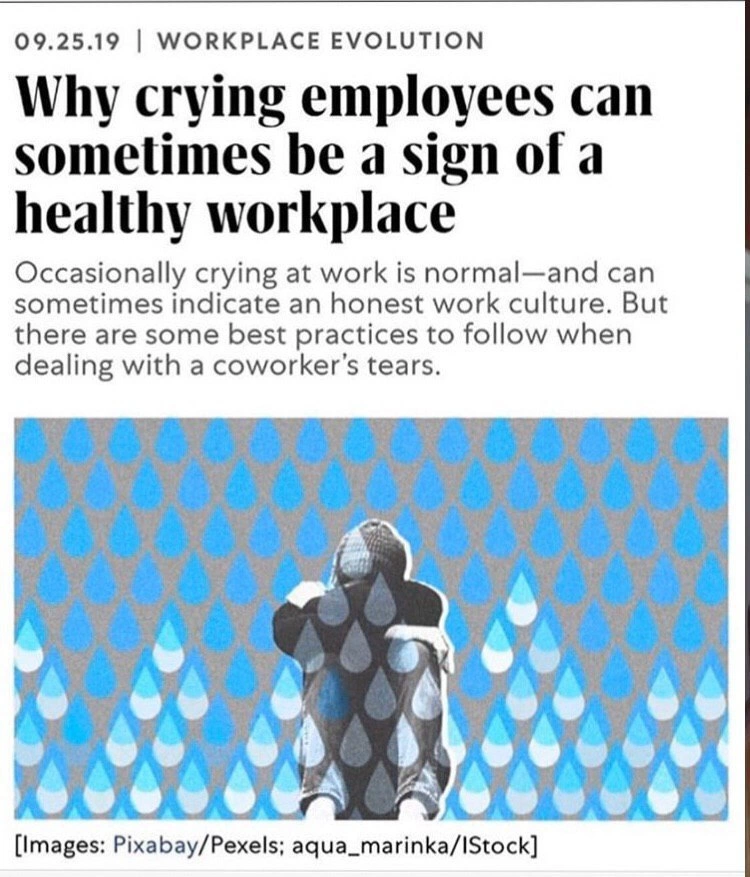
The joke lands because the screenshot uses polished corporate-publication language to turn an obvious distress signal into a workplace maturity metric. The visible headline says:

Why crying employees can sometimes be a sign of a healthy workplace

That is the kind of sentence that makes experienced developers check whether the office coffee has been replaced with incident-response adrenaline. The article framing is careful and humane on its own terms: the subheading says, Occasionally crying at work is normal-and can sometimes indicate an honest work culture. But in a developer meme context, that sentence gets recompiled into something much darker: if enough people are crying, maybe the culture is not "honest"; maybe the roadmap is a hostage note with Jira formatting.

The visual reinforces the inversion. A hunched person sits alone with their head down, surrounded by oversized blue teardrops. It does not look like a healthy exchange of vulnerability. It looks like the final form of DeveloperBurnout after sprint planning, broken deploys, surprise deadlines, and a retrospective where the action item is somehow "communicate better" again.

The post message sharpens the satire by proposing bottom lines about making a PM cry during every sprint planning or forwarding the article to a CEO who agrees. That pulls the meme into CorporateCulture and Management_PMs territory: organizations love measurable signals, but they often measure the easiest symptom instead of the underlying disease. If crying becomes evidence of psychological safety, management gets a convenient loophole. The team is not overloaded; they are just being authentic. The release train is not on fire; it is emotionally transparent.

The deeper workplace irony is that modern engineering organizations have learned the vocabulary of MentalHealthInTech without always changing the incentives that damage mental health. They can say "bring your whole self to work" while still rewarding heroic overtime, ambiguous ownership, constant context switching, and roadmap commitments made before anyone asks the people building the thing. The meme is funny because it exposes that gap: corporate language can sand the sharp edges off suffering until burnout starts looking like a culture win.

Description

The image is a cropped article screenshot dated "09.25.19" under the section label "WORKPLACE EVOLUTION". The headline reads, "Why crying employees can sometimes be a sign of a healthy workplace," followed by the subheading, "Occasionally crying at work is normal-and can sometimes indicate an honest work culture. But there are some best practices to follow when dealing with a coworker's tears." Below the text is an illustration of a person sitting with their head down in front of a background full of large blue teardrop shapes, with the image credit "[Images: Pixabay/Pexels; aqua_marinka/iStock]". The joke for a developer audience is the corporate tendency to rebrand burnout symptoms as culture maturity instead of fixing workload, process, or management failures.

Comments

8
Anonymous ★ Top Pick If crying at standup is a health signal, the sprint retro is just observability for burnout.
  1. Anonymous ★ Top Pick

    If crying at standup is a health signal, the sprint retro is just observability for burnout.

  2. @DavidGarciaCat 1y

    The second line is shocking

  3. @dsmagikswsa 1y

    best practice...what a buzz word

    1. @ZgGPuo8dZef58K6hxxGVj3Z2 1y

      You need to specify date else it may be best practice from before internet times

  4. @graduated_vernier 1y

    A little suicide and homicide at the work place is a good indicator of shareholder value.

  5. @TheFloofyFloof 1y

    making people who start pointless meetings cry is a developer's rite of passage

  6. @azizhakberdiev 1y

    Hell, yeah, that's a good thing Especially when we get overtime Love when company wants to have more of my time Please, keep it up

  7. @ercolebellucci 1y

    Thanks guys, I’ll make my boys (female) cry and tell her is normal that girl bosses cry because and link this article

Use J and K for navigation