Skip to content
DevMeme
1456 of 7435
The Exponential Cost of 'Just One More Feature'
TechDebt Post #1630, on May 27, 2020 in TG

The Exponential Cost of 'Just One More Feature'

Why is this TechDebt meme funny?

Level 1: Small Change, Big Mess

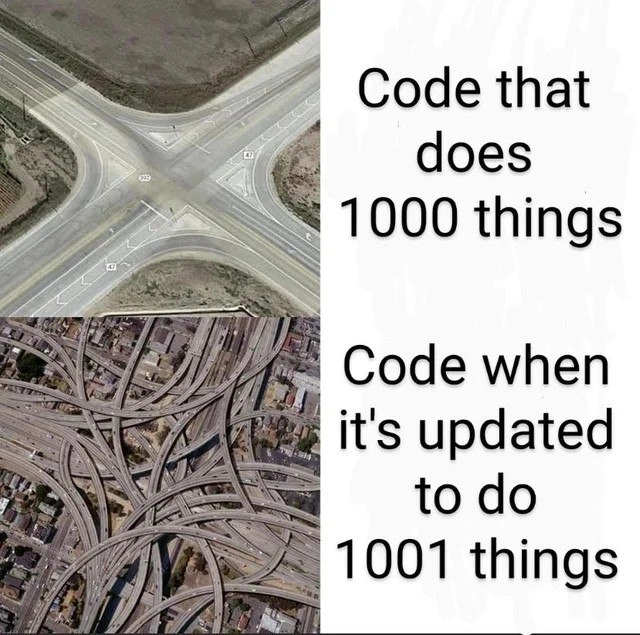
Imagine you have a big box of toys that’s super neatly organized – all 1000 pieces in the right place. You add just one more toy to the box, and suddenly toys spill out everywhere and the room turns into a giant mess. 😮 That’s what this meme is joking about. The first picture is like a tidy, simple road intersection – it’s easy to drive through, just like a cleanly organized set of instructions. The second picture is like if you took that road and kept adding more and more loops and turns until it became a crazy maze. It’s saying that adding one extra “thing” (like one more feature or task) to a well-organized project can sometimes unexpectedly make the whole thing confusing and tangled. It’s funny because it shouldn’t happen – one tiny change shouldn’t wreck everything – but in real life, often it does. It’s like when your room is clean, and you think, “I’ll just play with one more toy,” and suddenly the whole place looks like a disaster zone. The meme uses those road images to make us laugh about how easily something simple can become an overwhelming spaghetti tangle if we’re not careful. It’s a playful warning: even a small extra change can turn order into chaos if you just pile it on.

Level 2: Spaghetti Code 101

Let’s break down the joke in simpler terms. The meme compares two pictures of roads to two versions of a codebase:

  • The first picture (a simple rural intersection) is like code that’s very clean and well-organized, even if it’s handling many tasks (1000 things). There are only a few straight roads, no confusion – this hints that the program’s logic is straightforward and structured. In coding, we strive for this kind of clarity: each part of the code has a clear purpose, and they intersect in minimal, controlled ways.
  • The second picture (a crazy spaghetti freeway interchange) represents the code after adding one more feature (1001 things). There are loops and ramps in every direction, which symbolizes spaghetti code – a term for code that’s tangled and overly complex. In a spaghetti codebase, the flow of execution jumps all over (kind of like a plate of spaghetti noodles twisting and crossing). It’s hard to follow what leads to what, just like that maze of highways is hard to navigate.

Spaghetti code is basically a big mess in programming. It often happens when people keep adding patches and fixes over time without restructuring the underlying design. Imagine a program where, instead of having distinct modules or functions for separate tasks, everything is intertwined: functions call each other in circles, global variables get changed from anywhere, and a small change in one place unexpectedly affects something in a far corner of the system. That’s a nightmare for maintainability – meaning how easy it is to modify or fix the code later. A well-maintained codebase is like that simple intersection: even if it handles lots of traffic (features), it’s organized so you can predict the paths. A poorly maintained one is like the spaghetti interchange: one wrong turn (or a small code change) and you get lost in a tangle of dependencies.

The meme’s text says “Code that does 1000 things” vs “Code when it’s updated to do 1001 things.” This highlights feature creep, which is when a project keeps getting more features added over time, sometimes without a pause to tidy up or rethink the design. A new feature might seem minor, but if the codebase wasn’t structured to accommodate it, developers might implement it in a quick-and-dirty way – for example, by copying and pasting code, adding a bunch of if statements in many places, or introducing some secret flags that alter behavior deep in the code. Such shortcuts contribute to technical debt. Technical debt is a metaphor: it’s like when you compromise on code quality (take a “quick hack” loan) to meet a short-term goal, but you’ll “pay for it” later with complexity and bugs (like paying interest on a debt). As technical debt grows, each new change becomes harder – just like if you borrowed a lot of money, each purchase you make adds more interest to pay off. In the code, that interest appears as confusion and brittleness.

Refactoring is the process that could prevent this, and it’s basically cleaning up or reorganizing code without changing what it does, to make it easier to work with. In the road analogy, refactoring would be like redesigning that chaotic interchange into something more manageable before adding yet another ramp. But often in real projects, refactoring is postponed or ignored due to deadlines. So, the code gets more tangled with each update. The maintainability_degradation shown in the meme is what happens when we don’t refactor regularly. CodeComplexity increases and CodeQuality drops. What was once a neat structure becomes a fragile system where a change in one spot might break something completely unrelated.

In simpler terms, the meme is a warning (delivered humorously): If you keep adding features without keeping the code organized, you’ll end up with a big mess. The top image’s simple crossroads is easy to navigate (just like well-structured code is easy to read and modify). The bottom image’s spaghetti freeway is confusing and error-prone (just like messy code where you can get “lost” trying to trace what it does). Developers often call overly complex, jumbled code a “spaghetti code nightmare” – that’s exactly what the second picture looks like. So the meme is using a visual metaphor that even non-coders can intuitively understand: one extra thing can turn order into chaos if you don’t manage complexity. It’s highlighting the importance of good design and code maintainability. The joke lands because it exaggerates how ridiculous the difference can feel: code doing 1000 things should be more complicated than code doing 1001, right? Yet we often experience that tiny addition making the whole project feel exponentially more complicated. Everyone in software has seen a trivial-sounding change blow up into a huge refactor because the existing structure couldn’t handle it gracefully. This meme captures that feeling in one before-and-after snapshot.

Level 3: The Straw That Broke the Code

In practice, experienced developers recognize this as the classic “just one more feature” syndrome: the code was running fine doing 1000 things, but that one extra ask turned it into a nightmare. The meme’s top image – a simple four-way rural intersection – represents a codebase with clean design and straightforward control flow. The bottom image – a massive tangled stack interchange – is the same code after feature #1001, now an over-engineered mess of pathways. The humor is darkly familiar: we’ve all seen a tidy project descend into spaghetti code after a few too many “quick additions.” It’s the straw that broke the camel’s back, or as we might say here, the straw that broke the code.

Why is this transition so relatable? Because in real software projects, requirements tend to grow continuously (feature creep is relentless). Each new feature often comes with tight deadlines and pressure to just “squeeze it in” without proper refactoring. Over time, these one-off tweaks accumulate into serious Technical Debt. The code acquires extra conditions, flags, and special cases woven through multiple modules. Initially, when the code handled 1000 things, perhaps it was organized – maybe using solid architecture principles and clear module boundaries. But by the time it’s asked to handle 1001, those boundaries give way under the weight of hacks and patchwork solutions. The result? A codebase that looks logically like that labyrinth of looping overpasses: convoluted control flows, tangled data paths, and ad-hoc connections everywhere.

This meme resonates with senior devs because it exaggerates a truth: often our code’s maintainability degrades drastically with seemingly small increments in scope. One more boolean flag or an extra “if” condition added in the wrong place, and suddenly nothing is straightforward anymore. Functions start doing too much (violating the Single Responsibility Principle), modules become tightly coupled (everything depends on everything else), and debugging or adding the next feature becomes a hair-pulling ordeal. It’s a visual metaphor for a code smell: the spaghetti_highway_interchange you see is basically a big neon sign that the code’s structure is broken. The straight rural road – “code that does 1000 things” – implies a well-architected system where even a lot of functionality can be handled in a simple, clear way. But “code when updated to do 1001 things” – the chaotic freeway – implies the architecture was stretched beyond its limits; instead of rethinking the design (maybe building a proper overpass or new abstraction), they just kept adding lanes and ramps in a haphazard way.

We laugh (or perhaps cry) because it’s a scenario every seasoned programmer recognizes. A project starts off clean, doing a few things well. Then features get piled on. Without periodic refactoring (restructuring the code without changing its external behavior), the internals turn into a Big Ball of Mud – the infamous worst-practice architecture where the system has no discernible structure. The meme specifically highlights feature creep: that tendency for software to accumulate more and more capabilities over time. Each little addition (especially if done quick-and-dirty) can introduce disproportionate complexity. It’s like adding one more loop ramp that winds around all existing roads – suddenly every part of the program has another way to interact (or interfere) with the rest.

The “1000 things” vs “1001 things” contrast is hyperbolic humor: obviously one feature alone isn’t always catastrophic. But it sure feels that way when you’re the developer who confidently merged a tiny change on Friday only to find on Monday that the entire module is now unpredictable. Often the code was just one step away from a maintenance meltdown, and that step was the latest feature. As a cynical veteran might quip, “Sure, just add the request. What’s the worst that could happen?” – and the next thing you know, CodeQuality plummets and you’re navigating a freeway of spaghetti logic at 3 AM, chasing down bizarre bugs introduced by that “small tweak”.

In sum, the meme uses an ingenious visual metaphor to capture an all-too-real software engineering truth: without care, more features = more complexity, and beyond a tipping point, it becomes an exponential spaghetti nightmare. It’s poking fun at our industry’s tendency to underestimate the impact of one more feature on a previously tidy system. Seasoned devs chuckle (or groan) because we know that maintaining simplicity requires constant effort – otherwise, today’s clean architecture might become tomorrow’s tangled interchange due to unchecked feature creep and accumulating technical debt. The humor has a bite of truth: RefactoringNeeded, ASAP! before that neat codebase becomes a permanent traffic jam.

Level 4: Complexity Event Horizon

At a certain point, adding even a single new feature to a software system can push it past a complexity threshold – like crossing an event horizon into chaos. This isn’t just hyperbole; it’s backed by software engineering theory. Lehman’s Law of Increasing Complexity observes that as a program evolves, its complexity rises unless active effort (refactoring, redesign) is made to reduce it. When code handles 1000 things, it might be near the limit of its original architecture’s design. That 1001st requirement can trigger a non-linear complexity explosion: new interdependencies emerge, and previously manageable structures break down. In theoretical terms, if each of N features potentially interacts with others, the potential interaction paths grow on the order of $N^2$. Going from 1000 to 1001 features isn’t a 0.1% increase in complexity – it could introduce up to ~1000 new interaction pathways! This is akin to an entropy increase in physics: without an input of organizing energy, disorder tends to grow. The code’s internal structure accumulates “software entropy” (a form of Technical Debt interest). One more feature added without rethinking design can tip the system from a tidy, planar graph of logic into a densely interconnected mesh. In short, fundamental laws of software evolution predict that without intervention, every extra capability complicates the system; cross a certain boundary and the complexity skyrockets irreversibly – a Complexity Event Horizon beyond which the codebase collapses into a tangled singularity of logic (hello, spaghetti freeway of doom).

Description

A two-panel comparison meme illustrating the fragile nature of software complexity. The top panel shows a clean, simple, and well-organized four-way road intersection, viewed from above, with the caption 'Code that does 1000 things'. It represents a complex but manageable system with clear architecture. The bottom panel shows a dizzying, chaotic, and massive highway interchange with countless interwoven and overlapping roads, a classic example of a 'spaghetti junction'. The caption for this panel reads 'Code when it's updated to do 1001 things'. The meme humorously captures the concept of software entropy, where a seemingly minor addition to a large codebase can cause a disproportionate explosion in complexity, turning a clean architecture into an unmaintainable mess. It's a visual metaphor for technical debt and the tipping point where a system's integrity collapses
Comments

7
Anonymous ★ Top Pick That '1001st thing' was just adding a simple boolean flag. The original architect has been found rocking back and forth in a corner, muttering something about Conway's Law and the seven new microservices they needed to plumb it in
  1. Anonymous ★ Top Pick

    That '1001st thing' was just adding a simple boolean flag. The original architect has been found rocking back and forth in a corner, muttering something about Conway's Law and the seven new microservices they needed to plumb it in

  2. Anonymous

    Legacy calculus: 1000 features = one clean intersection; 1000 + 1 = a stack interchange of patch-classes, façade hacks, and that global singleton we swore we killed three migrations ago

  3. Anonymous

    The 1001st feature is always "support the previous 1000 features but slightly differently" - and that's when your elegant strategy pattern discovers it needs a strategy for choosing strategies

  4. Anonymous

    This perfectly captures the architectural reality every senior engineer knows: the difference between 1000 features and 1001 isn't linear - it's the difference between a well-planned interchange and the Judge Harry Pregerson Interchange in LA. That one 'simple' feature request inevitably requires touching every abstraction layer, adding conditional logic to handle edge cases with the existing 1000 features, maintaining backwards compatibility, and creating a dependency graph that would make a graph database weep. It's not feature creep; it's feature avalanche with O(n²) complexity growth

  5. Anonymous

    That 1001st ‘quick tweak’ is where your extension points turn out to be if‑else chains, coupling explodes, and the test matrix goes NP‑hard

  6. Anonymous

    One more feature, and your codebase's cyclomatic complexity rivals the interchange's lane count - good luck tracing that stack trace

  7. Anonymous

    “Just one more case” is when your elegant abstraction admits it was a switch - OCP collapses, cyclomatic complexity spikes, and the codebase qualifies as a freeway interchange

Use J and K for navigation